BUDAPEST, Hungary (July 18) -- The second day of the Budapest Ranking Series will see action in Freestyle 74kg, 86kg and 92kg and Women's Wrestling 50kg, 53kg, 57kg, 59kg and 72kg.
WATCH LIVE | LIVE MATCH ORDER | DAY 1 RESULTS
14:35: Elena BRUGGER (GER) pins Anastasiia SIDELNIKOVA (UWW) after an 11-0 to enter the 59kg final. Erika BOGNAR (HUN) gives the hosts a finalists as well after beating Nadzeya BULANAYA (UWW), 5-1.
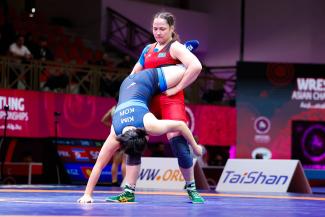
14:25: A pin from Helen MAROULIS (USA) and she marches into the 57kg final in her first competition since the Olympics. Tamara DOLLAK (HUN) had no answers to Maroulis' class. Maroulis will now face another youngster, NEHA (IND), who defeated Roza SZENTTAMASI (HUN) 8-4 in the other semifinal.
14:15: Natalia MALYSHEVA (UWW) survives a huge head-throw from Seoyoung PARK (KOR) in the final 30 seconds to beat her 5-4 and enter the 53kg final in which she will take on ANTIM (IND) after the Indian defeated Felicity TAYLOR (USA) 10-0. A series of five different takedowns there. Antim had beaten Malysheva 10-0 at the Mongolian Open in June.
14:05: Two pins in the 50kg semifinals! Elizaveta SMIRNOVA (UWW) pins Kseniya STANKEVICH (UWW) while Evin DEMIRHAN (TUR) pins Natalia PODUVOA (UWW).
Women's Wrestling semifinals
14:00: Trent HIDLAY (USA) reaches the final at 92kg after Dauren KURUGLIEV (GRE) pulls out injured seconds into the bout. Kurugliev seems to have fallen on his knee as Hidlay scored a takedown. Hidlay will take on world silver medalist Miriani MAISURADZE (GEO) in the final after the Georgian wins via technical superiority against Musza ARSUNKAEV (HUN)
13:55: Mahamedkhabib KADZIMAHAMEDAU (UWW) pins Ali SAVADKOUHI (IRI) in the 86kg semifinal after building up a lead. Savadkouhi had one exposure turn but that was all as Kadzimahamedau defended another attack and then scored a takedown. He finally pins Savadkouhi to enter the final in which he will face Arsenii DZHIOEV (AZE) who rolled to a 10-0 win over Osman GOCEN (TUR).
13:40: World U23 champion Magomed KHANIEV (AZE) has had an excellent morning session which he caps off with a semifinal victory over (BRN) Magomedrasul ASLUEV (BRN). He gets Takahashi for the gold medal bout.
13:35: Kota TAKAHASHI (JPN) and David CARR (USA) locked in a battle. Both are the representatives at the World Championships for their respective countries. Takahashi with the first opening but Carr runs out of zone. He is docked a point for fleeing. Takahashi up 2-0. Double-leg from Takahashi but Carr has the chest-wrap. Exposure from Carr but Takahashi keeps control. It's awarded only two points for the Japan wrestlers and nothing for Carr. Takahashi leads 4-0 at the break. Takahashi doesn't slow down in the second period and scores two stepouts to make it 6-2. Carr fires back with a takedown to cut the lead to 6-2. He scores another takedown and now Takahashi is feeling the pace of the bout. Carr tries to turn but is blocked in the process, as Takahashi earns two points. A reversal makes it 8-5. Carr with a takedown with 10 seconds left to make it 8-7. Takahashi defends the final 10 seconds to win 8-7 but we have United States challenge. Nothing on review and Takahashi wins the semifinal
Semifinals begin at 13:30 local time
13:00: Mahamedkhabib KADZIMAHAMEDAU (UWW) with a top 9-1 win at 86kg against Nurzhan ISSAGALIYEV (KAZ) and he secures his place in the semifinals in which he will face Savadkouhi of Iran.
12:50: Ali SAVADKOUHI (IRI) shuts out Rakhim MAGAMADOV (FRA) in the 86kg quarterfinal and wins 5-0. He reaches the semifinal.
12:40: David CARR (USA) comes out aggressively with the whistle against Orozobek TOKTOMAMBETOV (KGZ) and scores a stepout. A takedown to take a 3-0 lead. He adds another stepout and leads 4-0. He adds four more points and doesn't let Toktomambetov any chance to scoring to win 8-0 and advance.
12:37: Kota TAKAHASHI (JPN) is slowed down by Murad KURMAGOMEDOV (HUN) but the Hungarian can't stop him from winning the 74kg bout 3-0. Two stepouts in that win.
12:20: Excellent positioning and defense from Helen MAROULIS (USA) as she beats Iryna KURACHKINA (UWW) 7-0 in their 57kg quarterfinal. Maroulis looks in top form in the two bouts so far.
12:10: Dauren KURUGLIEV (GRE) has no trouble in seeing off Osman NURMAGOMEDOV (AZE), 5-1, in the 92kg quarterfinal. This is better score line than the European final in which Kurugliev won by two points.
12:00: ANTIM (IND) has just beaten Zeynep YETGIL (TUR) 10-0 in the opening round at 53kg. Yetgil had handed Antim a 10-0 thrashing in the first bout at Paris Olympics and this match was a completely different between the two.
11:45: Kota TAKAHASHI (JPN) and Taimuraz SALKAZANOV (SVK) are in battle at 74kg. But it Takahashi who comes out the winner 6-6 on criteria. He will face Murad KURMAGOMEDOV (HUN) next
11:35: David CARR (USA) has a back-and-forth bout with Turan BAYRAMOV (AZE) but he hands the Azerbaijani a 5-3 loss at 74kg. Carr is the United States representative for the World Championships.
11:20: Two Indians entered at 50kg and both start off with wins. NEELAM (IND) has a close 10-8 match with Madison PARKS (CAN) while Priyanshi PRAJAPAT (IND) beats Audrey JIMENEZ (USA), 3-0.
11:15: First sight of Helen MAROULIS (USA) internationally since the 2024 Paris Olympics. There is absolutely no sign of any rust as she uses the arm-bar to pin compatriot Amanda MARTINEZ (USA) inside the first period at 57kg. Paris Olympic champ Sarah HILDEBRANDT (USA) is in the coaches' corner here.
11:00: Natalia PUDOVA (UWW), winner of Mongolia Open Ranking Series, starts with a 12-4 victory over Emma LUTTENAUER (FRA) at 50kg. One of the most attacking wrestlers at 50kg is definitely a medal threat in Zagreb.
10:45: Osman NURMAGOMEDOV (AZE) has no trouble in keeping Magomed SHARIPOV (BRN) off himself and he wins his first bout at 92kg, 6-1, to move one. On the other mat, Trent HIDLAY (USA) beats Abubakr ABAKAROV (AZE) 7-2. This means that Nurmagomedov may be the first choice for Azerbaijan now for the World Championships.
10:30: The day two of the Ranking Series event in Budapest will see three Freestyle weight classes and four Women's Wrestling. Big names will be on the mats in the Hungarian capital.


Share your thoughts.
Comments