

Asian Championships: Rise of Sujeet Fuels India’s 65kg Gold Hopes
Sunday, April 5, 2026 - 14:05 By Vinay Siwach

BISHKEK, Kyrgyzstan (April 4) -- When SUJEET (IND) steps on the mat at the Asian Championships in Bishkek on Friday, he will carry hopes of a country looking for an Asian champion in a Freestyle weight class other than 57kg for the past seven years.
The 23-year-old is unbeaten this year, winning gold medals at the Zagreb Open and Muhamet Malo Ranking Series, making him the favorite to win gold at 65kg in Bishkek. The last time India won a gold medal at the Asian Championships was 2019 when Bajrang PUNIA (IND) won in Xi'an, China.
"I don't think much about anything," Sujeet says. "I say the name of the God and step on the mat. I will do the same at the Asian Championships.
"I am happy that I wrestle at 65kg because India has a decent history at 65kg. I will also try to carry it forward."
The 65kg field in Bishkek includes returning 61kg Asian champion Takara SUDA (JPN) who is moving up one weight. Suda's ability to score at any time in a bout puts him as the biggest threat against Sujeet.
World bronze medalist Umidjon JALOLOV (UZB) is another strong competitor for Sujeet. The Indian enjoys a 4-0 head-to-head record against the Uzbekistan wrestler but at last year's Asian Championships, Sujeet pulled out of his bronze medal bout against Jalolov due to an injury.
Another tough competitor for Sujeet can be Peyman NEMATI (IRI). The two wrestled in the final of the Zagreb Open and the Iranian managed to keep Sujeet quiet despite losing 3-0. He will be keen to avenge that loss and win gold for Iran.
Abdulmazhid KUDIEV (TJK), a world bronze medalist at 70kg in 2024, can spring a surprise and so can former U17 world champion Rustamzhan KAKHAROV (KGZ).
Early Start
Hailing from village Imlota, Charkhi Dadri in Haryana, a state that produces majority of wrestlers in India, Sujeet was introduced to wrestling in his village.
"There was an old akhada [training school] in my village so I used to go there," he says. "No coach had formal experience as such and I used to lose at the district level. I remember I lost in 2019 at the state level."
While there was little history of wrestling in the village itself, Sujeet's father Dayanand KALKAL was a national-level wrestler and was keen for his son to pick the sport as well. Till 2020, Sujeet continued training in the village.
"I was decent in studies," he says. "I balanced it with wrestling but after school, it was all wrestling. My village was very supportive of my wrestling. And then in 2021, I made the switch."
From south-west Haryana, Sujeet moved to Sonipat, a district in Haryana 60 kilometers north of New Delhi. With more experienced training partners, Sujeet could feel the improvements in his wrestling.
"The shift in 2021 to Sonipat changed my wrestling," he says. "My wrestling matured and the other wrestlers had international experience so it helped me in all aspects."
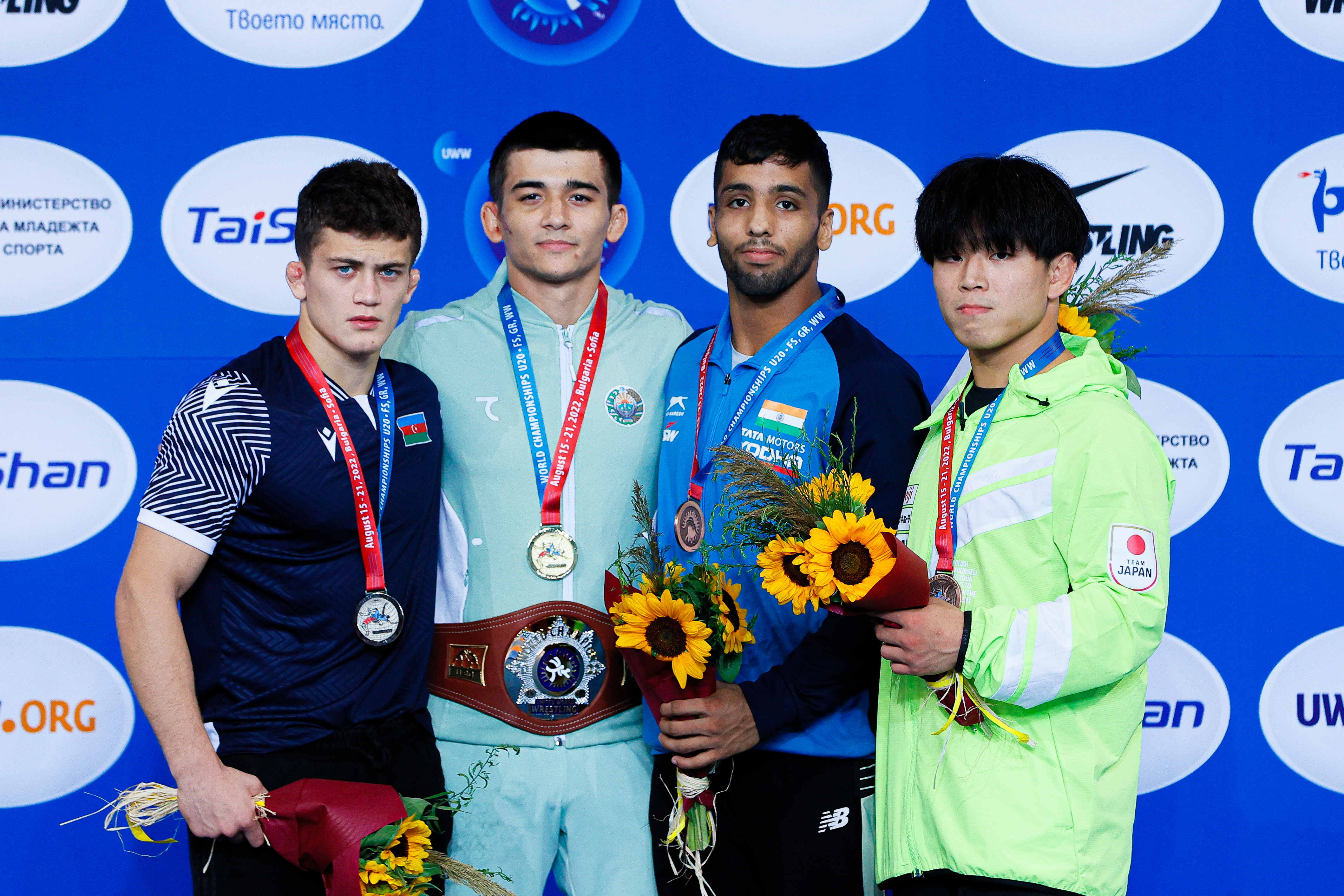 SUJEET (IND), third from left, won a bronze medal at the 2022 U20 World Championships in Sofia. (Photo: United World Wrestling / Kostadin Andonov)
In just one year, Sujeet made the U20 Indian team and was on his way to Bulgaria for the World Championships. He lost to Ziraddin BAYRAMOV (AZE) in the semifinals but won a bronze medal at 65kg, his first in international wrestling on debut.
"I was happy that I won a medal in my first-ever competition despite it being bronze," he says. "My wrestling was different than my opponents. I had never experienced that. But slowly I got used to it."
The biggest challenge for Sujeet was the vast difference in wrestling between junior and senior levels.
"When you shift from junior to senior, there is a lot of difference from power to technique," he says. "Opponents study you a lot once you are consistently competing. Everyone studies each other but I stick to my techniques."
Senior Career
Sujeet made the required adjustments and won the senior nationals in India to make the team with a hope to qualify for the 2024 Paris Olympics. But that journey ended in a heartbreak.
At the Asian Olympic Qualifiers in Bishkek, Sujeet failed to reach the competition due to floods at the Dubai airport. A month later at the World Olympic Qualifiers in Istanbul, Sujeet squandered a 2-0 lead against Zain RETHERFORD (USA) and missed out on a ticket to Paris.
"My father says do not celebrate too much when you win, don't be disheartened when you lose, balance it," he says. "So I try to keep it balanced. I don't sulk when I lose. I think about it a little and then move on, sit with my friends and try to see what I can improve."
In need of training partners who could challenge him with different styles, Sujeet spent a few months training overseas. He picked Mongolia, Russia and Japan, and picked a few details from the sparring sessions. He also realized that depending on the renowned Indian conditioning will not be enough to win medals at the world level.
"In India, the training lasts long, usually 3-4 hours," he says. "In Japan, they have smaller training sessions with focus on speed. Russia also has longer sessions with focus on scrambles and bouts.
"Our stamina comes from the longer trainings which are also very hard. The Indian sit-ups are quite different. Others also have unique ways to train but they focus on their own styles. But we ultimately work hard for longer bouts."
Sujeet ended 2024 with a bronze medal at 70kg at the U23 World Championships.
For the majority of 2025, he remained an under-the-radar wrestler. He won the Ranking Series event in Budapest but was far off from being a medal threat at the September World Championships. However, a bout against Olympic silver medalist Rahman AMOUZAD (IRI) at the World Championships caught the attention of the fans.
Though he lost 6-5, Sujeet was surprisingly the only wrestler who troubled Amouzad, the eventual world champion, in Zagreb.
"It was my first bout so I was all over the place and he was clearly stronger than me," he recalls. "May be next time I will be calmer. I took too much pressure on myself to win a medal and that showed in my bout against Real WOODS (USA)."
Woods beat Sujeet in repechage after an initial flurry of turns and then defended his lead to win 7-5. Sujeet returned home empty-handed.
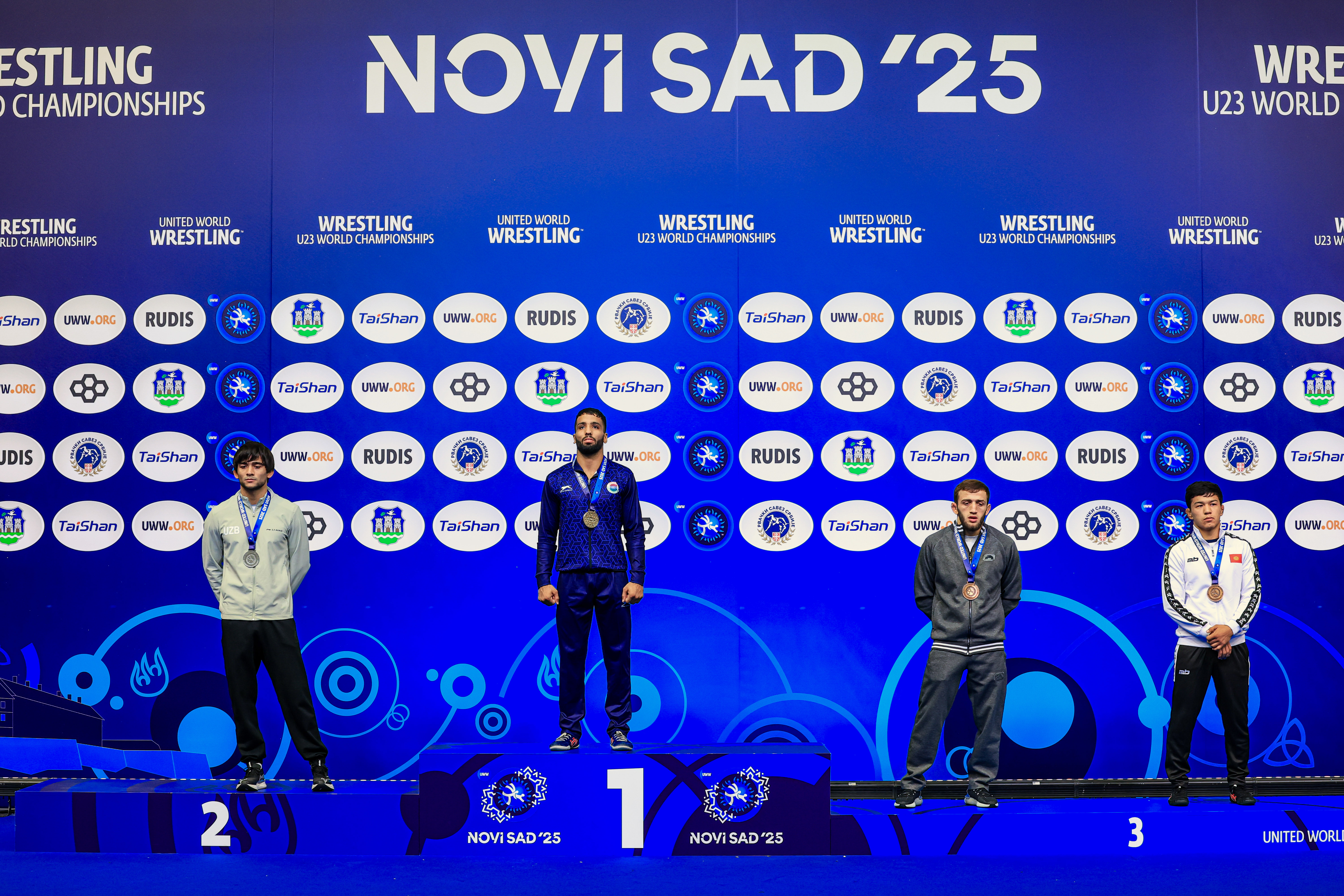 SUJEET (IND), second from left, as the U23 world champion in 2025. (Photo: United World Wrestling / Amirreza Aliasgari)
Unbeaten Streak
But in a month's time, Sujeet would make amends and win the U23 world title with a stunning series of win over former U23 world champion Bashir MAGOMEDOV (UWW) in the quarterfinals, former U20 world champion Yuto NISHUCHI (JPN) in semifinals and Jalolov, who had won bronze in Zagreb, 10-0 in the final. He scored in the final 10 seconds in the quarterfinals and semifinals.
"At the U23 Worlds, I did not care much about the draw," he says. "I think I can manage to score at any moment. I do panic but I try to remain calm. I like going for the sweep and catch both legs to score points."
The Asian Championships will be a huge test of Sujeet's recent form and skill. A gold in Bishkek can put him in the top-tier of 65kg. Does he have the class to win in Bishkek and beyond?
"My wrestling is going good," he says. "Some win via technique, some win by speed. I personally feel my wrestling is good to win here."
Share your thoughts.
Comments