CROALVILLE, IOWA, United States (May 8) -- The United States opened the 2026 Pan-American with six golds medals out of eight on offer on day one of the tournament in Coralville, Iowa. The two other golds went to Cuba, who suffered two losses as well in the finals.
The most significant gold medal for the U.S. came at 130kg as Cohton SCHULTZ (USA) upset defending champion Oscar PINO (CUB) in the final, avenging his last year's loss, to win gold. Though it was an actionless final with both wrestlers exchanging passivity points, it was Schultz who got the first one which gave him the criteria win.
Both wrestlers had their chances to score from the top with Schultz trying to do a front headlock throw and Pino trying the classic gut-wrench. However, both failed in their moves and the American defend his criteria to claim his first-ever Pan-Am gold.

Beka MELELASHVILI (USA) also had to battle it out against a former Pan-Am champion Daniel GREGORICH (CUB) for his 8-6 win and the 82kg gold medal. Melelashvili raced to a 7-0 lead from par terre but as he was trying the match-winning turn on Gregorich, the Cuban blocked him and held him in danger for two points. Melelashvili led 7-2 at the break.
As no passivity was awarded in the second period, Gregorich made a desperate headlock throw for four points but Melelashvili scored a reversal and led 8-6 with 42 seconds remaining. He defended his lead till the end to beat Gregorich for the second time in the day as he also won 1-1 on criteria in the Nelson bracket.
Former U17 world champion Joel ADAMS (USA) turned the 77kg final on its head from par terre in the second period to beat Oscar BARRIOS (HON), 10-1. When Adams got the par terre 1:52 remaining, he lifted Barrios and slammed him on the mat for a four-pointer. He continued the sequence and thew Barrios for another four-pointer to finish 9-1. Honduras challenged the second throw as it may have come after Adams moved outside the zone but on review the throw was changed to five points.
At 82kg, as only two wrestlers were entered, Kamal BEY (USA) and Diego MACIAS (MEX) wrestled in the final and former displayed his big-throwing ability to win the bout and gold 9-1.
The first scoring sequence was rather lame when Bey pushed Macias towards the zone and the Mexican just fell on his back, giving Bey four points. The two traded stepouts and Bey led 5-1 at the break. 15 seconds into the second period, Bey launched Macias for a big body throw, finishing the bout 9-1.
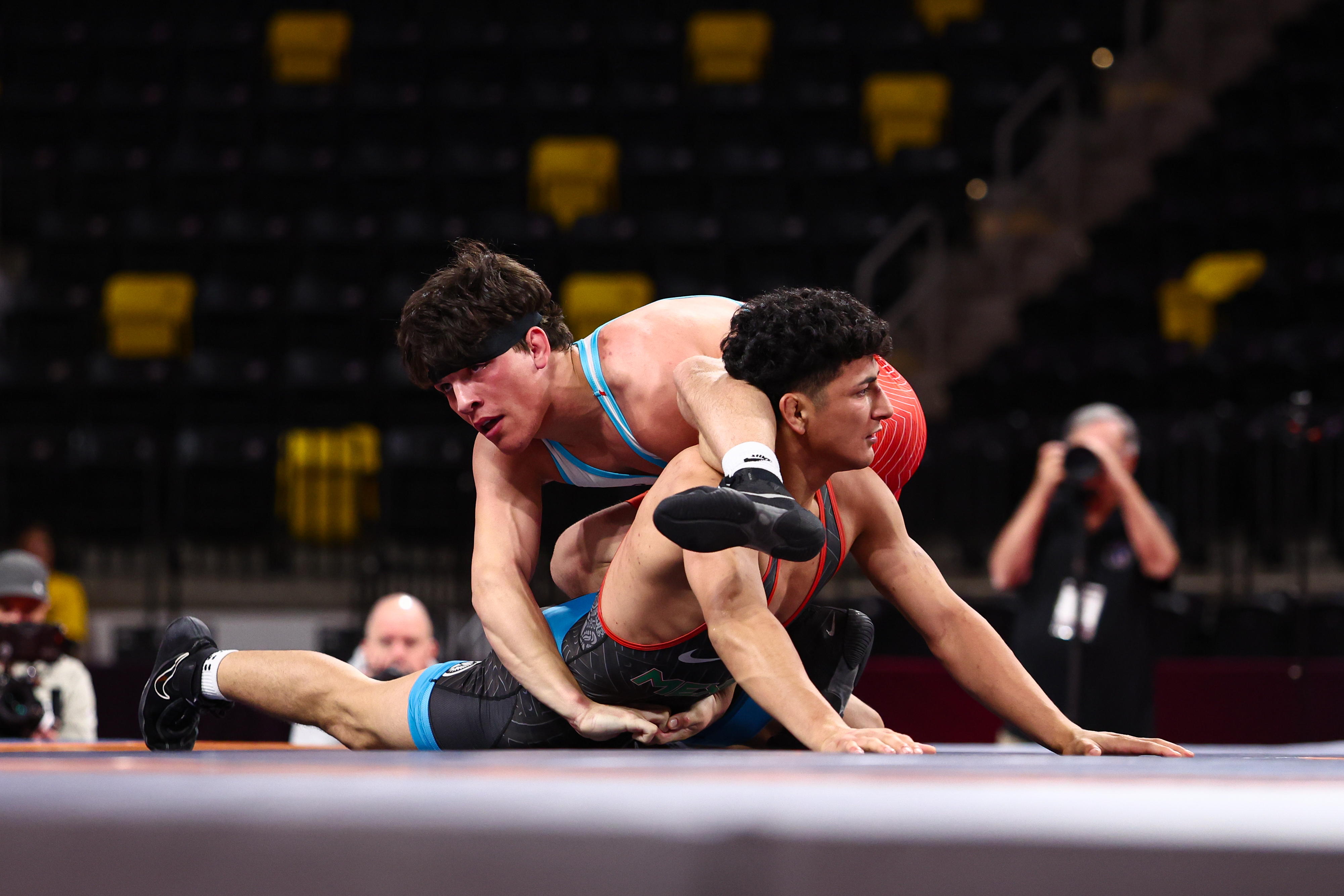 Landon DRURY (USA) tries to score on Angel SEGURA (MEX) during their 63kg bout. (Photo: United World Wrestling / Jake Kirkman)
Landon DRURY (USA) and Max NOWRY (USA) won all their round-robin bouts to win gold medals at 63kg and 55kg, respectively.
Drury won four bouts with varied dominance but his first win, 9-3 over Jeremy PERALTA (ECU) in Round 1, proved crucial as Peralta did not lose any other bouts and finished with a silver medal.
Returning to international wrestling after four years, 36-year-old Nowry won his fourth Pan-Am title to go along with his golds in 2013, 2019 and 2020. He won all three bouts in the 55kg round-robin via technical superiority to claim gold.
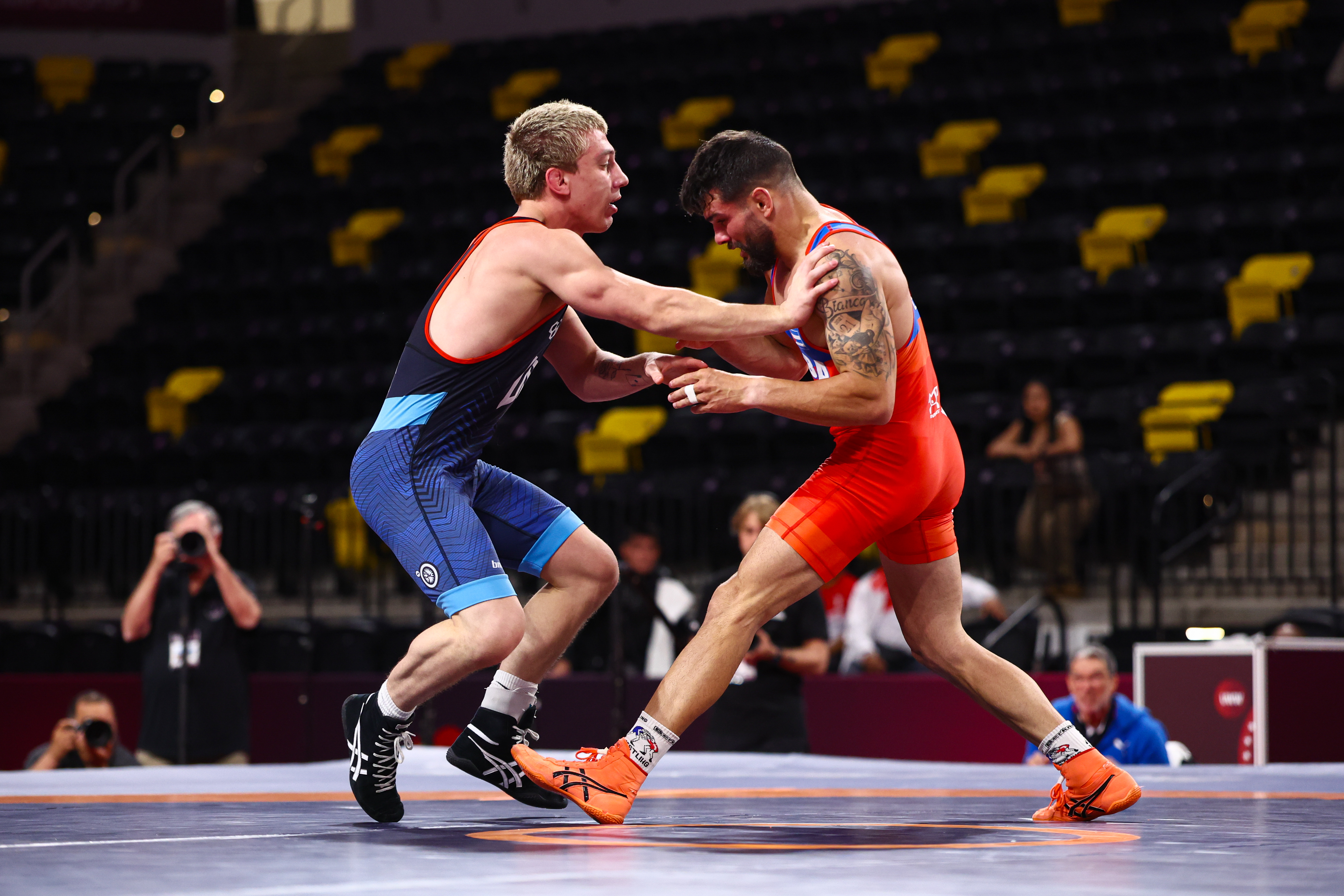 Luis ORTA (CUB), red, wrestles Otto BLACK (USA) during the 67kg final. (Photo: United World Wrestling / Jake Kirkman)
Orta Wins 5th Pan-Am Gold
Former Olympic and world champion Luis ORTA (CUB) continued his undefeated streak at the continental championships, winning his fifth gold medal on Thursday. In a thrilling final against Otto BLACK (USA) at 67kg, Orta barely held on for a 5-3 victory.
Orta opened the scoring with stepout before getting the passivity call. He scored a turn using high gut-wrench for two and then added another for a 6-0 lead. However, the U.S. challenged and the second turn was cancelled as Orta committed an offensive leg foul to run Black.
Black got the par terre in the second period and foxed Orta with a turn. He initiated the attack towards his right before switching direction to neutralize Orta's defense. Black's two-point turn but Orta's lead to 4-3 with 1:59 remaining.
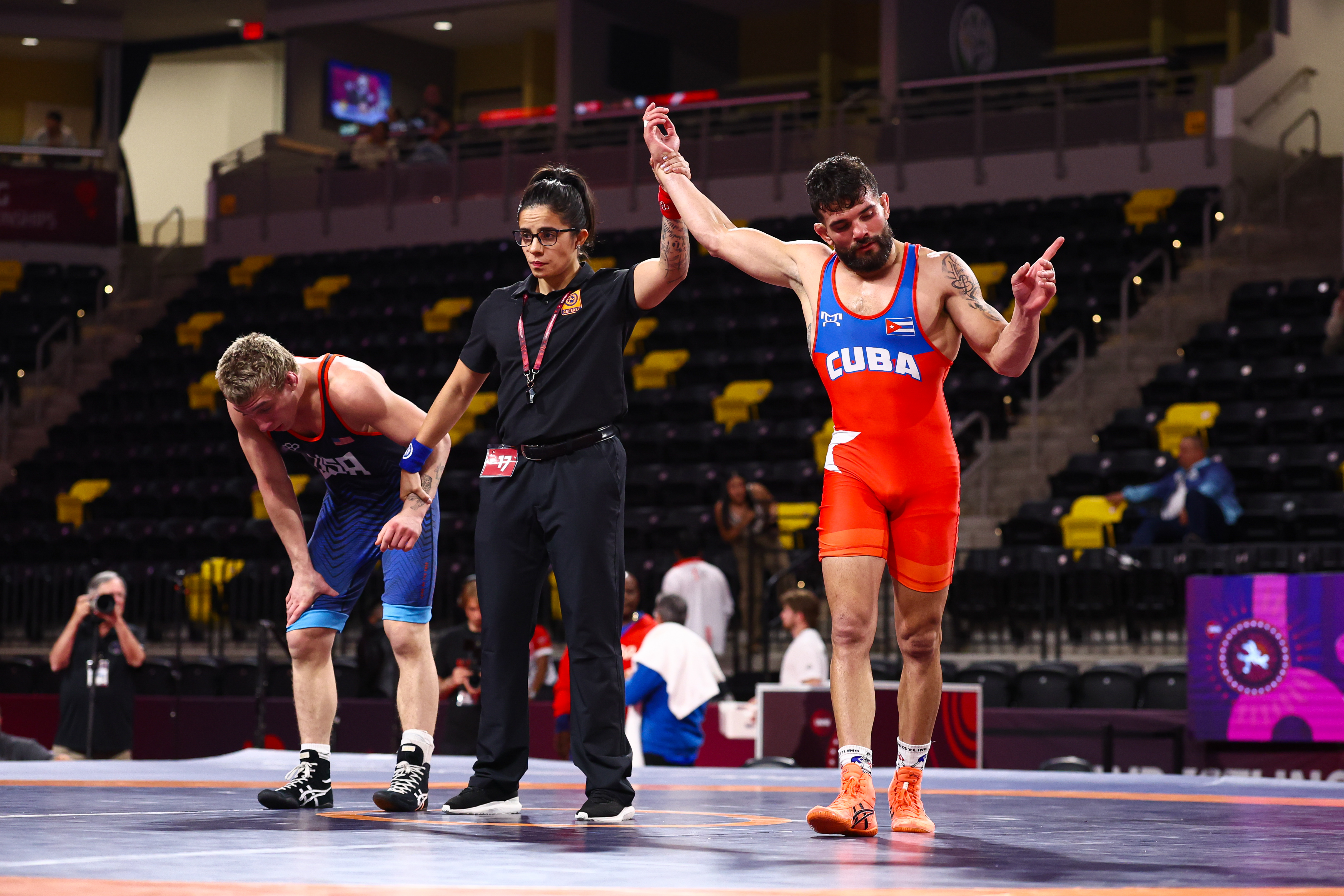 Luis ORTA (CUB) won his fifth Pan-American gold medal on Thursday. (Photo: United World Wrestling / Jake Kirkman)
But Orta was not done. He used a drag to score a takedown but the referee blew the whistle before he could complete it. Orta was awarded one point for a stepout which did not please him but he led 5-3.
The victory extended Orta's unbeaten streak at Pan-Ams to 16 wins and he has outscored his opponents 99-15 in those matches.
The second gold medal for Cuba was won by Kevin DE ARMAS (CUB) as he blanked Clisman CARRACEDO (ECU), 11-0, in the 60kg final.
On his Pan-Am debut, De Armas faced the youngster Carracedo but showed no mercy, scoring two front headlock turns for a 4-0 lead. He then got the par terre position and using a high gut-wrench, got two more points. He then lifted Carracedo and slammed him on the mat for four points that confirmed his technical superiority win.

RESULTS
55kg
GOLD: Max NOWRY (USA)
SILVER: Isaac MARIN MATA (MEX)
BRONZE: Moises PERALTA GONZALEZ (ECU)
60kg
GOLD: Kevin DE ARMAS (CUB) df. Clisman CARRACEDO (ECU), 11-0
BRONZE: Pedro DE SOUZA (BRA) df. Carlos HERRERA (VEN), 5-3
BRONZE: Yerony LIRIA (DOM) df. Abel SANCHEZ (PER), 10-1
63kg
GOLD: Landon DRURY (USA)
SILVER: Jeremy PERALTA (ECU)
BRONZE: Angel SEGURA (MEX)
67kg
GOLD: Luis ORTA (CUB) df. Otto BLACK (USA), 5-3
BRONZE: Nilton SOTO (PER) df. Irving SALAZAR (MEX), 5-5
BRONZE: Julian HORTA (COL) df. Jose VARELA (GUA), 9-0
77kg
GOLD: Joel ADAMS (USA) df. Oscar BARRIOS (HON), 10-1
BRONZE: Eduardo BERNAL (CHI) df. Justin BOYCE (BAR), 8-0
BRONZE: Joilson DE BRITO (BRA) df. David CHOC HUOC (GUA), 3-1
82kg
GOLD: Kamal BEY (USA) df. Diego MACIAS (MEX), 9-1
87kg
GOLD: Beka MELELASHVILI (USA) df. Daniel GREGORICH (CUB), 8-6
BRONZE: Luis AVENDANO (VEN) df. Johan BATISTA (DOM), via inj. def.
130kg
GOLD: Cohlton SCHULTZ (USA) df. Oscar PINO (CUB), 1-1
BRONZE: James FORD (PUR) df. Jose NUNEZ (DOM), via fall
BRONZE: Guilherme EVANGELISTA (BRA) df. Tyrece THOMPSON (JAM), via fall


Share your thoughts.
Comments