

Bureau Tightens Tournament Regulations, 'Pushout' Interpretation
Friday, August 24, 2018 - 18:30 By United World Wrestling Press

CORSIER-SUR-VEVEY (August 24) -- United World Wrestling held a meeting of its bureau last month during the Junior European Championships in Rome.
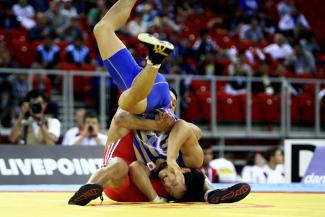
The bureau discussed several topics around the operation of United World Wrestling including participation in championships, late registrations, obligations of team leaders, obligations of inspectors and updated World Cup regulations. The members also passed a stricter enforcement of the ‘pushout’ rule to promote the use of technical actions on the edge of the competition surface.
Below is a summary of what was discussed around each topic.
• Participation in championships: No title or medal can be given if less than five athletes are registered in a weight category. This new rule will be applied in the United World Wrestling Championships but not in the international tournaments.
• Late registrations: Countries will not be allowed to register for United World Wrestling events late (after registration deadlines) in 2019.
• Obligations of team leaders: The team leader (or his substitute) shall draw a number for his athlete to be used for pairing. If the team leader (or his substitute) can't attend the draw because of exceptional reason, he must inform the organizer. The organizer will have the responsibility to communicate it to the UWW results' team and the number of his wrestler will be drawn by the technical delegate or the responsible person of the draw. If the technical delegate does not get information from the organizer that your representative cannot attend the draw, he will not pick a number for your athlete.
• Obligations of inspectors: During the inspection visit, all the hotels and meals must be controlled by the inspectors. Based on their evaluation, they have the power to propose a reduction of the accommodation fee if the level of services is below the proposed price by the organizers.
• Updated World Cup regulations: An athlete may opt for the next higher category than their body weight, except for the heavyweight category, for which contestants must weigh over 97kg for freestyle and Greco Roman, and over 72kg for women's wrestling. The intent is to allow a substitute in a lighter weight category to replace an injured athlete in the heavier weight category.
• Rule changes: Two scoring adjustments were made for the push out and the ordered par terre position (Articles 39 and 45). If a wrestler pushes his/her opponent out of bounds with no meaningful action, no point will be awarded, and the attacking wrestler will not be penalized with a caution anymore. If the top wrestler commits a foul during the ordering of the par terre position, the bout will resume in the standing position without the top wrestler receiving a caution. These rules will be implemented on Sept. 1, 2018.
Share your thoughts.
Comments