BUDAPEST, Hungary (July 20) -- World and European champion Nihat MAMMADLI (AZE), five days short of his 23rd birthday, gave himself a birthday present and kept his World Championships preparations on track by winning the Budapest Ranking Series on Sunday.
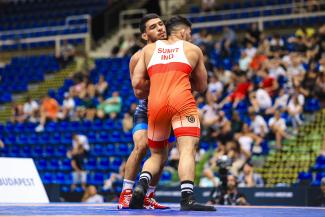
Three months after winning the European title, Mammadli enjoyed a successful day in Budapest, winning gold at 60kg after beating SUMIT (IND), 5-1, in the final.
There were seven other gold medalist as the Ranking Series came to a close on Sunday. With this, the World Championships season will begin next week in Athens, Greece with the World U17 Championships.
Mammadli was put in par terre in the first period but as casual as he is, Mammadli defended any turn. He blocked Sumit's attempt to get a gut-wrench mid-turn and got two points. He got a bodylock to kick off second period and scored a takedown to make it 4-1. As Sumit was put in par terre, Mammadli further led 5-1. However, he was happy to not put any effort in attempting any turns.
Sumit tried getting a hold of Mammadli in the final two minutes but it to no avail and Mammadli won the final 5-1.
Earlier in the day, Mammadli defeated Georgij TIBILOV (SRB) in the semifinals, 3-2, in what was a rematch of the European final that was won by Mammadli.
Another European champion Emin SEFERSHAEV (UWW) captured gold medal in Budapest after he beat Marlan MUKASHEV (KAZ), 9-0, in the 55kg final.
Apart from the small hiccup he had in the semifinal against Ikhtiyor BOTIROV (UZB), Sefershaev had an top tournament, outscoring his opponents 27-7 in four bouts.
Botirov scored five points on Sefershaev but he was able to score five on him as well and won the bout the bout on criteria. In the final, Sefershaev did not have any trouble and rolled Mukashev four time from par terre to finish the bout.
At 63kg, Sergey EMELIN (UWW) denied Vitalie ERIOMENCO (MDA) a Ranking Series gold medal after beating him 5-0 in the final. Emelin scored points from par terre and kept the pressure in the second period as well and was not called passive. He held his 5-0 lead for six minutes of the bout to win gold medal.
Joni KHETSURIANI (GEO) emerged as the champion at 67kg after a final of two halves against Valentin PETIC (MDA), who unfortunately ended with another silver medal at the Ranking Series, his third this year. He has silver medals from Zagreb and Albania.
The final began with a quick takedown from Khetsuriani and he then lifted Petic for a suplex for four points. For the next throw, he performed a turn but it was ruled a below-the-waist foul and no points were awarded.
Georgia challenged asking for two points but the referees awarded one point for stepout on review, making the score 7-0 for Khetsuriani. Petric failed to break Khetsuriani's defense for the remaining 4:30 and dropped the final.
Hosts Hungary had a rather disappointing evening session as Robert FRITSCH (HUN) and Zoltan LEVAI (HUN) suffered losses in the 77kg and 82kg finals, respectively.
Fritsch was defeated 5-2 in the 77kg final by Sergei KUTUZOV (UWW) who had a 3-0 lead at the break in the final. Fritsch closed the gap to 3-2 with a stepout and par terre point but he failed to make a move from that position.
Kutuzov was happy defending but Fritsch pushed for a stepout to which Kutuzov circled and returned to center to get a point. A lost challenge late in the bout gave one more point to Kutuzov who won 5-2.
There was further disappointment for Hungary as Levai, moving up from 77kg to 82kg, suffered a 5-1 loss in the 82kg final against Adlet TIULIUBAEV (UWW).
After getting the par terre position in the first period, Levai failed to score any points. Tiuliubaev made no such mistakes and scored two turns from par terre in the second period and won 5-1.
At 97kg, Giorgi MELIA (GEO) came out as a clear winner as Hayk KHLOYAN (ARM) had no answer to Melia's aggressive style of wrestling in the final.
Melia rolled to a 3-1 victory to capture yet another gold medal for Georgia in Budapest.
With the fourth and final Ranking Series in the books, wrestlers will now receive seeds for the World Championships once the final entries are closed.
RESULTS
55kg
GOLD: Emin SEFERSHAEV (UWW) df. Marlan MUKASHEV (KAZ), 9-0
BRONZE: Denis MIHAI (ROU) df. Alpamys DASTANBEK (KAZ), 1-1
BRONZE: Anil MOR (IND) df. Ikhtiyor BOTIROV (UZB), 7-4
60kg
GOLD: Nihat MAMMADLI (AZE) df. SUMIT (IND), 5-1
BRONZE: Georgij TIBILOV (SRB) df. Seunghak KIM (KOR), 5-2
BRONZE: Sadyk LALAEV (UWW) df. Galym KABDUNASSAROV (KAZ), 5-3
63kg
GOLD: Sergey EMELIN (UWW) df. Vitalie ERIOMENCO (MDA), 5-0
BRONZE: Yerzhet ZHARLYKASSYN (KAZ) df. Islomjon BAKHRAMOV (UZB), via inj.
BRONZE: Dinislam BAMMATOV (UWW) df. Karen ASLANYAN (ARM), via fall
67kg
GOLD: Joni KHETSURIANI (GEO) df. Valentin PETIC (MDA), 7-0
BRONZE: Leri ABULADZE (GEO) df. Minseong KWON (KOR), 8-3
BRONZE: Haavard JOERGENSEN (NOR) df. Daniial AGAEV (UWW), 1-1
77kg
GOLD: Sergei KUTUZOV (UWW) df. Robert Attila FRITSCH (HUN), 5-2
BRONZE: Levente LEVAI (HUN) df. Sanan SULEYMANOV (AZE), 3-2
BRONZE: Sergei STEPANOV (UWW) df. Stoyan KUBATOV (BUL), 7-1
82kg
GOLD: Adlet TIULIUBAEV (UWW) df. Zoltan LEVAI (HUN), 5-1
BRONZE: Erik SZILVASSY (HUN) df. Beka MELELASHVILI (USA), 2-1
BRONZE: Jalgasbay BERDIMURATOV (UZB) df. Rafael IUNUSOV (UWW), 2-1
97kg
GOLD: Giorgi MELIA (GEO) df. Hayk KHLOYAN (ARM), 3-1
BRONZE: Murad AHMADIYEV (AZE) df. Ilia ERMOLENKO (UWW), 8-4
BRONZE: Markus RAGGINGER (AUT) df. Arvi SAVOLAINEN (FIN), 6-3



Share your thoughts.
Comments