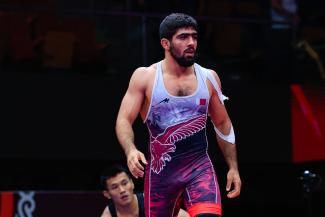
BISHKEK, Kyrgyzstan (April 7) -- Shahin BADAGHIMOFRAD (QAT) won a historic bronze medal for Qatar at the 2025 Asian Championships. In Bishkek, he created another history.
Badaghimofrad became the first-ever Qatar wrestler to reach the final in Greco-Roman at the Asian Championships on Tuesday after he defeated Ibragim MAGOMADOV (KAZ), 9-8, in a thrilling bout at 82kg.
In an all but lost semifinals, the Qatar wrestler, made a huge comeback against the former Asian champion, who led 7-2 at one point. Badaghimofrad scored a stepout but Qatar challenged for two points. It, however, lost it which made the score 8-3 for Magomadov.
But it was all Badaghimofrad after that as he scored a takedown, two stepouts, a point for par terre and also got a fleeing point for his 9-8 win.
He will now look to become Qatar's first-ever Asian champion in any style when he faces Amin HOSSEINI (IRI) in the final on Tuesday.
Hosseini became the sixth Iran wrestler to reach the final at this Asian Championships after he defeated PRINCE (IND) 10-0. Hosseini scored a four-point throw from par terre to lead 5-0 and then Iran challenged for a leg foul from Prince which was confirmed on review. With a 7-0 lead, Hosseini completed a correct throw for two points. India challenged asking for no points but lost it to give one more point to Hosseini.
In other weight classes, Hadi SARAVI (IRI) is a win away from defending his Asian title at 97kg after he reached the final in Bishkek with a 3-1 win over Islam YEVLOYEV (KAZ) in the semifinal. He scored a turn from par terre and was content to defend his lead. He will face returning bronze medalist NITESH (IND) in the final after the Indian scored a 7-2 win over Zegang WANG (CHN).
Nitesh got the par terre in the first period and turned Wang for a 3-0 lead before launching a throw for four points to make it 7-0. No par terre was awarded in the second period but Wang scored a drag to takedown to score two points but with just five seconds left.
72kg semifinals - Javad REZAEI (IRI) had to throw Shakhzod KUCHKOROV (UZB) twice to complete a 9-0 victory in the semifinals. Rezaei began the semifinal with a takedown and turn to lead 4-0. He then threw Kuchkorov for four points, giving him an 8-0 win. But Uzbekistan challenged and on review, Kuchkorov's head was outside before the throw, reversing the score to 4-0. Soon, Rezaei was awarded the par terre position and he made no mistake this time, completing a 9-0 win.
He will face Almatbek AMANBEK (KAZ) for the gold medal after the Kazakhstan wrestler got a 3-1 win over Amantur ISMAILOV (KGZ) in the other semifinal. Amanbek was leading 1-1 on criteria when he got the par terre position, making his lead 2-1. He then scored a stepout against a tiring Ismailov which was enough to confirm his winning score.
67kg semifinals - Kyrgyzstan got it's fourth finalist when returning silver medalist Razzak BEISHEKEEV (KGZ) defeated Ahmadreza MOHSEN NEZHAD (IRI) in the 67kg semifinals. Awarded the first par terre, Beishekeev used two reverse body throws for four points each to win. Iran challenged and the first throw was scored two points after review. However Mohsen Nezhad had committed a defensive foul while defending the second period. He was docked two points for the foul, which eventually still gave the win to the Kyrgyz wrestler.
Beishekeev will look to change the color of his medal on Wednesday when he faces Kensuke SHIMIZU (JPN) who got the better of Abdumalik AMINOV (UZB), 5-2, in the semifinal. Aminov was awarded a par terre and a stepout in the first period to lead 2-0.
Shimizu got similar scoring the second period to lead 2-2 on criteria. Aminov challenged for a point when Shimizu did not complete a throw and Aminov landed on top. But Uzbekistan lost the challenge which gave the additional point to the Japanese wrestler. Aminov tried an arm throw but Shimizu blocked it for a takedown which gave him two more points.
60kg semifinals - The 60kg gold medal bout will be a repeat of last year's Asian Championships final as both Se ung RI (PRK) and Alisher GANIEV (UZB) marched into final with commanding victories.
Defending champion and world and Olympic bronze medalist Ri took just 27 seconds to reach a second straight Asian Championships. He used a four-pointer and then two front chestwrap rolls to finish the bout 8-0 against Yerbol KAMALIYEV (KAZ).
In the other semifinal, Ganiev got first par terre against Yu SHIOTANI (JPN) and lifted before slamming him on the mat for four points. He continued the sequence and completed another four-point throw to win the bout. Japan challenged for a foul but lost the challenge to give one more point to Ganiev, making him a 10-0 winner.
RESULTS
60kg
SF 1: Alisher GANIEV (UZB) df. Yu SHIOTANI (JPN), 10-0
SF 2: Se ung RI (PRK) df. Yerbol KAMALIYEV (KAZ), 8-0
63kg
SF 1: Razzak BEISHEKEEV (KGZ) df. Ahmadreza MOHSEN NEZHAD (IRI), 9-0
SF 2: Kensuke SHIMIZU (JPN) df. Abdumalik AMINOV (UZB), 5-2
72kg
SF 1: Almatbek AMANBEK (KAZ) df. Amantur ISMAILOV (KGZ), 3-1
SF 2: Javad REZAEI (IRI) df. Shakhzod KUCHKOROV (UZB), 9-0
82kg
SF 1: Shahin BADAGHIMOFRAD (QAT) df. Ibragim MAGOMADOV (KAZ), 9-8
SF 2: Mohammadamin HOSSEINI (IRI) df. PRINCE (IND), 10-0
97kg
SF 1: Hadi SARAVI (IRI) df. Islam YEVLOYEV (KAZ), 3-1
SF 2: NITESH (IND) df. Zegang WANG (CHN), 7-2
Qualification Highlights
13:13: Former Asian champion Ibragim MAGOMADOV (KAZ) picks up a 3-1 victory over Aram VARDANYAN (UZB) who is moving up to 82kg from 77kg in which he won Asian gold last year. Magomadov with a turn after being awarded the par terre to build a 3-0 lead. Vardanyan was the par terre position in the second period which gave him the one point but that was as the Kazakhstan wrestler advanced to the semifinals.
13:03: Shahin BADAGHIMOFRAD (QAT), who won Qatar's historic first medal in Greco-Roman at the Asian Championships last year and with hopes to change the color this year, begins with a 5-3 victory over Rui LIU (CHN). He scores two turns from par terre while allowing Liu only one to keep the lead. He advances to the semifinals at 82kg
12:57: Taishi NARIKUNI (JPN) sees his bid to add an Asian Greco gold to the one he won in Freestyle in 2022 end with a thud, as the Japanese went down to a quick 9-0 loss to Javad REZAEI (IRI) at 72kg. Rezaei, a former world U23 silver medalist who won the gold at this year's Tirana Ranking Series tournament, got the passivity call and went ahead 3-0 with a gut wrench. But the Iranian was hardly finished, as he then launched Narikuni for a 4-point throw, then ended the proceedings at 2:01 with another gut wrench to advance to the semifinals. Narikuni, who is also entered at Freestyle 70kg, is the first Japanese to compete in both styles at an Asian Championships since 1983.
12:52: Former world and Asian bronze medalist Amantur ISMAILOV (KGZ) scores a takedown and 2-point roll, then finishes off ANIL (IND) with a 4-point arm throw to end their 72kg quarterfinal with an 8-0 win in 1:05.
12:50: A takedown and two massive four-point throws from returning silver medalist Alisher GANIEV (UZB) for a 10-0 win in just a minute and four seconds at 60kg. Highlights stuff from Ganiev!
12:45: Former Asian champion Yu SHIOTANI (JPN) slips out from the bottom of par terre and gains a 2-point exposure and reversal in the second period, clinching a 6-2 victory over SAHIL (IND) and berth in the 60kg semifinals.
12:41: Reigning champion and World and Olympic bronze medalist Se Ung RI (PRK) starts his title defense at 60kg with a hard-fought 6-2 victory over 2024 world U23 and U20 champion Ali AHMADI VAFA (IRI). After giving up an early takedown, Ri spins out of an arm throw to go behind for a takedown, then goes ahead 4-2 with a gut wrench. In the second period, Ri adds another takedown and holds on for a place in the semifinals.
12:33: The Asian gold-medal hopes of world silver medalist Hanjae CHUNG (KOR) came to a painful end, as he had to default his match with Razzak BEISHEKEEV (KGZ) due to an elbow injury, shortly after giving up a 4-point throw that saw him fall behind 5-1. Whether Chung will be able to continue to add to his two Asian bronzes and one silver remains to be seen.
12:30: Olympic and defending champion Hadi SARAVI (IRI) takes his sweet time to score a technical superiority 8-0 win over Minho LEE (KOR) at 97kg. While the match went on for more than four minutes, Saravi never looked in trouble.
12:27: Zegang WANG (CHN) ends the long-shot hopes of Gankhuyag GANBAATAR (MGL) for an improbable Greco-Freestyle double gold, storming to an 8-0 win to advance to the 97kg semifinals.
12:24: Kensuke SHIMIZU (JPN) uses a cross-body lift from par terre to slam down Sachin SAHRAWAT (IND) in their 67kg quarterfinal match, but keeps the hold and secures the fall at 1:39.
12:23: In a battle of past 77kg bronze medalists, Rui LIU (CHN) takes a 4-1 lead into the second period of his 82kg bout with Yryskeldi MAKSATBEK UULU (KGZ) when he gives up a 2-point fingers-grabbing foul to suddenly make things interesting. But Liu fends off everything the home wrestler throws at him for a 4-3 win and a place in the quarterfinals.
12:19: Another quick finish on Mat C. Returning silver medalist Yuri NAKAZATO (JPN) falls to Islam YEVLOYEV (KAZ), 8-0, in just 58 seconds at 97kg
12:16: Ahmadreza MOHSEN NEZHAD (IRI) with quick 10-0 win over Sunat ABDULLOEV (TJK). The former U20 world champion took just 2:45 minutes to advance at 67kg.
12:15: Two-time Asian U23 champion Haodong TAN (CHN) hits a 4-point throw late in the first period to complete a stunning fightback against Kurmanbek ZHAPAROV (KGZ) for a 7-5 victory at 60kg. Tan had fallen behind 5-0 in the first period, with part of those points coming on a leg foul after he had apparently stopped a throw by Zhaparov. That foul came into play later after Tan cut the lead to 5-3, as the front headlock throw that he hit was initially scored as 2 points, which would have left him behind criteria. But after a referees' discussion, it was revised to 4, putting him over the top.
12:10: Taishi NARIKUNI (JPN), another wrestler trying to achieve a Greco-Freestyle double, gets his first international Greco win with a 11-2 win over Loiqi AMIRKHONZODA (TJK) at 72kg. Narikuni scored a takedown and then got the par terre position from which he scored an exposure to lead 5-0. Amirkhonzoda managed to get a reverse exposure to make it 5-2. Narikuni manages to come back on top and rolls Amirkhonzoda twice to win the 72kg bout
12:05: Ali AHMADI VAFA (IRI) built a 7-0 lead from par terre with three turns against Minwoo KIM (KOR) but used the full seconds period to score the final two points when Kim tried a desperate throw. Ahmadi Vafa was awarded the fall and he advances at 67kg.
12:00: Gankhuyag GANBAATAR (MGL), another of the gutsy wrestlers attempting the Greco-Freestyle double in Bishkek, doesn't get the venture off to a good start, as he falls behind 7-0 in the first period of his 97kg bout with Ibrahim FALLATAH (KSA). But the Mongolian hangs tough and scores a takedown before the period ends to make it 7-2. Ganbaatar gets shot at par terre, and while Fallatah resists at first, Ganbaatar's gut wrench takes him over four times. Ganbaatar adds a late takedown and walks off a 13-7 winner.
11:49: Kensuke SHIMIZU (JPN), a world bronze medalist at 63kg in 2021, rallies with a stepout and spin-behind takedown midway through the second period for a 4-3 win at 67kg over two-time Asian bronze medalist Ji LENG (CHN).
11:48: In a thriller right off the bat on Mat B, world silver medalist Hanjae CHUNG (KOR) gets a second chance at par terre in the second period, and boy did he make the most of it, launching Asian U23 champion Bagdat SABAZ (KAZ) for a 4-point throw to win 7-4 in their opening match at 67kg
11:30: Welcome to Bishkek on a hazy spring day for the second day of competition in Greco-Roman. The qualifying rounds will be held in the remaining five weight classes of 60kg, 67kg, 72kg, 82kg and 97kg, with world and Olympic champion Hadi SARAVI (IRI) headlining the action as he goes for a fourth Asian title.



Share your thoughts.
Comments