#WrestleZagreb

Ex-Japan champ Shimoyamada trying to put Australia on wrestling map

By Ken Marantz

TOKYO (Sept. 3) -- When Tsuchiku SHIMOYAMADA (AUS) decided to relocate from his native Japan to Australia, he wasn't showered with gifts from a grateful federation looking for an established wrestler to give the country a global boost.

He was more interested in golden beaches than bringing his new homeland gold medals.

"I was in Cairns, and I was feeling like, 'I want to move to Australia,'" Shimoyamada said during a trip back to Japan in July for a tournament. "I like this place. It's good for me. The lifestyle is easy."

Four years after announcing his retirement and three years after making the bold move to Land Down Under, the 31-year-old is back in the game, hoping to put a country more known for its swimmers and rugby players onto the world wrestling map.

While a longshot at best, Shimoyamada, a two-time Japan national champion and two-time Asian medalist, will get a chance to become Australia's first-ever world medalist when he takes the mat at Greco 67kg next week in Zagreb.

It will be the third World Championships of his career and first since 2021, when he nearly knocked off the Olympic champion and symbolically left his shoes on the mat after a repechage-round loss as a sign of his retirement. He finished ninth in his only other appearance in 2018.
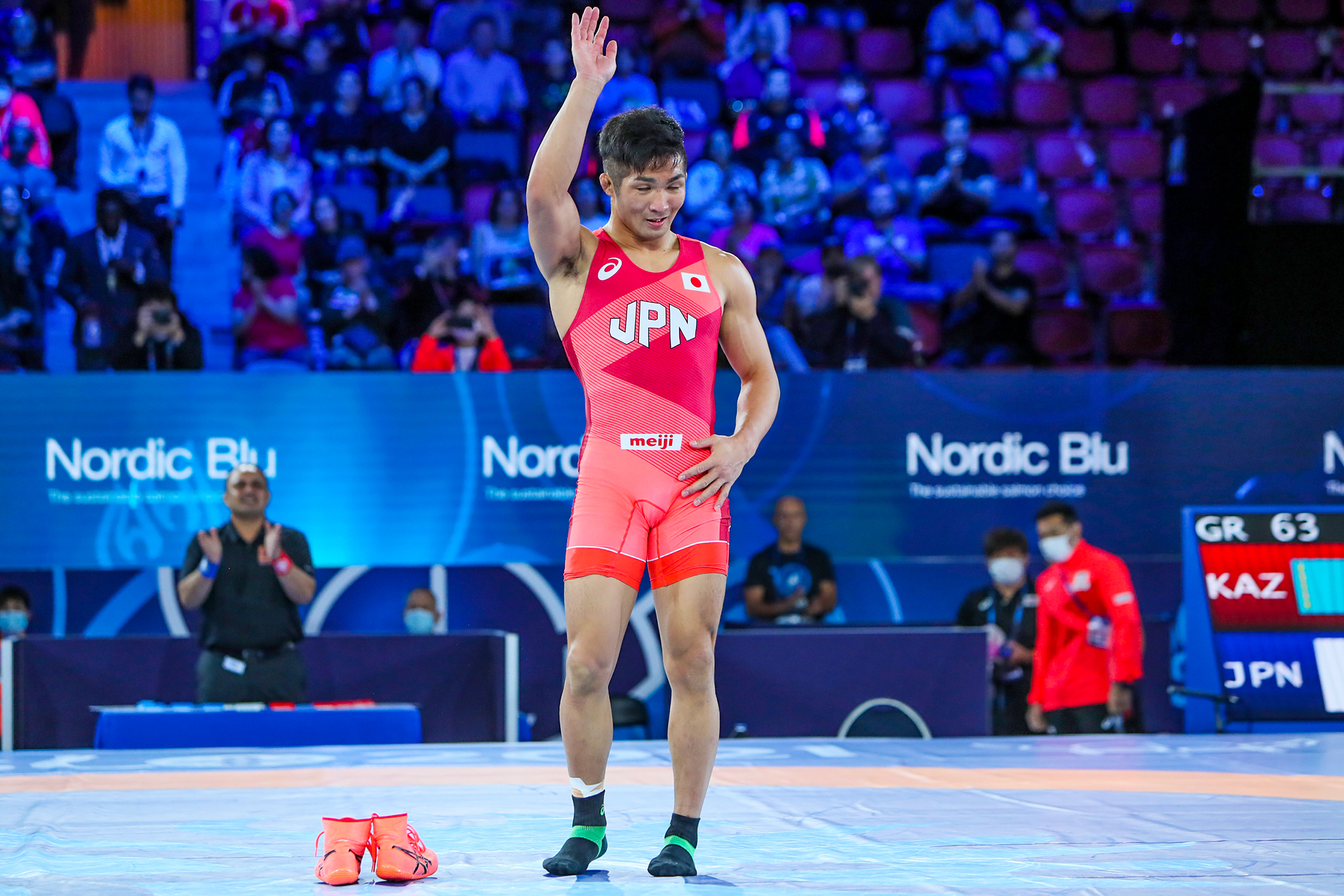
Tsuchika SHIMOYAMADA (AUS)Tsuchika SHIMOYAMADA (AUS) had left his shoes on the mat during the 2021 World Championships to mark his retirement. (Photo: United World Wrestling / Martin Gabor)

Success breeds success, and Australian wrestling officials are hoping that Shimoyamada, in addition to helping cultivate a new generation of wrestlers, can produce results that will spark more interest in the sport. Getting through the rounds, even if he falls short of a medal, would have a positive effect, says one official.

"That would be a very good achievement for us," says Aryan Negahdari, president of New South Wales Wrestling Federation, who accompanied him and several wrestlers to Japan. "For many, many years, we haven't a wrestler making it into the semifinals, or even the quarterfinals of the World Championships. Even that itself would be a good achievement."

While Australia has never won a world medal, it may be surprising to learn that the country has actually brought home three Olympic medals -- although it has been nearly eight decades since the most recent one.

Eddie SCARF broke the ice with a bronze medal at freestyle 87kg at the 1932 Los Angeles Olympics. Australia then got two at the 1948 London Games, a silver from Richard GARRARD at freestyle 73kg and a bronze from Joseph ARMSTRONG at freestyle over-87kg. The closest the country has come since then was a fourth place at Freestyle 62kg by Cris BROWN at the 1984 Los Angeles Games.

On the world stage, the highest finishes by Australians were fifth places by Jackie BRYDON at women's 50kg in 1993 at Stavern, Norway, and Macedonian-born Lila RISTEVSKA at women's 47kg at Moscow 1995. There have been three men who have placed sixth, all in freestyle, with the most recent being Uzbekistan-born Talgat ILYASOV at 74kg at New York 2003.
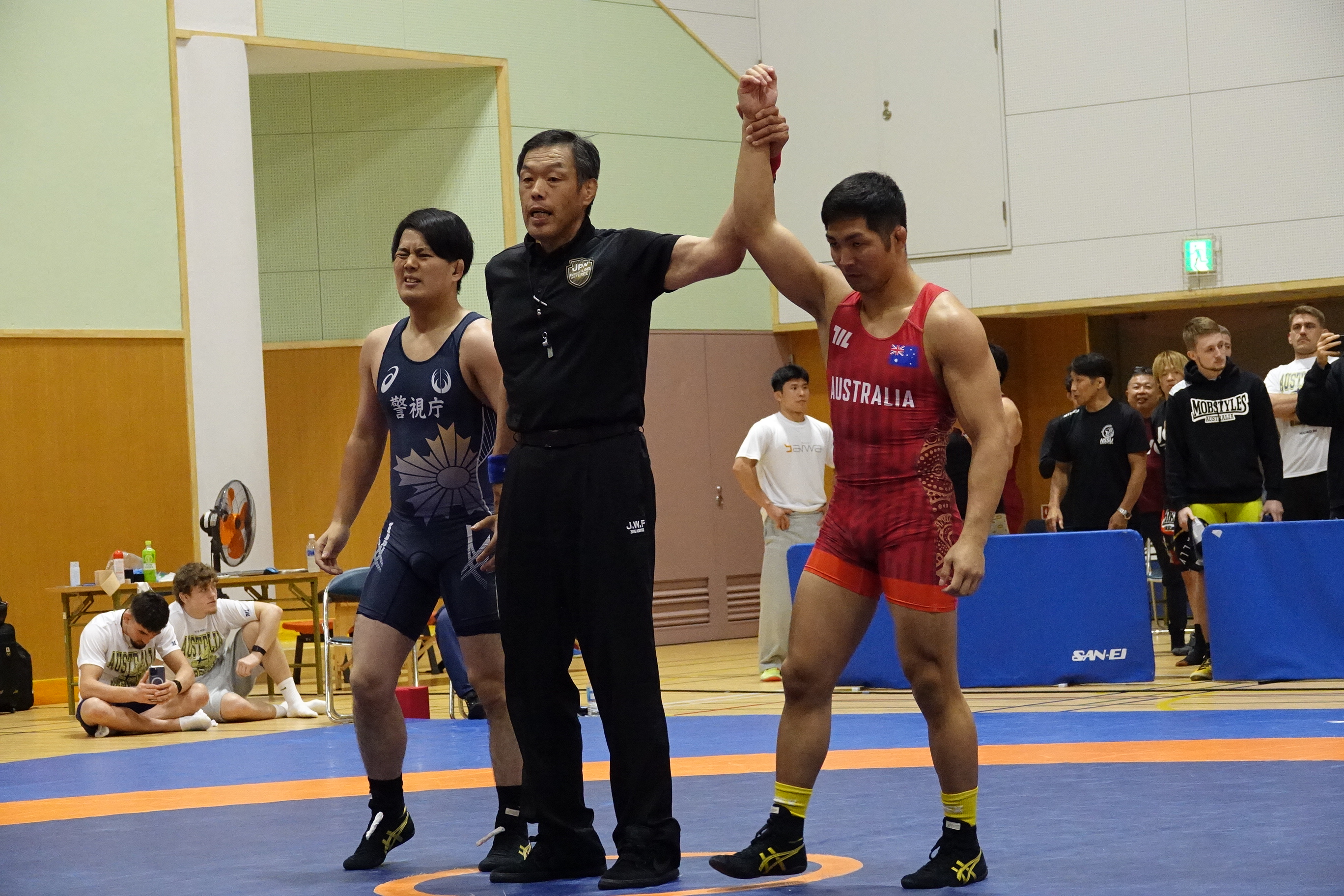
Tsuchika SHIMOYAMA (JPN)Tsuchika SHIMOYAMADA advances to the semifinals at the All-Japan Non-Student Championships in July with a 52-second win over Kokoro GOTO. (Photo: Koji Fuse / wrestling-spirits.jp)

As a Greco wrestler, Shimoyamada will be trying to beat even longer odds. Up to now, Australia has never placed higher than 18th at a World Championships.

Following his graduation from Nippon Sports Science University, which also produced Paris Olympic champions Kenichiro FUMITA and Nao KUSAKA as well as Tokyo bronze medalist Shohei YABIKU, Shimoyamada joined the Tokyo Metropolitan Police Department team. He stayed on the force after ending his wrestling career, but found it wasn't for him.

"When I was back in Japan, I started working for the police," he says. "To be honest, it was stressful. It was not for me."

A trip to Australia opened his eyes to a place where he could start a new life. At first, he planned to only go into coaching, but a practical reason arose that led him to decide to return to the mat -- it helped him get the visa he needed to live in the country.

"I didn't think about wrestling by myself, I thought I could help as a coach," he says. "But for the visa condition, it's better to keep active."

In 2023, he received a residence visa as a "global talent," and in January 2024, United World Wrestling approved his switch of national affiliation to Australia.

Unfortunately, the approval did not come in time for him to try to qualify for the 2024 Paris Olympics. He is still working on gaining citizenship. His need to find a way to make a living proved harder than he expected as he settled in Sydney.

"I'm teaching wrestling, and I'm working as a lifeguard at a swimming pool," he said. "Life is not easy. It's expensive, everything, rent, bills, car."

Shimoyamada's need for gainful employment produced a symbiotic relationship with his hosts, who suddenly found themselves blessed with a world-class competitor to help raise the level of the sport.

"I really think we're super lucky to have him because not only is he a high-level athlete, but he has been helping us a lot as a coach, especially Greco-Roman coach," Negahdari says. "So because of him, we have a lot more athletes doing Greco-Roman, training under Tsuchika."

Shimoyamada's arrival also gave Australia a bonus of sorts -- a connection with an established power in the sport. Through Shimoyamada's ties with his alma mater NSSU, there have been numerous exchanges of wrestlers between the two countries.
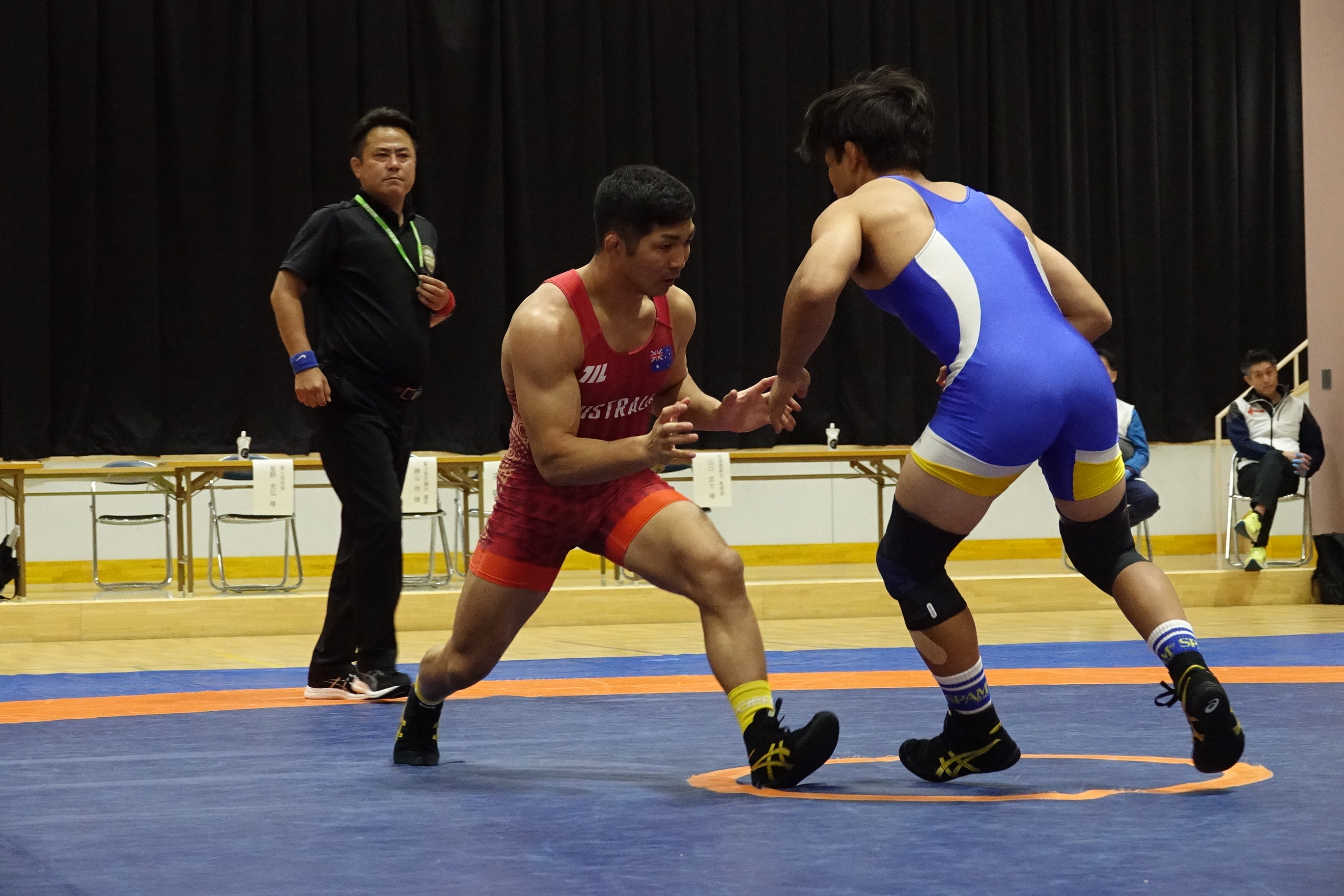
Tsuchika SHIMOYAMADA (AUS)Tsuchika SHIMOYAMA faces Keitaro ONO in his opening match at the All-Japan Non-Student Championships in July. (Photo: Koji Fuse / wrestling-spirits.jp)

In the early summer, Paris Olympic silver medalist Daichi TAKATANI and former women's U23 world champion Yu SAKAMOTO went to Australia to put on clinic. In July, Shimoyamada led a contingent of Australian wrestlers who participated in the All-Japan Non-Student Championships (a second-tier national tournament) before training at NSSU.

"He's also been very good for us to build connections with Japan," Nagahdari says. "We've been coming [to Japan] for four years now, like twice a year, training with the Japanese teams. We've had a lot of Japanese athletes coming over to Australia to do seminars for us, to do training with us...It has been very, very beneficial for us in many different ways."

Shimoyamada entered the Non-Student meet at 72kg to give him the high-level competition he needed as preparation for the World Championships, and which is sorely lacking back in Australia. Aside from the low-level Oceania Championships and tournaments in Australia, it was his first outing since the 2021 World Championships.

He held his own, although he lost in the semifinals to Yamato HAGIWARA before winning his bronze-medal match over Rintaro SOGABE, the younger brother of Paris Olympian Kyotaro SOGABE, a fellow NSSU alum who will be Japan's entry at 67kg and a potential opponent of Shimoyamada in Zagreb.

Shimoyamada made his international debut at the 2016 Asian Championships in Bangkok, placing eighth. He won his first All-Japan title in December 2017, earning a return to the continental meet in 2018 in Bishkek, where he took home the silver medal after losing in the final to Almat KEBISPAYEV (KAZ).

Just when it looked like he had lost his edge after losing back-to-back All-Japan finals to Shogo TAKAHASHI in 2018 and 2019, Shimoyamada rebounded to claim his second title in 2020 with a victory over rising NSSU star Katsuaki ENDO. After Shimoyamada left the scene, Endo and Kyotaro Sogabe would battle ruthlessly for supremacy at 67kg.

His final year wrestling for Japan may have been his most productive. At the 2021 Asian Championships in Almaty, he avenged his loss to Kebispayev from three years before to capture the elusive gold. He followed that with a victory at the All-Japan Invitational Championships, known as the Meiji Cup, to clinch his ticket to the World Championships in Oslo.
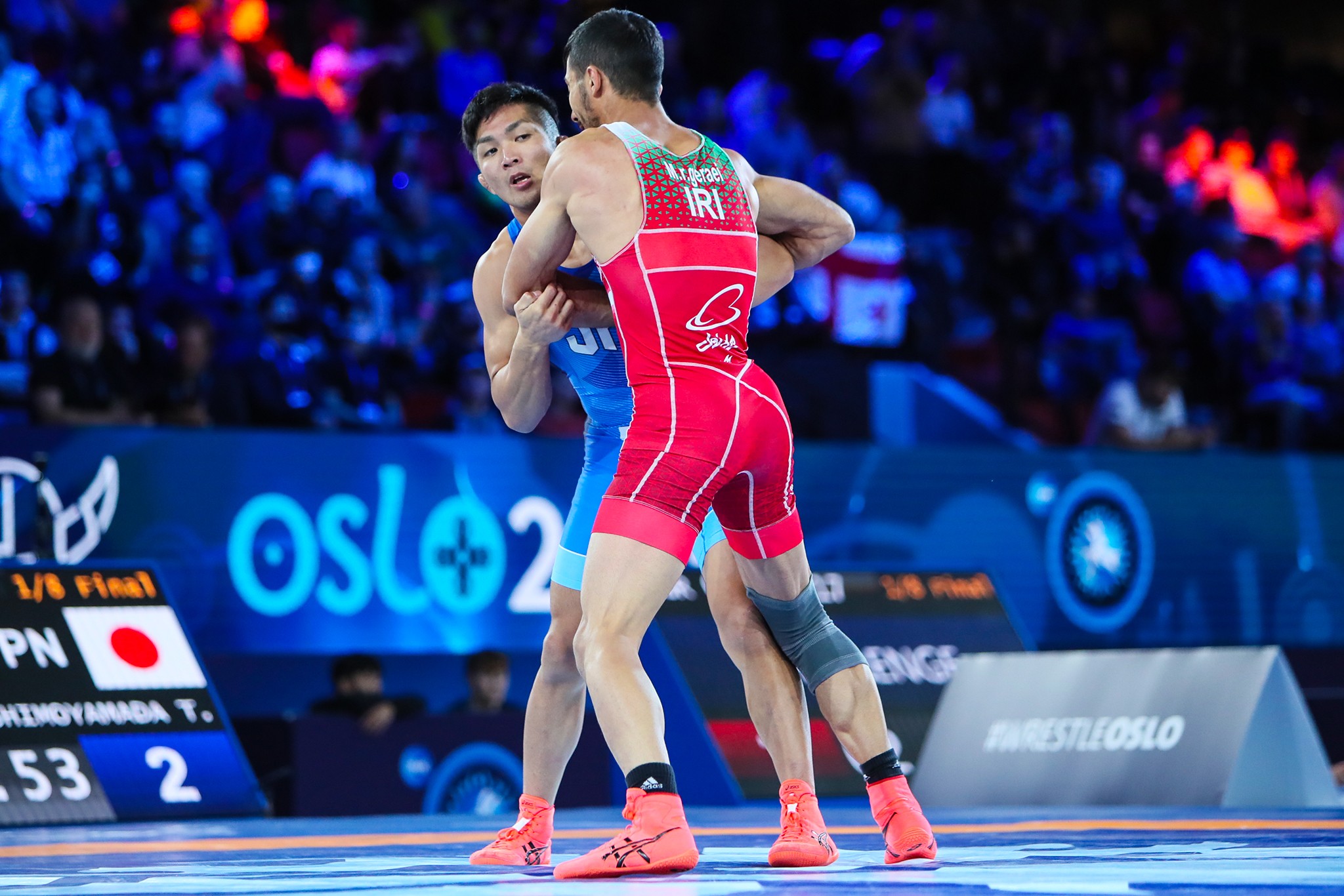
Tsuchika SHIMOYAMADA (AUS)Tsuchika SHIMOYAMADA (AUS) was dominating Mohammadreza GERAEI (IRI) in their match at the 2021 World Championships before being pinned. (Photo: United World Wrestling / Martin Gabor)

In the second round, Shimoyamada encountered Mohammadreza GERAEI (IRI), one of the few gold medalists from the Tokyo Olympics two months earlier who were entered at the worlds. It would probably be the most impressive loss of his career.

Shimoyamada was dominating the Iranian, scoring with a 4-point arm throw to build up a 6-1 lead. But disaster struck with just over a minute to go. Geraei caught Shimoyamada in a lapse and bear-hugged him backward directly to his back for a shocking victory by fall.

Shimoyamada then lost his repechage match to teenager Hasrat JAFAROV (AZE), and the last we saw of him was him walking off the mat, leaving his shoes behind.

Fast forward four years, and Shimoyamada is now competing for himself and his adopted homeland. While he would like to qualify for the 2028 Los Angeles Olympics, age and opportunity might be too big hurdles to get over.

"I think that's a last challenge, for the Olympics, because I'm not young," Shimoyamada said. "If I can make it for Australia, that's good. Everyone will get interested in wrestling. That's what I should do."

Looking long range, Australian officials are hoping to develop talent to make a good showing when the country hosts the Olympics in Brisbane in 2032. They are hoping that Shimoyamada can spark enough interest and help raise the level in time.

"I think we're in the very early stages, compared to international standards," Nagahdari says. "But I think we can definitely see a very huge improvement, like in the last few years. We have a lot more members now, the number of our wrestlers. For example, compared to only three or four years ago, it has doubled. It's growing slowly, but at a good pace.

"It's a very slow progress, because you know that wrestling is super hard. It takes like a decade to build an athlete to that level. And we're really focusing our efforts toward the Brisbane Olympics in 2032."

Shimoyamada is determined to do whatever he can to make it happen.

"It's hard to get a gold medal at the World Championships and the Olympics, to be honest," he says. "If I make the Olympics, the next generation can become interested in getting to the Olympics or World Championships and they will practice hard."
#wrestlebishkek

Badaghimofrad Claims Historic Asian Gold for Qatar

By Ken Marantz

BISHKEK, Kyrgyzstan (April 8) -- Shahin BADAGHIMOFRAD (QAT) continued to make history for his adopted homeland, and this time it came at the expense of his real one.

Iranian-born Badaghimofrad gave Qatar its first-ever gold medal at the Asian Championships, coming from behind for a 4-3 victory over Amin HOSSEINI (IRI) in the Greco 82kg final on Wednesday in Bishkek, Kyrgyzstan.

“I won a bronze medal at last year's Asian Championships, and this year I'm very happy that I managed to take a bigger step and win a gold medal,” Badaghimofrad said.

On a night when five different countries struck gold to finish up the Greco competition, Alisher GANIEV (UZB) ended a recent run of runner-up finishes with a victory at 60kg, and world and Olympic champion Hadi SARAVI (IRI) won his third straight title and fourth overall at 97kg.

Razzak BEISHEKEEV (KGZ), who had settled for the silver medal the past two years, made it to the top step of the podium at 67kg to give the host nation its fourth gold, and Almatbek AMANBEK (KAZ) handed Iran another defeat in a final to take the 72kg crown.

Despite going two for seven in gold-medal matches, Iran cruised to the team title by medaling in every weight class for the first time since 1983. The wrestling powerhouse finished with 195 points to outdistance host Kyrgyzstan, which had four champions and compiled 153 points. Uzbekistan, with two gold medalists, was third with 136.

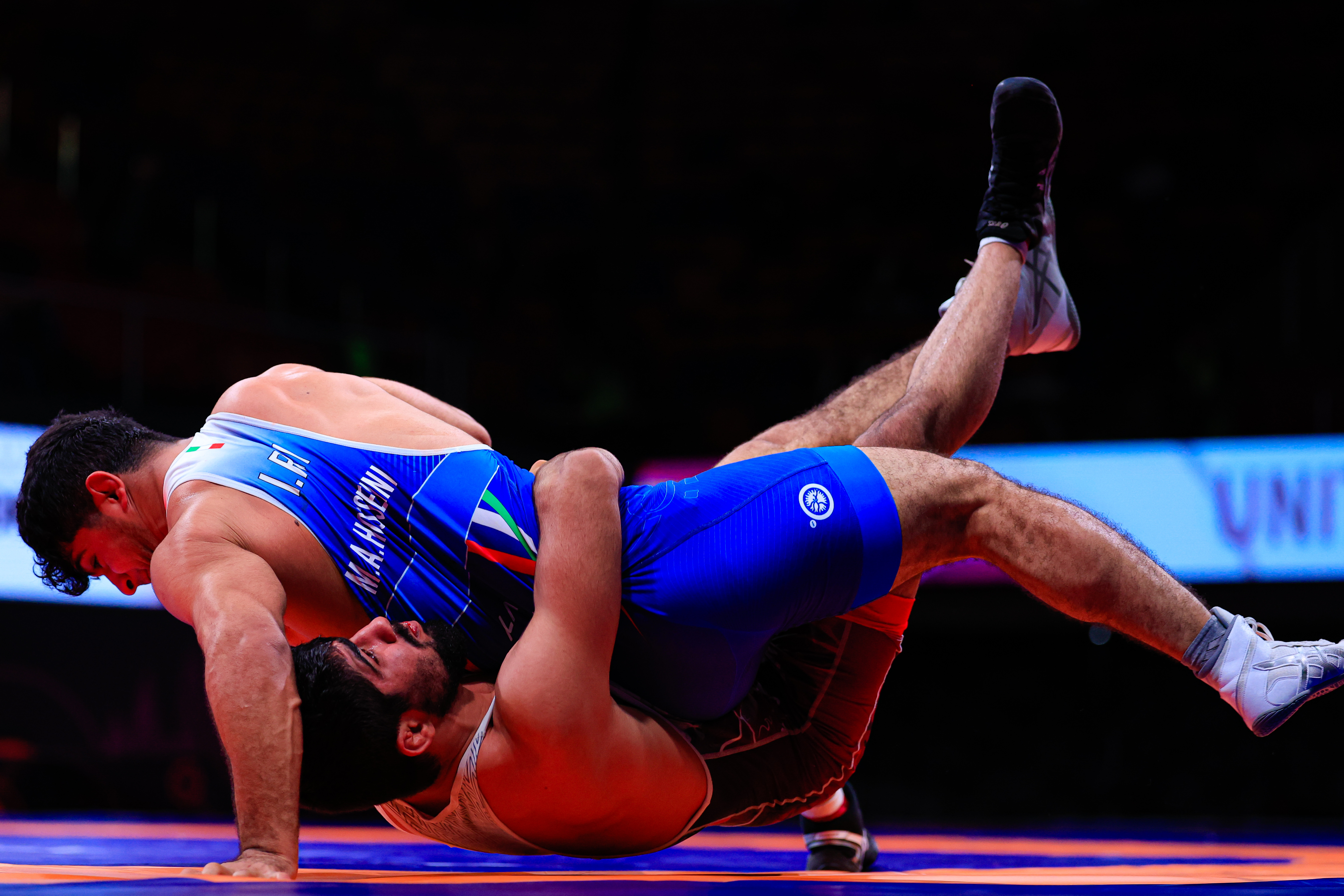
Shahin BADAGHIMOFRAD (QAT)Shahin BADAGHIMOFRAD (QAT) turns Amin HOSSEINI (IRI) during the 82kg final at the Asian Championships. (Photo: United World Wrestling / Kostadin Andonov)
Badaghimofrad, who had been a world cadet (U17) silver medalist and world junior (U20) bronze medalist, was competing for Iran when he first appeared at the Asian Championships three years and 15 kilograms ago, placing fifth in Ulaanbaatar, Mongolia.

A native of Khuzestan Province in southeast Iran, he changed his allegiance after 2023 and debuted for Qatar in February 2025 at the Tirana Ranking Series, where he could only manage a seventh-place finish. But a month later, he placed third at the Asian Championships in Amman, Jordan, marking Qatar’s first ever medal in Greco and just its second overall.

Badaghimofrad’s more recent results were not exactly awe-inspiring – an 11th place at the World Championships in Zagreb, then back-to-back seventh places at Ranking Series tournaments in February this year.

And the outlook did not appear much better in Wednesday’s final when Hosseini, the winner of this year’s Tirana Ranking Series tournament, opened the scoring with a gut wrench for a 3-0 lead in the first period.

In the second period, Badaghimofrad got his chance in par terre and, breaking down stiff resistance from Hosseini, managed to roll him over. An Iranian challenge for a potential leg foul was unsuccessful, putting the Qatari up 4-3, which is how it ended.

“I had wrestled my opponent before, so we were both familiar with each other’s styles,” Badaghimofrad said. “Knowing I could apply my move on the ground, I approached the match without any stress. When the referee gave the passivity warning, I was able to execute my move and emerge as the winner.”

Badaghimofrad knows he still has a way to go if he wants to achieve similar success on the bigger global stages.

“My wrestling isn’t perfect yet, and I’m gradually trying to improve it … so I can get thebest result at the World Championships and the Olympics,” he said.

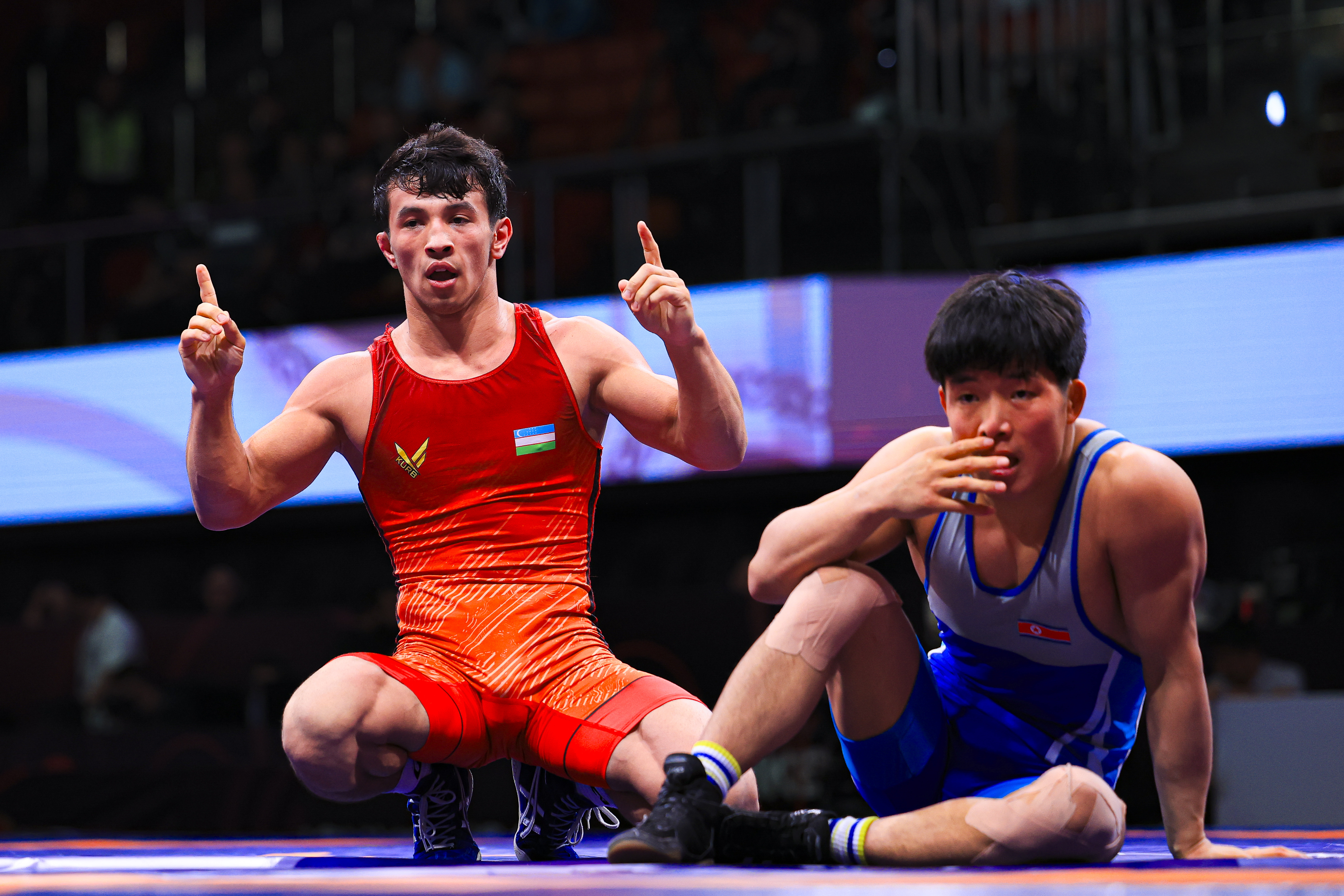
Alisher GANIEV (UZB)Alisher GANIEV (UZB) defeated Se Ung RI (PRK) in the 60kg final to claim his first-ever Asian title. (Photo: United World Wrestling / Kadir Caliskan)
Ganiev finally got the result he was looking for, escaping from second-place purgatory by avenging a loss in last year’s 60kg final with a victory by fall over world and Olympic bronze medalist Se Ung RI (PRK).

Ganiev went up 2-1 when he stepped over and gained an exposure on Ri’s gut-wrench attempt from par terre. In the second period, he increased the lead with a passivity point and a challenge point, but made the score moot when he pancaked Ri to the mat and held on for a fall at 5:06.

“The plan was not to rush, to wrestle patiently, wait for the right moment in par terre,” Ganiev said. “However, during the match, things changed. I managed to score points [from bottom] in par terre. In the second period, I continued with my approach. We prepared specifically for this opponent.”

Ganiev finished second at the Zagreb Ranking Series in February 2025, and again at this year’s. In between, he lost in last year’s Asian final to Ri and in the final of the World Championships to Aidos SULTANGALI (KAZ).

“I had been waiting for a long time,” Ganiev said. “This is my second Asian Championship. In the first one, I finished in second place. Now in 2026 I finally took first place. Today, all the hard work paid off. In the 2025 final, I made mistakes, but this time I corrected them.”

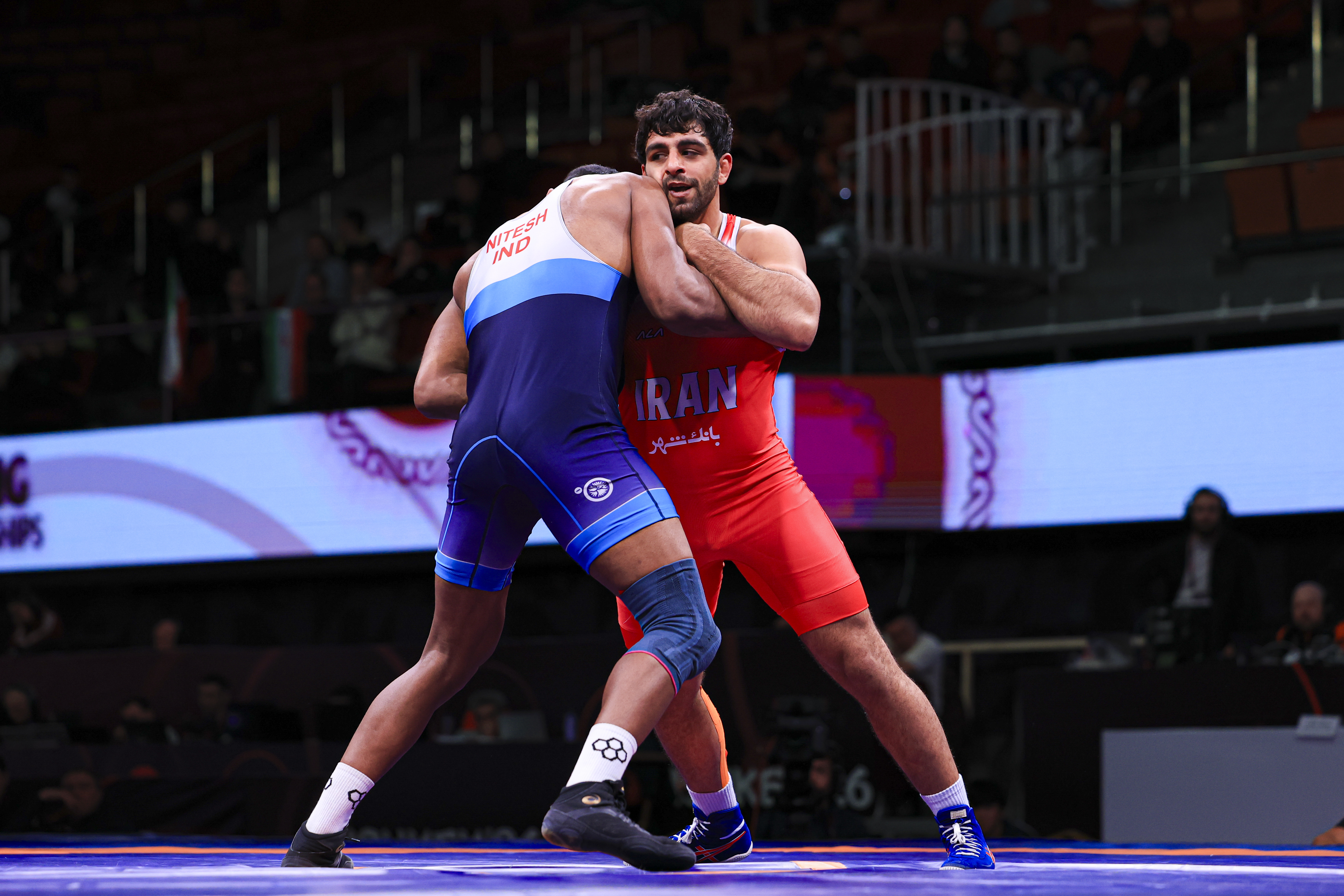
Hadi SARAVI (IRI)Hadi SARAVI (IRI) defended his Asian title with a 7-1 win over NITESH (IND). (Photo: United World Wrestling / Kadir Caliskan)
While a number of Saravi’s teammates faltered at the final hurdle, the two-time Olympic medalist proved to be a rock of stability in claiming the 97kg gold with a solid albeit not overwhelming 7-1 win over NITESH (IND).

“I managed to finish the competition with the gold medal,” Saravi said. “After the World Championships, I set aside some time for recovery to get my body back in shape. The coaches decided to send me to the Asian Championships. I arrived at this competition with only a relative level of readiness, but thankfully I managed to achieve the best result and claim gold.”

Saravi, whose long list of laurels also includes four world medals, reeled off two rolls from par terre in the first period to lead 5-0. After being put on the bottom in the second but never budging, Saravi added a pair of stepouts to beat Nitesh for the third time in as many career meetings and clinch his fourth Asian gold over a seven-year span.

“The final was tougher [than the previous matches] because I’d suffered a knee injury before arriving, which was bothering me a bit and meant I couldn't keep up with my training properly or come to the competition fully prepared,” Saravi said. “Because of that I was a bit unsettled.”

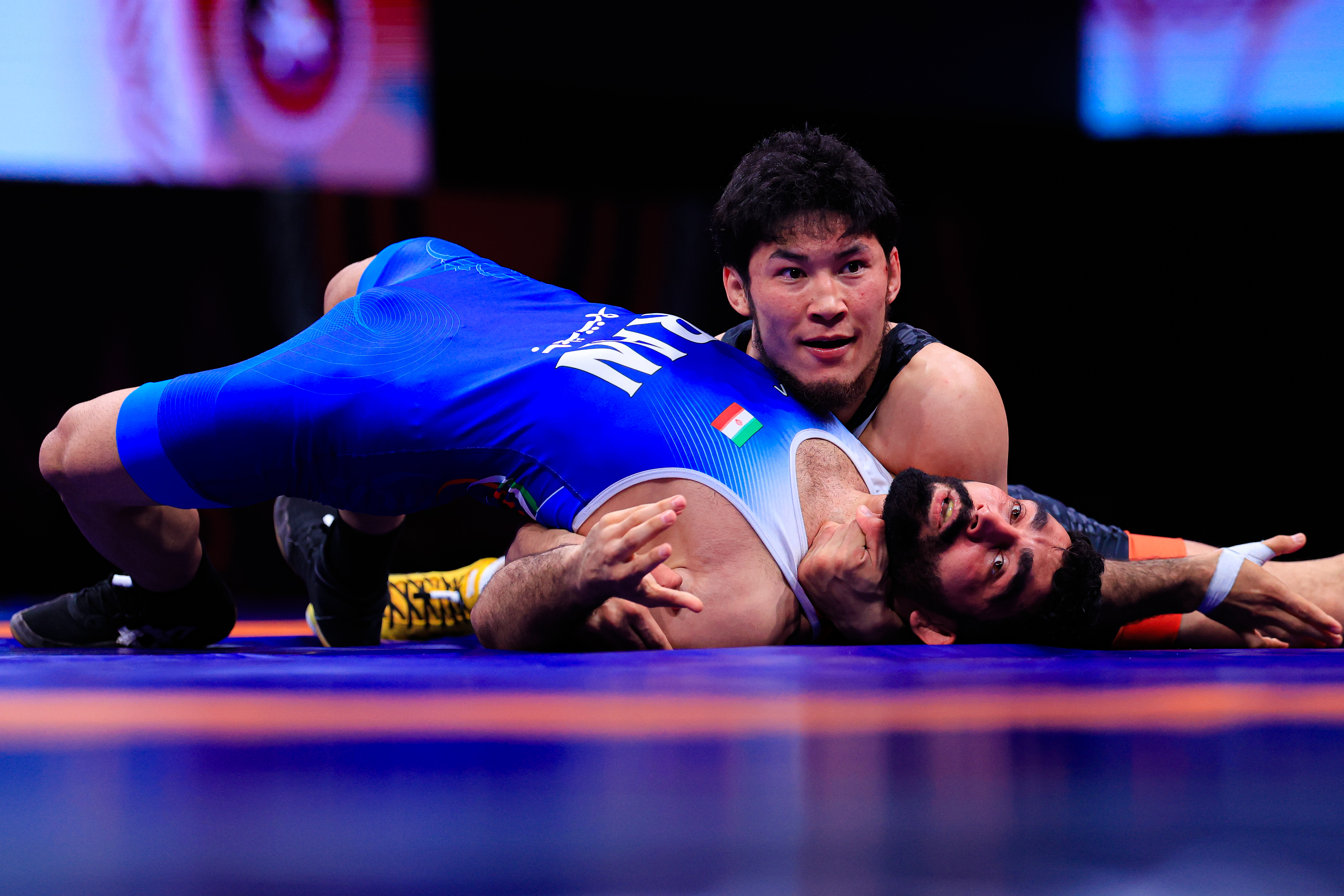
Almatbek AMANBEK (KAZ)Almatbek AMANBEK (KAZ) tries to pin Javad REZAEI (IRI) during the 72kg final. (Photo: United World Wrestling / Kostadin Andonov)
At 72kg, Amanbek capped his senior Asian debut with a stunning victory by fall over Javad REZAEI (IRI), which more than avenged a 3-2 loss to the Iranian in the quarterfinals of the Tirana Ranking Series that Rezaei won.

“It’s the first time I’ve taken first place in the 72-kilogram category,” said Amanbek, who moved up from 67kg this year. “It’s been an incredibly emotional day. 

“I’d give myself a ten out of ten. I did really well. Everything went exactly as I’d planned. I can give myself a pat on the back.”

The quick succession of moments that led to Amanbek’s victory started with him on the bottom of par terre. When Rezaei tried to force a gut wrench, Amanbek stepped over, scooped Rezaei’s head and held him down for a fall in 1:50.

“I know that Iranian wrestler, we faced each other at a ranking tournament in Albania,” Amanbek said. “I lost there. Today I got my revenge. I was in good spirits. We went out there and stuck to our tactics and our game plan. That’s why we won.”

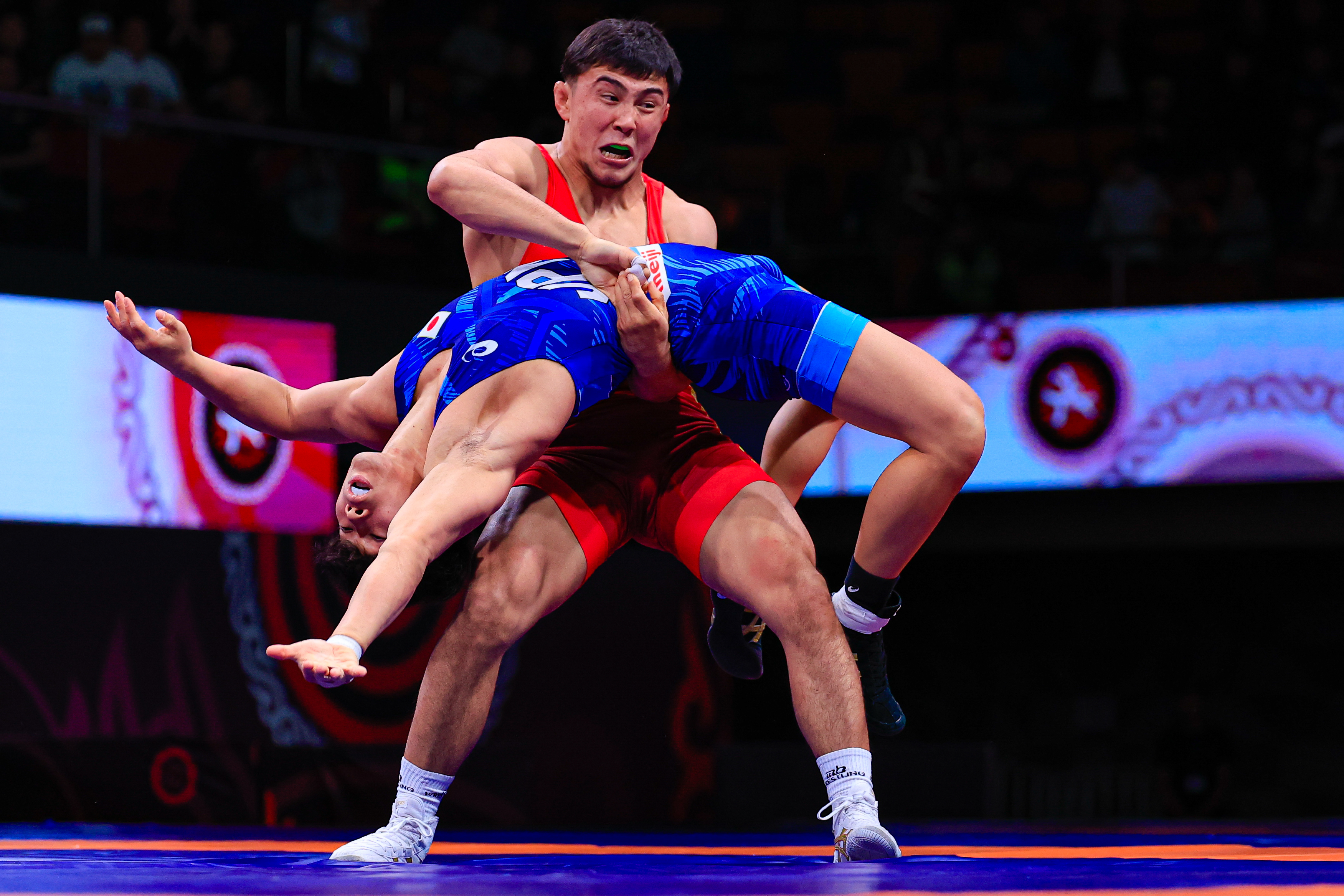
Razzak BEISHEKEEV (KGZ)Razzak BEISHEKEEV (KGZ) scores a four-point throw on Kensuke SHIMIZU (JPN) during the 67kg final. (Photo: United World Wrestling / Kostadin Andonov)
At 67kg, Beishekeev wrapped up a strong Greco outing for the home team by soundly defeating former world bronze medalist Kensuke SHIMIZU (JPN) 8-2.

“I can say that this victory means a lot to me,” Beishekeev said of triumphing in front of the home crowd at Zhastyk Arena. “I truly felt the strong support of my people, it gave me strength and motivation. Thanks to that, everything came together today and I became a champion.”

Beishekeev all but put the match away in the first period, when he not only completed a gut wrench from par terre, but added a 4-pointer by lifting Shimizu and dumping him onto this back.

In the second period, Beishekeev gave up a passivity point but nothing from the bottom of par terre, and received a point himself when the Japanese side unsuccessfully challenged for a leg foul. A late stepout by Shimizu only changed the margin of victory.

In the three previous Asian Championships, Beishekeev’s results had been: bronze, silver, silver.

“Behind this success is a lot of hard work,” he said. “I worked patiently, step by step, never forgetting my goal and constantly pushing forward. If we continue working with the same determination, I believe a gold medal at the World Championships is also possible. “

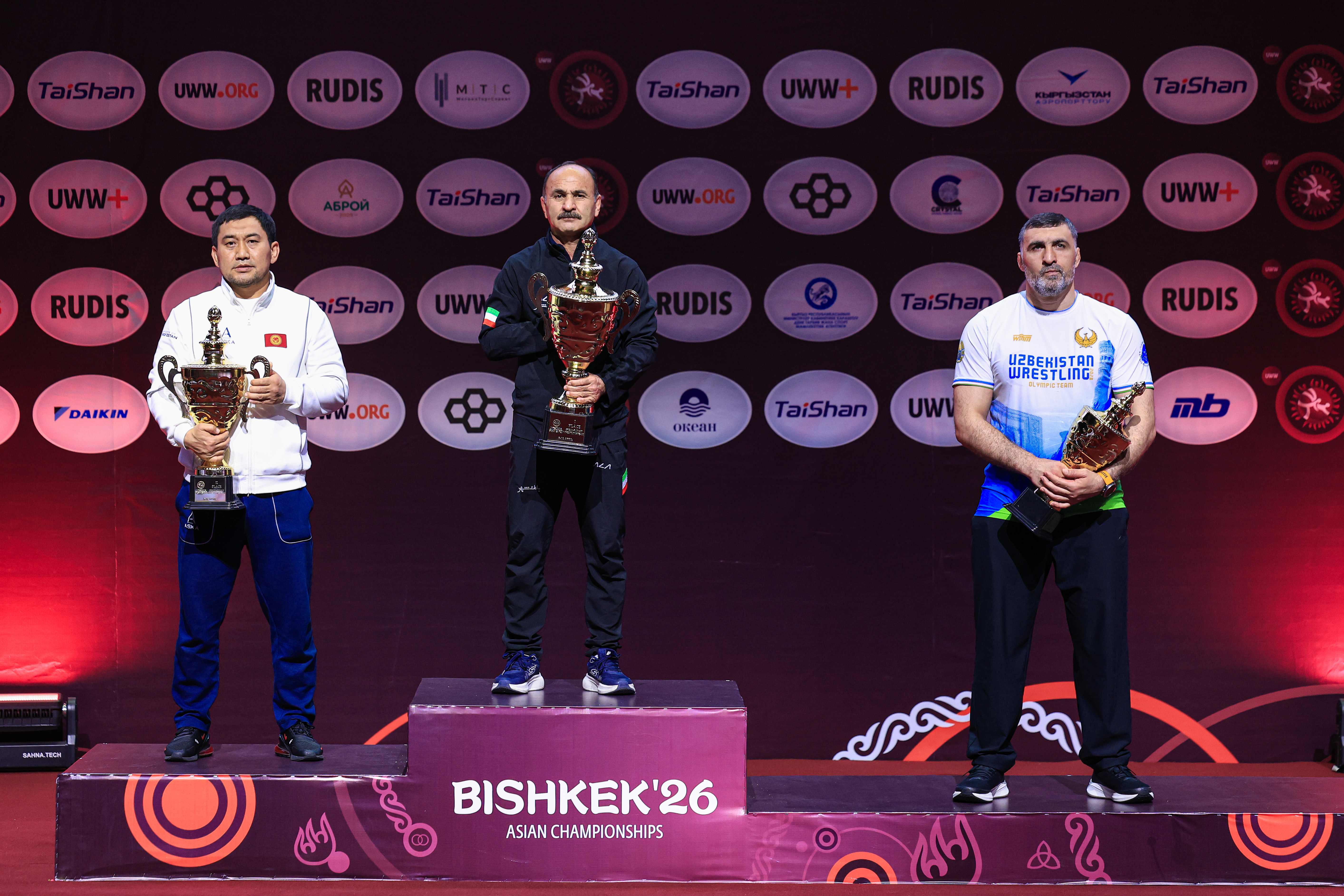
IranIran won the team title in Greco-Roman at the Asian Championships. (Photo: United World Wrestling / Amirreza Aliasgari)

Entire Iranian team comes away with medals

In the bronze-medal matches, Ali AHMADI VAFA (IRI) and Ahmadreza MOHSEN NEZHAD (IRI) both picked up their first major senior medals and assured that nobody on the Iranian Greco team would be leaving Bishkek empty-handed.

Ahmadi Vafa, who won world titles at each of the three age-group levels from 2022 to 2024, secured a bronze medal at 60kg with a 10-0 rout of Yerbol KAMALIYEV (KAZ).

After a 4-point throw from par terre, Ahmadi Vafa tossed Kamaliyev again, although he didn’t get the necessary exposure and it was ruled a 2-pointer. But the Iranian continued the move and forced Kamaliyev to his back for 2 more to end it at 1:49.

The other bronze at 60kg went to Yu SHIOTANI (JPN), who was back on the Asian scene for the first time since winning the 55kg gold in 2022, the same year he won a world bronze.

Shiotani hit a 4-point throw from par terre, good enough for a 5-1 win over two-time former Asian U23 champion Haodong TAN (CHN).

At 67kg, Mohsen Nezhad, a 2025 world U23 bronze medalist, gained his bronze without a fight, as he received a victory by default from world silver medalist Hanjae CHUNG (KOR), who had suffered an elbow injury in his quarterfinal loss to Beishekeev on Tuesday.

Sachin SAHRAWAT (IND) captured his second career 67kg bronze when he fought back from behind three times to eventually come away with a 6-5 win over Abdumalik AMINOV (UZB).

A drag-by takedown in the final 30 seconds finally put Sahrawat over the top, after he had trailed 1-0, 3-2 and 5-3 during the match.

At 72kg, Taishi NARIKUNI (JPN) saw his bid for a place in wrestling history harshly ended by Shakhzod KUCHKOROV (UZB), who needed less than a minute to uncork a pair of 4-point throws in a 9-0 romp.

Narikuni, the 2022 champion at Freestyle 70kg, was looking to join the select group of wrestlers with Asian medals in both styles – a group that compatriot Kaisei TANABE (JPN) joined the previous day by taking a bronze at 63kg.

Ironically, last December, Narikuni had pipped Tanabe in each’s bid to become the first wrestler in 52 years to complete the Freestyle-Greco double at the All-Japan Championships. Narikuni did it by also winning the Freestyle 70kg title, while Tanabe fell short by finishing third at 65kg.

Narikuni will be returning to the Bishkek mat on Friday for the Freestyle 70kg qualification rounds as he attempts to bounce back from his Greco disappointment. Narikuni also won the world gold in Freestyle in 2022, but his attempt to repeat that feat in Greco last year in Zagreb ended in the first round.

Dongyu LI (CHN) took the other bronze at 72kg on Wednesday with a somewhat odd victory by fall over Amantur ISMAILOV (KGZ).

After breaking out to a 5-0 lead with two rolls from par terre, Li secured double underhooks and pancaked Ismailov to his back for 4 points.

Having achieved a win by technical superiority, Li stood up and thrust his fists in the air in triumph, only to notice that Ismailov was still lying on his back. Li then hopped on top of his prone opponent for an easy fall in 2:40.

At 82kg, Kakabay KAKABAYEV (TKM) became the third wrestler from Turkmenistan to make it to a bronze-medal match in Greco and have a chance to become the country’s first medalist since 2018, and the third to come up short.

Kakabayev never really had a chance against PRINCE (IND), who reeled off four rolls in a row from par terre en route to a 10-1 victory. That gave Prince a senior Asian bronze a year after winning one on the U20 level.

The other 82kg match saw veteran and former Asian champion Ibragim MAGOMADOV (KAZ) earn his fourth straight Asian medal and second straight bronze with a 5-3 victory over Rui LIU (CHN).

Magomadov, the 2023 champion at 72kg and a bronze medalist last year at 77kg, hit a 4-point throw from par terre in the first period, then held on after giving up a 2-point penalty in the second.

At 97kg, Zagreb Ranking Series silver medalist Islam YEVLOYEV (KAZ), the 2024 world U20 champion at 82kg, never gave Minho LEE (KOR) a chance, spinning behind for a takedown then chalking up a combination of exposures and rolls for a 9-0 victory in 1:27.

Zegang WANG (CHN) was equally dominant in taking the other 97kg bronze with an 11-1 victory over Melis AITBEKOV (KGZ) in his Asian debut.

Photo

Day 3 Results

Greco-Roman

60kg (10 entries)
GOLD: Alisher GANIEV (UZB) df. Se Ung RI (PRK) by Fall, 5:06 (6-1)

BRONZE: Yu SHIOTANI (JPN) df. Haodong TAN (CHN), 5-1
BRONZE: Ali AHMADI VAFA (IRI) df. Yerbol KAMALIYEV (KAZ) by TS, 10-0, 1:49

67kg (11 entries)
GOLD: Razzak BEISHEKEEV (KGZ) df. Kensuke SHIMIZU (JPN), 8-2

BRONZE: Ahmadreza MOHSEN NEZHAD (IRI) df. Hanjae CHUNG (KOR) by Inj. Def.
BRONZE: Sachin SAHRAWAT (IND) df. Abdumalik AMINOV (UZB), 6-5

72kg (10 entries)
GOLD: Almatbek AMANBEK (KAZ) df. Javad REZAEI (IRI) by Fall, 1:50 (2-1)

BRONZE: Dongyu LI (CHN) df. Amantur ISMAILOV (KGZ) by Fall, 2:40 (9-0)
BRONZE: Shakhzod KUCHKOROV (UZB) df. Taishi NARIKUNI (JPN) by TS, 9-0, :48

82kg (10 entries)
GOLD: Shahin BADAGHIMOFRAD (QAT) df. Amin HOSSEINI (IRI), 4-3

BRONZE: Ibragim MAGOMADOV (KAZ) df. Rui LIU (CHN), 5-3
BRONZE: PRINCE (IND) df. Kakabay KAKABAYEV (TKM) by TS, 10-1, 2:06

97kg (11 entries)
GOLD: Hadi SARAVI (IRI) df. NITESH (IND), 7-1

BRONZE: Islam YEVLOYEV (KAZ) df. Minho LEE (KOR) by TS, 9-0, 1:27
BRONZE: Zegang WANG (CHN) df. Melis AITBEKOV (KGZ) by TS, 11-1, 4:11

Women’s Wrestling

50kg (11 entries)
SF 1: Son Hyang KIM (PRK) df. Aktenge KEUNIMJAEVA (UZB), 12-8
SF 2: Yui SUSAKI (JPN) df. Maral TANGIRBERGENOVA (KAZ) by TS, 8-0, 2:00

55kg (8 entries)
SF 1: Sowaka UCHIDA (JPN) df. Ariunzaya ODONCHIMEG (MGL) by TS, 10-0, 1:33
SF 2: Yuxuan LI (CHN) df. Hansika LAMBA (IND) by TS, 11-1, 5:54

59kg (8 entries)
SF 1: Mengyu XIE (CHN) df. NEHA (IND), 12-5
SF 2: Sena NAGAMOTO (JPN) df. Ulmeken ESENBAEVA (UZB) by TS, 10-0, 4:00

68kg (10 entries)
SF 1: Meerim ZHUMANAZAROVA (KGZ) df. Zelu LI (CHN), 1-1
SF 2: Miwa MORIKAWA (JPN) df. Delgermaa ENKHSAIKHAN (MGL), 7-0

76kg (9 entries)
SF 1: Aiperi MEDET KYZY (KGZ) df. Hui Tsz CHANG (TPE) by TS, 11-0, 1:03
SF 2: Davaanasan ENKH AMAR (MGL) df. Gulmaral YERKEBAYEVA (KAZ), 7-2