TOKYO (May 23) -- Nonoka OZAKI won her latest showdown with Paris Olympic champion Sakura MOTOKI, and this time there was no having to cut it close.
Ozaki broke open a close match in the second period, pulling away to an 8-2 victory to advance to the women’s 62kg final at the Meiji Cup All-Japan Invitational Championships on Saturday in Tokyo.
"I’m used to being patient before getting going, and in the second period I was able to seize the momentum,” Ozaki said.
The victory put Ozaki into Sunday’s final, where a victory over world 59kg champion Sakura ONISHI will secure her place on Japan’s team to both the Asian Games, to be hosted by Japan, and the World Championships.
Others advancing to their respective finals on the third day of the four-day tournament at Tokyo’s Komazawa Gym were Paris Olympic gold medalists Kotaro KIYOOKA at Freestyle 65kg, Akari FUJINAMI at women’s 57kg and Nao KUSAKA at Greco 77kg, along with Paris bronze medalist Yui SUSAKI at women’s 50kg.
The much-anticipated clash between Ozaki and Motoki was the feature match of the session, and came a round earlier than expected after Onishi upended Motoki 9-7 in their Nordic round-robin group opener.
After a staid first period in which the lone score was an activity point for Motoki, Ozaki stepped up her game and scored a quick takedown to start the second period. When Motoki tried to spin out of an underhook, Ozaki stopped her for 2.
Motoki kept that movement going and got behind for a 1-point reversal, only for Ozaki to stuff a roll attempt for a 2-point exposure to go up 6-2. Ozaki then got behind for a final takedown to complete a solid victory.
The last time they faced each other was in December at the Emperor’s Cup All-Japan Championships, which along with the Meiji Cup, serve as the qualifiers for this year’s Asian Games and World Championships. A victory at both means an automatic place on the Japan team; if the winners are different, a playoff is held between them.
Last December, Ozaki pulled off a late 3-3 victory in the final over Motoki, which earned her a ticket to last month’s Asian Championships, where she won her third career continental gold.
It also avenged a loss by the identical score at last year’s Meiji Cup, which Motoki followed up by beating Ozaki in 6-5 in a nail-biting playoff. With those wins, Motoki secured a ticket to the World Championships in Zagreb, where she won the gold medal.
“I didn’t want to have similar gap in scores like in the previous tournaments or have a one-point difference,” Ozaki said. “I wanted to win after building up a big lead.”
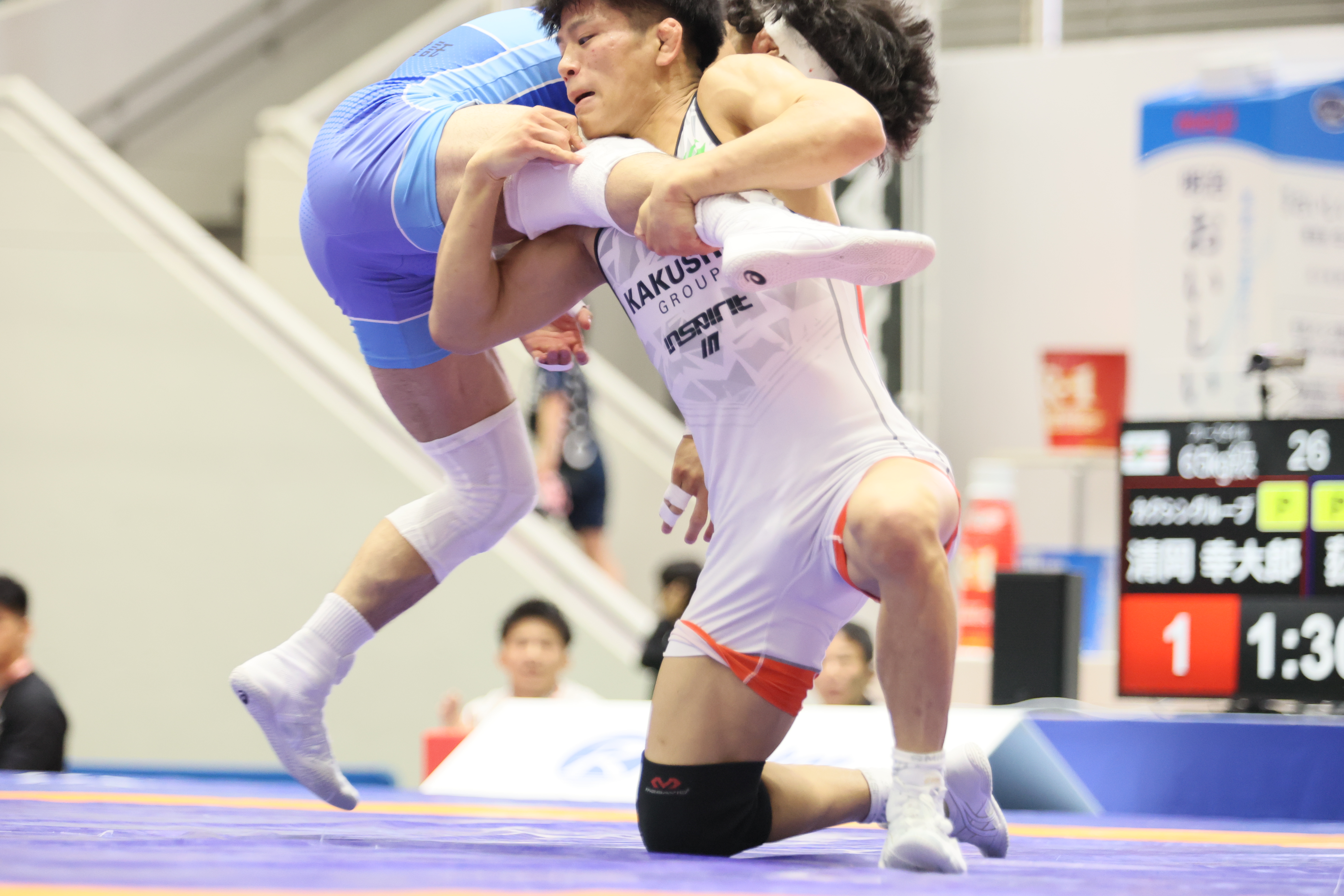 Kotaro KIYOOKA (JPN) reached the 65kg final and will take on Kaisei TANABE (JPN) for the gold medal. (Photo: wrestling-spirits.jp / Takeo Yabuki)
The other Paris medalists – Kiyooka, Fujinami, Kusaka and Susaki – were all Emperor’s Cup champions and can secure their Asian Games and world team spots without a playoff with victories in Sunday’s finals.
Kiyooka had his hands full in advancing to the Freestyle 65kg final with a 3-1 victory in the semifinals over 2024 world U23 silver medalist Kaiji OGINO.
Ogino was leading in the second period on criteria after each received an activity point, when Kiyooka launched an attack that sent Ogino reeling off the mat for a stepout, to which a fleeing point was added.
Kiyooka said that Ogino put up a defense that resembled that of rival Rahman AMOUDZAD (IRI), who lost to Kiyooka in the final in Paris but gained revenge by relegating him to the silver at the Zagreb Worlds.
“I really felt it as we were going at it,” Kiyooka said. “But being able to overcome that is a big step.”
In Sunday’s final, Kiyooka will face fellow Nippon Sports Science University alumnus Kaisei TANABE, who advanced with an 8-2 victory over world U23 silver medalist Takara SUDA.
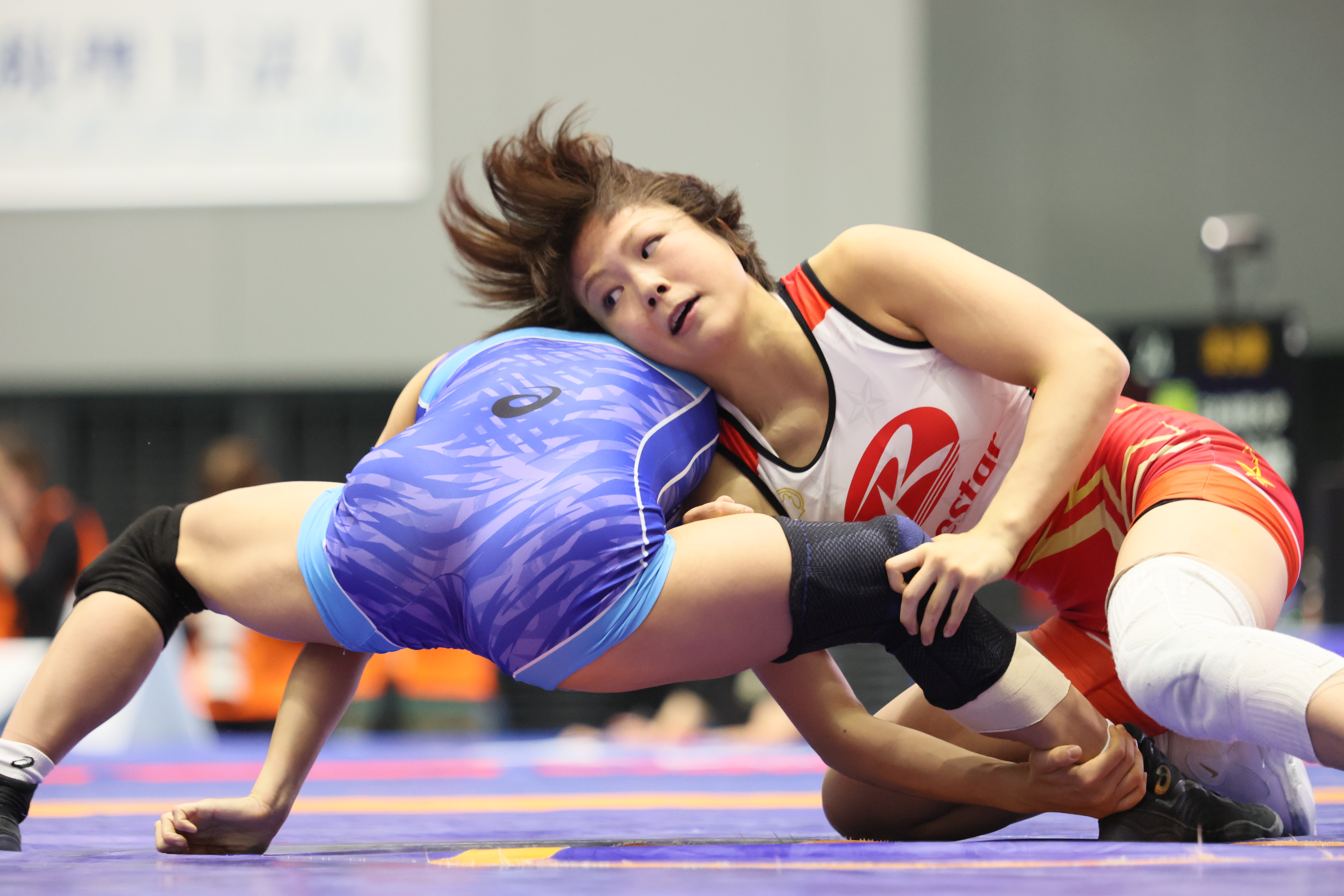 Akari FUJINAMI (JPN) moved into the 57kg final after a 10-0 win over Sara NATAMI (JPN). (Photo: wrestling-spirits.jp / Takeo Yabuki)
Fujinami, still depending mostly on takedowns as she makes the physical adjustment to 57kg after winning the Paris gold at 53kg, cruised into the final with a 10-0 whitewash of Sara NATAMI.
With her second victory by technical superiority of the day, Fujinami extended her current win streak to 152 matches, dating back to her junior high school days.
In the final, she will face Sena NAGAMOTO, the Emperor’s Cup champion at 59kg who has made the bold move to drop down to 57kg and challenge the seemingly invincible Fujinami.
Nagamoto advanced with a 2-0 victory over Himeka TOKUHARA, who famously put Fujinami into the most danger of having her streak broken by nearly pinning her in the final at the Emperor's Cup, only for Fujinami to survive the predicament and rebound to beat her.
Kusaka looked to be cruising in his semifinal at Greco-Roman 77kg against Kodai SAKURABA, only to give up a 4-point throw from par terre in the second period. Still, the Zagreb silver medalist managed to hang for a 6-5 win.
In the gold-medal match, Kusaka will face Isami HORIKITA in a rematch of the Emperor’s Cup final.
Susaki encountered a slight blip in her 12-2 victory over Umi ITO in the women’s 50kg semifinals, which earned her a trip to the final against world U20 champion Rinka OGAWA.
Susaki led 2-0 late in the first period when she got stuck attempting a front headlock roll, giving Ito 2 points and the lead on criteria. But Susaki shook off the foible and piled up the points in the second period to finish off Ito.
At Freestyle 74kg, world champions Yoshinosuke AOYAGI and Kota TAKAHASHI both advanced to the final to set up a rematch of their high-level championship match at the Emperor’s Cup.
Aoyagi, who moved up to the Olympic weight after winning the world title at 70kg, won by fall over Ryoya YAMASHITA, while Takahashi, the reigning world champ at 74kg, eked out a 3-1 win over Hikaru TAKATA.
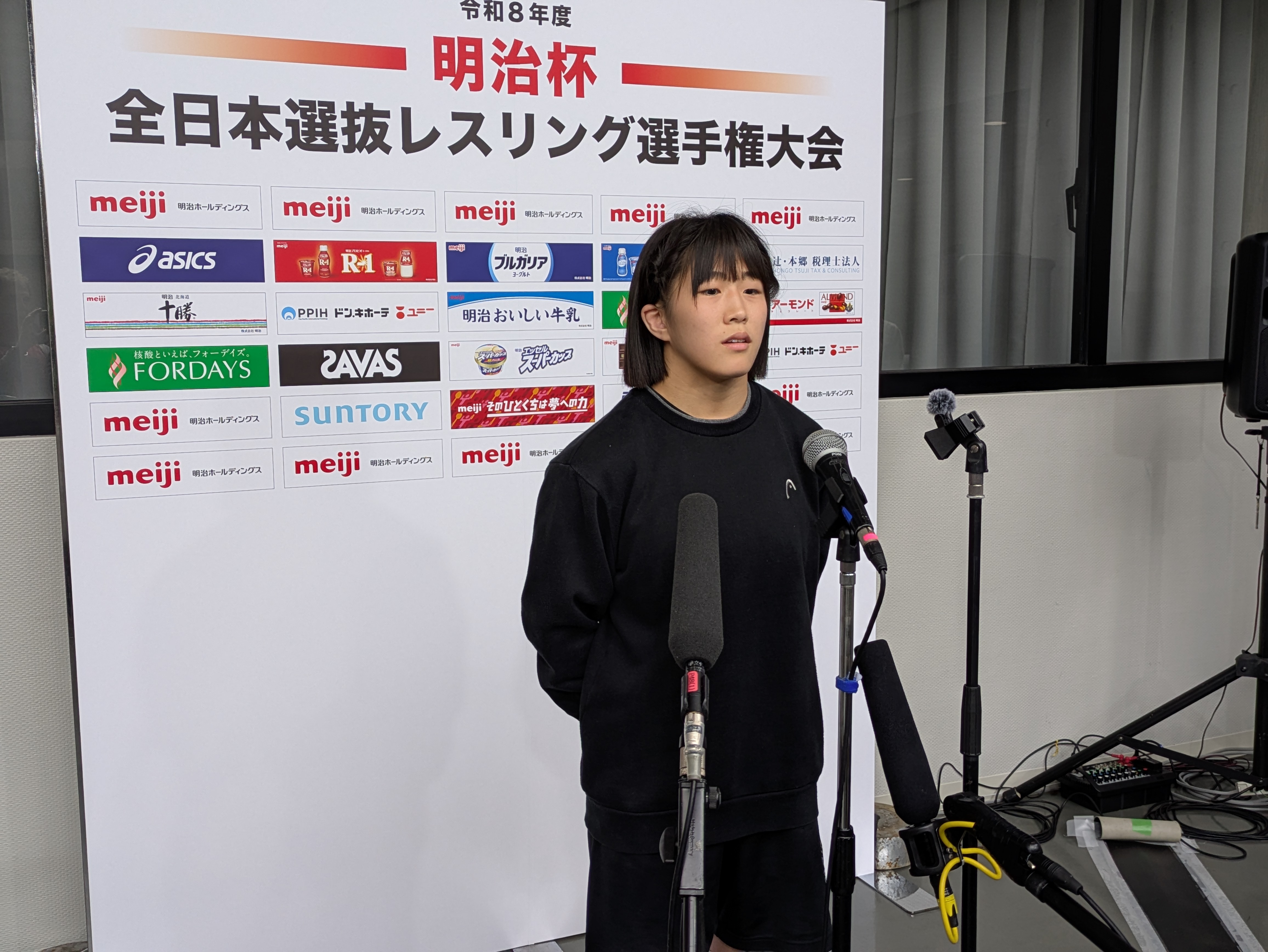 Yu KATSUME (JPN), 18, suffered her first-ever loss since July 2019. (Photo: United World Wrestling)
Future Prospect Katsume Falls Short
Earlier, at 50kg, highly touted high schooler Yu KATSUME made her long-awaited senior debut, but came up on the short end of a 3-1 decision in the quarterfinals to Morishita. Only a second-period go-behind takedown by Morishita separated the two, with each receiving an activity point.
“It was a match that I feel I could have won,” Katsume said. “I feel it’s not like I can’t compete here.”
The loss ended a remarkable winning streak for Katsume, the 2024 world U17 champion at 46kg who had not lost since she was in the fifth grade of elementary school back in July 2019. She had put up Susak and Fujinami-like numbers, winning 22 straight tournaments on various age group levels.
Katsume, who turned 18 earlier this month, was familiar with her opponent. She is a senior at the high school attached to Shigakkan University, which Morishita attends, and the teams practice together.
“We know each other styles, so I wasn’t sure how the match would go,” Katsume said. “I thought I could do it, but I didn’t do the attacking wrestling that I usually do.”
As for suffering a rare defeat, Katsume commented, “I’m the younger one, and I had never entered a senior tournament. My opponent had been to finals [on this level], so the pressure was on her. Looking at it that way, I thought I could win.”



 Franz Beckenbauer was awarded wrestling’s highest honor, the Golden Necklace, by UWW Bureau Member Rodica YAKSI.
Share your thoughts.
Comments