

#JapanWrestling

Fumita returns to book ticket to Belgrade; Sakurai, Ishii make it

By Ken Marantz

TACHIKAWA, Japan  (July 1) -- Tokyo Olympic silver medalist Kenichiro FUMITA managed to defy the doctor and recover enough to make it onto the mat for the world team playoff. Having come this far, neither Maito KAWANA nor a nasty gash over his eye was going to stop him.

Fumita defeated Kawana 3-1 to secure the Greco-Roman 60kg spot on Japan's team to this year's World Championships as the seven final places in Olympic weight classes were decided on Saturday in Tachikawa in western Tokyo.

"Among competitions in which I wasn't in perfect condition, I came into this tournament in the lowest I have been, and could not move as I wanted," said Fumita, who was forced to withdraw from the Meiji Cup All-Japan Invitational Championships two weeks ago due to a torn right hamstring.

The Meiji Cup was the second of Japan's two domestic qualifiers for the World Championships, along with the Emperor's Cup All-Japan Championships held last December. Winners of both automatically earned places on the team to Belgrade; in cases where the champions were different, a playoff would decide matters.

Also earning tickets to Belgrade were women's world 57kg champion Tsugumi SAKURAI and Ikuei University teammate and world 68kg silver medalist Ami ISHII -- both with dramatic victories -- while world 76kg bronze medalist Yuka KAGAMI took a gamble and made it pay off to earn a return trip to the worlds.

Kenichiro FUMITA (JPN)Kenichiro FUMITA works to turn Maito KAWANA in the Greco 60kg playoff. (Photo: Japan Wrestling Federation / Takeo YABUKI)

With his victory, Fumita will get a chance to regain the world title he won in 2017 and 2019 and improve on his bronze-medal finish from 2022. But more importantly, it gives him a chance to qualify for the 2024 Paris Olympics, where making amends for his Tokyo silver holds top priority.

The Japan Federation has decreed that any wrestler in an Olympic weight class who wins a medal at the World Championships will automatically fill the spot in Paris themselves.

"The biggest reason [for my win] is that I want to get back to the Olympics and win a gold medal," Fumita said.

Fumita had won the Emperor's Cup by beating Kawana in the final but was forced to miss the Meiji Cup when he tore a hamstring in practice in early May. Kawana won the title in his absence to earn the place in the playoff.

Fumita said that the doctor who diagnosed his injury said it would take 12 weeks to heal. That ruled him out of the Meiji Cup, but he was determined to make it back in time for the playoff.

"At the Meiji Cup, I saw my Nittaidai teammates do so well," said Fumita, using the familiar name for his alma mater, Nippon Sports Science University, where he and other alums still train. "It was tough to watch. But I watched the Meiji Cup with a positive outlook. That really gave me motivation."

Fumita spent three weeks completely away from the mat after the injury and did what he could to prepare, including adding swimming to his training regimen. It worked somewhat, but he acknowledged he wasn't at his best.

"Up to now, I've never cramped during a match," he said. "But it happened now. Usually before a match, I jump in the air twice. But when I jumped today, I already started to feel I was cramping up. I was really surprised. In this condition, I wrestled at my limit."

In the match, Fumita was put into par terre first and, while not even attempting a big throw, managed to lever Kawana over for a 2-point roll. Early in the second period, a clash of heads left him with a bloody gash over his left eye that required his head to be wrapped. When put on the bottom, he resisted and held on for the victory.

"Still, I was able to fight to the end," Fumita said. "I took [the points] that I could get, and defended well to keep from giving up points. I think that was from what I learned while I was injured."

Among the small crowd at Dome Tachikawa Tachihi was the 27-year-old Fumita's wife and baby daughter Hazuki, who was born in January. "I only want my daughter to see me winning," he said with a smile.

Tsugumi SAKURAI (JPN)Tsugumi SAKURAI, red, has now beaten Sae NANJO in four of five career matches at women's 57kg, all victories in the final seconds. (Photo: Japan Wrestling Federation / Takeo YABUKI)

Sakurai deals Nanjo yet another last-second loss

For the fourth time in five meetings between the two, Sakurai left it until the final seconds in handing world U23 champion Sae NANJO a heartbreaking defeat.

Sakurai scored a 2-point exposure off a front headlock in the last second -- and which was only awarded after a challenge -- to edge Nanjo 2-2 on last-point criteria and earn a shot a defending her 57kg world title.

"The match was tough and I couldn't control the flow," Sakurai said. "At the end, I was fighting on sheer will and was able to get the points and win."

In the Meiji Cup final, Sakurai was awarded a takedown with less than a second left on the clock, which was upheld on a challenge, to defeat Nanjo 5-2 and avenge a loss in the Emperor's Cup semifinals.

On Saturday, Nanjo came out strong and scored a shrug-by single-leg takedown in the first period. It looked like that would be enough as she continually fended off Sakurai's attacks well into the second period.

But Sakurai managed to pull a rabbit out of the hat yet again. Gaining a front headlock with seven seconds left, her first attempt at a roll went nowhere. But she tried again with all of her might, and it just got Nanjo's shoulders to break the 90-degree plane, although the referees did not see it that way.

Sakurai's look of despondency suddenly turned to joy when the mat chairman announced that she had indeed earned the points.

"Honestly speaking, I wasn't sure if I turned her or not," said Sakurai. "I had to go for it and just tried the move. Seeing the video, it looked like I got her over."

At the Emperor's Cup, Nanjo had finally gotten the best of Sakurai by taking a five-point lead and holding on for a 5-4 win in the semifinals. That was after Sakurai had scored last-second victories in their two previous meetings, at the 2021 Emperor’s Cup and at last year's Meiji Cup.

"I've been in this situation before and I was able to win, so I wasn't anxious," Sakurai said. "I've faced this opponent a number of times and I've gotten single-leg takedowns, but she was on the lookout for that. There was a moment in there I thought I was going to lose, but my desire to go to the Paris Olympics made me fight to the end."

On the path to Belgrade, Sakurai also defeated Tokyo Olympic champion Risako KINJO in the semifinals of the Meiji Cup.

"Japan has incredible depth and to win out gives me confidence," Sakurai said. "I want to be the one who takes the Olympic gold next and I'll do what I have to do to get there."

Ami ISHII (JPN)Ami ISHII looks for an opening the women's 68kg playoff against Miwa MORIKAWA. (Photo: Japan Wrestling Federation / Takeo YABUKI)

Ishii assured she will join teammate Sakurai on the plane to Belgrade by holding on for a nail-biting 2-1 win over world 65kg champion Miwa MORIKAWA, avenging a loss to her in the Meiji Cup semis.

Ishii scored a double-leg takedown in the first period and, after giving up an activity point in the second, fended off Morikawa's attacks for the victory.

"I worked to fix what went wrong at the Meiji Cup, but I also worked on strengthening my usual techniques," Ishii said.

Yuka KAGAMI (JPN)Yuka KAGAMI keeps hold of Ayano MORO's leg during a key point in their women's 76kg bout. (Photo: Japan Wrestling Federation / Takeo YABUKI)

At 76kg, Kagami followed up on her Meiji Cup victory over world U20 champion Ayano MORO by scoring a takedown with 50 seconds left to win 2-2 in a bout that hinged on a risky challenge by the Kagami side.

The 18-year-old Moro had opened the match with a single-leg takedown, then scrambled out of several scoring chances by Kagami. In the second period, Kagami got in deep on a single, but Moro worked around to the back into a grapevine-like situation and was given a 2-point takedown.

Kagami, however, had never lost her grip on Moro's leg, and Toyo University coach Shogo MAEDA decided to challenge the call, even though a rejection would put her into a deeper five-point hole.

The referees' call was overturned, and Moro's two-point lead restored, opening the door for Kagami to win with just one score.

"I myself thought she didn't get it," said Kagami, who had shoulder surgery in January after defaulting at the Emperor's Cup. "If I challenged it, it could make it 5-0 and make it tougher for me. I thought for a moment about rejecting it, but I looked at my coach and he said it was alright. I left it up to my coach."

Maeda acknowledged that the challenge was risky, but concluded it was worth it because in essence being down five points is not much different than being down by four.

"The opponent was being very cautious of tackles," Maeda said. "If [we didn't challenge and] it became four points, it would have been difficult. But if we got it, it would just be a difference of one takedown. To have a chance, we needed it to be 2-0. I understood the risk."

The three other playoffs were in Greco-Roman, with 2022 world U23 bronze medalists Kyotaro SOGABE (67kg) and Nao KUSAKA (77kg) prevailing, along with 2018 Asian silver medalist Masato SUMI (87kg).

The playoffs in the non-Olympic weight classes will be held on July 17.

All wrestlers who finished in the top two in an Olympic weight at either the Emperor's Cup or Meiji Cup are eligible to make a challenge in a non-Olympic weight. Among notable wrestlers who are eligible, but as yet undecided, are Kinjo and Morikawa.
#wrestlebishkek

Badaghimofrad Claims Historic Asian Gold for Qatar

By Ken Marantz

BISHKEK, Kyrgyzstan (April 8) -- Shahin BADAGHIMOFRAD (QAT) continued to make history for his adopted homeland, and this time it came at the expense of his real one.

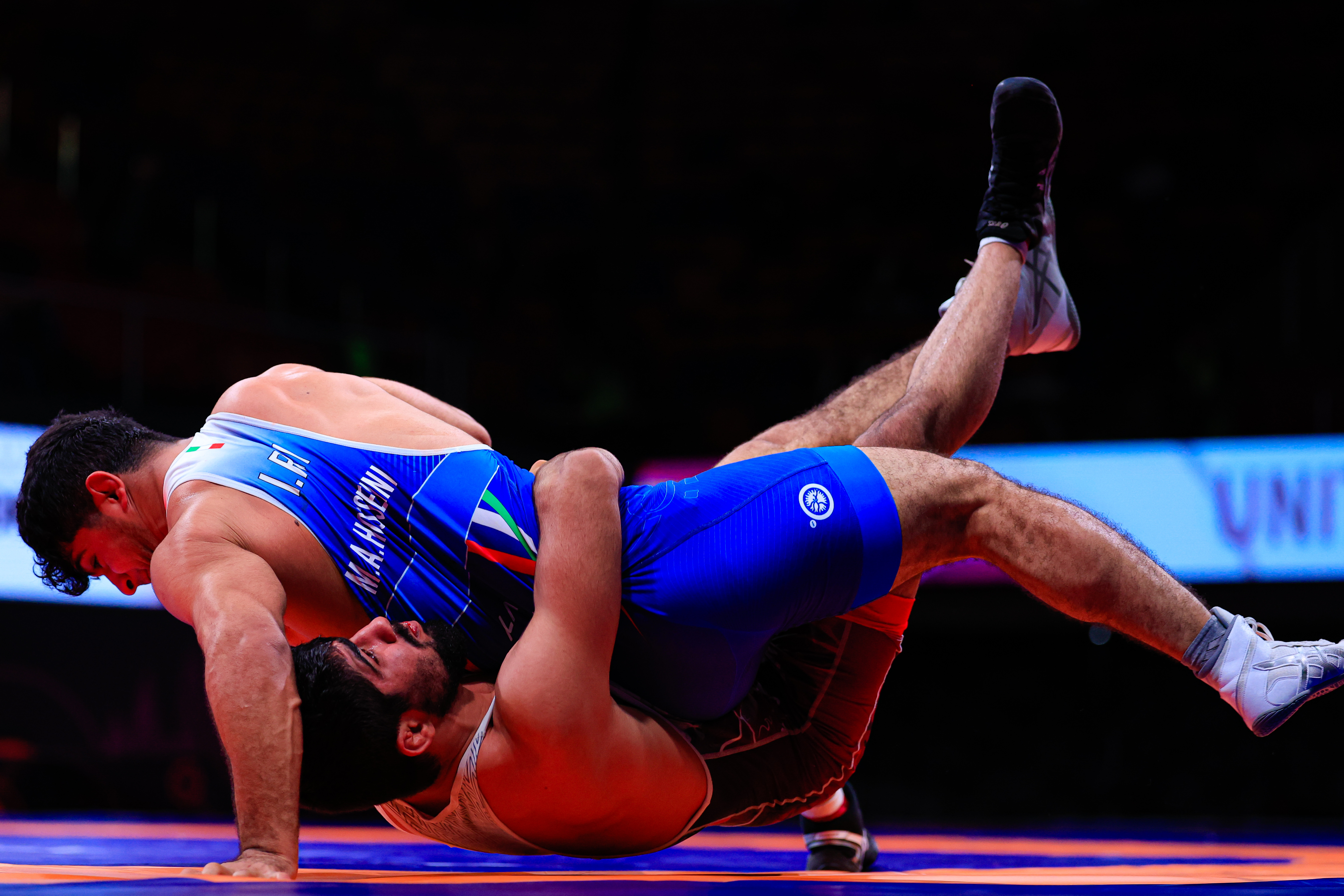
Iranian-born Badaghimofrad gave Qatar its first-ever gold medal at the Asian Championships, coming from behind for a 4-3 victory over Amin HOSSEINI (IRI) in the Greco 82kg final on Wednesday in Bishkek, Kyrgyzstan.

“I won a bronze medal at last year's Asian Championships, and this year I'm very happy that I managed to take a bigger step and win a gold medal,” Badaghimofrad said.

On a night when five different countries struck gold to finish up the Greco competition, Alisher GANIEV (UZB) ended a recent run of runner-up finishes with a victory at 60kg, and world and Olympic champion Hadi SARAVI (IRI) won his third straight title and fourth overall at 97kg.

Razzak BEISHEKEEV (KGZ), who had settled for the silver medal the past two years, made it to the top step of the podium at 67kg to give the host nation its fourth gold, and Almatbek AMANBEK (KAZ) handed Iran another defeat in a final to take the 72kg crown.

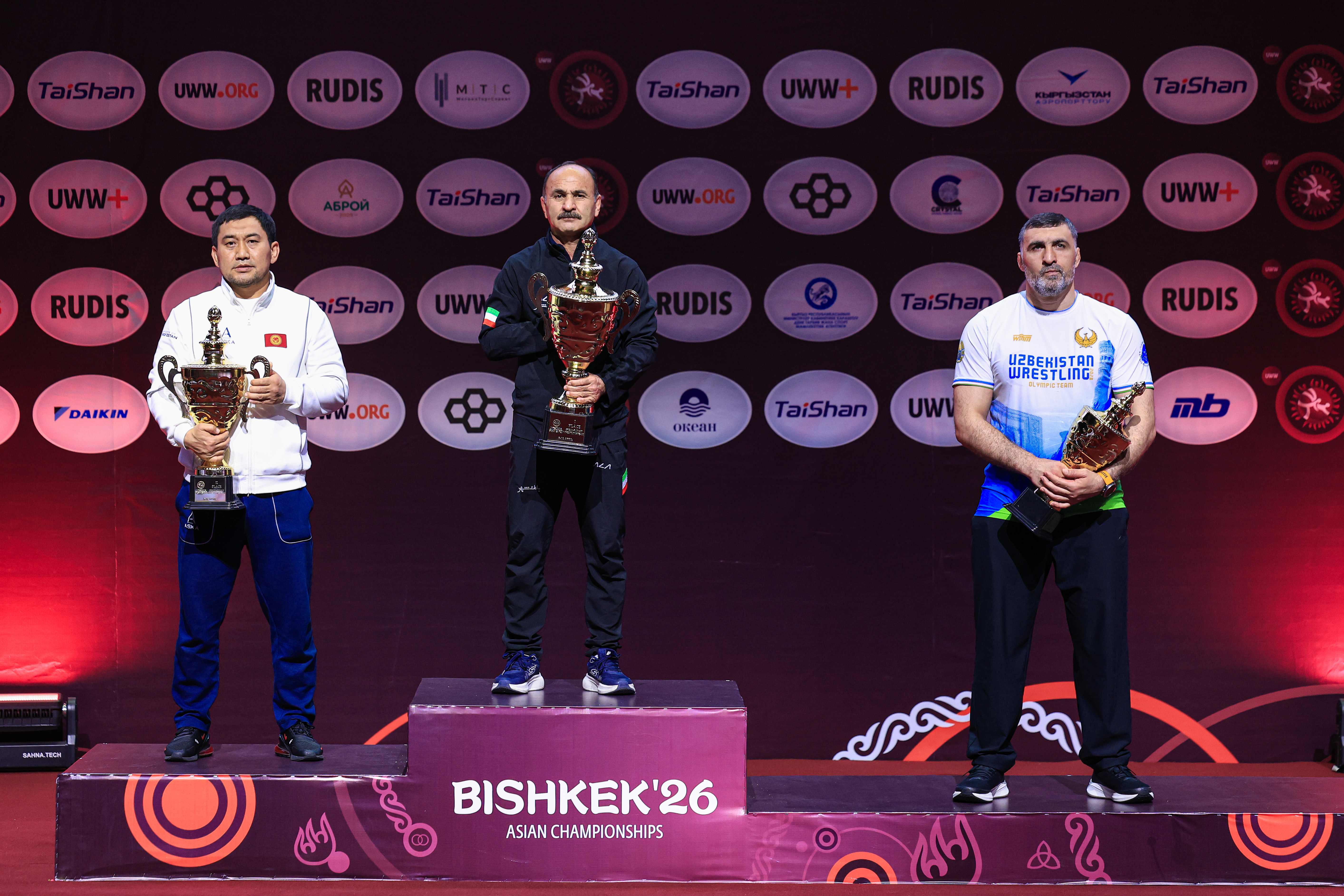
Despite going two for seven in gold-medal matches, Iran cruised to the team title by medaling in every weight class for the first time since 1983. The wrestling powerhouse finished with 195 points to outdistance host Kyrgyzstan, which had four champions and compiled 153 points. Uzbekistan, with two gold medalists, was third with 136.

Shahin BADAGHIMOFRAD (QAT)Shahin BADAGHIMOFRAD (QAT) turns Amin HOSSEINI (IRI) during the 82kg final at the Asian Championships. (Photo: United World Wrestling / Kostadin Andonov)
Badaghimofrad, who had been a world cadet (U17) silver medalist and world junior (U20) bronze medalist, was competing for Iran when he first appeared at the Asian Championships three years and 15 kilograms ago, placing fifth in Ulaanbaatar, Mongolia.

A native of Khuzestan Province in southeast Iran, he changed his allegiance after 2023 and debuted for Qatar in February 2025 at the Tirana Ranking Series, where he could only manage a seventh-place finish. But a month later, he placed third at the Asian Championships in Amman, Jordan, marking Qatar’s first ever medal in Greco and just its second overall.

Badaghimofrad’s more recent results were not exactly awe-inspiring – an 11th place at the World Championships in Zagreb, then back-to-back seventh places at Ranking Series tournaments in February this year.

And the outlook did not appear much better in Wednesday’s final when Hosseini, the winner of this year’s Tirana Ranking Series tournament, opened the scoring with a gut wrench for a 3-0 lead in the first period.

In the second period, Badaghimofrad got his chance in par terre and, breaking down stiff resistance from Hosseini, managed to roll him over. An Iranian challenge for a potential leg foul was unsuccessful, putting the Qatari up 4-3, which is how it ended.

“I had wrestled my opponent before, so we were both familiar with each other’s styles,” Badaghimofrad said. “Knowing I could apply my move on the ground, I approached the match without any stress. When the referee gave the passivity warning, I was able to execute my move and emerge as the winner.”

Badaghimofrad knows he still has a way to go if he wants to achieve similar success on the bigger global stages.

“My wrestling isn’t perfect yet, and I’m gradually trying to improve it … so I can get thebest result at the World Championships and the Olympics,” he said.

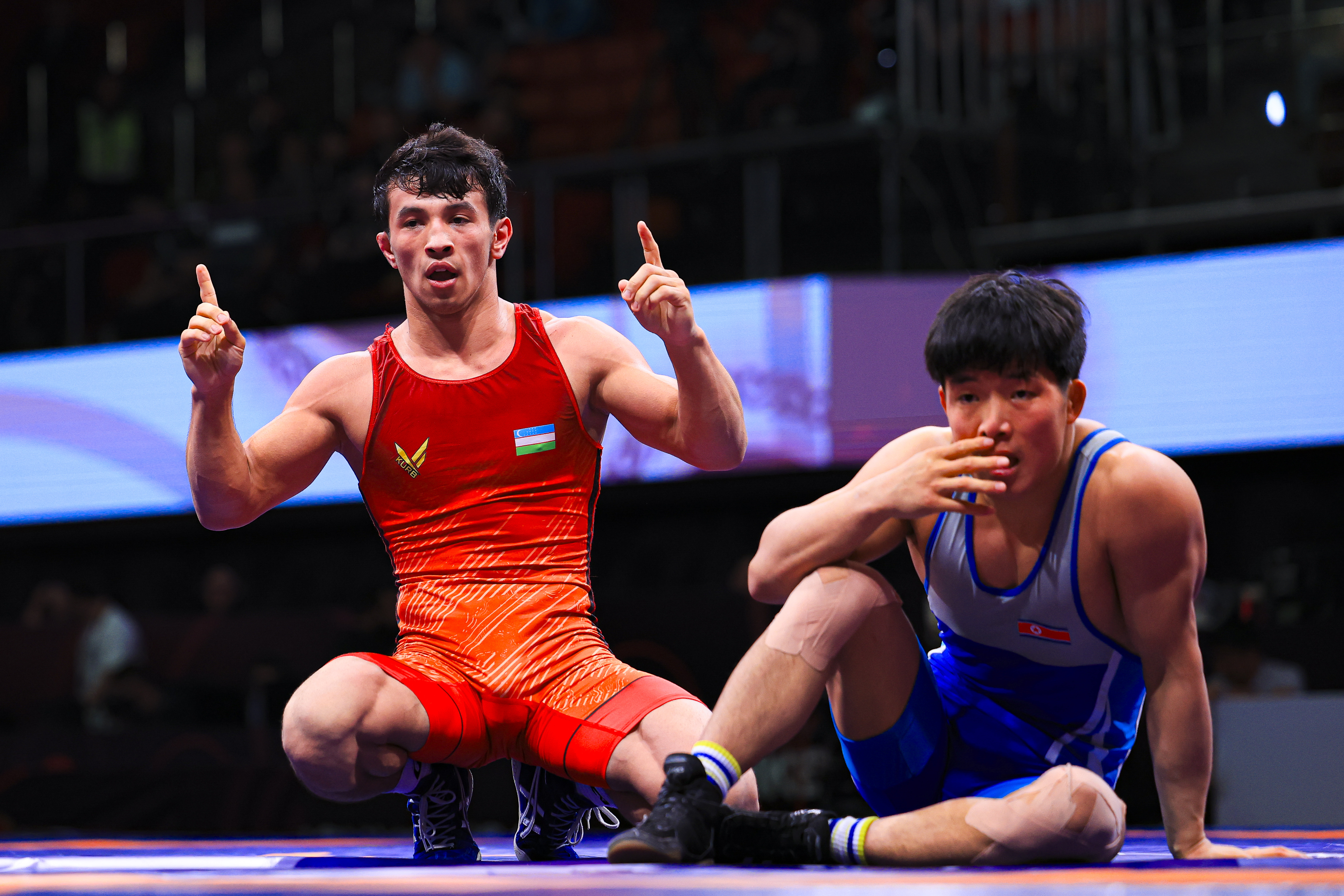
Alisher GANIEV (UZB)Alisher GANIEV (UZB) defeated Se Ung RI (PRK) in the 60kg final to claim his first-ever Asian title. (Photo: United World Wrestling / Kadir Caliskan)
Ganiev finally got the result he was looking for, escaping from second-place purgatory by avenging a loss in last year’s 60kg final with a victory by fall over world and Olympic bronze medalist Se Ung RI (PRK).

Ganiev went up 2-1 when he stepped over and gained an exposure on Ri’s gut-wrench attempt from par terre. In the second period, he increased the lead with a passivity point and a challenge point, but made the score moot when he pancaked Ri to the mat and held on for a fall at 5:06.

“The plan was not to rush, to wrestle patiently, wait for the right moment in par terre,” Ganiev said. “However, during the match, things changed. I managed to score points [from bottom] in par terre. In the second period, I continued with my approach. We prepared specifically for this opponent.”

Ganiev finished second at the Zagreb Ranking Series in February 2025, and again at this year’s. In between, he lost in last year’s Asian final to Ri and in the final of the World Championships to Aidos SULTANGALI (KAZ).

“I had been waiting for a long time,” Ganiev said. “This is my second Asian Championship. In the first one, I finished in second place. Now in 2026 I finally took first place. Today, all the hard work paid off. In the 2025 final, I made mistakes, but this time I corrected them.”

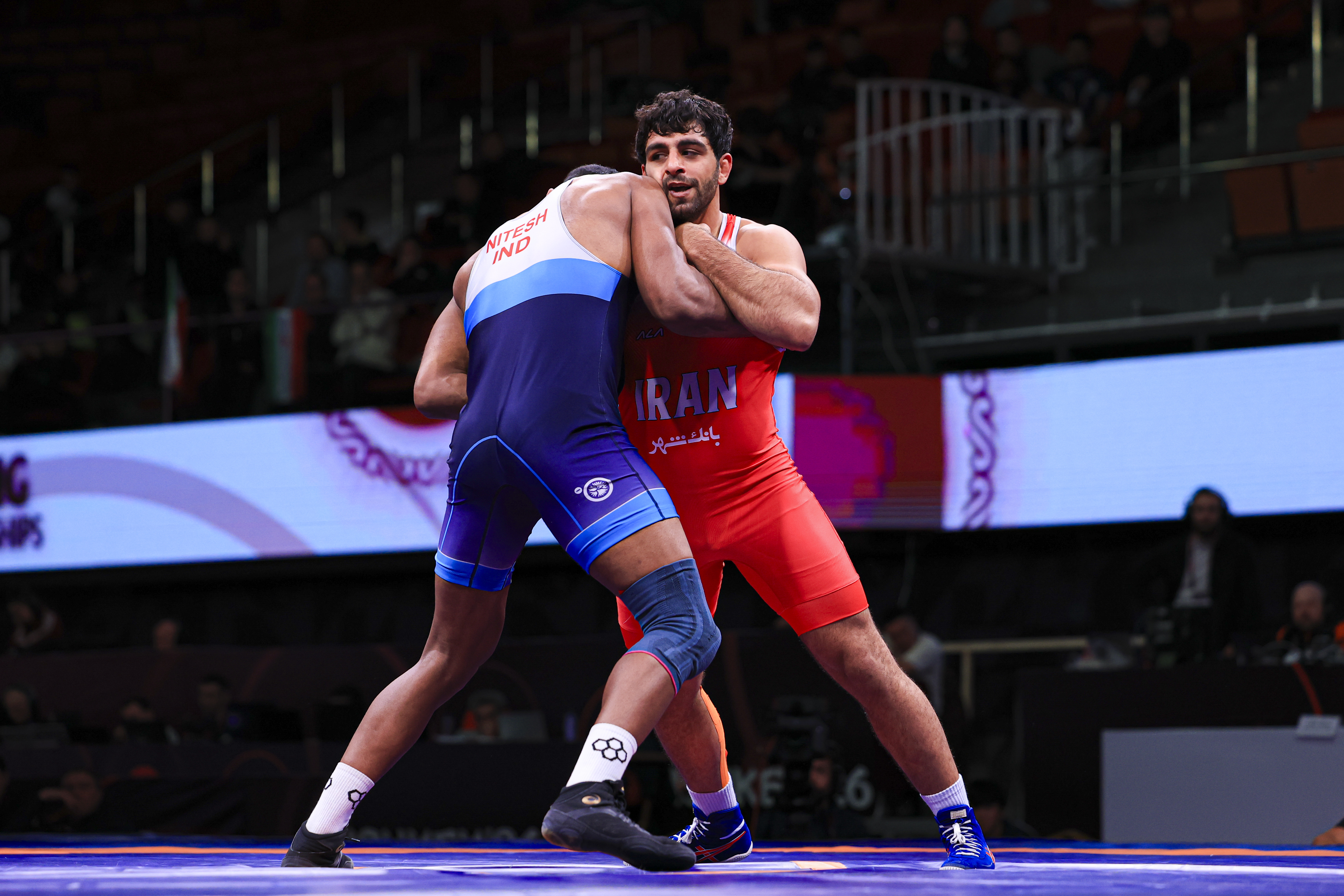
Hadi SARAVI (IRI)Hadi SARAVI (IRI) defended his Asian title with a 7-1 win over NITESH (IND). (Photo: United World Wrestling / Kadir Caliskan)
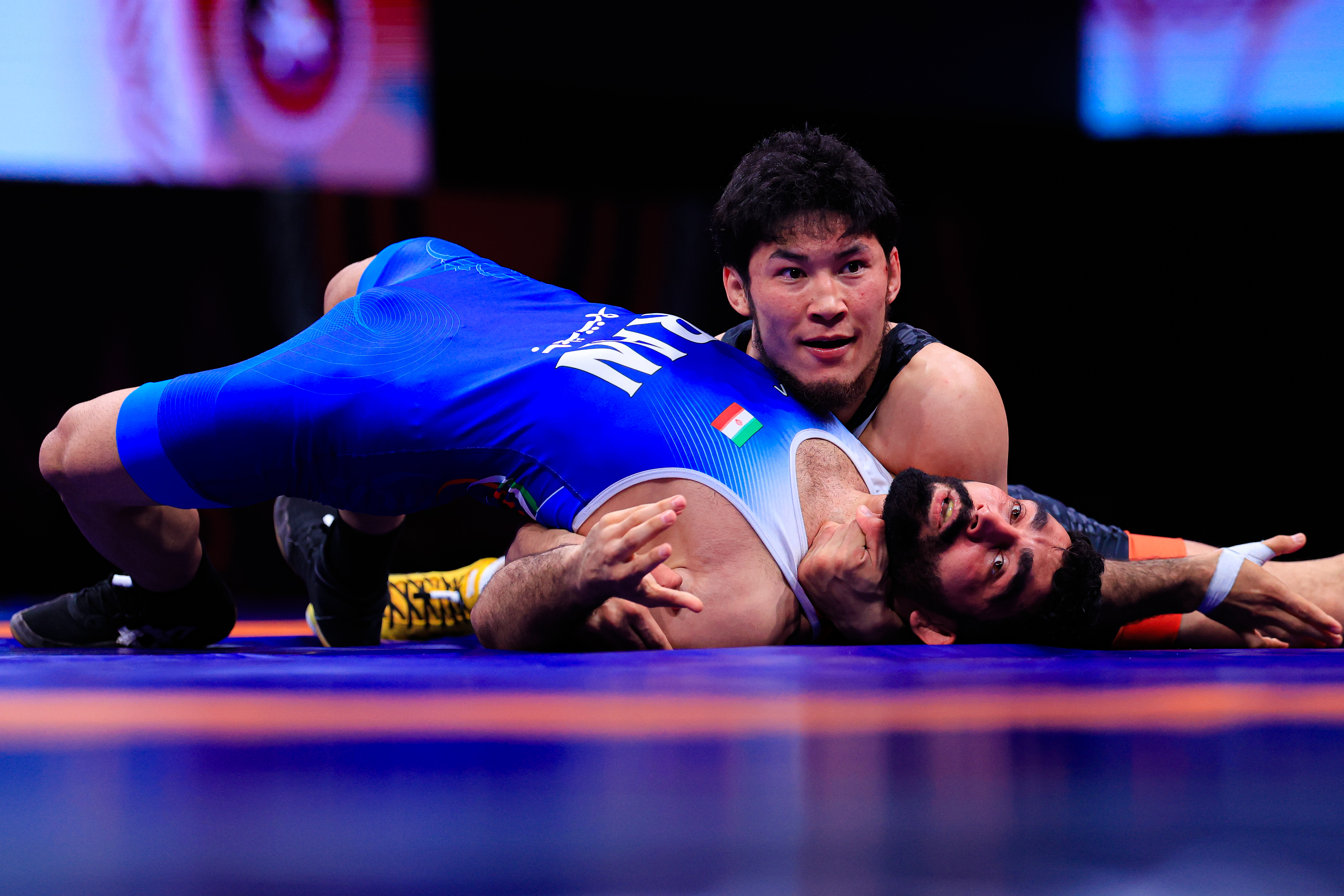
While a number of Saravi’s teammates faltered at the final hurdle, the two-time Olympic medalist proved to be a rock of stability in claiming the 97kg gold with a solid albeit not overwhelming 7-1 win over NITESH (IND).

“I managed to finish the competition with the gold medal,” Saravi said. “After the World Championships, I set aside some time for recovery to get my body back in shape. The coaches decided to send me to the Asian Championships. I arrived at this competition with only a relative level of readiness, but thankfully I managed to achieve the best result and claim gold.”

Saravi, whose long list of laurels also includes four world medals, reeled off two rolls from par terre in the first period to lead 5-0. After being put on the bottom in the second but never budging, Saravi added a pair of stepouts to beat Nitesh for the third time in as many career meetings and clinch his fourth Asian gold over a seven-year span.

“The final was tougher [than the previous matches] because I’d suffered a knee injury before arriving, which was bothering me a bit and meant I couldn't keep up with my training properly or come to the competition fully prepared,” Saravi said. “Because of that I was a bit unsettled.”

Almatbek AMANBEK (KAZ)Almatbek AMANBEK (KAZ) tries to pin Javad REZAEI (IRI) during the 72kg final. (Photo: United World Wrestling / Kostadin Andonov)
At 72kg, Amanbek capped his senior Asian debut with a stunning victory by fall over Javad REZAEI (IRI), which more than avenged a 3-2 loss to the Iranian in the quarterfinals of the Tirana Ranking Series that Rezaei won.

“It’s the first time I’ve taken first place in the 72-kilogram category,” said Amanbek, who moved up from 67kg this year. “It’s been an incredibly emotional day. 

“I’d give myself a ten out of ten. I did really well. Everything went exactly as I’d planned. I can give myself a pat on the back.”

The quick succession of moments that led to Amanbek’s victory started with him on the bottom of par terre. When Rezaei tried to force a gut wrench, Amanbek stepped over, scooped Rezaei’s head and held him down for a fall in 1:50.

“I know that Iranian wrestler, we faced each other at a ranking tournament in Albania,” Amanbek said. “I lost there. Today I got my revenge. I was in good spirits. We went out there and stuck to our tactics and our game plan. That’s why we won.”

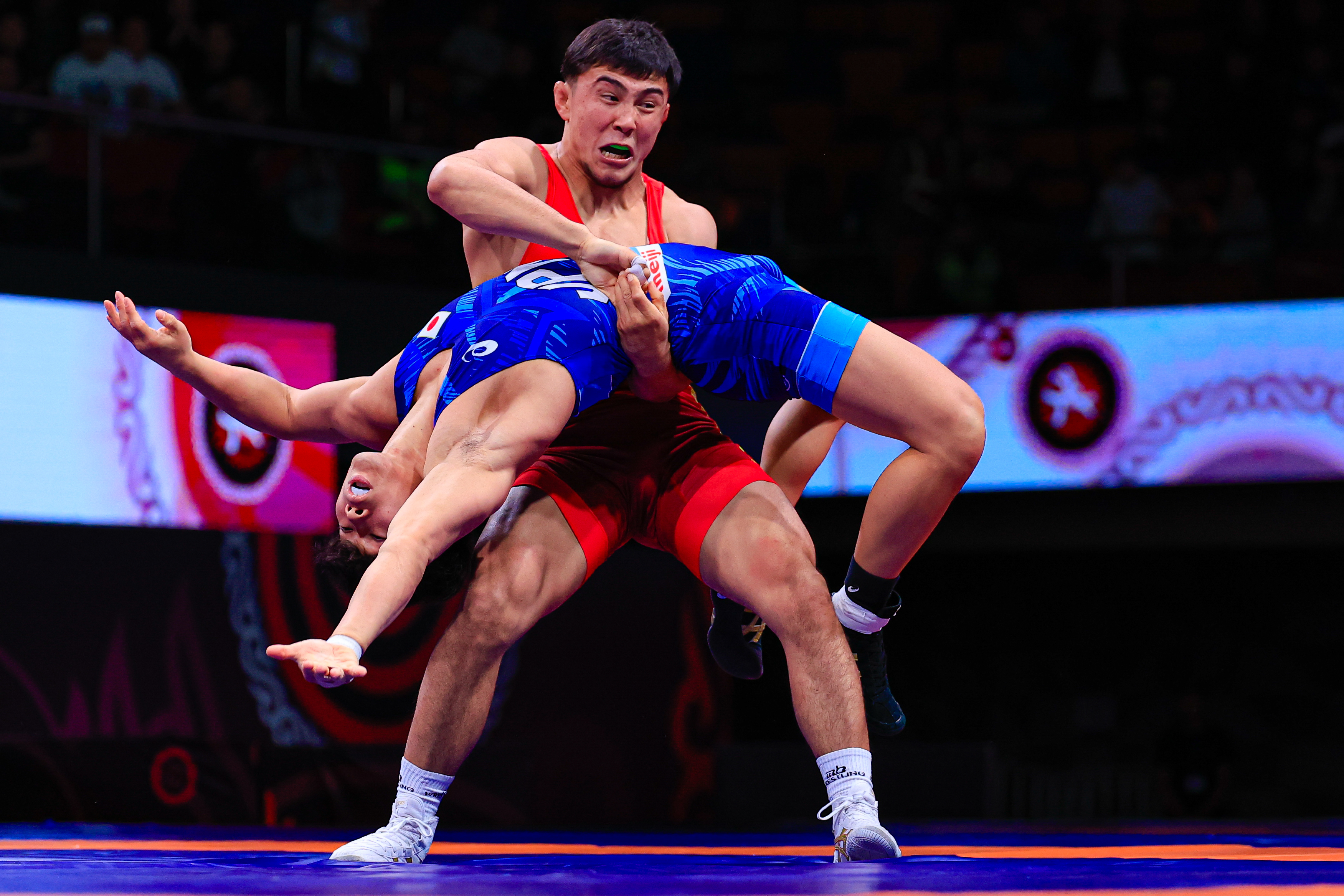
Razzak BEISHEKEEV (KGZ)Razzak BEISHEKEEV (KGZ) scores a four-point throw on Kensuke SHIMIZU (JPN) during the 67kg final. (Photo: United World Wrestling / Kostadin Andonov)
At 67kg, Beishekeev wrapped up a strong Greco outing for the home team by soundly defeating former world bronze medalist Kensuke SHIMIZU (JPN) 8-2.

“I can say that this victory means a lot to me,” Beishekeev said of triumphing in front of the home crowd at Zhastyk Arena. “I truly felt the strong support of my people, it gave me strength and motivation. Thanks to that, everything came together today and I became a champion.”

Beishekeev all but put the match away in the first period, when he not only completed a gut wrench from par terre, but added a 4-pointer by lifting Shimizu and dumping him onto this back.

In the second period, Beishekeev gave up a passivity point but nothing from the bottom of par terre, and received a point himself when the Japanese side unsuccessfully challenged for a leg foul. A late stepout by Shimizu only changed the margin of victory.

In the three previous Asian Championships, Beishekeev’s results had been: bronze, silver, silver.

“Behind this success is a lot of hard work,” he said. “I worked patiently, step by step, never forgetting my goal and constantly pushing forward. If we continue working with the same determination, I believe a gold medal at the World Championships is also possible. “

IranIran won the team title in Greco-Roman at the Asian Championships. (Photo: United World Wrestling / Amirreza Aliasgari)

Entire Iranian team comes away with medals

In the bronze-medal matches, Ali AHMADI VAFA (IRI) and Ahmadreza MOHSEN NEZHAD (IRI) both picked up their first major senior medals and assured that nobody on the Iranian Greco team would be leaving Bishkek empty-handed.

Ahmadi Vafa, who won world titles at each of the three age-group levels from 2022 to 2024, secured a bronze medal at 60kg with a 10-0 rout of Yerbol KAMALIYEV (KAZ).

After a 4-point throw from par terre, Ahmadi Vafa tossed Kamaliyev again, although he didn’t get the necessary exposure and it was ruled a 2-pointer. But the Iranian continued the move and forced Kamaliyev to his back for 2 more to end it at 1:49.

The other bronze at 60kg went to Yu SHIOTANI (JPN), who was back on the Asian scene for the first time since winning the 55kg gold in 2022, the same year he won a world bronze.

Shiotani hit a 4-point throw from par terre, good enough for a 5-1 win over two-time former Asian U23 champion Haodong TAN (CHN).

At 67kg, Mohsen Nezhad, a 2025 world U23 bronze medalist, gained his bronze without a fight, as he received a victory by default from world silver medalist Hanjae CHUNG (KOR), who had suffered an elbow injury in his quarterfinal loss to Beishekeev on Tuesday.

Sachin SAHRAWAT (IND) captured his second career 67kg bronze when he fought back from behind three times to eventually come away with a 6-5 win over Abdumalik AMINOV (UZB).

A drag-by takedown in the final 30 seconds finally put Sahrawat over the top, after he had trailed 1-0, 3-2 and 5-3 during the match.

At 72kg, Taishi NARIKUNI (JPN) saw his bid for a place in wrestling history harshly ended by Shakhzod KUCHKOROV (UZB), who needed less than a minute to uncork a pair of 4-point throws in a 9-0 romp.

Narikuni, the 2022 champion at Freestyle 70kg, was looking to join the select group of wrestlers with Asian medals in both styles – a group that compatriot Kaisei TANABE (JPN) joined the previous day by taking a bronze at 63kg.

Ironically, last December, Narikuni had pipped Tanabe in each’s bid to become the first wrestler in 52 years to complete the Freestyle-Greco double at the All-Japan Championships. Narikuni did it by also winning the Freestyle 70kg title, while Tanabe fell short by finishing third at 65kg.

Narikuni will be returning to the Bishkek mat on Friday for the Freestyle 70kg qualification rounds as he attempts to bounce back from his Greco disappointment. Narikuni also won the world gold in Freestyle in 2022, but his attempt to repeat that feat in Greco last year in Zagreb ended in the first round.

Dongyu LI (CHN) took the other bronze at 72kg on Wednesday with a somewhat odd victory by fall over Amantur ISMAILOV (KGZ).

After breaking out to a 5-0 lead with two rolls from par terre, Li secured double underhooks and pancaked Ismailov to his back for 4 points.

Having achieved a win by technical superiority, Li stood up and thrust his fists in the air in triumph, only to notice that Ismailov was still lying on his back. Li then hopped on top of his prone opponent for an easy fall in 2:40.

At 82kg, Kakabay KAKABAYEV (TKM) became the third wrestler from Turkmenistan to make it to a bronze-medal match in Greco and have a chance to become the country’s first medalist since 2018, and the third to come up short.

Kakabayev never really had a chance against PRINCE (IND), who reeled off four rolls in a row from par terre en route to a 10-1 victory. That gave Prince a senior Asian bronze a year after winning one on the U20 level.

The other 82kg match saw veteran and former Asian champion Ibragim MAGOMADOV (KAZ) earn his fourth straight Asian medal and second straight bronze with a 5-3 victory over Rui LIU (CHN).

Magomadov, the 2023 champion at 72kg and a bronze medalist last year at 77kg, hit a 4-point throw from par terre in the first period, then held on after giving up a 2-point penalty in the second.

At 97kg, Zagreb Ranking Series silver medalist Islam YEVLOYEV (KAZ), the 2024 world U20 champion at 82kg, never gave Minho LEE (KOR) a chance, spinning behind for a takedown then chalking up a combination of exposures and rolls for a 9-0 victory in 1:27.

Zegang WANG (CHN) was equally dominant in taking the other 97kg bronze with an 11-1 victory over Melis AITBEKOV (KGZ) in his Asian debut.

Photo

Day 3 Results

Greco-Roman

60kg (10 entries)
GOLD: Alisher GANIEV (UZB) df. Se Ung RI (PRK) by Fall, 5:06 (6-1)

BRONZE: Yu SHIOTANI (JPN) df. Haodong TAN (CHN), 5-1
BRONZE: Ali AHMADI VAFA (IRI) df. Yerbol KAMALIYEV (KAZ) by TS, 10-0, 1:49

67kg (11 entries)
GOLD: Razzak BEISHEKEEV (KGZ) df. Kensuke SHIMIZU (JPN), 8-2

BRONZE: Ahmadreza MOHSEN NEZHAD (IRI) df. Hanjae CHUNG (KOR) by Inj. Def.
BRONZE: Sachin SAHRAWAT (IND) df. Abdumalik AMINOV (UZB), 6-5

72kg (10 entries)
GOLD: Almatbek AMANBEK (KAZ) df. Javad REZAEI (IRI) by Fall, 1:50 (2-1)

BRONZE: Dongyu LI (CHN) df. Amantur ISMAILOV (KGZ) by Fall, 2:40 (9-0)
BRONZE: Shakhzod KUCHKOROV (UZB) df. Taishi NARIKUNI (JPN) by TS, 9-0, :48

82kg (10 entries)
GOLD: Shahin BADAGHIMOFRAD (QAT) df. Amin HOSSEINI (IRI), 4-3

BRONZE: Ibragim MAGOMADOV (KAZ) df. Rui LIU (CHN), 5-3
BRONZE: PRINCE (IND) df. Kakabay KAKABAYEV (TKM) by TS, 10-1, 2:06

97kg (11 entries)
GOLD: Hadi SARAVI (IRI) df. NITESH (IND), 7-1

BRONZE: Islam YEVLOYEV (KAZ) df. Minho LEE (KOR) by TS, 9-0, 1:27
BRONZE: Zegang WANG (CHN) df. Melis AITBEKOV (KGZ) by TS, 11-1, 4:11

Women’s Wrestling

50kg (11 entries)
SF 1: Son Hyang KIM (PRK) df. Aktenge KEUNIMJAEVA (UZB), 12-8
SF 2: Yui SUSAKI (JPN) df. Maral TANGIRBERGENOVA (KAZ) by TS, 8-0, 2:00

55kg (8 entries)
SF 1: Sowaka UCHIDA (JPN) df. Ariunzaya ODONCHIMEG (MGL) by TS, 10-0, 1:33
SF 2: Yuxuan LI (CHN) df. Hansika LAMBA (IND) by TS, 11-1, 5:54

59kg (8 entries)
SF 1: Mengyu XIE (CHN) df. NEHA (IND), 12-5
SF 2: Sena NAGAMOTO (JPN) df. Ulmeken ESENBAEVA (UZB) by TS, 10-0, 4:00

68kg (10 entries)
SF 1: Meerim ZHUMANAZAROVA (KGZ) df. Zelu LI (CHN), 1-1
SF 2: Miwa MORIKAWA (JPN) df. Delgermaa ENKHSAIKHAN (MGL), 7-0

76kg (9 entries)
SF 1: Aiperi MEDET KYZY (KGZ) df. Hui Tsz CHANG (TPE) by TS, 11-0, 1:03
SF 2: Davaanasan ENKH AMAR (MGL) df. Gulmaral YERKEBAYEVA (KAZ), 7-2