

Fumita returns to book ticket to Belgrade; Sakurai, Ishii make it
Saturday, July 1, 2023 - 16:39 By Ken Marantz

TACHIKAWA, Japan (July 1) -- Tokyo Olympic silver medalist Kenichiro FUMITA managed to defy the doctor and recover enough to make it onto the mat for the world team playoff. Having come this far, neither Maito KAWANA nor a nasty gash over his eye was going to stop him.
Fumita defeated Kawana 3-1 to secure the Greco-Roman 60kg spot on Japan's team to this year's World Championships as the seven final places in Olympic weight classes were decided on Saturday in Tachikawa in western Tokyo.
"Among competitions in which I wasn't in perfect condition, I came into this tournament in the lowest I have been, and could not move as I wanted," said Fumita, who was forced to withdraw from the Meiji Cup All-Japan Invitational Championships two weeks ago due to a torn right hamstring.
The Meiji Cup was the second of Japan's two domestic qualifiers for the World Championships, along with the Emperor's Cup All-Japan Championships held last December. Winners of both automatically earned places on the team to Belgrade; in cases where the champions were different, a playoff would decide matters.
Also earning tickets to Belgrade were women's world 57kg champion Tsugumi SAKURAI and Ikuei University teammate and world 68kg silver medalist Ami ISHII -- both with dramatic victories -- while world 76kg bronze medalist Yuka KAGAMI took a gamble and made it pay off to earn a return trip to the worlds.
 Kenichiro FUMITA works to turn Maito KAWANA in the Greco 60kg playoff. (Photo: Japan Wrestling Federation / Takeo YABUKI)
With his victory, Fumita will get a chance to regain the world title he won in 2017 and 2019 and improve on his bronze-medal finish from 2022. But more importantly, it gives him a chance to qualify for the 2024 Paris Olympics, where making amends for his Tokyo silver holds top priority.
The Japan Federation has decreed that any wrestler in an Olympic weight class who wins a medal at the World Championships will automatically fill the spot in Paris themselves.
"The biggest reason [for my win] is that I want to get back to the Olympics and win a gold medal," Fumita said.
Fumita had won the Emperor's Cup by beating Kawana in the final but was forced to miss the Meiji Cup when he tore a hamstring in practice in early May. Kawana won the title in his absence to earn the place in the playoff.
Fumita said that the doctor who diagnosed his injury said it would take 12 weeks to heal. That ruled him out of the Meiji Cup, but he was determined to make it back in time for the playoff.
"At the Meiji Cup, I saw my Nittaidai teammates do so well," said Fumita, using the familiar name for his alma mater, Nippon Sports Science University, where he and other alums still train. "It was tough to watch. But I watched the Meiji Cup with a positive outlook. That really gave me motivation."
Fumita spent three weeks completely away from the mat after the injury and did what he could to prepare, including adding swimming to his training regimen. It worked somewhat, but he acknowledged he wasn't at his best.
"Up to now, I've never cramped during a match," he said. "But it happened now. Usually before a match, I jump in the air twice. But when I jumped today, I already started to feel I was cramping up. I was really surprised. In this condition, I wrestled at my limit."
In the match, Fumita was put into par terre first and, while not even attempting a big throw, managed to lever Kawana over for a 2-point roll. Early in the second period, a clash of heads left him with a bloody gash over his left eye that required his head to be wrapped. When put on the bottom, he resisted and held on for the victory.
"Still, I was able to fight to the end," Fumita said. "I took [the points] that I could get, and defended well to keep from giving up points. I think that was from what I learned while I was injured."
Among the small crowd at Dome Tachikawa Tachihi was the 27-year-old Fumita's wife and baby daughter Hazuki, who was born in January. "I only want my daughter to see me winning," he said with a smile.
 Tsugumi SAKURAI, red, has now beaten Sae NANJO in four of five career matches at women's 57kg, all victories in the final seconds. (Photo: Japan Wrestling Federation / Takeo YABUKI)
Sakurai deals Nanjo yet another last-second loss
For the fourth time in five meetings between the two, Sakurai left it until the final seconds in handing world U23 champion Sae NANJO a heartbreaking defeat.
Sakurai scored a 2-point exposure off a front headlock in the last second -- and which was only awarded after a challenge -- to edge Nanjo 2-2 on last-point criteria and earn a shot a defending her 57kg world title.
"The match was tough and I couldn't control the flow," Sakurai said. "At the end, I was fighting on sheer will and was able to get the points and win."
In the Meiji Cup final, Sakurai was awarded a takedown with less than a second left on the clock, which was upheld on a challenge, to defeat Nanjo 5-2 and avenge a loss in the Emperor's Cup semifinals.
On Saturday, Nanjo came out strong and scored a shrug-by single-leg takedown in the first period. It looked like that would be enough as she continually fended off Sakurai's attacks well into the second period.
But Sakurai managed to pull a rabbit out of the hat yet again. Gaining a front headlock with seven seconds left, her first attempt at a roll went nowhere. But she tried again with all of her might, and it just got Nanjo's shoulders to break the 90-degree plane, although the referees did not see it that way.
Sakurai's look of despondency suddenly turned to joy when the mat chairman announced that she had indeed earned the points.
"Honestly speaking, I wasn't sure if I turned her or not," said Sakurai. "I had to go for it and just tried the move. Seeing the video, it looked like I got her over."
At the Emperor's Cup, Nanjo had finally gotten the best of Sakurai by taking a five-point lead and holding on for a 5-4 win in the semifinals. That was after Sakurai had scored last-second victories in their two previous meetings, at the 2021 Emperor’s Cup and at last year's Meiji Cup.
"I've been in this situation before and I was able to win, so I wasn't anxious," Sakurai said. "I've faced this opponent a number of times and I've gotten single-leg takedowns, but she was on the lookout for that. There was a moment in there I thought I was going to lose, but my desire to go to the Paris Olympics made me fight to the end."
On the path to Belgrade, Sakurai also defeated Tokyo Olympic champion Risako KINJO in the semifinals of the Meiji Cup.
"Japan has incredible depth and to win out gives me confidence," Sakurai said. "I want to be the one who takes the Olympic gold next and I'll do what I have to do to get there."
 Ami ISHII looks for an opening the women's 68kg playoff against Miwa MORIKAWA. (Photo: Japan Wrestling Federation / Takeo YABUKI)
Ishii assured she will join teammate Sakurai on the plane to Belgrade by holding on for a nail-biting 2-1 win over world 65kg champion Miwa MORIKAWA, avenging a loss to her in the Meiji Cup semis.
Ishii scored a double-leg takedown in the first period and, after giving up an activity point in the second, fended off Morikawa's attacks for the victory.
"I worked to fix what went wrong at the Meiji Cup, but I also worked on strengthening my usual techniques," Ishii said.
 Yuka KAGAMI keeps hold of Ayano MORO's leg during a key point in their women's 76kg bout. (Photo: Japan Wrestling Federation / Takeo YABUKI)
At 76kg, Kagami followed up on her Meiji Cup victory over world U20 champion Ayano MORO by scoring a takedown with 50 seconds left to win 2-2 in a bout that hinged on a risky challenge by the Kagami side.
The 18-year-old Moro had opened the match with a single-leg takedown, then scrambled out of several scoring chances by Kagami. In the second period, Kagami got in deep on a single, but Moro worked around to the back into a grapevine-like situation and was given a 2-point takedown.
Kagami, however, had never lost her grip on Moro's leg, and Toyo University coach Shogo MAEDA decided to challenge the call, even though a rejection would put her into a deeper five-point hole.
The referees' call was overturned, and Moro's two-point lead restored, opening the door for Kagami to win with just one score.
"I myself thought she didn't get it," said Kagami, who had shoulder surgery in January after defaulting at the Emperor's Cup. "If I challenged it, it could make it 5-0 and make it tougher for me. I thought for a moment about rejecting it, but I looked at my coach and he said it was alright. I left it up to my coach."
Maeda acknowledged that the challenge was risky, but concluded it was worth it because in essence being down five points is not much different than being down by four.
"The opponent was being very cautious of tackles," Maeda said. "If [we didn't challenge and] it became four points, it would have been difficult. But if we got it, it would just be a difference of one takedown. To have a chance, we needed it to be 2-0. I understood the risk."
The three other playoffs were in Greco-Roman, with 2022 world U23 bronze medalists Kyotaro SOGABE (67kg) and Nao KUSAKA (77kg) prevailing, along with 2018 Asian silver medalist Masato SUMI (87kg).
The playoffs in the non-Olympic weight classes will be held on July 17.
All wrestlers who finished in the top two in an Olympic weight at either the Emperor's Cup or Meiji Cup are eligible to make a challenge in a non-Olympic weight. Among notable wrestlers who are eligible, but as yet undecided, are Kinjo and Morikawa.

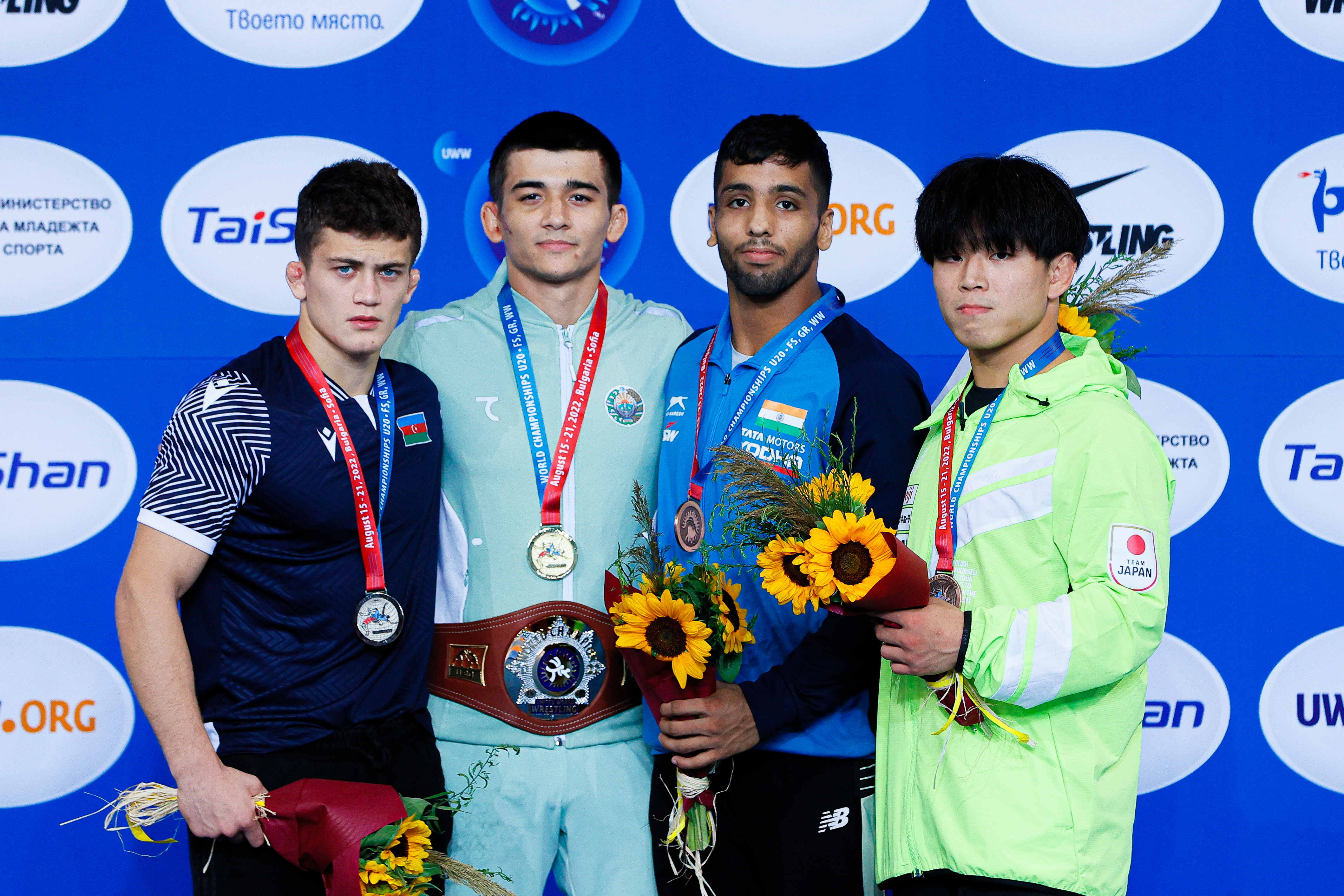 SUJEET (IND), third from left, won a bronze medal at the 2022 U20 World Championships in Sofia. (Photo: United World Wrestling / Kostadin Andonov)
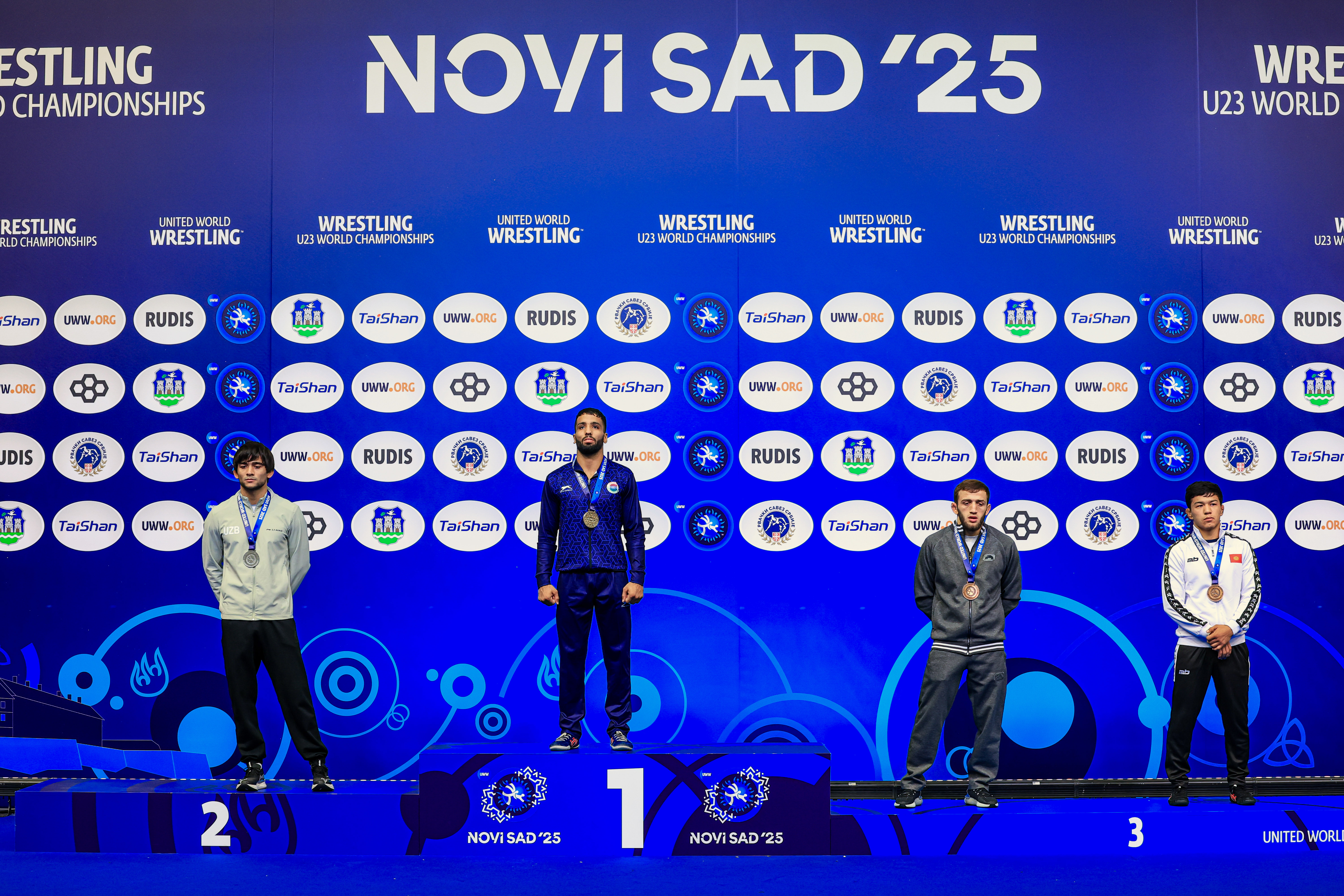 SUJEET (IND), second from left, as the U23 world champion in 2025. (Photo: United World Wrestling / Amirreza Aliasgari)
Share your thoughts.
Comments