

Incoming OSU prospect Sakamoto wins 1st All-Japan title
Sunday, December 22, 2024 - 14:13 By Ken Marantz

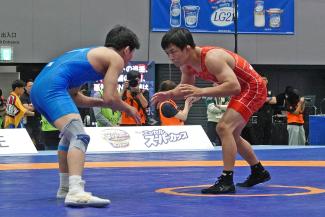
Rin SAKAMOTO works to turn Daito KATSUME after scoring the lone takedown of the freestyle 57kg final. (Photo: Takeo YABUKI / JWF)
TOKYO (December 22) -- Aside from occasional moves that are ineffective in freestyle, Rin SAKAMOTO was able to make enough of a transition back from American folkstyle to capture his first senior national title in his homeland.
Sakamoto, who has taken the rare path among Japanese wrestlers of heading overseas for college, defeated Daito KATSUME 4-0 in the freestyle 57kg final at the Emperor's Cup All-Japan Championships on Sunday in Tokyo.
"I've been practicing in America up to now and only doing folkstyle," Sakamoto said. "It was tough adjusting back to freestyle. I couldn't do my wrestling, so I'm not very satisfied."
The final day of the four-day tournament, which is serving as the first of two domestic qualifiers for next year's World Championships, also saw world 55kg champion Moe KIYOOKA make an early move down to the Olympic weight of 53kg, where she picked up a third straight title.
 Rin SAKAMOTO became the first U.S.-based wrestler to win an All-Japan title since 1995 with a victory at freestyle 57kg. (Photo: Takeo YABUKI / JWF)
The 19-year-old Sakamoto, a two-time Inter-High champion at Tokyo's Jiyugaoka Gakuen High School, has been training for the past fourth months at U.S. powerhouse Oklahoma State University, where next month he will officially enroll and be eligible to compete in matches for the Cowboys, who are now coached by former Olympic champion David Taylor.
Sakamoto is hoping to follow in the footsteps of legendary two-time Olympic champion Yojiro UETAKE, who won three NCAA titles from 1964-66 at Oklahoma State. More recently, Sanshiro ABE won an NCAA title at Penn State in 1996, and was the last U.S.-based wrestler to win the All-Japan, in 1995.
"I think it fits my style of wrestling," Sakamoto said of American folkstyle, which puts more emphasis on control, particularly in its version of par terre or when exposing the opponent's back. "I've always liked the American style. If I make the adjustment, either style is alright for me."
The first sign of difference between the two styles came when Sakamoto stepped onto the mat wearing a headgear, an extremely rare sight in Japan. He explained that at OSU, "we have to wear a headgear all of the time, even in practice. So it's not to get me used to wearing one, but because I'm already used to it."
In his opening match, which he went on to win 15-6, he had been taken down and, instead of just lying flat and resisting being turned, he got up to his knees and grabbed the opponent's wrist -- in folkstyle, the wrestler on bottom must try to escape or reverse.
The referee on Sunday was having none of it, commanding he release the wrist. "I kept getting warned," he said. "I have to work harder to make the change."
He also twice used a counter lift in defending a takedown that put him to his own back, which gave his opponent 2 points before getting 2 for himself. In folkstyle, there would have been no points for his own exposure.
But takedowns and sprawling are pretty much universal, and his cat-like reflexes and natural speed carried him into the semifinals, where he forged out a 10-4 win over two-time Asian bronze medalist Rikuto ARAI.
The final against Katsume, who was hampered by a left knee injury that had him hobbling onto and off the mat, lacked the flamboyance of the first two matches, with Sakamoto limited to an activity point and a stepout in the first period, and a defensive takedown in the second.
"I left too much in the tank and did not dictate the match," Sakamoto lamented. "It became a really boring match."
The two were already acquainted, having split two matches while in high school. Katsume, now a sophomore at Yamanashi Gakuin University, beat Sakamoto 8-0 in the semifinals of the 2021 Inter-High championship, but a year later, Sakamoto gained revenge with a 6-2 victory in the final.
Sakamoto said he will return to the U.S. on January 11, two days before the new OSU semester starts in Stillwater, Oklahoma. From then, it will be full-time folkstyle in a wrestling room where he will face stiff competition to make the lineup at 125 pounds (56.7 kilograms).
"There are quite a few in the lighter weights, and I feel like I'm having to catch up in folkstyle," Sakamoto said. "I'm aiming for [the] Los Angeles [Olympics], but for the next two years, I'll focus on freestyle. One goal is to become a NCAA champion."
Sakamoto will, however, return to Japan in the spring for the Meiji Cup All-Japan Championships, the second of the two qualifiers for the World Championships. To help him make the adjustment back to freestyle, he will likely enter the JOC Junior Olympic Cup in April, an U20 tournament in which he placed third this year.
Sakamoto is not the only member of his family with an adventurous streak. Older sister Yu, the world U23 champion at 53kg, is currently a member of the Northern Michigan University team.
 Moe KIYOOKA defends against a takedown attempt in the women's 53kg final against Saki YUMIYA. (Photo: Takeo YABUKI / JWF)
Kiyooka gets early start in filling 53kg hole
Four years out from the Los Angeles Olympics, Japanese star and Paris Olympic champion Akari FUJINAMI made a not-so-unexpected announcement that she was moving up to 57kg, starting a scramble to fill the hole at 53kg that she left behind.
Perhaps no one was more affected by the news than Kiyooka, who took no time in staking her claim when she rolled to a 9-0 victory in the 53kg final over Saki YUMIYA on Sunday.
Kiyooka, the younger sister of Paris freestyle 65kg gold medalist Kotaro KIYOOKA, had won the All-Japan title at 55kg the past two years, and mulled over whether it was too early to begin the quest to make Los Angeles at 53kg.
"I considered entering at 55kg right up to the last moment," Kiyooka said. "But consulting with my coach, we decided that because I had won the gold at the World Championships at 55kg, I needed to start thinking about things related to the next Olympics, like cutting weight. It's important to become accustomed to doing that. So I set the goal of winning the title at 53kg here."
She knows she will have plenty of competition ahead, notwithstanding speculation that Tokyo Olympic gold medalist Yui SUSAKI might move up from 50kg to 53kg.
"Including the opponents here, there will be even more strong wrestlers," Kiyooka said. "I need to train to get better so I can be confident when I face them and come out on top."
Kiyooka never has to look far for motivation to seek Olympic glory. She was in Paris as a training partner for Ikuei University teammate Tsugumi SAKURAI, who went on to win the 57kg gold.
"I was glad I could help, but there was also the pain of not being in the Olympics," she said. "But seeing people so close to me succeed has shown me that it's not impossible, which has given me strong motivation."
One shortcoming of her wrestling that she addressed on Sunday was her tendency to be a slow starter. She came firing out in her opening match, winning 10-0.
"As I always say, I never move well in the first match," Kiyooka said. "To overcome that, I concentrated on the opening match. As the matches continued, I got used to it and the final was my most solid match of the day."
In the final, Kiyooka scored two takedowns in each period in outclassing Yumiya, a world U20 bronze medalist this year.
 Sara NATAMI became a three-time national champion by winning the women's 57kg title, her first at an Olympic weight. (Photo: Takeo YABUKI / JWF)
Natami catches up to younger sister with 57kg title
Sara NATAMI has quite a sibling rivalry going on, and Sunday she finally caught up to younger sister Ruka when it comes to competing in an Olympic weight class.
Natami, the 2023 world U23 champion, dominated Ichika ARAI 10-2 in the 57kg final to add to two previous All-Japan titles at 59kg.
"At the Meiji Cup [last June], my younger sister won this weight class," said Natami, who had to skip that tournament due to a knee injury. "I was determined to win the next one and that led to this win.
"I had never won [a national title] at an Olympic weight. My sister beat me to it, and that was frustrating. That was the feeling as I prepared for this."
Natami said the two, an alumni and current student at Shigakkan University, respectively, sometimes practice together, "but it ends up becoming a fight."
Natami's biggest win, however, came in the semifinals, when she stuck two-time reigning champion Sae NANJO for a fall that marked her first-ever victory over her fellow Shigakkan alum and avenged a loss in the same round last year.
"We've faced each other since elementary school and I had never beaten her," Natami said. "Beating Sae was among my goals."
Last year, Natami was leading 5-0 when Nanjo, a two-time world U23 champion, suddenly turned the tide and scored a fall in the final minute.
 Kaito INABA celebrates after successfully defending his Greco 60kg title. (Photo: Takeo YABUKI / JWF)
In the other final of the day, Asian silver medalist Kaito INABA successfully defended his Greco 60kg title, scoring a victory by fall with the first scoring move of the final against Yu SHIOTANI.
Shiotani, a world 55kg bronze medalist in 2022, attempted a spinning arm throw that ended with him on his back and Inaba's arm wrapped around his throat. The mat referee was not in a position to see what might be construed as a choke hold and called the fall at 1:24.
Day 4 Results
Freestyle
57kg (24 entries)
GOLD -- Rin SAKAMOTO df. Daito KATSUME, 4-0
BRONZE -- Rikuto ARAI df. Isami TAKATA by TF, 10-0, 1:47
BRONZE -- Kento YUMIYA df. Taketo NINOMIYA, 9-7
Greco-Roman
60kg (14 entries)
GOLD -- Kaito INABA df. Yu SHIOTANI by Fall, 1:24 (3-0)
BRONZE -- Koto GOMI df. Kosei TAKESHITA by TF, 11-1, 4:02
BRONZE -- Keijiro SONE df. Yasuhito MORI, 5-3
Women's Wrestling
53kg (9 entries)
GOLD -- Moe KIYOOKA df. Saki YUMIYA, 9-0
BRONZE -- Haruna MORIKAWA df. Miwa MAGARA, 3-1
BRONZE -- Narumi NAKAMURA df. Mihoko TAKEUCHI, 7-5
57kg (9 entries)
GOLD -- Sara NATAMI df. Ichika ARAI, 10-2
BRONZE -- Ibuki TAMURA df. Iroha FUJIYAMA by Inj. Def., :01
BRONZE -- Sae NANJO df. Miuna KIMURA by Fall, 5:50 (7-4)
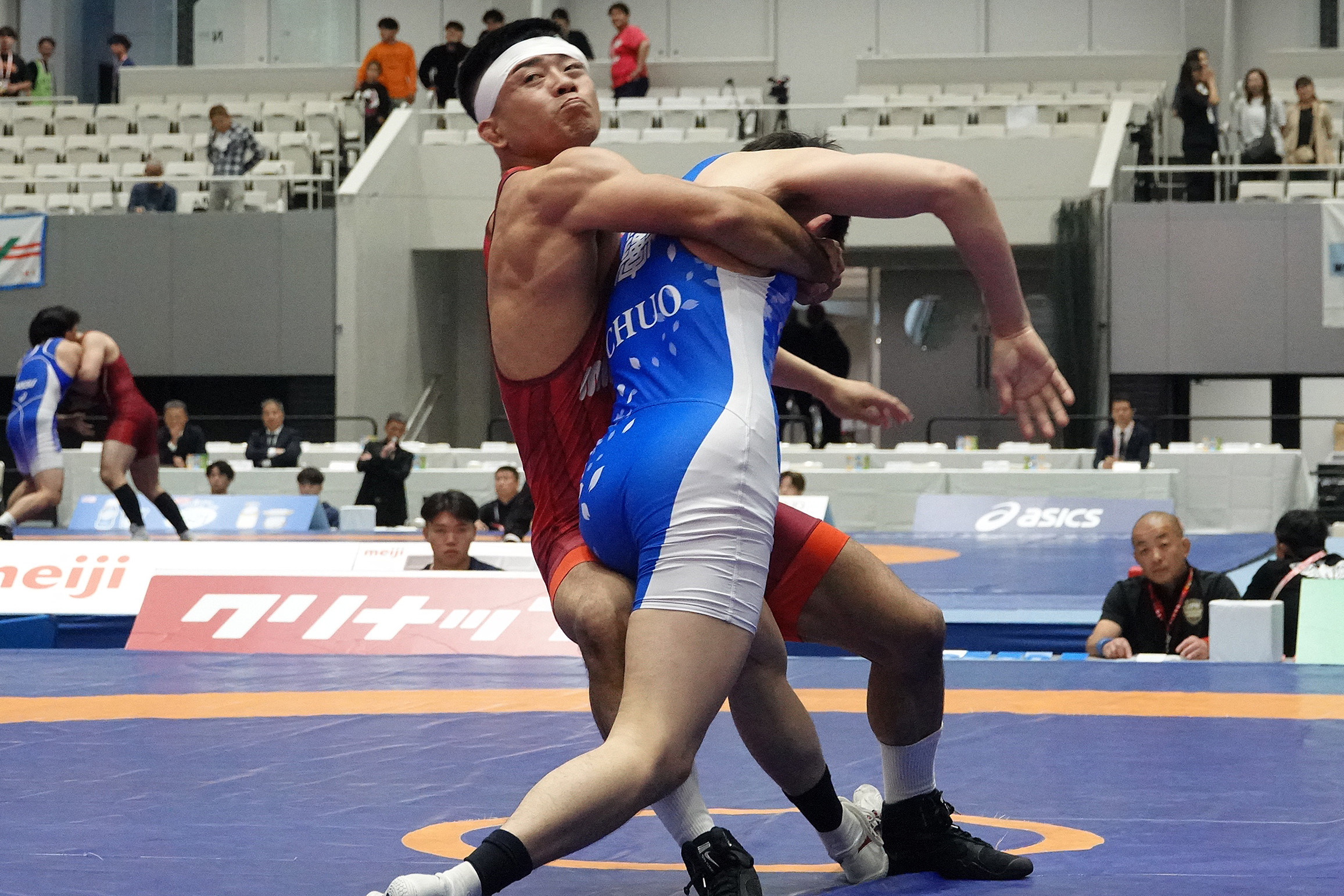 Kenichiro FUMITA (JPN) hits a four-point throw in his round one bout. (Photo: wrestling-spirits.jp / Ikuo Higuchi)
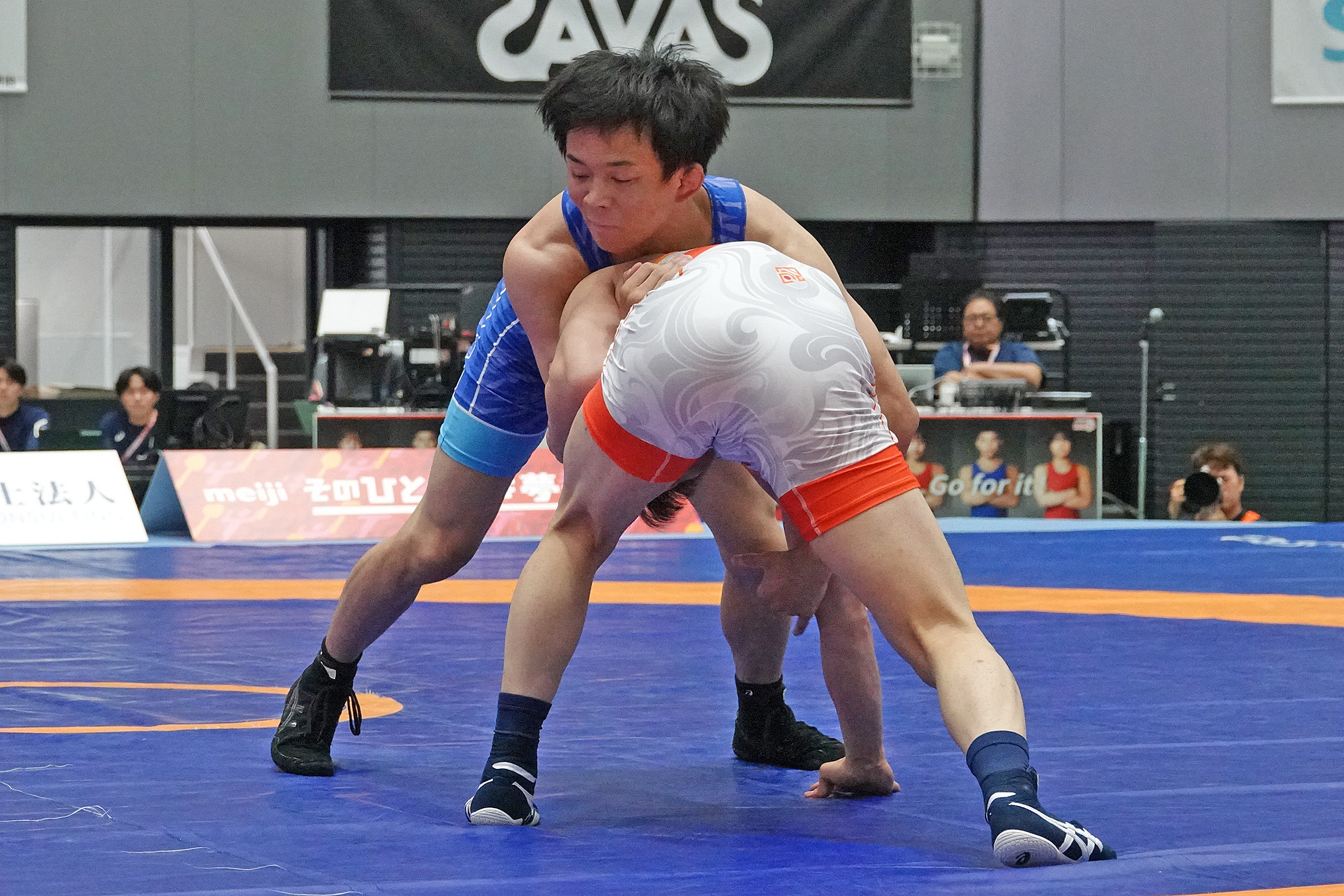 Rei HIGUCHI (JPN) reached the 61kg final at the Meiji Cup. (Photo: wrestling-spirits.jp / Ikuo Higuchi)
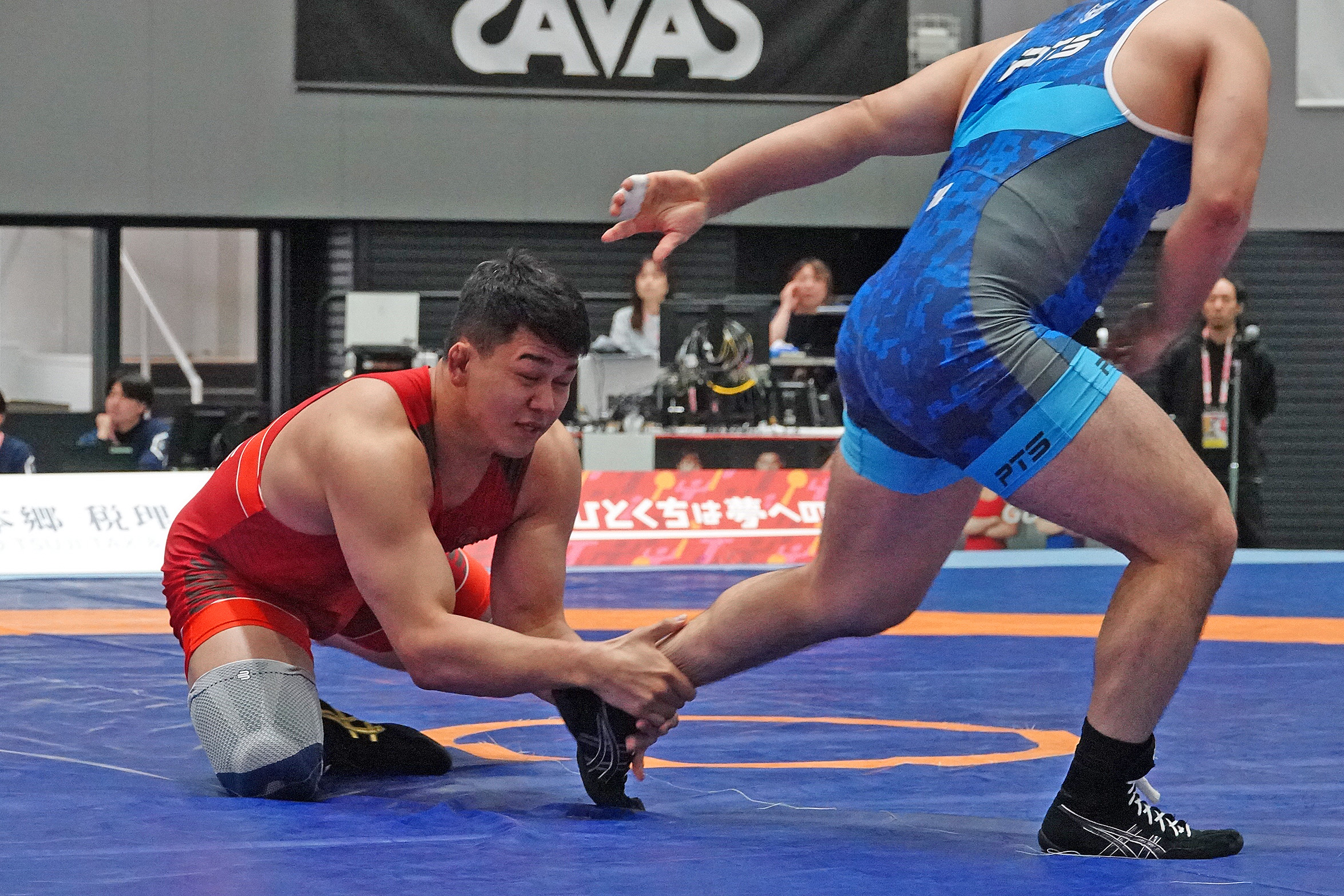 Asian champion Arash YOSHIDA (JPN) returned to the final of Meiji Cup at 97kg. (Photo: wrestling-spirits.jp / Ikuo Higuchi)
Share your thoughts.
Comments