

Japan's Irie Aims for Golden Birthday Bonus in Senior World Debut
Monday, September 9, 2019 - 14:28 By Ken Marantz

TOKYO---When Yuki IRIE, the only wrestler on the planet to have ever defeated two-time world champion Yui SUSAKI, beat her for the third time in her career two months ago, it was far more than just a win over a formidable opponent.
It finally meant that Irie had the mental toughness to win when it counted most. That she had overcome the hardships of the past year. And in this case, that she could prevail when the stakes could hardly have been higher.
Irie's 6-1 victory over Susaki in the Japan national team playoff on July 6 not only denied her younger rival a chance for a third straight world title, it gave herself a first-ever ticket to the senior world championships---and in the leadup to the Olympic year, that has far-reaching ramifications.
"After the Meiji Cup, I worked on fixing my mistakes," Irie says, referring to a last-second loss to Susaki at the second of Japan's national tournaments that serve as national team qualifiers, and which set up the playoff between the two for the women's 50kg spot on the squad to Nur-Sultan.
"I was determined not to let her score at the end and came up with a strategy. I don't focus on analyzing the opponent, I work to know better what I can do. It paid off that I could improve and make the changes."
Irie, a world junior champion in 2012, had since then played second or third fiddle to a succession of domestic stars in her stacked weight class --- Hitomi OBARA, Eri TOSAKA and Susaki --- who combined to keep the world or Olympic titles in in the lightest women's division in Japanese hands every year but one dating back to 2010.
Irie will aim to keep that streak alive and make sure that Sept. 20, the first day of competition at 50kg, turns out special---and not just because it will be her 27th birthday.
The Japanese federation has decreed that any wrestler winning a medal at the world championships will not only earn a berth for Japan at the Tokyo 2020 Olympics, but fill the spot themselves without any further qualifying process. By making it to the final, which will be held the next day, Irie would already know she had made the Olympic team.
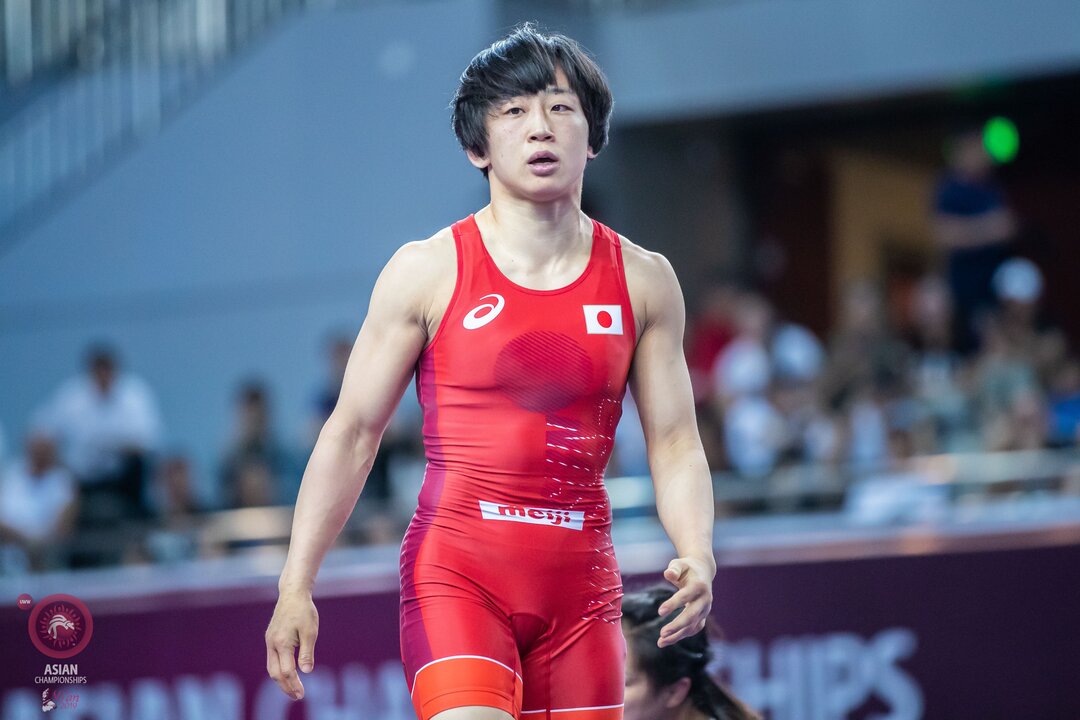 Yuki IRIE (JPN) will wrestle in her first World Championships beginning on September 20. (Photo: Sachiko Hotaka)
"On that birthday, I can't let myself relax," Irie says, speaking at an interview with the UWW website at a recent national team training camp in Tokyo. "When the matches are over, then I can start thinking about the Olympics."
Irie will look to emerge victorious from a field led by veteran Mariya STADNIK (AZE), the runner-up to both Tosaka at the Rio 2016 Olympics and Susaki at last year's world championships.
Others expected to be in contention are 2018 world bronze medalists SUN Yanan (CHN) and Oksana LIVACH (UKR), and 2017 world bronze medalist KIM Son-Hyang (PRK). Irie has chalked up recent victories over both Sun and Kim, the win over the former coming in the final at the Asian Championships in Xi'an in April. Livach is the European champion.
Stadnik, 31, won by technical fall in the only previous meeting between the two, but that was back at the 2014 Golden Grand Prix. A lot has changed since then for Irie, and perhaps no more than over the past year.
The season actually started on a high note, when Irie pulled a surprise at the All-Japan Championships in December 2017. The tournament, known as the Emperor's Cup and the first of the two national team qualifiers, had been billed as a clash between teen phenom and reigning world champion Susaki and Olympic champion Tosaka, who was making a comeback following foot surgery after Rio 2016.
Instead, Irie crashed the party, whipping Susaki by 10-0 technical fall in the semifinals, then holding on to edge Miho IGARASHI 6-5 in the final to regain the national title she first won in 2015, when she beat an up-and-coming Susaki in the first meeting between the two. Tosaka's title hopes ended when she defaulted her semifinal match against Igarashi.
The victory put Irie onto Japan's teams in 2018 for the Asian Championships in Bishkek, the Women's World Cup hosted by Japan, and the Asian Games in Jakarta. But that is where the story takes a downturn.
Coming off a third career title at the Yarygin Grand Prix, Irie headed to Bishkek in high spirits --- only to be dealt a stunning loss in the semifinals by Vinesh VINESH (IND) and having to settle for a bronze.
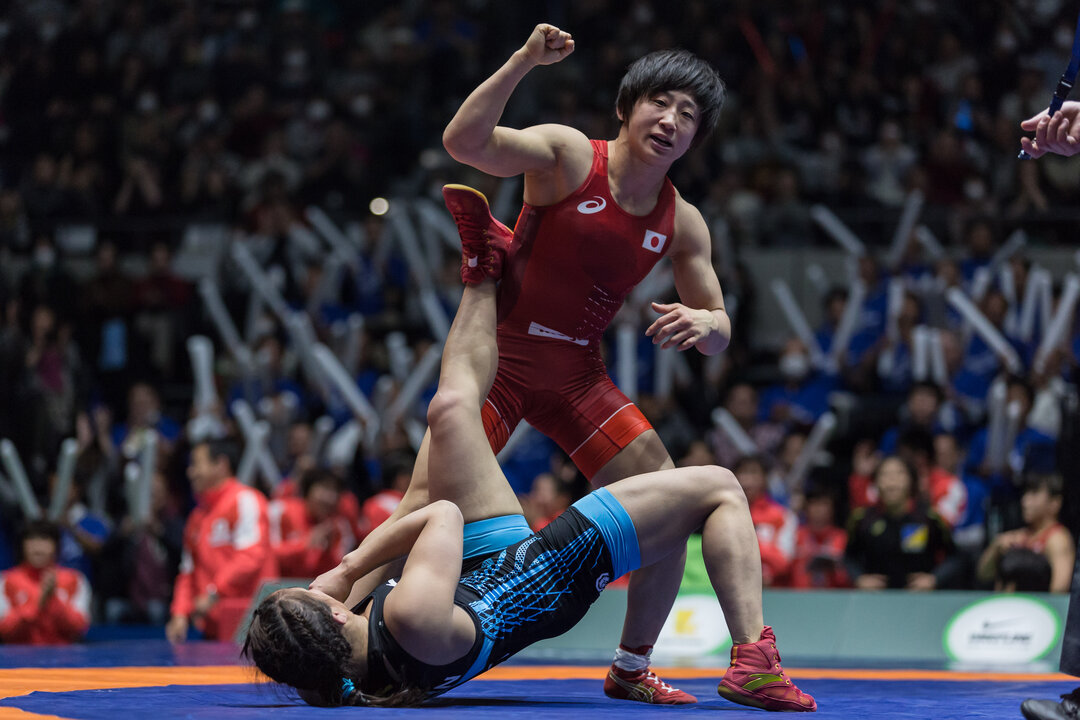 Irie sticks world and Olympic bronze medalist SUN Yanan (CHN) at the 2018 Women's Wrestling World Cup. (Photo: Max Rose-Fyne)
She followed that with a successful Women's World Cup in March, going 3-0, including a victory by fall over Sun, and helping Japan take the title. In the meantime, Susaki won the Klippan Lady and waited for her chance for revenge, which would come three months later.
At the Meiji Cup, Irie defeated Tosaka 6-2 in the semifinals, setting up a showdown in the final with Susaki. But Susaki caught her with a pancake and scored a fall in 3:37. That set up a playoff for the world championships in Budapest, which Susaki won 6-4 with a dramatic takedown in the final 15 seconds.
The additional salt to the wound would come a month later in Jakarta, where Irie suffered her second loss of the year to Vinesh to finish with the silver medal at the Asian Games.
"Psychologically, I was depressed," Irie says. "Physically, there was a gap between what I was thinking to do and what I actually did. Along with the losses, that took a toll and led to depression."
To right the ship, Irie, a member of the Japan Self-Defense Force Physical Training School in Tokyo, returned to her roots on the southern island of Kyushu. It was there that she started wrestling at age 5, and where she knew could always turn to her high school coach and long-time mentor Hideki TSUJI.
It was because of Tsuji that Irie attended college on Kyushu instead of going to powerhouse Shigakkan University or one of the top schools in the Tokyo area. She didn't seem to lose anything, as she won four national collegiate titles while at Kyushu Kyoritsu University.
"My coach has been teaching me since I was in kids wrestling, even now, when I return home, he coaches me," Irie says. "I wanted to keep him as a coach. Even when I was in college, I would go to his high school and practice, and he would watch my movement and offer advice."
Irie returned to Tokyo for the 2018 Emperor's Cup in a better frame of mind and with the kinks, mainly in her stance, worked out. For better or worse, she did not have to face Susaki, who withdrew from the tournament due to an elbow injury. Irie again got the best of Tosaka, winning 4-4 in the semifinals.
"When we were in high school, I beat her," Irie says of her long rivalry with Tosaka. "But when we got to university, she really got stronger. She had a scary presence."
Irie then won the title with a 6-0 victory over Kika KAGATA, earning her a ticket to this year's Asian Championships in Xi'an, where she beat Sun in the final for her first continental gold since 2015.
But the path to the World Championships still had to pass through Susaki, and it got extended at the Meiji Cup in dramatic fashion. Susaki scored a miraculous 4-point move in the last 2 seconds of their quarterfinal match for a 6-4 win, then went on to win the title and set up yet another playoff between the two---this time with Olympic implications.
This time Irie was ready. She never hesistated, nor dangerously sat on a lead as she had done at the Meiji Cup, and forged a solid victory that left Susaki in tears.
"She went in with the attitude of being the challenger," Japan national women's coach Masashi SAITO says. "Her being the aggressor was the usual pattern for her, she has always had the ability. When she loses, she herself knows she has to fix various things. She regained the confidence going into matches. Her aggressiveness became her strength."
Saito added he was impressed with how decisively Irie handled the rematch with Susaki. "It was amazing. Her speed, technique were superb. Her mental state was good."
Irie gained a "bonus" two weeks later, when younger sister Nanami also secured a ticket to Nur-Sultan in the non-Olympic weight of 55kg by winning a wrestle-off with Haruna OKUNO, the world champion at 53kg who had lost out on a place in that weight class to the 55kg world champion Mayu MUKAIDA.
"I've been competing along with her for a long time, so I'm really happy that we can appear together," the soft-spoken Irie says while flashing a warm smile. "After all, she's the person I'm closest to, so we can be honestly critical with each other about both good and bad things."
Older brother Shinji and younger sister Kumi, currently a national collegiate champion, also wrestled, causing some intense times in the Irie household while they were growing up in Kitakyushu, Fukuoka Prefecture.
"At practice, it would be a mix of fighting and wrestling," Irie recalls. "None of us wanted to lose to the other. So I would fight with my younger sisters. My brother became too strong, so he was unbeatable for us."
Yuki made her first big mark in 2006 when she captured the national junior high school title at 46kg. (While Irie's weight has hardly changed since then, Nanami and Kumi overcame her in size when they were in high school.) Of note was that among the bronze medalists in that weight class was Sara DOSHO, currently the reigning Olympic and world champion at 68kg.
"The next year, she got much bigger," Irie says with a laugh. "It's like she became a different person."
Irie's first dip into the international waters came in March 2011, just before her graduation from Kokura Commercial High School, where she won two national titles. Irie entered the senior division at 48kg at the Klippan, winning the gold in her debut at the prestigious Swedish tournament.
"I was really excited and looking forward to it," Irie says. "My impression was that it was fun. [The foreign wrestlers] seem to rely on power more than Japanese wrestlers."
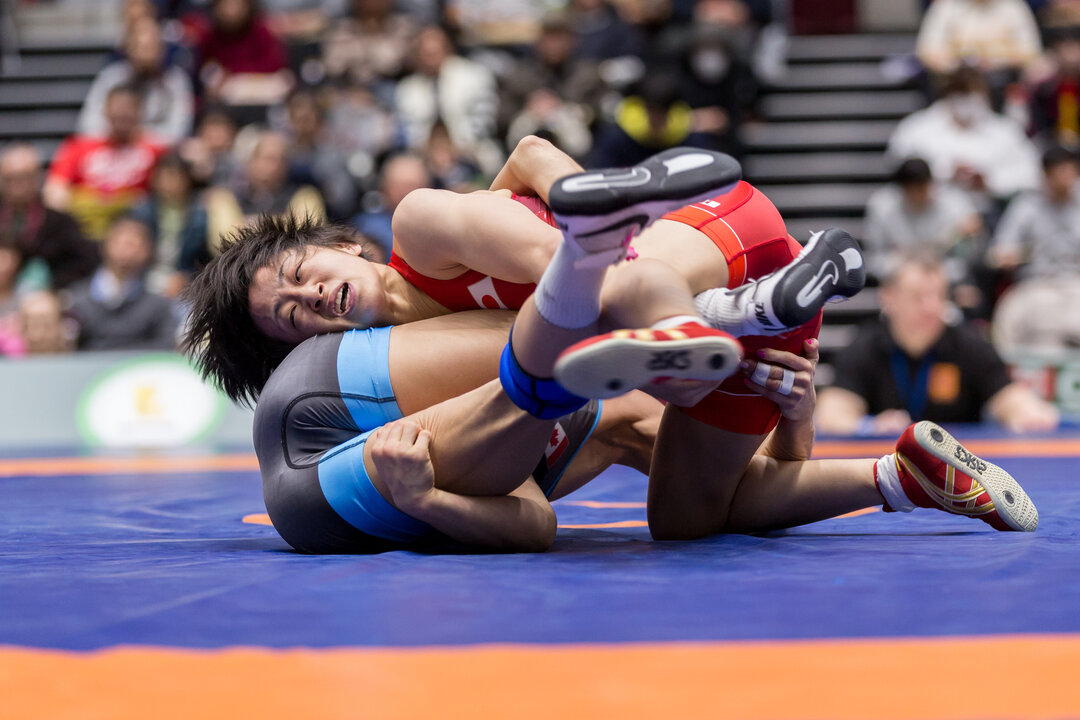 If Irie wins a medal at the 2019 World Championships, she'll lock up her spot on Japan's team at the 2020 Olympic Games. (Photo: Max Rose-Fyne)
Irie says she will take that same attitude into Nur-Sultan, when she aims for the biggest prize of her career.
"This is my first time to appear [at the world championships], the feeling is like when I first entered the Klippan," Irie says. "The feeling of enjoying myself is strong, but as a tournament, I am looking to win each match one at a time and take the title. And as a bonus, if I win the gold, the Olympic berth comes with it."
After graduating from college, it was the structured atmosphere of the JSDF Physical Training School that appealed to her and led her to join that team. It was also no coincidence that one of the coaches is Obara, who won most of her eight world titles under her maiden name of Sakamoto.
"Only a person who has been to an Olympics, who knows the feeling and atmosphere, can point out the dos and don'ts," Irie said. "She teaches me the tough aspects. It's really been good."
Having competed in the shadow of three of Japan's greatest women's wrestlers for much of her career, one might believe that Irie was hexed to be in such a strong weight class. She thinks of it in the opposite way.
"It's tough, but it allowed me to develop and make progress," she says. "With the Olympic champion and the world champion in the country, I could practice and have matches on a high level. To me, that was a plus."
And having beaten both of them, now it's time for her to reap the rewards. No birthday cake can compete with that.
Share your thoughts.
Comments