

Kawai Topples Icho in Playoff for World Team; Otoguro In, Susaki Out
Sunday, July 7, 2019 - 21:47 By Ken Marantz

WAKO, Saitama (July 6)---Risako KAWAI all but dealt a death blow to Kaori ICHO's quest for an epoch-making fifth straight Olympic gold medal. It's now in Kawai's hands to finish the job in two months.
For the second time in three weeks, Kawai toppled her fellow Olympic champion, scoring a 3-3 victory on big-point criteria to earn the women's 57kg berth on Japan's team to the World Championships in Kazakhstan in September.
"I really don't remember much about it, but I'm glad I won," Kawai said at a post-match press conference. "Over this past year, things happened around me that I had never imagined would occur. I had changed the environment around me, and in December, I thought about quitting wrestling and talked it over with my family. I'm glad that I didn't."
The showdown was one of six on a special day of playoffs for tickets to the World Championships in Olympic weight classes, which also saw Takuto OTOGURO earn a shot at keeping the freestyle 65kg crown he won a year ago, while Yui SUSAKI was denied a chance for a third straight women's 50kg world title.
The playoffs in Wako, Saitama Prefecture, about 20 kilometers north of Tokyo, paired the winners of the two national competitions that serve as qualifiers for the World Championships. In the 12 other Olympic divisions, one wrestler won both tourneys to clinch an automatic berth.
Icho had beaten Kawai 3-2 with a dramatic takedown in the final 10 seconds at the All-Japan Championships (Emperor's Cup) in December, a loss that nearly led Kawai to abandon the sport. But she turned the tables in June at the All-Japan Invitational Championships (Meiji Cup), holding on for a 6-4 win to set up the playoff.
"It has been three weeks since the Meiji Cup," Kawai said. "I knew Kaori would approach it differently, and I carefully considered what I would do as I prepared. Strategically, it didn't really go as I had pictured. But in the end, what I had practiced as always came out naturally."
As for her strategy, Kawai said it was to "get in on tackles and firmly finish off the takedown. But it wasn't that easy."
In the nationally televised wrestle-off, Kawai was the aggressor and got in deep with a number of single-leg attempts, only to see Icho squirm free. With just over a minute left in the match, the score was still 1-1, with both points scored on the activity clock and Kawai ahead on last-point.
Just as she did in the Meiji Cup with time running out, the 35-year-old Icho dug deep with the determination that had earned her 10 world titles dating back to 2002 and went on the attack.
Icho got in deep on a single leg, but Kawai clamped down and, applying a reverse nelson, managed to gain a 2-point exposure with 50 seconds left. Icho worked her way out of the predicament and behind for a point to cut the lead to 3-2, but her frenetic efforts for a takedown in the final seconds could only result in a stepout that left her on the short end of a 3-3 score.
"It's disappointing, but I did what I needed to do to get here and prepared well, so I have no regrets," said Icho, who took a hiatus following the Rio 2016 Olympics and only returned to competition last September.
"I don't think that I was weak. Risako was strong. From the time I decided to come back, there was the difficulty of filling in a two-year blank combined with a desire that never left, and this is where I am now.
"As an experience, it was a fulfilling one year. Many friends, family and others came to this arena to give me support, and I went into this wanting to give them a chance to see me at the World Championships and Tokyo Olympics. As I won't be able to show them, that's what hurts."
Actually, the light at the end of the Tokyo 2020 tunnel has not completely gone out for Icho, although it's been reduced to a speck. The Japan federation has decreed that any Japanese wrestler winning a medal at the World Championships will automatically earn a place on the Tokyo 2020 team---which greatly enhanced the incentive to make it to the Kazakh capital of Nur-Sultan.
The door for Icho would reopen in the unlikely event that Kawai, the 63kg champion at Rio 2016 and 59kg gold medalist at last year's worlds in Budapest, fails to win a medal in Nur-Sultan. In that case, the qualifying process would go back to the beginning.
For Kawai, the victory keeps alive her dreams of appearing in the Olympics with younger sister Yukako, a world silver medalist who already secured her ticket at 62kg. Risako had taken a gamble by going down to 57kg and challenging Icho, and it paid off with the two victories that Yukako watched at matside.
The playoffs for the undecided places in the non-Olympic weights will be held July 21. Because so many top wrestlers funneled into the Olympic weights, the federation decided that, in order to send the strongest possible team to Kazakhstan, it will allow those who finished as runner-up in an Olympic weight at either the Emperor's Cup or Meiji Cup to enter the wrestle-offs at a non-Olympic weight.
That means that technically Icho could try to make the team at, say, 59kg in an attempt to win a first world title since 2015, although there have been no indications that she will do so.
Otoguro avenges loss; Irie finally gets best of Susaki
In other featured matches on a day of high drama, world champ Otoguro bounced back from his loss in the Meiji Cup final to Rei HIGUCHI by chalking up a solid 5-0 victory to fill the 65kg berth.
Otoguro, his preparations affected by knee problem that kept him out of the Freestyle World Cup and the Asian Championships, had been dealt a devastating 15-5 technical fall loss three weeks ago by Higuchi, the Rio 2016 silver medalist at 57kg.
That was Otoguro's first loss to a Japanese opponent since junior high school, but he showed he was ready this time around with his third victory over Higuchi in 2 1/2 years.
Leading 2-0 in the second period from a pair of points off the activity clock, Otoguro sliced in on a low double for a takedown with 1:40 left. He then held off Higuchi's late attacks, adding a stepout in the waning seconds for the final margin of victory.
"I wasn't accustomed to losing, and it was so devastating, it was like I had no idea what to do," said Otoguro, who shed very different tears after this victory. "So many people helped me out, and I'm happy I could come out with a win through their support."
While the Kawai-Icho clash has garnished the most national attention, the budding rivalry at women's 50kg has been no less intense, and this time Asian champion Yuki IRIE came out on top.
Irie chalked up her third career victory over Susaki---the only losses of Susaki's career on any level dating back to junior high school---winning 6-1 to earn her first trip to a World Championships.
Irie has been a recent thorn in Susaki's side, but the reigning world champion always came up with the big win needed to get to the major events. It was almost exactly a year ago that Susaki knocked off Irie in a playoff en route to defending her world title in Budapest.
And after pulling out of the Emperor's Cup due to an elbow injury, Susaki faced a must-win situation at the Meiji Cup to keep alive her hopes of appearing at Tokyo 2020. She did it in dramatic fashion, scoring a 4-point move with two seconds left to beat Irie 6-2 in the quarterfinals, before whipping Rio 2016 champion Eri TOSAKA in the final to set up the playoff.
This time, there would be no mistakes by Irie, and no miracle finish for Susaki.
In the first period, just after losing a point on the activity clock, Irie scored a takedown to take a 2-1 lead into the second period. With 1:20 left, she scored another takedown, then topped that off with a roll to make it 6-1, which is how it ended, leaving the 20-year-old Susaki in tears.
"There were so many people supporting me, my only feeling is that I have to apologize to them," Susaki said between sobs.
The 26-year-old Irie, who capped her gold-medal run at the Asian Championships in April in China with a victory over Rio 2016 bronze medalist SUN Yanan (CHN), has tradition on her side in a bid to medal in Nur-Sultan and clinch a Tokyo 2020 spot---Japan has made the podium in the lightest women's weight class at every World Championships dating back to 2005 except one (2009).
"The Olympic [berth] has still not been secured, so I'm happy, but first I have to focus on the World Championships," Irie said. "It will be my first World Championships, so I will prepare so I can fight without being nervous."
In other playoffs, Mao OKUI scored a dramatic upset over former world bronze medalist Yuhi FUJINAMI in freestyle 74kg, winning 5-4 with a takedown at the buzzer to earn his first trip to the World Championships.
Okui trailed 3-0 early in the second period, then twice got behind a standing Fujinami, only to fail to break him down to the mat for a takedown. Both times he executed a roll at the edge, but each one was ruled to have been launched out of bounds; the first gave Fujinami a point for an unsuccessful challenge and the other one for himself for a stepout.
Down 4-3 with 10 seconds left, a flurry starting with Okui's single-leg attempt ended with Fujinami, a 2017 world bronze medalist at 70kg, on all fours. At the buzzer, Okui pulled off a roll---this time well in bounds---that was confirmed by video to be in time.
"I thought, 'If I don't get it now, everything I've done up to now will have no meaning,' and I just went for the tackle," Okui said.
At the Meiji Cup, Okui scored a victory by fall in the semifinals over a less-than-par Fujinami, who was still recovering from a knee injury suffered at the Asian Championships and a back injury suffered a week before the tournament.
At freestyle 125kg, Nobuyoshi ARAKIDA spun behind off a front headlock for a late takedown and a 4-1 win over Yasuhiro YAMAMOTO to earn his fifth trip to the World Championships and first in five years.
That reversed the outcome of a playoff last year between the two that Yamamoto won by the same score.
Shohei YABIKU, a former world junior bronze medalist, will look for his first hardware on the senior level in three tries after defeating Naotsugu SHOJI by 9-0 technical fall at Greco-Roman 77kg.
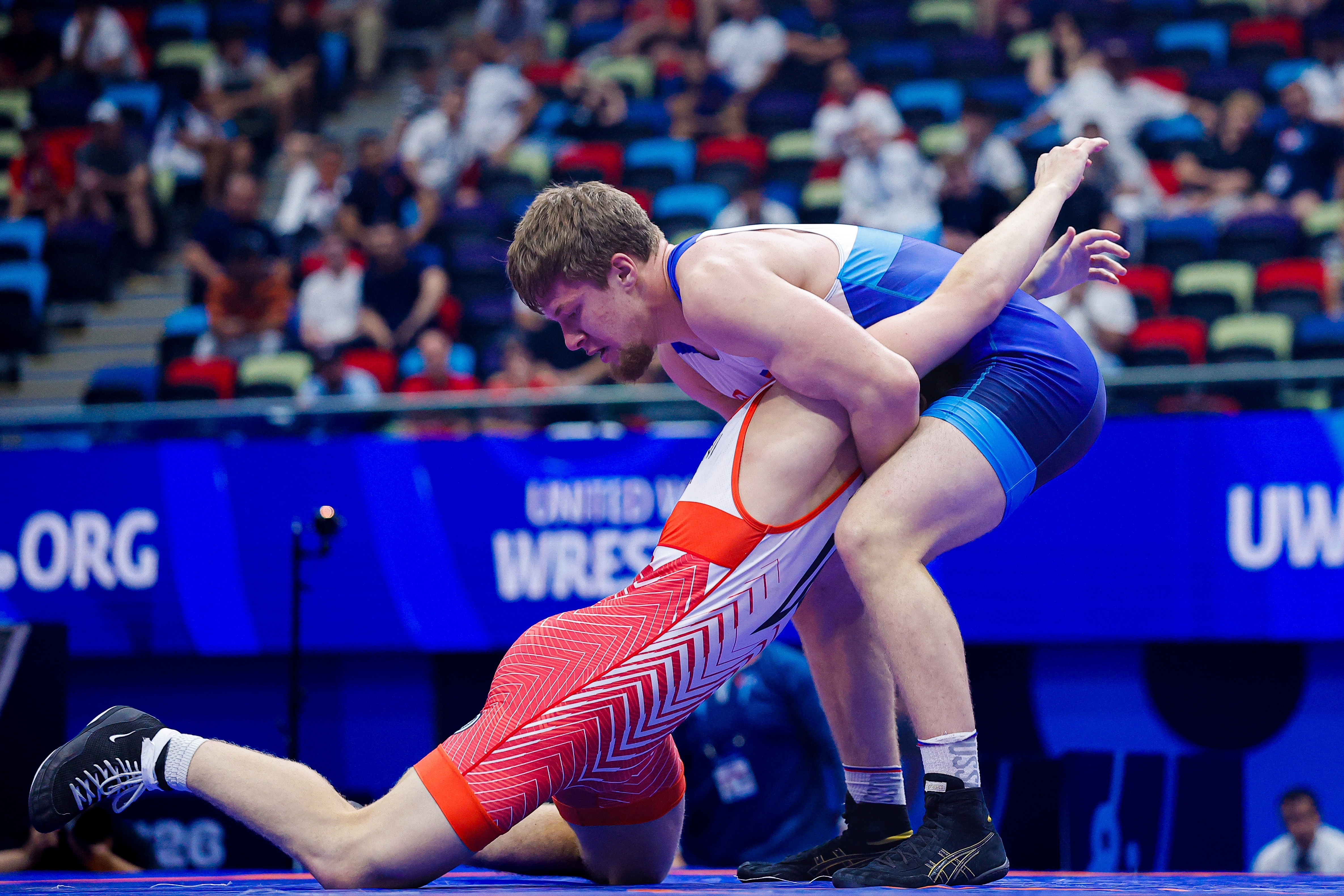 Abdurazak SHABANOV (RUS) tries to score on Salah TSARNI (USA) during the 92kg final. (Photo: United World Wrestling / Kostadin Andonov)
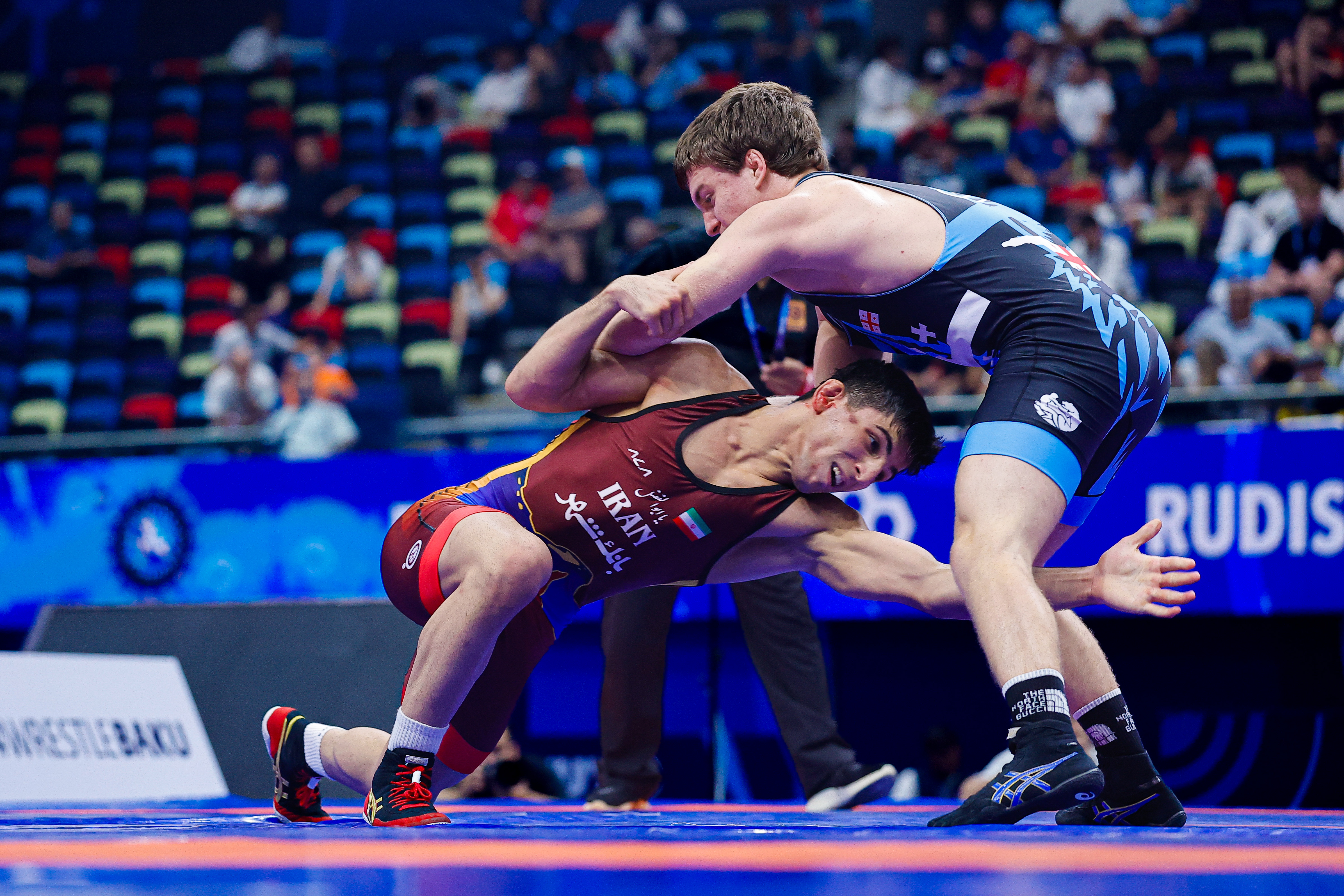 Reza SHAMSIPOUR (IRI) tries to score on Bohdan KVANTALIANI (GEO) during the 71kg final. (Photo: United World Wrestling / Kostadin Andonov)
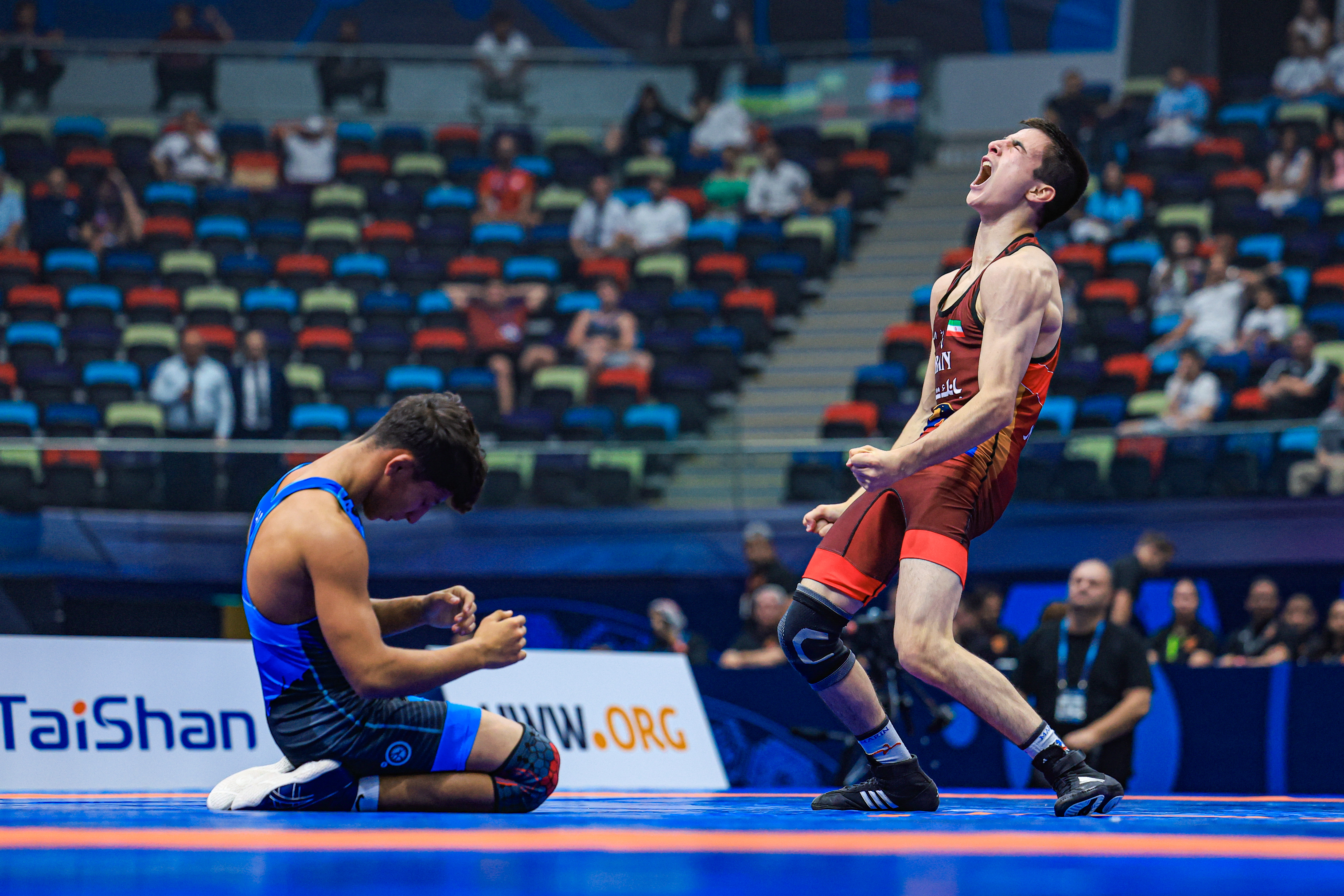 Benyamin ASHOFTEH (IRI) celebrates after winning the 51kg final against Ibrahim HASANOV (AZE). (Photo: United World Wrestling / Amirreza Aliasgari)
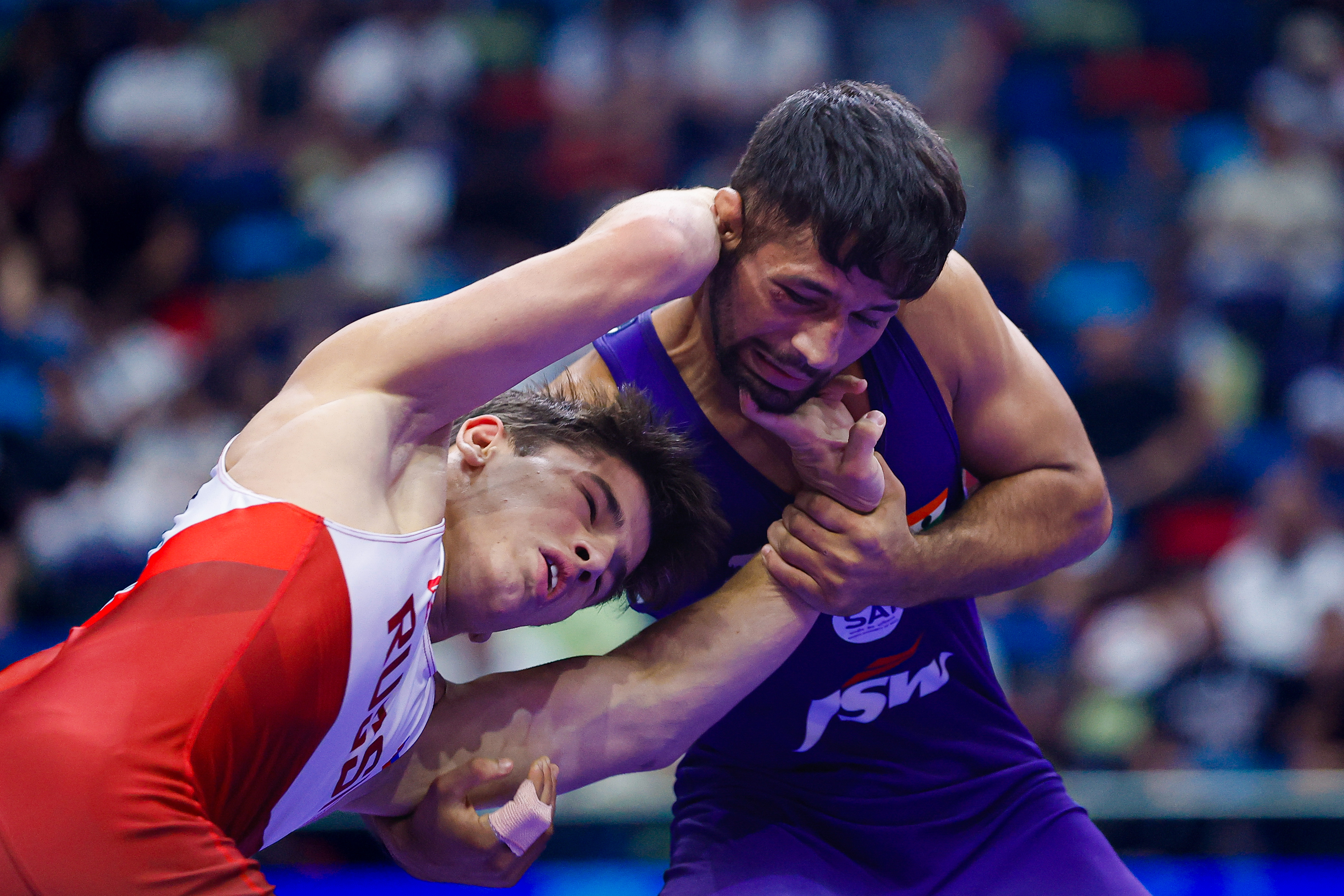 SITENDER (IND) using the two-on-one to set up his takedown against Sergei KARMRIAN (RUS). (Photo: United World Wrestling / Kostadin Andonov)
Share your thoughts.
Comments