

Japan Wrestling

Rising Star Fujinami Earns Ticket to Oslo Worlds for Senior International Debut

By Ken Marantz

TOKYO (May 27) --- Watch out world, Akari FUJINAMI is ready to take you on. And take you down.

Fujinami, a highly touted future star in the boundless constellation of Japanese women's wrestling, has set a date for her highly anticipated senior international debut. It will come at the World Championships in Oslo in October --- one month before her 18th birthday.

"Just imagining that makes me excited, the thought of me competing there," Fujinami said. "My image is that the world level gets higher year after year, and I want to keep getting better so that it makes people think, 'that Fujinami is strong.'"

There was no doubt about that on Thurday, when the 2018 world cadet champion secured her ticket to Oslo in the women's 53kg class by winning the title at the Meiji Cup All-Japan Invitational Championships in Tokyo, beating two world medalists along the way.

The victory followed up Fujinami's one last December at the Emperor's Cup All-Japan Championships, which marked her first tournament on the senior level. The two tournaments serve as qualifiers for the World Championships, with playoffs for weight classes in which the winners are different.

Fujinami earned the spot on the Japanese team outright with a 10-0 technical fall victory in the final over Nanami IRIE, the 2019 world silver medalist at 55kg, in a repeat of the gold-medal match at the Emperor's Cup.

"It gives me some boost of confidence, but looking at the world, I feel I need to get much stronger," Fujinami said. "Many issues that need to be addressed came out, and heading to the World Championships, I will have to practice harder."

Fujinami advanced to the final with an 11-2 victory over two-time former world champion Haruna OKUNO, who has been trying to work out of a slump after losing out on the Olympic spot at 53kg to Mayu MUKAIDA.

Fujinami also beat Okuno at the Emperor's Cup, but Okuno was suffering from a strained leg muscle at the time. Okuno said she was physically fine this time, but was just overmatched by the high schooler.

"When it comes to level, at this point its not right to even compare me with Fujinami," Okuno said. "Having strong opponents in my weight class stimulates me. And Fujinami's presence means something to me and gives me something to aim for."

Fujinami has not lost since June 2017, when she was defeated in the final of the national junior high school championships to Umi ITO, who placed second on Thursday at 50kg. She has now won 19 consecutive tournaments and 75 straight matches, including the cadet 53kg title at the 2020 Klippan Lady Open and the 2018 world and Asian cadet golds.

At 1.63 meters, Fujinami is relatively tall for a Japanese, and she uses her added reach to keep opponents from getting a clear shot at a takedown. That's if they get a chance, because she is almost always on the offensive as a whirlwind of motion, much like another native of Mie Prefecture in central Japan, Saori YOSHIDA.

Fujinami swept through her three Meiji Cup matches relying mostly on a single-leg takedown that she says she polished after having some trouble at the Emperor's Cup.

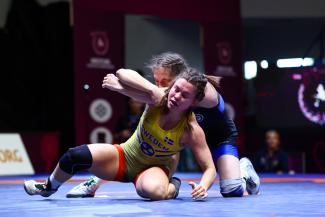
Akari FUJINAMI looks to set up a shot on two-time former world champion Haruna OKUNO. She won the match, 11-2. (Photo: Japan Wrestling Federation)

"At that time, I realized that I had a problem finishing up my tackles," she said. "This time, I kept in mind working for the point as soon as I grabbed the leg. There were times it was good and other times I got anxious, and I need to still work on that."

The lone high schooler in her weight class, Fujinami displayed amazing composure and confidence. Asked if she felt pressure, she replied, "I kept telling myself, just go as usual, just go as usual. Because of that, I was able to go into my matches in a calm manner."

Among those impressed with Fujinami is two-time world champion Yui SUSAKI, who will attempt to win the 50kg gold medal in her Olympic debut this summer. She even said she could learn a thing or two from the teenager.

"She's really strong," said Susaki, who is not entered in the tournament but is there to support her Waseda University teammates. "She has good technique when tying up, and has good speed. There are things that I can learn from her."

Like Susaki, the 11 other wrestlers who have qualified for the Tokyo Olympics have skipped the four-day tournament at Tokyo's Komazawa Gym. Also missing are fans, friends and family members, as strict coronavirus protocols are in place due to Tokyo's declaration of a third state of emergency amid a recent surge.

"I was able to follow up the Emperor's Cup and win here which was the main thing, but I'm also grateful that under these circumstances a tournament was able to be held," Fujinami said in a sign of maturity.

Fujinami did have a family member with her -- her father, Toshikazu, who is her coach at Inabe Gakuen High School. He also heads the kids wrestling club where she started the sport at age 3, following in the wrestling shoes of older brother Yuhi FUJINAMI, a 2017 world bronze medalist in freestyle 70kg.

"At first she didn't show much interest," Toshikazu recalled. "It took about a year before she started doing it for real. I brought her to the wrestling club, but she didn't care. She came along with her older brother. I thought it would never happen if she kept on like this."

But Akari stuck with it, and started to give a show of things to come.

"She really got serious about her third year of elementary school," Toshikazu said. "Up to then, she didn't win very much. In her third year, she won her first national title. That lit a fire and she really took off."

Asked what kind of child Akari was, her father didn't hesitate in pointing out what is also behind her success: "She was the type who hated losing. If you played a game with her and she lost, she would get really down, and knock over things just to see what would happen."

Fujinami's father said he first realized his daughter's potential for success on the highest level when she won her first national junior high school championship in her third year, after falling short the previous two years.

"From there, she started to pull away," he said. "In her first and second years, she lost to wrestlers who were older and are now here at the nationals. After she won in her third year, she really started progressing.

"Another turning point was the qualifying for the world cadet [in 2018] where she won a close match in the final over an older opponent," he added, referring to the 2018 Junior Queens Cup, where as a junior high schooler she beat high schooler Rina KATAOKA 4-2 in the final.

"By winning that, you could see she had really changed and improved. At that point, I felt she could make a challenge on the world level, and she won the Asian cadet and world cadet. That match was the turning point."

Recognizing her potential, the Japan federation invited Fujinami to a recent national team camp, where word is she more than held her own in sparring with Mukaida. Fujinami used it as opportunity to absorb as much as she could from the nation's elite.

Fujinami, who was too young to enter the qualifying process for the Tokyo Olympics, has her sites set firmly on Paris in 2024.

"In two more years, I want to be in the thick of things with the Olympics, and become an Olympian and win the title," she said. "To make my dream come true, I want to take in everything I can from today's wrestlers all the way up to Paris."

Nonoka OZAKI laces her way to a 6-0 shutout win over Yui SAKANO. (Photo: Japan Wrestling Federation)

Ozaki also gains ticket to Oslo

In other action, another former world cadet champion from 2018 will be joining Fujinami on the flight to Oslo for her senior international debut, as Nonoka OZAKI captured the 62kg title with a 6-0 victory over Yui SAKANO.

"Last year I won the Emperor's Cup, and that gave me the right to enter the Meiji Cup," Ozaki said. "I trained with the goal of winning the title and getting to appear at the World Championships. I was relieved to achieve that, and I am determined to be ready for the World Championships."

Ozaki repeated as world cadet champion in 2019, and won three consecutive cadet titles at the Klippan Lady Open from 2018 to 2020.

"I have experience of winning the world cadet title, and it will be my first senior tournament [overseas]," Ozaki said. "I'm really excited. I've been watching as senior wrestlers have won world titles, and I've always thought I definitely want to stand on that stage."

Ozaki is a graduate of the same elite JOC Academy that produced Susaki, but she veered from the usual path by entering Keio University, a school known for its academics and not for wrestling. She will continue to train at the Academy while pursuing her studies in the Faculty of Environment and Information Studies.

Also bound for Oslo for their first senior World Championships are 2019 world junior champions Sae NANJO at 57kg and Miwa MORIKAWA at 65kg.

Nanjo, who also won the world U-23 title in 2019, chalked up three straight technical falls without giving up a point, capped by an 11-0 victory in the final over Sakura MOTOKI.

Morikawa had just one match, but it was tough one as she forged out a 4-2 victory  over 2020 Asian champion Naomi RUIKE.

In Greco-Roman, newly crowned Asian champion Tsuchika SHIMOYAMADA earned a second trip to the World Championships when he took the 67kg gold with a 9-5 victory over teenager Kyotaro SOGABE.   
#wrestlebishkek

Makhmudov Repeats Triumph in Bishkek as Kyrgyzstan Strikes Three Gold

By Ken Marantz

BISHKEK, Kyrgyzstan (April 7) -- The decibel level was just as deafening, and the outcome the same. The only thing different was the venue, although it was only about 50 meters across the street.

Local hero Akzhol MAKHMUDOV (KGZ) gave the host country the victory it most wanted to see, winning the 77kg gold in Greco-Roman at the Asian Championships on Tuesday in Bishkek to repeat his breakout victory of 2018 in the same city.

Makhmudov held off a fierce challenge from Ali OSKOU (IRI) for a 3-3 victory in the final to secure his fourth career Asian gold and fifth medal overall, much to delight of the thunderous partisan crowd packed into Zhastyk Arena.

“It’s a huge, huge joy,” Makhmudov said. “Of course, it’s hard to put into words, but at the same time, I’m not going to stop here or dwell on it. Yes, I became the Asian champion, the anthem was played, the flag was raised. Now it’s time to move forward.”

While the spotlight shined brightest on Makhmudov, he had to share it a bit with compatriots Aftandil TAALAIBEK UULU (KGZ) and Asan ZHANYSHOV (KGZ), who also defeated Iranian opponents in striking gold at 63kg and 87kg, respectively, on the first night of medal matches in the seven-day tournament.

The night wasn’t a total wash for Iran, however, as reigning world champion Amin MIRZAZADEH (IRI) showed he was still the preeminent power at 130kg by snatching his fourth career Asian gold, while Ikhtiyor BOTIROV (UZB) won the other gold at stake at 55kg.

Akzhol MAKHMUDOV (KGZ)Akzhol MAKHMUDOV (KGZ) after winning his first Asian title in Bishkek in 2018. (Photo: United World Wrestling / Max Rose-Fyne)

It was eight years ago that a then-teenaged Makhmudov burst onto the international stage at Bishkek’s Soviet-era Kojomkul Sports Palace on the other side of Togolok Moldo Street, sending the home crowd into a cacophonous frenzy by winning the 72kg gold.

“I still remember 2018 the most, because I was younger then and the wrestling was much more spectacular,” Makhmudov said. “Right now, I’m not in my best shape, but I still managed to win my fourth gold medal. At the moment, I’m only at about 25–30 percent of my form.”

That 2018 win served as the launching pad for one of Asia’s top Greco wrestlers in history, although his ascent was delayed for some time due to a severe knee injury.

After taking a silver medal at the 2021 Tokyo Olympics, he reached the pinnacle in 2022 with victories at 77kg at both the World and Asian Championships, a feat he repeated in 2023. He added a second Olympic medal the next year with a bronze in Paris.

He took his time returning to the sport from a break after Paris, winning the title at the 2025 Islam Solidarity Games in his lone competition that year. This year, his only action ahead of Bishkek came at the Zagreb Ranking Series in February, where he failed to medal at 82kg.

If there were any concerns whether Makhmudov, who will turn 27 next week, has lost his edge, he put the matter to rest with his solid performance before the home fans.

Akzhol MAKHMUDOV (KGZ)Akzhol MAKHMUDOV (KGZ) sets up a throw against Ali OSKOU (IRI) during the 77kg final at the Asian Championships. (Photo: United World Wrestling / Kostadin Andonov)

In the final against Oskou, the winner of the Zagreb tournament, Makhmudov got the first chance in par terre and muscled the Iranian over with a reverse body lock, although Oskou rolled through for a reversal. The Kyrgyzstan side challenged for a leg foul, but it was denied, leaving Makhmudov with a slim 3-2 lead.

In the second period, Oskou received a passivity point but could not turn Makhmudov, leaving the latter ahead 3-3 on criteria. Makhmudov got a second chance at par terre, but after failing to pad his lead, he successfully fended off Oskou for the final minute to clinch the win.

“Without a doubt, the toughest match for me was the final, as you saw yourselves,” Makhmudov said. “It was very hard and intense. I prepared for it like any other match, there was responsibility, and of course, I wanted to win, as always.”

Making the moment more special was that his family was among the throng packed into the arena.

“This victory was very important to me,” he said. “My family was here, my father was in the stands, supporting me, praying for my victory. To win in front of him and to justify his hopes means a lot.”

Aftandil TAALAIBEK UULU (KGZ)Aftandil TAALAIBEK UULU (KGZ) scored a 7-2 victory over Erfan JARKANI (IRI) in the 63kg final. (Photo: United World Wrestling / Kostadin Andonov)

Prior to Makhmudov’s triumph, Taalaibek Uulu fired up the crowd with a stunning 7-2 victory in the 63kg final over Zagreb Ranking Series champion Erfan JARKANI (IRI) for his first major medal of any kind.

Taalaibek Uulu scored an opening takedown, then hit a 4-point throw from par terre, off of which Jarkani scored a reversal to make it 7-1 after the first period. Jarkani got his chance at par terre in the second, but couldn’t budge Taalaibek Uulu, whose only previous senior international medal was a bronze in Antalya in 2024.

Asan ZHANYSHOV (KGZ)Asan ZHANYSHOV (KGZ) celebrates after beating world champion Gholamreza FAROKHI (IRI) in the 87kg final. (Photo: United World Wrestling / Kostadin Andonov)

Not to be outdone, world bronze medalist Zhanyshov completed Kyrgyzstan’s triple crown of titles with a masterful 11-4 victory at 87kg over a very tough Gholamreza FAROKHI (IRI), the 82kg champion at last year’s World Championships in Zagreb.

Zhanyshov, no doubt inspired by his compatriots’ success and the crowd’s fervor, stunned Farokhi with a spectacular 4-point lateral drop for a quick lead, which grew to 7-0 with an activity point, stepout and unsuccessful challenge.

Farokhi, also the 2025 world U23 champion in this weight class, surged back with a barrel roll for 2 and a 2-point exposure. But when he tried a roll, Zhanyshov stepped over for a 2-point exposure, and another 2 was tacked on after Farokhi bridged out of the ring, making it 11-4.

That was how it ended, as neither wrestler could generate any more points. A despondent Farokhi abandoned the fight with a full seven seconds still on the clock.

Amin MIRZAZADEH (IRI)Amin MIRZAZADEH (IRI) captured his fourth Asian title at 130kg. (Photo: United World Wrestling / Kostadin Andonov)

At 130kg, Mirzazadeh proved too much for Russian-born Rafael TSITSUASHVILI (UZB), as he was never threatened in a 9-0 victory to add to his previous Asian golds from 2020, 2023 and 2024.

Mirzazadeh, who won his second world title in Zagreb last September, rolled Tsitsuashvili twice from par terre in the first period for a 5-0 lead, then ended the match at 27 seconds into the second with a takedown-gut wrench combination.

“After the World Championships in 2025, my first competition in 2026 started with the Asian Championships and I was able to achieve the gold medal with a brilliant performance,” Mirzazadeh said. “This is the first step of my path this year in 2026 and I hope that I can achieve succes one after the other.”

For Mirzazadeh, getting to Bishkek was half the battle, given the limits on air travel out of his country.

“Emotionally, it was definitely different,” he said. “We were probably on the road for fifty hours, on the ground, because our country is in a difficult situation right now, but I thank God that I was able to win the gold medal despite these issues and the difficulty of the route.

“I hope that I was able to bring a smile to the faces of the people of my country for a moment."

Ikhtiyor BOTIROV (UZB)Ikhtiyor BOTIROV (UZB) celebrates after winning his first Asian title. (Photo: United World Wrestling / Amirreza Aliasgari)

At 55kg, two-time bronze medalist Botirov struck gold at last with an impressive 9-0 win in 1:47 over LALIT (IND).

Botirov got the first chance in par terre, and that was all he needed, as he reeled off four gut wrenches despite some tough resistance from Lalit, who had been looking to become India’s first Asian champion in Greco since 2020.

“This is the result of all our efforts, my first gold medal at the senior Asian Championships,” Botirov said. “I would like to express my sincere gratitude to my coaches who supported me closely throughout this journey. We prepared very ntensively for this competition. Before coming here, my coach told me, ‘You will become a champion,’ and sent me here with that belief.”

Botirov, who added to the bronze medals he took home in 2023 and 2025, had avenged a loss in this year’s Zagreb Ranking Series final to Mohammad HOSSEINVAND (IRI) in the quarterfinals.

“I lost that match by two points,” Botirov said of the defeat in Zagreb. “But this time, I changed my tactics. I started attacking from the very beginning, took the first period, and studied his movements. That’s how I managed to win.”

Kaisei TANABE (JPN)Kaisei TANABE (JPN), Freestyle 65kg Asian champion last year, won a Greco bronze this year. (Photo: United World Wrestling / Kostadin Andonov)

Ex-Freestyle champ Tanabe joins exclusive club with Greco bronze

In the bronze-medal matches, Kaisei TANABE (JPN) joined an exclusive club of wrestlers in Asian Championships history who have won medals in both Freestyle and Greco when he took home a bronze at 63kg.

Tanabe, the champion last year at Freestyle 65kg, secured his place in history when he forged out a 9-0 victory over Azatjan ACHILOV (TKM), securing the winning point with a stepout at the first-period buzzer.

“My feeling is that I’m relieved, but I also have a strong regret that I didn’t put out in yesterday’s match what I did today,” Tanabe said, referring to his loss on Monday in the semifinals to Taalaibek Uluu.

Tanabe pulled away with a 4-point back drop from par terre, then reeled off three consecutive stepouts. An unsuccessful challenge that the final one was scored in time added the final point.

Regarding the flashy 4-pointer, Tanabe said, “A lot of people said they wanted me to put on an exciting match for the people watching. Whether I win or lose, I want to liven things up.”

Tanabe, who father and coach Chikara TANABE (JPN) was an Olympic bronze medalist, was unable to defend his Freestyle crown after losing in the semifinals at the All-Japan Championships in December, but earned his ticket to Bishkek by winning at Greco 63kg.

Tanabe, a product of powerhouse Nippon Sports Science University, said he will continue competing in both styles “as long as it continues to be fun for me. I want to be a wrestler who people find incredibly entertaining, whether or not they wrestle or whether or not that know about wrestling.”

On Wednesday, Taishi NARIKUNI (JPN), the Freestyle 70kg champion in 2022, will get a chance to join Tanabe in becoming a double-style medalist when he competes in the bronze-medal match at Greco 72kg.

The other 63kg bronze on Tuesday went to Hyunwoong CHOI (KOR), who jumped out to a 7-0 lead after a 4-point headlock throw, then held on to deny former champion Islomjon BAKHRAMOV (UZB) a fourth career Asian medal.

Korea also picked up a bronze in the wildest match of the tournament so far, with Yeonghun NOH (KOR) chalking up three 4-point throws while also nearly being pinned in coming away with a crazy 15-14 win at 77kg over AMAN (IND).

Noh used a back trip, headlock and hip throw for his 4-pointers, the last of which should have ended the match at 12-3, but Aman rolled through to continue the movement and came up with a 2-point exposure that kept him alive.

Behind 14-7 heading into the second period, Aman countered for 2-point takedown, then stopped a throw attempt to send Noh straight to his back for 4 – and what the mat referee indicated was a fall. But it was not confirmed, and Noh survived the final 23 seconds, albeit there were the obligatory challenges that added to the drama but did not change the outcome.

In the other 77kg match, Doniyorkhon NAKIBOV (UZB) got three gut wrenches from par terre in the first period, then finished up a 10-1 victory in the second over Kaharman KISSYMETOV (KAZ) for his second career Asian bronze. 

At 55kg, Hosseinvand, the lone Iranian to fail to make the final on the first day, assured he would not return empty-handed, silencing the home crowd with a 7-1 victory over Ulan MURATBEK UULU (KGZ).

Hosseinvand, put on top in par terre for a second time in the first period after a foul, used the opportunity to score a 4-point throw to go up 7-0, then held out when he was on the bottom in the second period to deny Muratbek Uulu a second career Asian bronze.

Huoying SHI (CHN), who had his breakout year in 2025 with a bronze medal at the World Championships, added a continental bronze in his senior Asian debut with a 9-0 pasting of Mizuki ARAKI (JPN).

Shi, who had failed to medal on the U20 and U23 levels at either of the Asian or World Championships, scored 2 with a counter to the back, then pancaked Asian debutante Araki for 4. From there, he went to a gut wrench to finish the match in 1:17.

At 87kg, former champions Nursultan TURSYNOV (KAZ) and Sunil KUMAR (IND) both added to hefty Asian medal collections, one with an one-sided win and other having to come from behind for a close victory.

Tursynov, who won the Asian title back in 2014 and won two silvers in the ensuing years, had little trouble demolishing Dovletmyrat BAYRAMOV (TKM), scoring a roll, 4-point back suplex and another roll from par terre for a 9-0 win in 1:41.

Kumar, the 2020 Asian champion, trailed by four points going into the second period when he used the par terre advantage to score two gut wrenches and walk off with a 5-4 victory over Mukhammadkodir RASULOV (UZB) – a two-time past bronze medalist himself – and boost his medal tally to six overall.

At 130kg, Korea made it 3 for 3 in bronze-medal matches by winning the battle of the Kims, as Minseok KIM (KOR) defeated namesake Roman KIM (KGZ) 4-0, scoring all of his points with slick first-period arm throw that emulated wrestlers half his size.

It was the Korean Kim’s fifth career Asian medal, adding to two bronzes from the Asian Games and another from the 2018 World Championships.

Three-time Asian U23 champion Wenhao JIANG (CHN) earned his first senior Asian medal with a 9-2 win over returning bronze medalist Yuta NARA (JPN) in the other 130kg match.

Photo

Day 2 Results

55kg (11 entries)
GOLD: Ikhtiyor BOTIROV (UZB) df. LALIT (IND) by TS, 9-0, 1:47

BRONZE: Huoying SHI (CHN) df. Mizuki ARAKI (JPN) by TS, 9-0, 1:17
BRONZE: Mohammad HOSSEINVAND (IRI) df. Ulan MURATBEK UULU (KGZ), 7-1

60kg (10 entries)
SF 1: Alisher GANIEV (UZB) df. Yu SHIOTANI (JPN) by TS, 10-0, 2:00
SF2: Se Ung RI (PRK) df. Yerbol KAMALIYEV (KAZ) by TS, 8-0, :27

63kg (11 entries)
GOLD: Aftandil TAALAIBEK UULU (KGZ) df. Erfan JARKANI (IRI), 7-2

BRONZE: Kaisei TANABE (JPN) df. Azatjan ACHILOV (TKM) by TS, 9-0, 3:00
BRONZE: Hyunwoong CHOI (KOR) df. Islomjon BAKHRAMOV (UZB), 9-6

67kg (11 entries)
SF 1: Razzak BEISHEKEEV (KGZ) df. Ahmadreza MOHSEN NEZHAD (IRI) by TS, 9-0, 1:58
SF2: Kensuke SHIMIZU (JPN) df. Abdumalik AMINOV (UZB), 5-2

72kg (10 entries)
SF 1: Almatbek AMANBEK (KAZ) df. Amantur ISMAILOV (KGZ), 3-1
SF2: Javad REZAEI (IRI) df. Shakhzod KUCHKOROV (UZB) by TS, 9-0, 1:55

77kg (12 entries)
GOLD: Akzhol MAKHMUDOV (KGZ) df. Ali OSKOU (IRI), 3-3

BRONZE: Yeonghun NOH (KOR) df. AMAN (IND), 15-14
BRONZE: Doniyorkhon NAKIBOV (UZB) df. Kaharman KISSYMETOV (KAZ) by TS, 10-1, 4:59

82kg (10 entries)
SF 1: Shahin BADAGHIMOFRAD (QAT) df. Ibragim MAGOMADOV (KAZ), 9-8
SF2: Amin HOSSEINI (IRI) df. PRINCE (IND) by TS, 10-0, 2:25

87kg (11 entries)
GOLD: Asan ZHANYSHOV (KGZ) df. Gholamreza FAROKHI (IRI), 11-4

BRONZE: Nursultan TURSYNOV (KAZ) df. Dovletmyrat BAYRAMOV (TKM) by TS, 9-0, 1:41
BRONZE: Sunil KUMAR (IND) df. Mukhammadkodir RASULOV (UZB), 5-4

97kg (11 entries)
SF 1: Hadi SARAVI (IRI) df. Islam YEVLOYEV (KAZ), 3-1
SF2: NITESH (IND) df. Zegang WANG (CHN), 7-2

130kg (10 entries)
GOLD: Amin MIRZAZADEH (IRI) df. Rafael TSITSUASHVILI (UZB) by TS, 9-0, 3:27

BRONZE: Minseok KIM (KOR) df. Roman KIM (KGZ), 4-0
BRONZE: Wenhao JIANG (CHN) df. Yuta NARA (JPN), 9-2