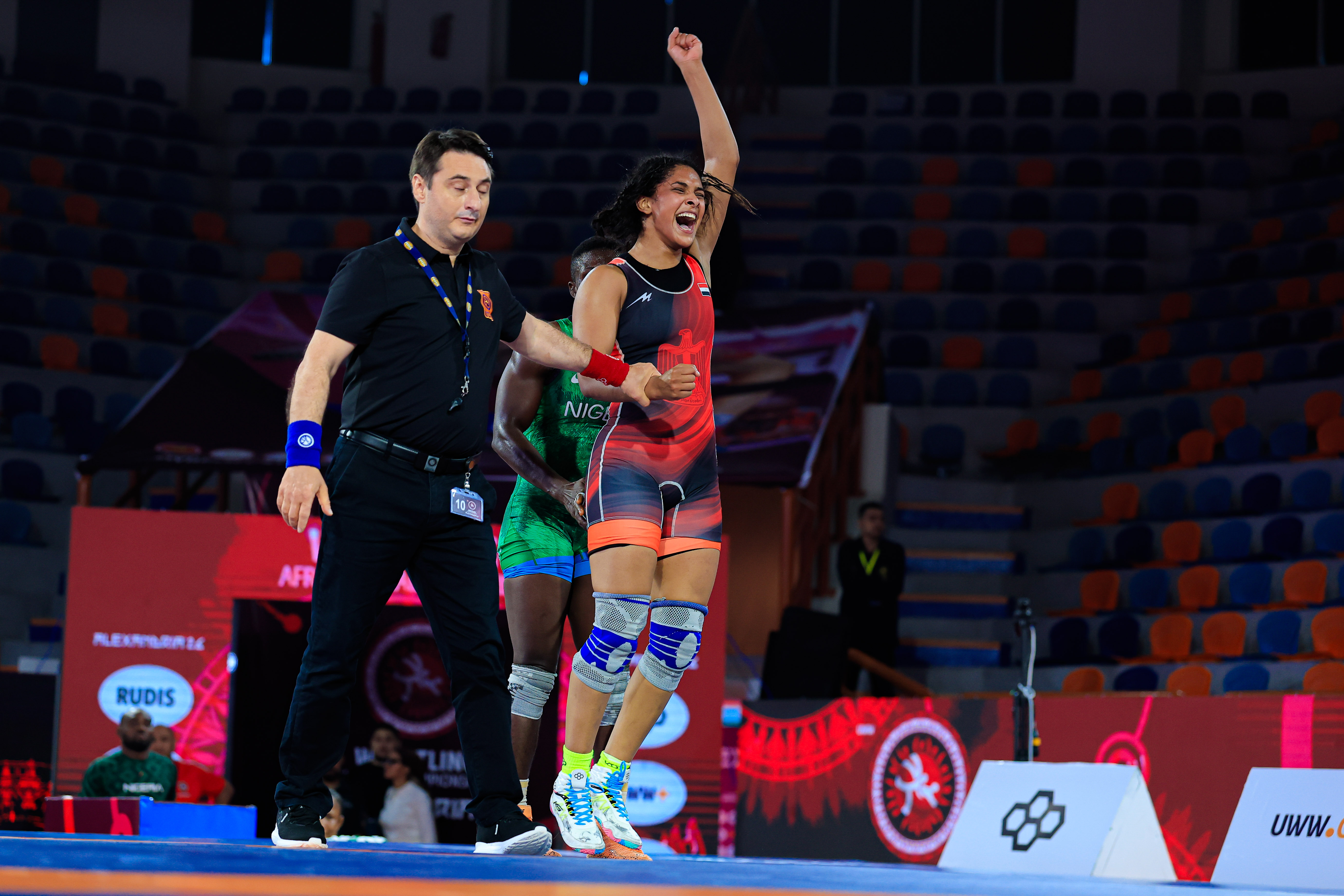
china wrestling

Rising Sun: Chinese Star Aims for Olympic Glory in Land of Top Rivals

By Ken Marantz

Once SUN Yanan (CHN) made the bold decision at 15 to leave home for the unknown to pursue a wrestling career, she knew there was no turning back.

"At the beginning, I told myself I needed to be independant, because I already left home," she recalls. "I cannot go back. If I go back, it would be shameful."

Sun has never looked back and, despite her late start in the sport, has forged a solid career that includes a world gold medal, an Olympic bronze and numerous other laurels. After a setback at the recent World Championships, the 27-year-old has her sights set firmly on the Tokyo 2020 Olympics.

"Step by step, I felt I really enjoyed wrestling and it already became part of my life," Sun says of her development in the sport. "And I wanted to realize my dream to be more confident and become a perfect lady because of wrestling. I really grew up."
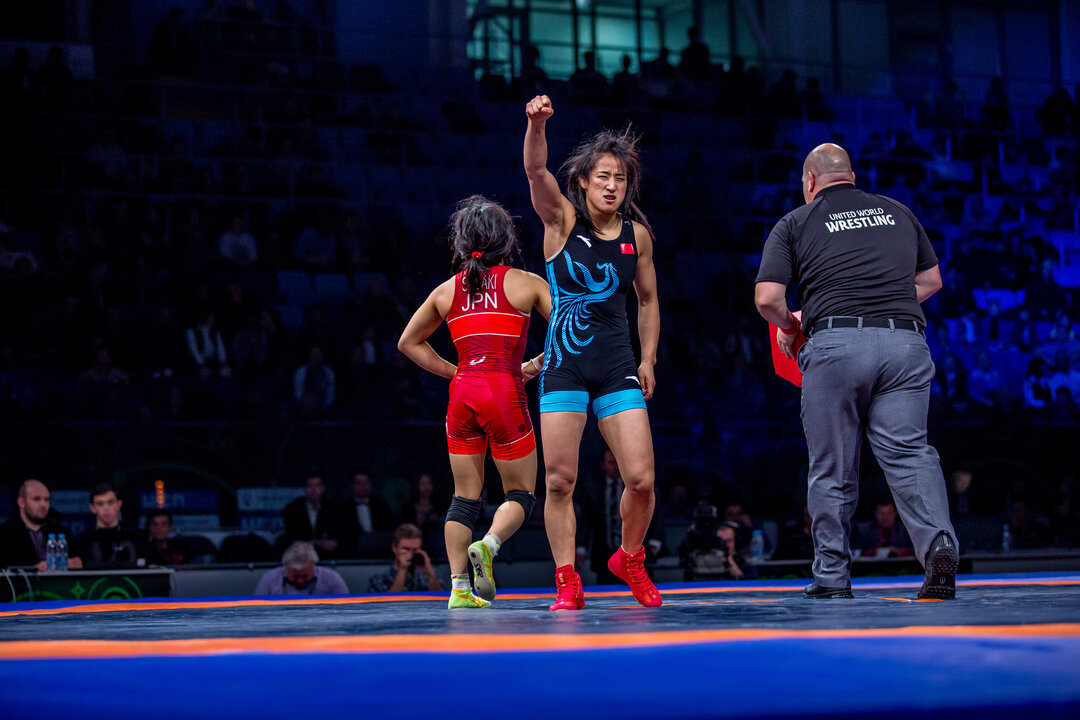
Yanan SUN celebrates during a match with Japan's Yui SUSAKI. (Photo: Max Rose-Fyne)

The 27-year-old Sun speaks easily and openly through an interpreter during an interview at last week's Tokyo 2020 test event, a women's tournament in the six Olympic weights. While Sun attended with the Chinese team but did not take part, the trip gave her a first glimpse of the Olympic venue, located in the Makuhari Messe convention center in neighboring Chiba city.

"I'm very excited when I imagine that next year maybe I will compete here at the Olympics," she says. "I hope I can be much stronger and show my best next year."

Sun secured a spot for China at 50kg by placing fifth at the World Championships in the Kazakh capital of Nur-Sultan last month. Although she finished out of the medals, she showed she could still be a factor in the weight class.

Throughout her career, Sun has inevitably found herself in high-level clashes with opponents from powerful Japan, and the draw in Nur-Sultan put her into a quarterfinal against Yuki IRIE (JPN). Irie, who knocked off two-time world champion Yui SUSAKI (JPN) to make the Japanese team, had beaten Sun in their last two meetings over the past two years.

But on this September day in Central Asia, Sun got the best of her nemesis with the kind of confidence and audacity that develops by leaving home as a teenager to strike out on one's own.

Sun built up a 9-1 lead with two bold moves before holding on for a nail-biting 13-12 win.

The first big move was a backdrop off a front headlock, a 4-point move more likely to be seen in Greco-Roman matches. She had used the move before in a 15-7 win over Vinesh PHOGAT (IND) in India's Pro Wrestling League in January 2018.

"In China, the women also practice that move," Sun says. "[The one against Vinesh] was better than this one."


She topped that soon after, getting behind Irie in the standing position and popping a slick back suplex for 5 points. That proved crucial as she saw an 11-3 lead with 1:30 left whittled down before coming away with the win.

After falling 6-4 to eventual champion Mariya STADNIK (AZE) in the semifinals, Sun lost the bronze-medal match to Ekaterina POLESHCHUK (RUS), although she can take some solace in the way she fought back from a 9-3 deficit with :19 left, scoring 6 points but losing on big-point criteria (the difference was 4-point headlock throw with :40 left).

That experience reaffirmed her policy of not concentrating solely on the Japanese, who will have to earn their own Olympic spot at 50kg at the Asian qualifier in March.

"I haven't only focused on Japan," Sun said. "Because my dream is to become the Olympic champion, so no matter if [the opponent] is Japanese or from other countries, I need to win, I need to improve myself."

As a rambunctious daughter of an electric welder growing up in Fengsheng village in Lioaning Province, located near the border with the Democratic People's Republic of Korea, Sun stood out for her prowess in sports, particularly for her speed as a runner. It caught the eyes of local sports officials.

"When I was young, I was really good at sports," Sun says. "Sprinting, all kinds of sports. One of the wrestling coaches went to my school and found me and invited me to train, and I found that it was very interesting."

One month after completing her studies at the time, Sun left home for the sports school. While she developed a passion for the sport, "at the time, I missed my home very much," she says, adding she returned home for visits just three times in two years. It's during those trips home she can indulge in her favorite dishes from the region, her mom's chicken mushroom stew and pickled cabbage with boiled pork.

Sun, who has a brother nine years her junior who also wrestled but has since stopped, says her family was concerned about her leaving at first, but always supported her efforts.

"At the beginning, my parents thought it would be very hard work," she says. "Later, they could feel that I am very happy when I am involved and I can fight for my team and country, and they supported me."
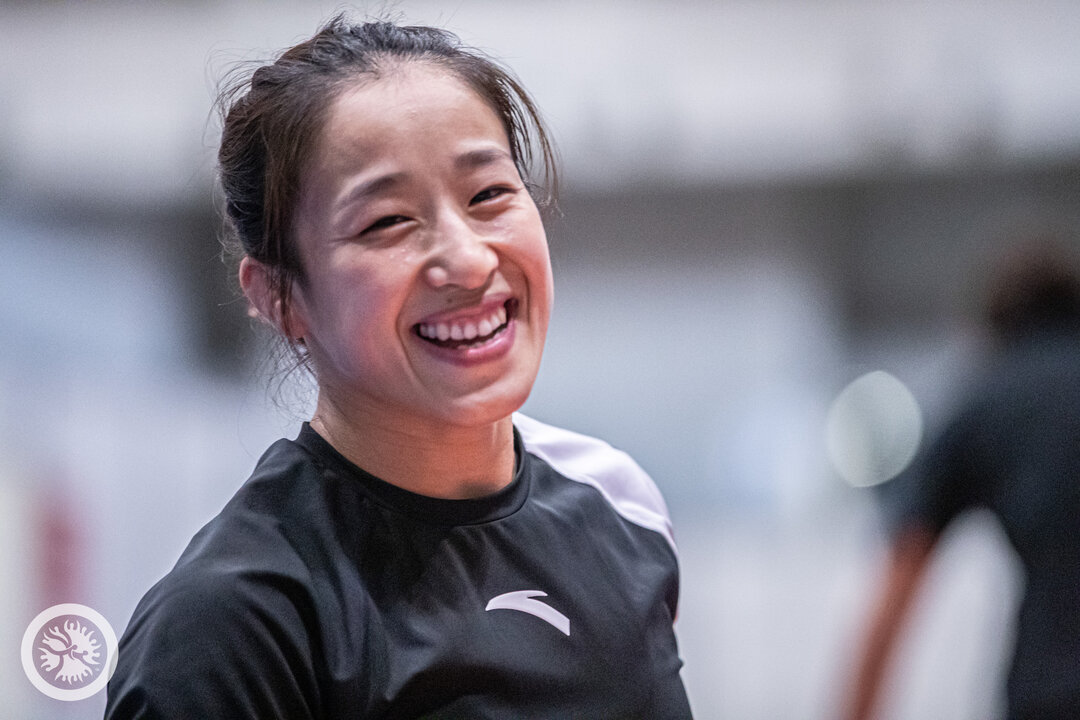
SUN Yanan smiles during a training session during the Toyko Test Event. (Photo: Sachiko Hotaka)

Three years after starting the sport, Sun was invited to train with the national team in Beijing for the first time. Like any youngster from a rural upbringing, she was awed by the big city and star-struck by the heroes with whom she trained.

"I felt that Beijing was a gorgeous city, the center of China, and I was very excited," Sun recalls. "I met so many world champions on the national team, and I so admired them.

"We trained with Wang Jiao, who was an Olympic champion [in 2008 at 72kg], and all I could do was just stare at her all the time," she says with a laugh. "Actually, Wang Jiao is also from Liaoning, the same team [as me], but I met her in Beijing."

Soon after arriving in the capital, she got her first taste of international competition at the 2010 Asian Junior Championships, although she did not have to leave the country. The tournament was held in the eastern China city of Huangshan, known for its World Heritage Site mountain peaks.

"At the time, it was my first time to see so many foreign faces," Sun says. "Some were fat, some were short, some were tall. It was very interesting to compete with so many foreigners."

Scaling her first wrestling mountain, Sun successfully reached the summit, and not surprisingly the final step to the top involved a Japanese. Sun faced Arisa TANAKA (JPN) in the 51kg final and came away with a hard-fought 2-0 (6-2, 9-6) win under the old scoring system.

"The final was with a Japanese wrestler, and I felt at the time the competition was very fierce," she says. "It was a very tough match for me."

Just over one month later, Sun made her first international trip, heading to Budapest for the junior World Championships. Once again, the title came down to her and a Japanese, and Sun walked off with the gold with a 2-1 (2-1, 3-3, 3-2) win over Haruka HIRANO (JPN).

In 2011, she achieved the Asian senior-junior double in tournaments held three weeks apart. Her first senior continental title came at 48kg in Tashkent in May, and the next month in Jakarta, she repeated as 51kg junior gold medalist. In both finals, she defeated Davaanchimeg ERKHEMBAYAR (MGL).

In September that year, she made her first appearance at the senior World Championships, but finished eighth at 51kg in Istanbul after losing to eventual champion Zamira RAKHMANOVA (RUS) in the third round and Jessica MACDONALD (CAN) in the repechage.

After finishing second to MacDonald at the World Championships the following year in Strathcona County, Canada, Sun reached the top of the podium on her third try at 51kg in Budapest in 2013. After gaining revenge by beating MacDonald in the semifinals, she defeated Sumiya ERDENECHIMEG (MGL) for the elusive gold.
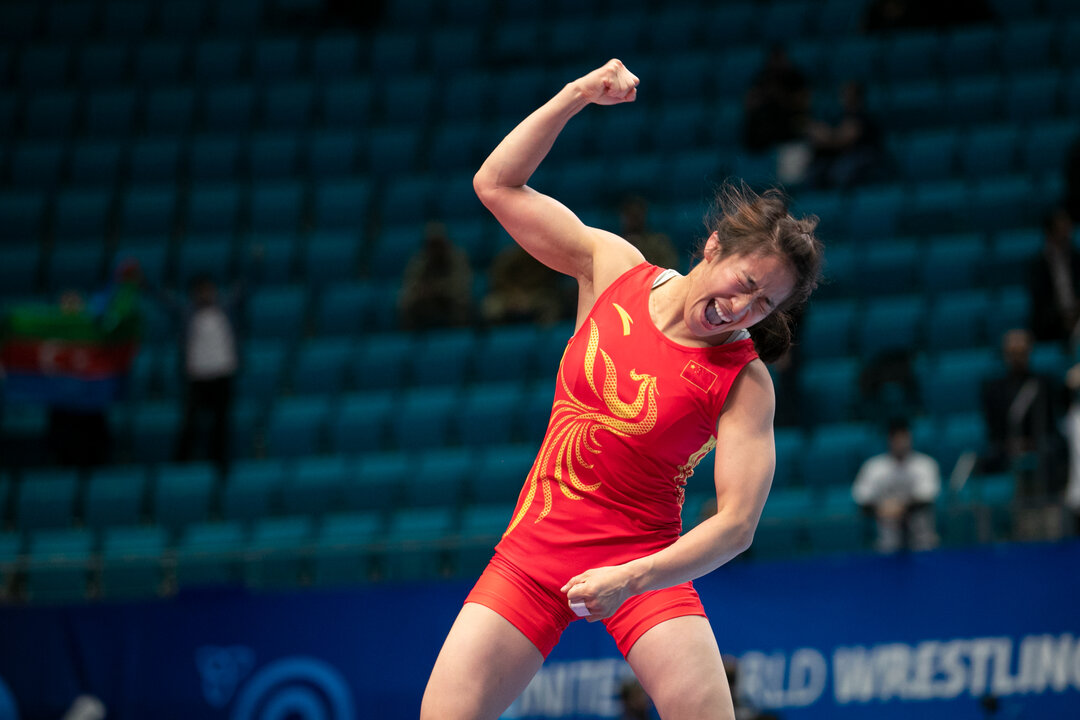
SUN Yanan gets emotional after defeating Yuki IRIE (JPN) at the 2019 World Championships. (Photo: Kadir Caliskan)

It took awhile for the magnitude of the accomplishment to sink in.

"At that time I didn't really pay that serious attention to the World Championships because I was still very young, even though I already attended many international competitions and in 2012, I got second [at the worlds]," Sun says. "It was my third time to attend the World Championships in 2013 and I was still feel very relaxed and did not know what it really meant, not like now."

From 2014, Sun dropped down to the Olympic weight of 48kg, which put her on a direct collision course with Japan's new lightweight star Eri TOSAKA (JPN). Tosaka, a year younger than Sun, was the 48kg champion at the 2011 Asian juniors, the year the Chinese won the 51kg title.

Their first encounter was a close one, with Tosaka winning 6-4 at the 2014 Women's World Cup. Six months later, the setting was the 48kg final at the Asian Games in Incheon, Korea, and the Japanese came away with a 5-1 win and the gold.

Sun would finally get the better of her rival at the 2016 Asian Championships in Bangkok, handing the three-time world champion her first defeat in almost 3 1/2 years with a dramatic victory in the semifinals.

Trailing 2-1, Sun turned Tosaka over with a crotch lift counter with :12 left, but in a final rolling flurry, Tosaka was awarded 2 points for an apparent 4-3 win. The Chinese side challenged the call, and it was amended to give each 2 points, reversing the outcome and making Sun a 5-4 winner.

Sun then went on to capture her second senior continental title with a 12-2 technical fall over Irina BORISSOVA (KAZ) in the final.

For Tosaka, the loss relieved some of the pressure she had put on herself, which would bear fruit when the two would meet with much more at stake six months later.

"Part of me feels relieved," Tosaka was quoted as saying on the Japan federation website at the time. "Up to now, I felt somehow I would always find a way to win. In the back of my mind, I would think, I'm still going to win. I didn't want to lose [today], but to win the gold medal at the Olympics, I think it was probably best to lose once."

That prove prescient, as Tosaka went on to win the gold medal at the Rio 2016 Olympics, taking out Sun in the semifinals 8-3 when she scored a takedown, then ripped off three straight ankle-lace rolls. Sun made sure she didn't leave Brazil empty-handed, as she defeated Zhuldyz ESHIMOVA (KAZ) by 10-0 technical fall for a bronze medal.

Following the Rio Games, Tosaka took time off and underwent foot surgery, but the 48kg hole (later to become 50kg) in the Japanese lineup was quickly filled by a new kid on the block, the teenaged Susaki. She marked her emergence by beating Sun 9-4 in the quarterfinals of the 2017 Asian Championships in New Dehli before going on to win the gold. Sun finished fifth.

Sun suffered another setback the following year at the Asian Games in Jakarta, where Vinesh, who suffered a dislocated knee during their quarterfinal match at Rio 2016, made amends by defeating the Chinese 8-2 in the qualification round. Vinesh went on to win the title by beating Irie in the final.

Sun got back on track by winning a bronze medal at the 2018 World Championships in Budapest, where she lost in the quarterfinals to Stadnik, whose subsequent loss in the final to Susaki gave the Japanese a second straight world title. At this year's Asian Championships, Sun took the silver after losing 6-4 in the final to Irie.

When Sun takes the mat at Makuhari Messe in pursuit of her dream of winning a gold medal at Tokyo 2020, there will be no shortage of rivals more than ready to burst her bubble.

Whoever earns the place for Japan---Susaki, Irie, Tosaka or anyone else---will have extra motivation in gunning for gold in front of the home crowd. And Stadnik, coming off her golden performance in Nur-Sultan, will surely be aiming to make up for her silver at Rio 2016 as her career winds down.

Sun, of course, is still young enough to be considered a candidate for the Paris 2024 Olympics, but she does not foresee sticking around for that one. Asked if she has considered retirement, she replied, "After this Tokyo Games and the year after, there is a National Games held once every four years. After that, maybe," then adds, "What I think most is how to realize my dream first. Then maybe travel around the world."

While an Olympic gold would certainly lead to more fame and fortune than she currently has accumulated like the medals in her trophy case, Sun says it would not have a personal effect on her.

"It will change nothing for me," she says. "I will still be myself. After this is realized, I will find my next dream and try to realize it."

And if it means leaving home, so be it. She will keep looking ahead.

#JapanWrestling

Fujinami survives scare to take 57kg title, extend streak to 150 wins

By Ken Marantz

TOKYO (December 21) -- It was one of those unimaginable scenes that suddenly appears like a mirage. Was that really Akari FUJINAMI, the Paris Olympic champion and two-time world champion who had not lost since 2017, on her back and fighting to prevent an upset of epic proportions?

Alas, Fujinami being Fujinami, she managed to avoid the fall, then came back with a late takedown to escape with a 4-2 victory over a gutsy Himeka TOKUHARA in the women's 57kg final at the Emperor's Cup All-Japan Championships on Sunday.

"I came up against reality at this tournament," said Fujinami, who extended her current winning streak to 150 matches dating back to junior high school, while continuing to make the tough adjustment from 53kg up to 57kg.

"To give up those points isn't a good thing, but it shows I have room for growth. Close matches like this are exciting. This down-to-the-wire, thrilling wrestling was really fun. I came out of this tournament with the feeling that I will become even stronger."

The final day of the four-day tournament at Tokyo's Komazawa Gym spotlighted much of the cream of the Japanese crop, with six medalists from the Paris Olympics in action and one weight class featuring a clash of reigning world champions.

Among the other Paris gold medalists, the lone one to taste defeat was Sakura MOTOKI, who fell to nemesis and Paris bronze medalist and defending champion Nonoka OZAKI 3-3 in a nail-biting women's 62kg final. Kotaro KIYOOKA triumphed amid a stacked field at freestyle 65kg, while Nao KUSAKA continued his domestic dominance at Greco 77kg.

The tournament is also serving as the qualifier for the Asian Championships in April, as well as one of two qualifiers for the World Championships and Asian Games, to be held in fall. The latter holds additional significance in that it will be held in Japan.

Akari FUJINAMI (JPN)Akari FUJINAMI finishes up the winning takedown against Himeka TOKUHARA in the final minute of the women's 57kg final. (Photo: Takeo Yabuki / wrestling-spirits.jp)

The 22-year-old Fujinami, the Paris champion at 53kg, announced earlier this year that she was moving straight up to the next Olympic weight class at 57kg. But she opted to not even try to qualify for this year's senior World Championships, feeling she wouldn't be physically ready, and instead had her first test run of sorts with a victory at the world U23.

The two days at the All-Japan seemed to validate her decision to not rush the process, as she had her hands full with two of Japan's more powerful wrestlers.

In the semifinals on Saturday, she was never in danger of losing to Asian champion Sara NATAMI, but she gave up two 2-point exposures on counters late in a 7-4 victory. Then against Tokuhara, it was like she ran into a brick wall that crashed down on top of her.

Tokuhara, a member of the Japan Self-Defense Force team who was a world U23 champion at 59kg in 2022, relies on her power, which earned her the ticket at 57kg to this year's World Championships in Zagreb, where she lost in a bronze-medal match.

"Tokuhara and Natami are both strong, physical wrestlers," Fujinami said. "When I moved up to 57kg, those are the two I most needed to beat. Beating them both is a plus. Of course, everyone looks at the points I gave up, but I became the challenger when I moved up in weight, and I'm glad to have been able to come out with the win."

Akari FUJINAMI (JPN)Akari FUJINAMI squares off with Himeka TOKUHARA in the women's 57kg final. (Photo: Takeo Yabuki / wrestling-spirits.jp)

After her win, which gave her a fourth career title and first since 2022, she showed a vulnerable side, acknowledging she has a fear of failure and concerns over her ability to continue her incredible success amid the new challenge. Speaking about the pressure brought her to tears at one point.

"I'm really afraid of losing," she said. "It's strange for me to start crying now. My goal is to win the titles at the Asian Games and Los Angeles Olympics, and every day, I wonder to myself, is this the right thing to do? Is this making me better?

"I am also human, and there are things that scare me. It's that fear that makes me work hard every day. I'm sure I will have even tougher matches ahead. It feels like a given that I will win, and if I lose, everything will fall apart."

Akari FUJINAMI (JPN)Akari FUJINAMI gets a stepout in the second period of the women's 57kg final. (Photo: Takeo Yabuki / wrestling-spirits.jp)

In the final, Fujinami found her takedown attempts consistently blocked by Tokuhara, who relied on an effective whizzer or a front head lock, and had only an activity point to show for the first 2:30 of the first period. That was when the wall fell on her.

When Fujinami shot in for a single, Tokuhara whizzered to get Fujinami to straighten up. Then she pivoted around with a fierce pancake that slammed Fujinami straight to her back for 2 points with :25 left on the clock.

Fujinami set her left elbow on the mat to keep her shoulder up as Tokuhara pressed for the fall.

With only a few seconds left, Fujinami transitioned to a bridge, but at one point her shoulders hit the mat for a split second. The mat referee indicated a fall, but neither side judge confirmed, and time ran out.

Asked when the last time she was in danger of a fall, Fujinami laughed and replied, "I can't even remember the [opponent's] name."

Fujinami said she knew how much time was left and that she was confident she could ride it out. She said she constantly practices for such a situation, even though it would seem that the odds of it happening were somewhere in the Powerball range.

"I thought the way she had the hold, I wouldn't be pinned," Fujinami said. "I do bridges every day in practice. I had prepared for the possibility of this situation, so I wasn't thinking, 'Oh no, what should I do?' And even though I don't have much actual experience, I stayed calm.

"I knew that move was in her arsenal, but I couldn't stop it. It showed that I still have weakness. I also practiced what to do after failing to get in on a tackle, but she still hit the move, so there's still some work to be done."

Akari FUJINAMI (JPN)Akari FUJINAMI shoots for the winning takedown against Himeka TOKUHARA in the final minute of the women's 57kg final. (Photo: Takeo Yabuki / wrestling-spirits.jp)

There was also still the match to be won, as she trailed 2-1 and had yet to come close to a takedown, which in this weight class, she has had to depend on more. In the 21 points she scored over three matches, none came from ground wrestling.

Midway through the second period, she was stopped again and close to being forced out with her back to the edge. But she nimbly used Tokuhara's momentum to slip around and force her out for a stepout that made it 2-2, but still left her trailing on criteria.

With a minute to go, Fujinami finally connected with a single-leg attempt. As Tokuhara reached over for a counter, Fujinami pressed ahead and gradually finished up the takedown with :45 left.

She then put up a wall of defense that Tokuhara could not penetrate to secure the victory. "I'm really happy to have come out with a win," Fujinami said. "It was a daily fight to prepare for this tournament."

Nonoka OZAKI (JPN)Nonoka OZAKI celebrates her victory over nemesis and Olympic champion Sakura MOTOKI in the women's 62kg final. (Photo: Takeo Yabuki / wrestling-spirits.jp)

There was more drama to follow in the next and final match of the tournament, which paired Motoki and Ozaki for supremacy at 62kg once again.

Last June at the Meiji Cup All-Japan Championships -- the second of the two domestic qualifiers for major global competitions -- Motoki squeaked out a 3-3 victory over Ozaki in the final. She then followed that with a 6-5 victory in the world team playoff in which she literally scored the winning takedown in the final second.

Ozaki could then only watch as Motoki went on to win her first senior world title, which she then followed up by winning the world U23 gold. That made her just the third wrestler in history to achieve the "Golden Grand Slam" of Olympic, senior world and all three world age-group golds.

On Sunday, it was Ozaki's turn for late dramatics, albeit she didn't cut it that close. She was leading 1-1 on criteria after an exchange of activity points when Motoki scored a single-leg takedown with 1:30 left. Ozaki kept up the pressure before securing a single-leg takedown of her own with :18 left for the victory.

"The last time, I lost with less than a second left, which taught me that that's something that can happen," Ozaki said. "I thought, if my opponent can do it, then I can do it as well. I thought to imitate, or learn from, Motoki's fighting style and her mental strength.

"In the second period, I gave up points, but I thought I would do to her what she did to me. I kept fighting and looked to take advantage of any chance."

Yoshinosuke AOYAGI (JPN)Yoshinosuke AOYAGI unsuccessfully attempts a front body lock roll in the freestyle 74kg final against Kota TAKAHASHI. (Photo: Takeo Yabuki / wrestling-spirits.jp)

Aoyagi prevails in clash of world champions

In the second final of the tournament that pitted reigning world champions, Yoshinosuke AOYAGI made a successful incursion into the freestyle 74kg territory currently ruled by Kota TAKAHASHI.

Aoyagi, the freestyle 70kg champion in Zagreb, scored a takedown and roll combination with 40 seconds left, then held on for a 4-4 victory on criteria for his first All-Japan title. 

While happy with the victory, Aoyagi was left less than satisfied by his lack of an effective offense. His winning combination came after he spun behind in countering a takedown attempt.

"I'm still small in build, and he controlled the flow of the match," Aoyagi said. "Honestly speaking, I thought if it stayed that way I would lose. I didn't score any points with my moves, so there is much to reflect on from this match."

He says he plans to enter a Ranking Series tournament and, without going into specifics, said he would like to go overseas to train with U.S. and Russian wrestlers which "is the best way to improve one's skills and which benefits both sides."

He is also looking forward to testing himself at the Asian Championships, "Where I can show that I can be competitive at 74kg on the global stage," he said.

"I'm still in the stage where it's really tough, and I lack the power and get pushed around," Aoyagi said. "After the match, my legs were burning. There's so much more I need to do. I will look for ways to make improvements."

Kotaro KIYOOKA (JPN)Kotaro KIYOOKA sweeps to the side for a takedown against Takara SUDA in the freestyle 65kg final. (Photo: Takeo Yabuki / wrestling-spirits.jp)

At freestyle 65kg, Kiyooka used his low single and dynamic speed to scrape together a 5-2 victory in the final over Asian 61kg champion Takara SUDA.

Kiyooka swept to a low single-leg takedown in each period, but said he needs to work on setting it up closer.

"I wanted to cut the distance a little more, and use more variation for my shots," he said. "There's still many things I need to work on."

Kiyooka said he gained inspiration from his sister Moe's victory at 53kg on Saturday. It marks the second time that the two have completed a sibling double after 2023, when he won his lone other title.

Kiyooka, who had never medaled on the world level when he came out of nowhere and triumphed at the Olympics, got a wakeup call of sorts in Zagreb, where Rahman AMOUZAD (IRI) avenged his loss in the Paris final by beating him for the world gold.

"I realized my weakness," Kiyooka said. "As I said during the World Championships, I felt I wasn't the true champion. Wrestling is very deep and it made me feel I can still grow, so I took [the loss] in a positive light."

Yui SUSAKI (JPN)Yui SUSAKI shoots for a takedown against Haruna MORIKAWA in the women's 50kg final.  (Photo: Takeo Yabuki / wrestling-spirits.jp)

At women's 50kg, Tokyo Olympic champion and Paris bronze medalist Yui SUSAKI turned a bit more conservative than she would have liked, but was never in danger in coming away with a 3-0 victory in the final over world U23 champion Haruna MORIKAWA.

Susaki scored a single-leg takedown and stepout in the first period, then spent the second trading underhook positions and fending off Morikawa's lone shot of the match to secure her fourth career title and first since 2022.

"It was my first All-Japan in awhile and I definitely wanted to win," Susaki said. "Although that feeling was strong, I wasn't aggressive enough in the second period. It was a match that brought up things to work on."

Susaki, a four-time world champion and another member of the "Golden Grand Slam" trio, took advantage of the absence of main rivals Remina YOSHIMOTO, who sat out the tournament, and Umi ITO, who withdrew due to injury.

"With the Los Angeles Olympics ahead and my main rivals not competing, I also considered this a tournament I couldn't lose," she said.

Susaki said the victory culminates a rough span since the disappointment of Paris, from which she still feels the sting of failing to defend her Olympic crown.

"There was the loss at the Paris Olympics, there were injuries and various hardships that I went through that I had never faced before," she said. "It was really a trying year and a half. If it wasn't for the support of many people, I would not have been able to make it back here."

In Greco 77kg, Kusaka executed a 2-point throw in his second chance from par terre -- there was some discussion over whether it should be scored as 4 -- which was enough for a 4-0 victory over 2023 champion Isami HORIKITA.

The victory added to Kusaka's lone other title, won at 72kg in 2019, and capped a year in which he also won a silver medal at the World Championships.

At Greco 67kg, defending champion Katsuaki ENDO won the latest in the seemingly endless series of finals with former Nippon Sports Science University teammate and top rival Kyotaro SOGABE, scoring a second-period gut wrench for a 3-1 victory.

It was Endo's fourth career title as he and Sogabe have now combined to win the last five golds.

Day 4 Results

Freestyle

65kg (15 entries)
GOLD: Kotaro KIYOOKA df. Takara SUDA, 5-2

BRONZE: Kaiji OGINO df. Shinnosuke SUWAMA, 3-0
BRONZE: Kaisei TANABE df. Futa MIYAZAKI by TF, 11-0, 3:45

74kg (11 entries)
GOLD: Yoshinosuke AOYAGI df. Kota TAKAHASHI, 4-4

BRONZE: Toki OGAWA df. Yujin TAKIZAWA, 4-1
BRONZE: Hikaru TAKATA df. Tatsuki KAMIYA by TF, 12-0, 2:35

Greco-Roman

67kg (13 entries)
GOLD: Katsuaki ENDO df. Kyotaro SOGABE, 3-1

BRONZE: Kensuke SHIMIZU df. Takaku SUZUKI by Fall, 4:30 (8-0)
BRONZE: Haruto YABE df. Kojiro HASEGAWA by TF, 13-2, 2:25

77kg (13 entries)
GOLD: Nao KUSAKA df. Isami HORIKITA, 4-0

BRONZE: Kiriru SHIMABUKURO df. Naoki KADODE, 7-1
BRONZE: Issei HONNA def. Kodai SAKURABA by Inj. Def.

Women's Wrestling

50kg (17 entries)
GOLD: Yui SUSAKI df. Haruna MORIKAWA, 3-0

BRONZE: Mako ONO df. Yuu SAKAMOTO, 3-1
BRONZE: Rinka OGAWA df. Kurumi KANAYAMA, 9-0

57kg (10 entries)
GOLD: Akari FUJINAMI df. Himeka TOKUHARA, 4-2

BRONZE: Rin KINOSHITA df. Risa MOTOHARA, 2-1
BRONZE: Sara NATAMI df. Miyu IWASAKI by Fall, 1:59 (4-0)

62kg (9 entries)
GOLD: Nonoka OZAKI df. Sakura MOTOKI, 3-3

BRONZE: Yuzuka INAGAKI df. Hana YOSHIKAWA by TF, 10-0, 3:38
BRONZE: Sakura ONISHI, no opponent