

Teen Star Fujinami Misses Shutout but Rolls to 2nd National Title at 53kg
Sunday, December 19, 2021 - 16:00 By Ken Marantz

TOKYO, Japan (December 19)--Teen phenom Akari FUJINAMI admits she's an attention-seeker who likes to stand out in the crowd, enough so that it motivated her to do something quite surprising after winning a world title in her international senior debut.
Less than three months later, it looks like Fujinami will be having a long stay in the spotlight after capturing a second national title just a month after her 18th birthday.
Fujinami gave up a rare takedown, but was otherwise unchallenged as she cruised to the women's 53kg title at the Emperor's Cup All-Japan Championships with an 8-2 victory in the final over former world silver medalist Nanami IRIE on Sunday at Tokyo's Komazawa Gym.
"To win the title, I'm happy as usual, but looking at how I did it, there were some rough parts that I'll need to work on if I want to improve and get to where I want to be," said Fujinami, who won the gold medal at October's World Championships in Oslo with four straight technical fall victories and without surrendering a point.
Fujinami was one of three reigning world champions in action on the final day of the four-day tournament, which is serving as one of two domestic qualifiers for next year's World Championships in Belgrade, as well as for the Asian Games in Hangzhou, China. The winners will also likely be selected for the Asian Championships, scheduled for April at a venue to be determined.
The results were mixed for the two other Oslo gold medalists, as Remina YOSHIMOTO managed to successfully defend her Emperor's Cup crown at women's 50kg, but Ken MATSUI went down to a humbling defeat in the Greco 55kg final.
Fujinami, who advanced to the final with a pair of 10-0 technical falls, capped her last tournament as a high schooler by extending a winning streak to 86 matches, dating back to her junior high school days in 2017.
Not that it matters to her. "The winning streak is in the past. I put more importance on now and what lies ahead," Fujinami said.
To qualify for Oslo, Fujinami won her first-ever events on the senior level, last year's Emperor's Cup and this year's Meiji Cup All-Japan Invitational Championships, the second qualifier for Japan's world team held in May. She turned heads at both by handily defeating both Irie and two-time former world champion Haruna OKUNO.
This time, Fujinami only had beat the winner of a semifinal between those two, and that became Irie after riding a 4-point pancake to a close 5-4 decision over Okuno. But Irie, the 2019 world silver medalist at 55kg, proved a different foe for Fujinami than the one who was dealt shutout losses the first two times they met.
Fujinami, relying on her lightning-quick single-leg attack, had a 4-0 lead in the second period when Irie used a hard cross face to fend off a tackle and spin behind. It was only the second time in 19 matches this year that someone scored on Fujinami. In the first period, Irie managed to slip out of the grasp of a tackle attempt.
"In the final, there was a time where I had a hold [of a leg] and lost it," Fujinami said. "It was just sloppy. Part of it was that I rushed my tackles, so now I feel like I really have to work on the fine points in practice."
While the takedown might have been a moral victory for Irie, it was hardly enough, especially after Fujinami came back with a pair of takedowns to put the match away. But it makes Fujinami aware that ascending the throne means that others are going to look for ways to knock her off it.
"I'm grateful that people are studying me," Fujinami said. "If I can win even after they study me, then it shows that I am making progress."
Later, Fujinami's father, who is also her coach at Inabe Sogo Gakuin High School in Mie Prefecture, revealed that Akari did not practice in the two days before the tournament because of back pain. He said that that might have affected her movement in the final.
All that Fujinami has accomplished is shadowed by the fact that it has come without the presence of Tokyo Olympic champion Mayu MUKAIDA, who, like all of Japan's gold medalists, skipped the tournament. But Fujinami openly welcomes that battle, whenever it comes.
"I haven't faced her yet, but someday I think we'll meet up, and I believe that I will definitely win," said Fujinami, who has already committed to attending Nippon Sports Science University in the spring. "She's a strong opponent, but I have a strong determination to beat her."
Her fervent desire to be in the spotlight led to a surprise in Oslo beyond her gold-medal run. After her victory, she stunned the Japanese press by bypassing the translator and answering an English question in English. She had gone to an English-language school while in elementary school but had specially prepared for Oslo.
"I'm the type who likes to get attention, and I figured the Japan women's team would win a lot of titles and I had worked hard to be among them," Fujinami said. "But I was thinking, what can I do to stand out among them? I thought if I answer in English to English questions in an interview, that might do it.
"To do that, from about three months before the World Championships, my teacher and I would meet at lunch and practice doing an interview in English."
Asked how being a world champion has affected her life, she replied, "So many people were happy for me, it made me realize how awesome it is to win. I want to get even stronger and win more on the global stage."
 Remina Yoshimoto, the 2021 world champion, became the national champion at 50kg (Tateo Yabuki / Japan Wrestling Federation)
For Yoshimoto, her victory at 50kg may have best revealed how far she has to go to catch up to Tokyo Olympic gold medalist Yui SUSAKI, who has beaten her in two career meetings.
Yoshimoto won a battle of activity clock points in the final against Umi ITO, receiving two in the second period for a dour 2-1 win over the teammate of Susaki's at Waseda University.
It was a rematch of the Meiji Cup final last spring but was a far cry from the 9-0 technical fall that Yoshimoto chalked up then.
"Without feeling pressure as the world champion, I was confident coming into here," Yoshimoto said. "I was able to win out against the tough competition, and that will be important for the future. That is part of making progress.
"But there were plenty of issues in my execution, and by drawing these out, I can work on them for the next tournament."
Yoshimoto knows she will have to pick up her game to have a chance against Susaki, who says she will enter next spring's Meiji Cup in a bid to earn a ticket to Belgrade and a third-world title.
"She's strong mentally," Yoshimoto said of Susaki. "She easily won at the Olympics, but she can find a way to win any match, even when she is losing. She's really amazing."
 Yu Shiotani humbled world champion Ken Matsui with an 11-0 win in the 55kg final. (Tateo Yabuki / Japan Wrestling Federation)
At Greco 55kg, Matsui's bid for a first career national title in what was billed as a clash of history-makers ended with a pair of thuds, as Asian champion Yu SHIOTANI slammed him to the mat with consecutive 5-point throws in an 11-0 technical fall.
"It was pathetic, I couldn't do anything," Matsui said. "I was on a high after winning at the World Championships, so I took it too lightly and went into the match thinking, 'I've got this won.'"
Shiotani, awarded the top position in par terre, lifted Matsui perpendicular into the air, then just fell forward and dumped him onto the mat. He then repeated the process, ending the match at 1:42.
"It's not that I particularly like [that move], but it's nice to win that way," said Shiotani, a student at Takushoku University.
Shiotani lost a chance to qualify for Oslo when he finished second at last year's Emperor's Cup for the second straight year, then missed this year's Meiji Cup due to injury. That opened the door for NSSU's Matsui, who won the Meiji Cup and then struck gold in Oslo.
"I couldn't compete sometimes or I was always finishing second," Shiotani said. "Matsui went to the World Championships and won the title. That was hard to take. But I was able to face him here and I thought this time I'll beat him."
Both have already earned places in Japanese wrestling history. Matsui's victory in Oslo at age 20 years 8 months made him Japan's youngest-ever world Greco champion, while five months earlier, Shiotani won the Asian title at age 19 years 5 months, making him the nation's youngest-ever continental champion.
Veteran Tomohiro INOUE won his sixth national title and first in three years with a 5-1 victory in the Greco 72kg final over defending champion Shogo TAKAHASHI -- who Inoue coached years ago at Ikuei High School in Hyogo Prefecture.
The 34-year-old Inoue, a member of the Japan team to Oslo, showed the master still had some life left in him by scoring a gut wrench from par terre in the second period, then adding a takedown when Takahashi seemed to lose his balance and fell backward.
The two previously met in the 66kg final in 2015, with Inoue winning by technical fall.
Takahashi, 27, has spent almost all of recent years at 67kg, where he won three national titles and a 2019 Asian bronze medal but came up short in two shots at qualifying for the Tokyo Olympics.
 Sohsuke Takatani is now the third wrestler in Japan to win 11 consecutive national titles. (Tateo Yabuki / Japan Wrestling Federation)
In freestyle, Sohsuke TAKATANI became the third wrestler in Japanese history to win 11 consecutive national titles and fifth with 11 overall when he successfully defended his 92kg crown.
The 32-year-old Takatani had little trouble storming to a 12-2 technical fall over 2020 Asian silver medalist Takuma OTSU, putting him into an elite group with Yasutoshi MORIYAMA (16 straight titles from 1982-95) and Kyoko HAMAGUCHI (12 straight from 1996-2007).
Takatani, the 2014 world silver medalist at 74kg, put together his streak over four weight classes. This summer, he appeared in his third Olympics at 86kg but fell in the first round. He was the only member of Japan's Olympic team to enter the Emperor's Cup.
 Toshihiro Hasegawa dropped down from 61kg to win the gold at 57kg. (Tateo Yabuki / Japan Wrestling Federation)
Toshihiro HASEGAWA, Japan's only freestyle medalist in Oslo when he won a bronze at 61kg, dropped down to 57kg and won his first national title with a 2-1 victory over Asian bronze medalist Yuto TAKESHITA.
Hasegawa, after giving up an activity clock point, used a slick duck under for a takedown with :05 left in the first period, and made that hold up to edge Takeshita, who ousted 2019 world junior champion Toshiya ABE 2-1 in the semifinals.
Day 4 Results
Freestyle
57kg (11 entries)
Final - Toshihiro HASEGAWA df. Yuto TAKESHITA, 2-1
3rd Place - Toshiya ABE df. Rikuto ARAI by TF, 14-4, 5:42
Semifinal - Takeshita df. Abe, 2-1
Semifinal - Hasegawa df. Arai, 4-2
92kg (12 entries)
Final - Sohsuke TAKATANI df. Takuma OTSU by TF, 12-2, 5:53
3rd Place - Yuto ITSUTSU df. Ryoichi YAMANAKA by TF, 10-0, 1:12
Semifinal - Takatani df. Itsutsu by TF, 17-4, 4:12
Semifinal - Otsu df. Yamanaka, 2-1
Greco-Roman
55kg (11 entries)
Final - Yu SHIOTANI df. Ken MATSUI by TF, 11-0, 1:42
3rd Place - Taiga ONISHI df. Kagetora OKAMOTO by Def.
Semifinal - Matsui df. Okamoto by Fall, 2:00 (9-0)
Semifinal - Shiotani df. Onishi by TF, 10-0, 2:15
72kg (12 entries)
Final - Tomohiro INOUE df. Shogo TAKAHASHI, 5-1
3rd Place - Seiya TERADA df. Daigo KOBAYASHI by Inj. Def., 0:44
Semifinal - Takahashi df. Terada, 5-1
Semifinal - Inoue df. Kobayashi by TF, 9-0, 4:23
Women's Wrestling
50kg (12 entries)
Final - Remina YOSHIMOTO df. Umi ITO, 2-1
3rd Place - Miho IGARASHI df. Haruna MORIKAWA by TF, 15-2, 6:00
Semifinal - Yoshimoto df. Morikawa by TF, 10-0, 1:13
Semifinal - Ito df. Igarashi by TF, 10-0, 1:27
53kg (12 entries)
Final - Akari FUJINAMI df. Nanami IRIE, 8-2
3rd Place - Haruna OKUNO df. Yumi SHIMONO, 5-3
Semifinal - Fujinami df. Shimono by TF, 10-0, 4:39
Semifinal - Irie df. Okuno, 5-4
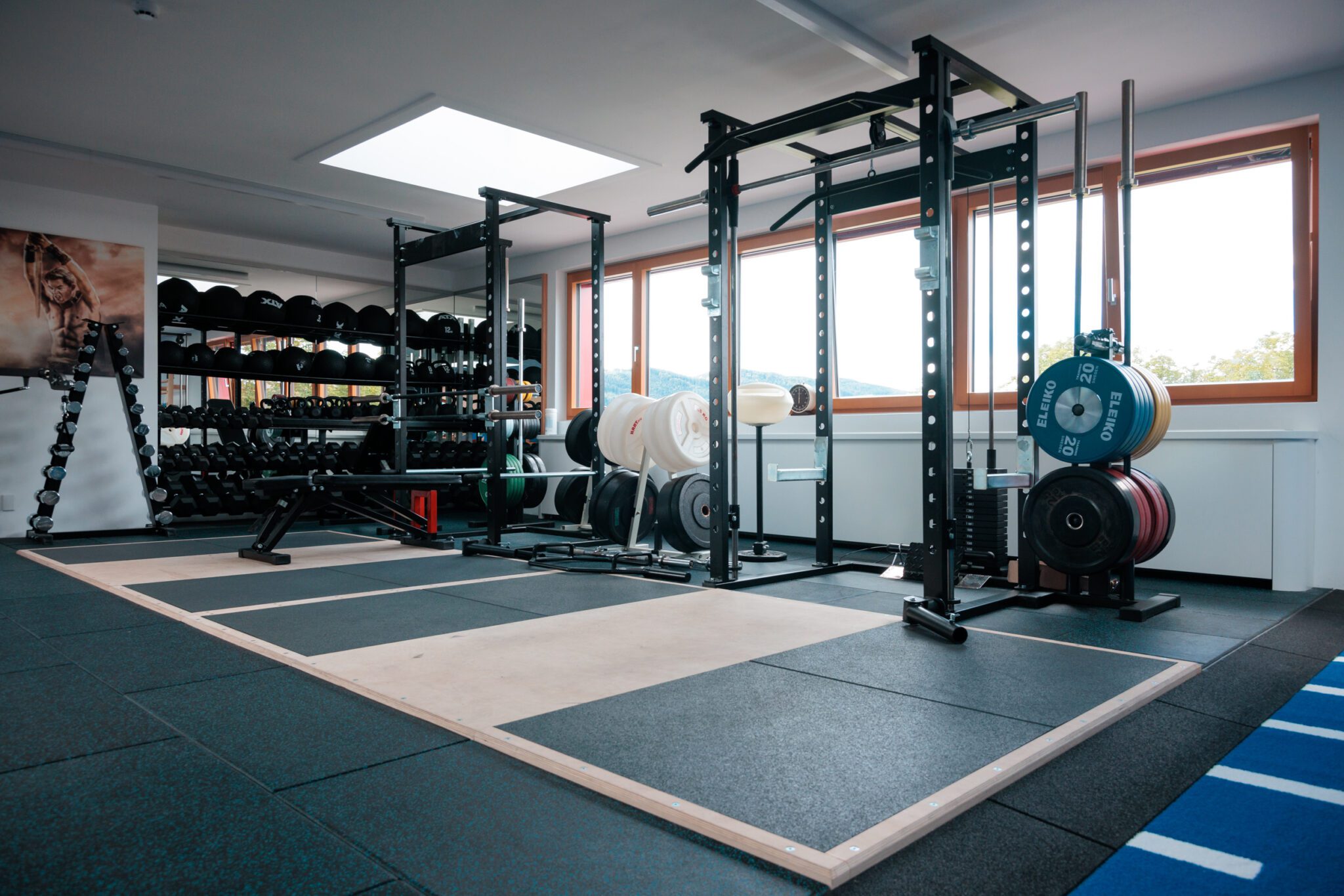 Fitness centre at A.C. Wals. (Photo: Austrian National Wrestling Centre)
 A.C. Wals
Share your thoughts.
Comments