

#RulesAndRegulations

UWW Changes Rules to Promote Active Wrestling, Balance in Brackets

By United World Wrestling Press

CORSIER-SUR-VEVEY, Switzerland (January 27) – United World Wrestling's Bureau announced changes to wrestling's rules that are effective immediately.

One of the most significant rule changes regards points scored by the active wrestler during the 30-second activity period. With the updated rules, the active wrestler will receive points for any attacking moves and one point if their opponent fails to score while on the 30-second activity period.

Introducing this change encourages the active wrestler to score point(s) during the 30-second activity period.

Before last week's changes, the active wrestler received points for their attacking move or the one-point for their opponent's inactivity.

Another key decision that'll impact the match-point system is the update to fleeing the mat.

Independent of the style, any wrestler fleeing the mat will be penalized with a caution and 1 point without the need of a previous verbal warning. This penalty is counted in addition to the scored action. (Example: if action ends with Takedown = 2 points, then caution + 1 additional point. With stepping-out = 1 point, then caution + 1 point).

In Greco-Roman, fleeing the hold in both parterre and standing position will now be penalized with caution + only 1 point for the opponent.

The Bureau also approved specific changes related to challenges, draws and passivity warnings.

Qualification round draws will now be equally distributed using the top-bottom-bottom-top approach to provide a balanced bracket between the upper and lower half of the draw. The system used to place the seeded wrestlers will also follow the approach.

Examples of different types of brackets can be accessed here.

Coaches can now request a challenge after the points are published on the scoreboard or five seconds after the wrestlers come to the neutral position. This is a change from the earlier rule where the coaches only had five seconds to challenge after the score in question was published on the scoreboard.

The Bureau removed the verbal warning for passivity for U15, U17 (cadet) and Veterans as periods are shorter than U20 (junior), U23 and Seniors.

If a wrestler is in a danger position and simulates an injury while their opponent is looking for the fall, the referee will no longer stop the bout. In this case, the referee will ask for the fall, and the mat chairman will confirm it.

For a complete list of United World Wrestling's most up-to-date rule changes, please click here.
#development

Road to Dakar 2026 Continues with Successful Central Africa Programme in Brazzaville

By United World Wrestling Press

BRAZZAVILLE, Republic of Congo (June 21) -- The second stop of the United World Wrestling (UWW) Africa Regional Educational Development Programme, Road to Dakar 2026, concluded successfully in Brazzaville after a week combining athlete preparation, education, technical development and competition in Olympic and Beach Wrestling.

Held from June 8 to 14 in the Republic of Congo, the Central Africa phase brought together National Olympic Committees and National Federations from across the region under a unified objective: strengthening wrestling ecosystems and creating more accessible pathways toward the Youth Olympic Games Dakar 2026.

As the second of four regional tournaments scheduled within the continental Road to Dakar programme, the event represented another important milestone on the road to the first Olympic event to be hosted on African soil.

Africa REDT

The UWW Africa Regional Educational Development Programme was designed as a comprehensive and sustainable model that extends beyond competition. The initiative combines athlete development camps, coach and referee education, and practical competition opportunities.

By decentralising activities across regions and consolidating training and competition into one structure, the programme aims to reduce financial barriers for national federations and increase opportunities for athletes and technical officials.

Throughout the week, athletes participated in intensive daily training sessions, as coaches attended the UWW Technical Course - Level 2, focused on improving technical knowledge, athlete development methodologies and long-term performance planning.

Africa REDT

Simultaneously, referees took part in dedicated education sessions covering Beach Wrestling and introductory officiating pathways, preparing them for selection to undertake the International Category III referee examination in the future.

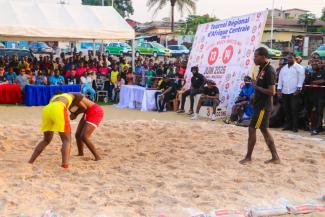
The programme concluded with the Regional Tournament, followed by the Beach Wrestling Regional Tournament, giving participants the opportunity to apply lessons learned during the educational phase directly into competition conditions.

The programme specifically prioritised youth development, with participating athletes largely drawn from the U17 age group and encouraging the involvement of emerging coaches across Central Africa. Support mechanisms jointly delivered by UWW and Olympic Solidarity helped facilitate participation through travel, accommodation, training access and tournament organisation.

Africa REDT

More than just a standalone event, Brazzaville demonstrated the long-term vision behind Road to Dakar 2026 by building stronger national structures, expanding participation and creating sustainable development opportunities well before the final qualification stages for the Youth Olympic Games.