

Uzbekistan's Bunyod Lays Foundation with Second U17 World Title
Wednesday, July 29, 2026 - 18:46 By Vinay Siwach

BAKU, Azerbaijan (July 29) -- The name Bunyod means “foundation” in Persian and is given to boys across Uzbekistan and parts of Central and South Asia.
It’s a name that suits 16-year-old Bunyod HASANOV (UZB) perfectly. Unlike other U17 wrestlers, Bunyod Hasanov has his wrestling foundation firmly in place.
On Tuesday, Hasanov won his second U17 world title, first wrestler from Uzbekistan to do so, as Greco-Roman came to a close at the U17 World Championships in Baku.
Read More: Hasanov Wins 48kg Gold in Athens
Most U17 world titles are won based on physical superiority, last-second heroics or narrow moments that can swing either way. That is not to diminish past world champions, but only a handful of wrestlers possess the tactical maturity and wrestling intelligence to execute complete game plans at such a young age.
Hasanov has separated himself even from that elite group.
Over the two World Championships, Hasanov demonstrated a brand of Greco-Roman rarely seen at the U17 level. He has a powerful gut-wrench, one of Greco-Roman's oldest and most effective turns.
He also has the pace to dictate the match and not fall into the passivity trap. He has the strength to throw as well, as he did Abdurrahman HUSEYNLI (AZE) during the 51kg final on Tuesday.
In his four bouts in Baku, Hasanov won three via technical superiority -- a difference of at least eight points. The only bout that did not end by technical superiority was still under his complete control as he won 6-2, outscoring his opponents 25-4 in the tournament. Last year, Hasanov outscored his opponents 32-7 in four bouts, with two technical superiority wins.
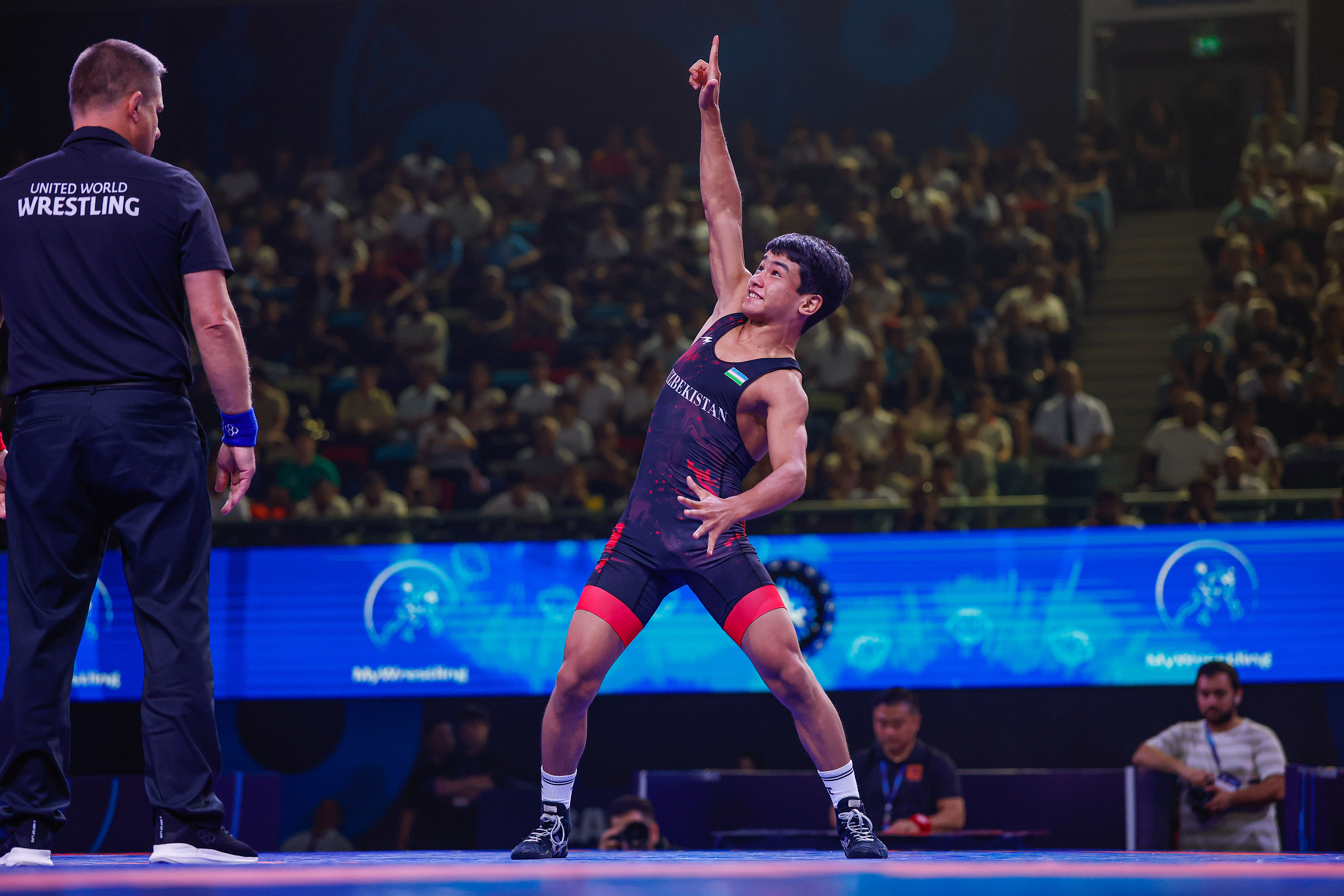 Bunyod HASANOV (UZB) celebrates after winning the 51kg world title, his second at U17 level. (Photo: United World Wrestling / Kostadin Andonov)
The 48kg world champion in Athens moved up to 51kg this year and made a stunning run to his second gold medal. His campaign in Baku differed from the one in Athens in many ways, but one thing that remained constant was Hasanov's control of the final.
Against returning bronze medalist Huseynli, he set the tone right from the start by going for the snaps and two-on-one. Huseynli was eventually called passive and Hasanov got the par terre from which he hit a remarkable suplex for four points.
He then lifted Huseynli again and threw him out of bounds for one point to lead 6-0. He then used his two-on-one to push the Azerbaijan wrestler towards the zone and score a stepout, swelling his lead to 7-0.
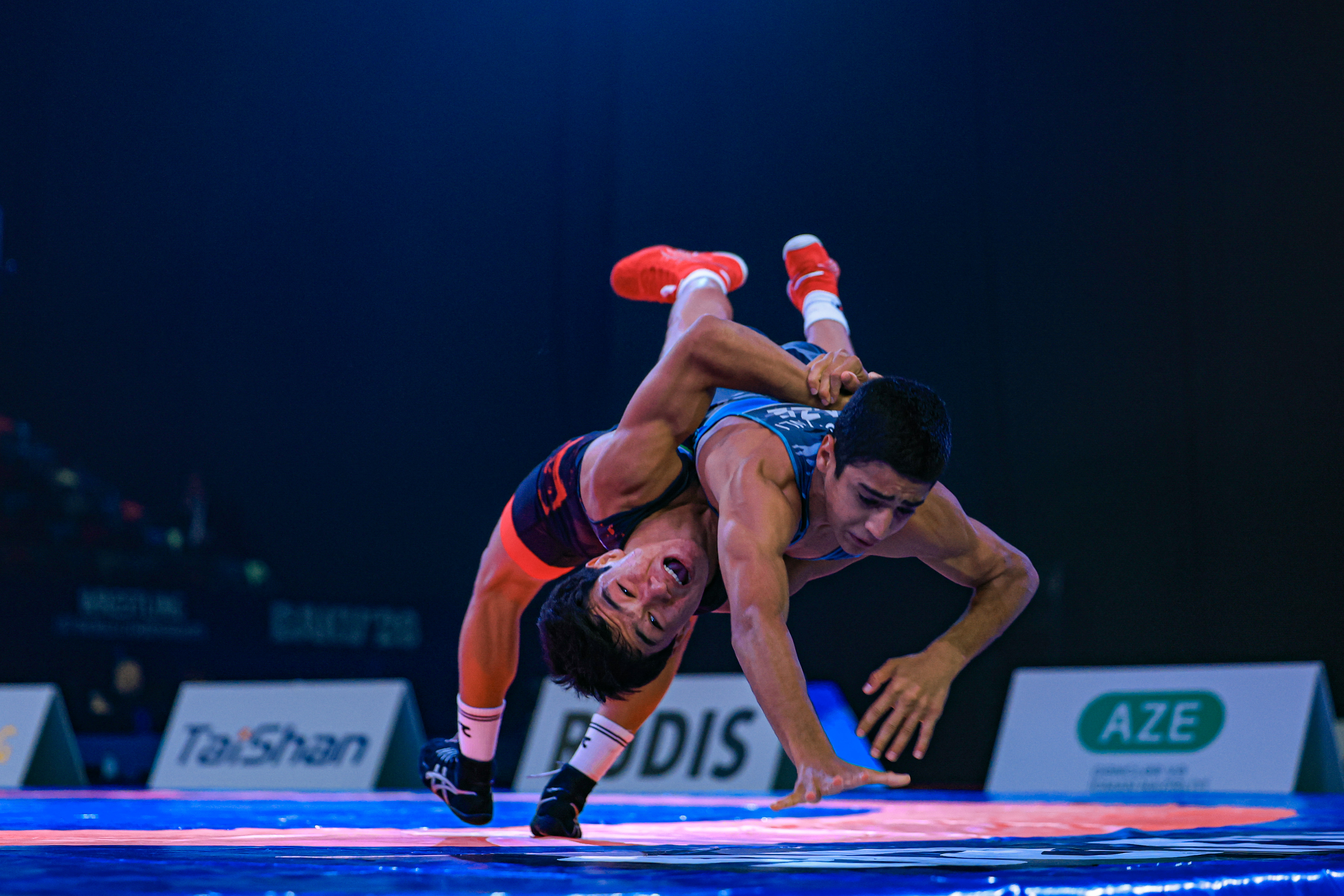 Bunyod HASANOV (UZB), below, throws Abdurrahman HUSEYNLI (AZE) during the 51kg final. (Photo: United World Wrestling / Amirreza Aliasgari)
Facing a decisive stepout, Huseynli attempted a throw of his own but landed on his own back instead, surrendering two points. Those points made Hasanov a 9-0 winner, who managed a more animated celebration than last year.
With the strong foundations that led him to his second world gold, Bunyod Hasanov will hope to build on it in the future.
Thanks to Hasanov's gold, Uzbekistan finished fourth in the team standings with 85 points, 11 behind third-placed Iran, which topped the standings last year. Russia won the team title with 127 points, while host Azerbaijan placed second despite failing to win a gold medal.
Wax Melts Javadli
Apart from Huseynli, Azerbaijan had another finalist in U17 European champion Ali JAVADLI (AZE) at 51kg, but he too suffered a one-sided defeat to Rylex WAX (USA).
Javadli gave the packed arena, waiting for the Azerbaijan national anthem to be played on Wednesday, hope when he piled up four points from par terre in the first period with a strong gut wrench.
Wax, however, silenced the arena in the second period when he got the par terre. He used a trap-arm-gut to roll him six times and reducing Javadli to tears after the final whistle. Wax secured the United States' first U17 Greco-Roman world title since 2024 after the team went without one last year.
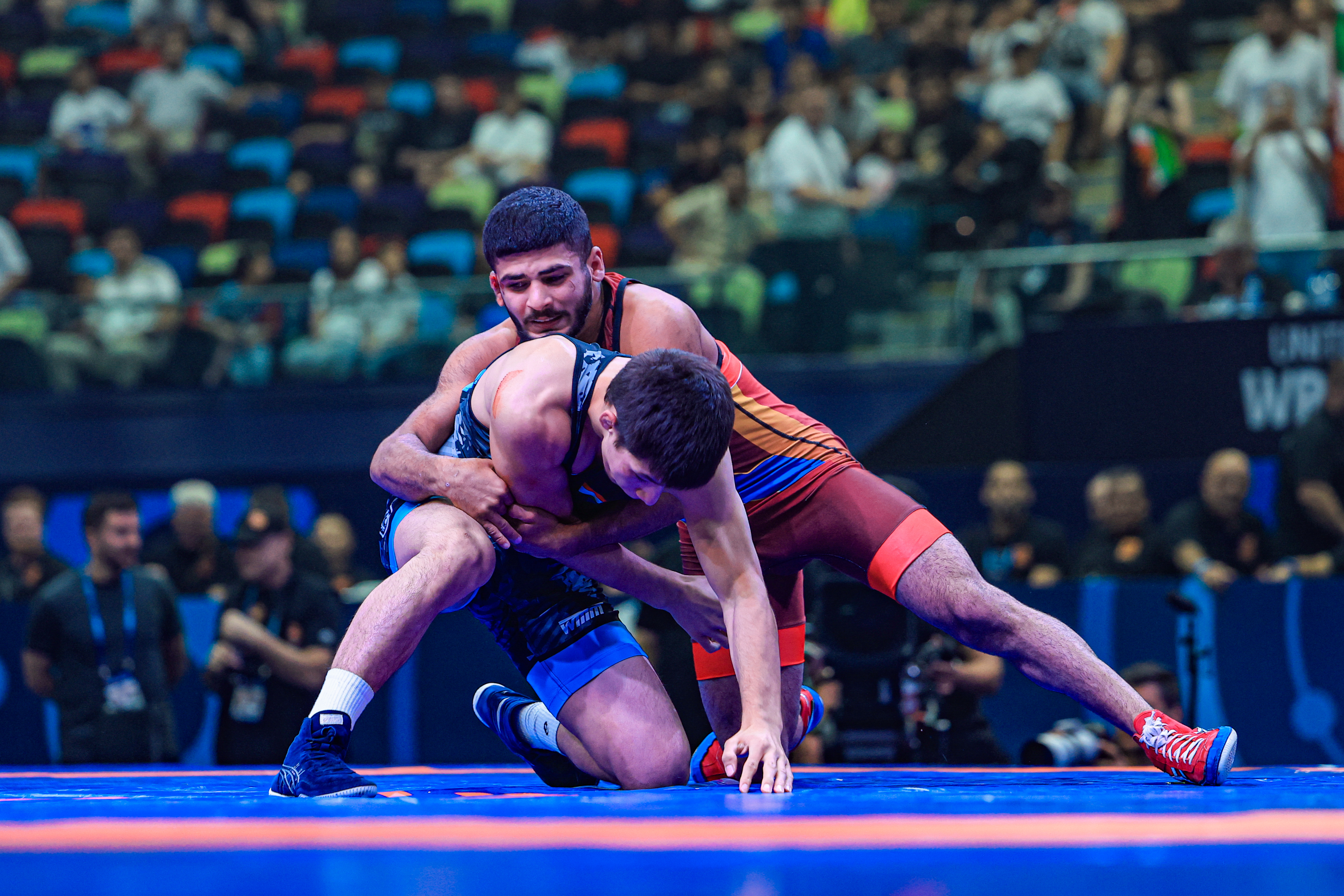 Amirreza TAHMASBPOUR (IRI) scores a takedown against Makhdi BAROTOV (TJK) during the 60kg final. (Photo: United World Wrestling / Amirreza Aliasgari)
Tahmasbpour Denies Barotov
Iran's disappointing tournament still had a bright spot in Amirreza TAHMASBPOUR (IRI), who upgraded his bronze from last year to gold at 60kg after an electric final. The Iranian's win also denied Makhdi BAROTOV (TJK) from becoming Tajikistan's first-ever Greco-Roman world champion at any level.
At one point in the 60kg final, Barotov must have thought he had ended the drought for his country. Tahmasbpour scored a takedown and two turns using trap-arm to build a 6-0 lead in the first minute. And it seemed that he would run away with the final.
The match turned on its head before the break. Barotov countered an attempted duck under, forcing Tahmasbpour backward for two points. Moments later, Barotov switched to double underhooks and launched the Iranian for a throw. Initially, the officials awarded four points to Tahmasbpour, but a successful challenge reversed the call and gave Barotov four points instead, putting him ahead 6-6 on criteria.
Tahmasbpour, however, knew that Barotov was struggling with conditioning and he began snapping the Tajikistan wrestler. After one of the snaps, he jumped over Barotov and secured the takedown that eventually gave him an 8-6 victory.
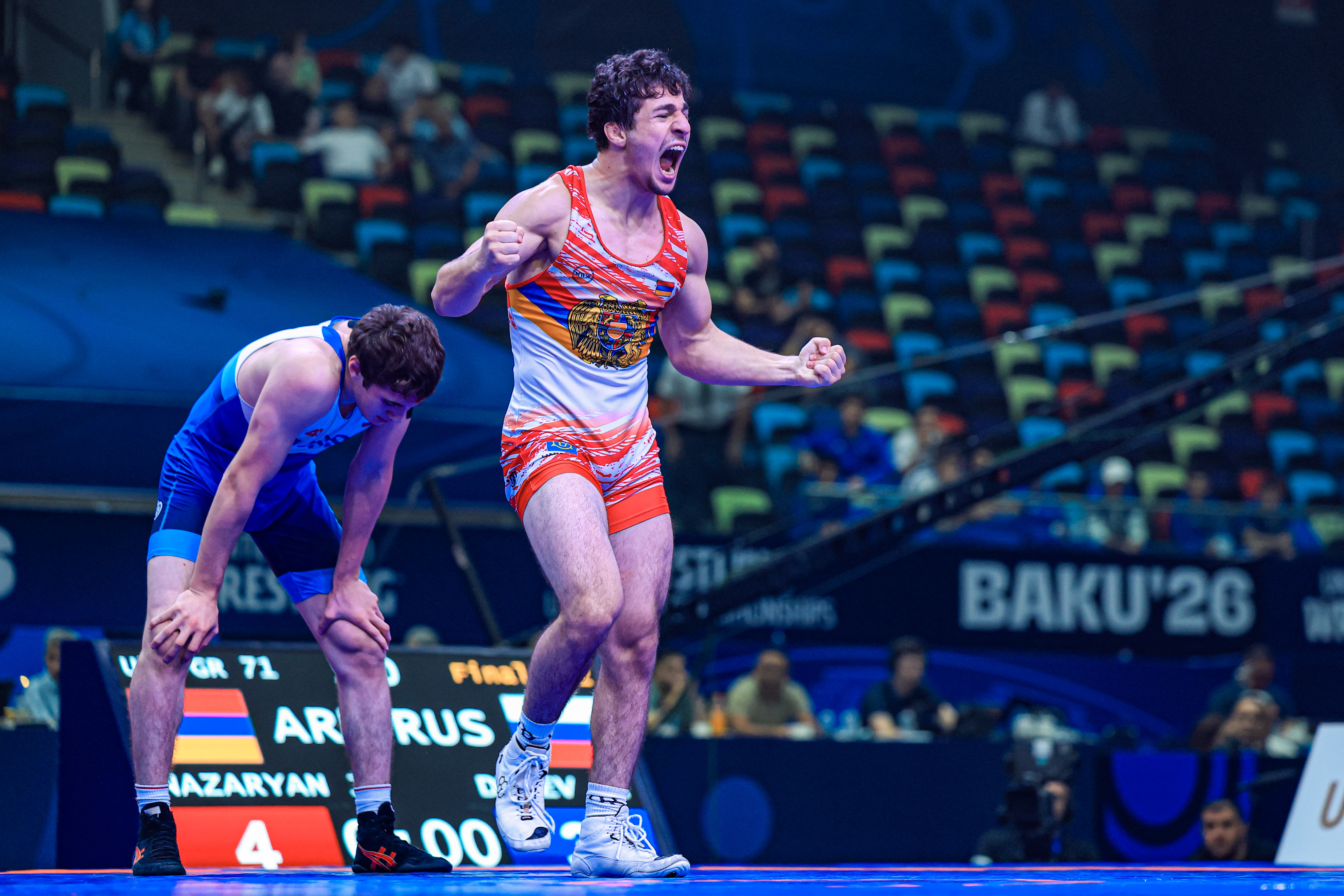 Janes NAZARYAN (ARM) celebrates after winning the 71kg gold medal in Baku. (Photo: United World Wrestling / Amirreza Aliasgari)
Nazaryan Repeats
Another returning champion Janes NAZARYAN (ARM), who won at 65kg last year in Athens, doubled up by winning the gold medal at 71kg in Baku. He made a comeback after falling behind against 65kg U17 European champion Aslan DZUEV (RUS) in the final.
Dzuev scored a headlock throw which the referees scored as two points as Nazaryan never seemed to have landed in danger. Russia challenged asking for four points but lost it, adding one point to Nazaryan's score. Dzuev then failed to score from par terre but led 3-1 at the break.
When Nazaryan got the par terre in the second period, he turned Dzuev with a strong gut-wrench and took a 4-3 lead that he defended to win his second U17 world title.
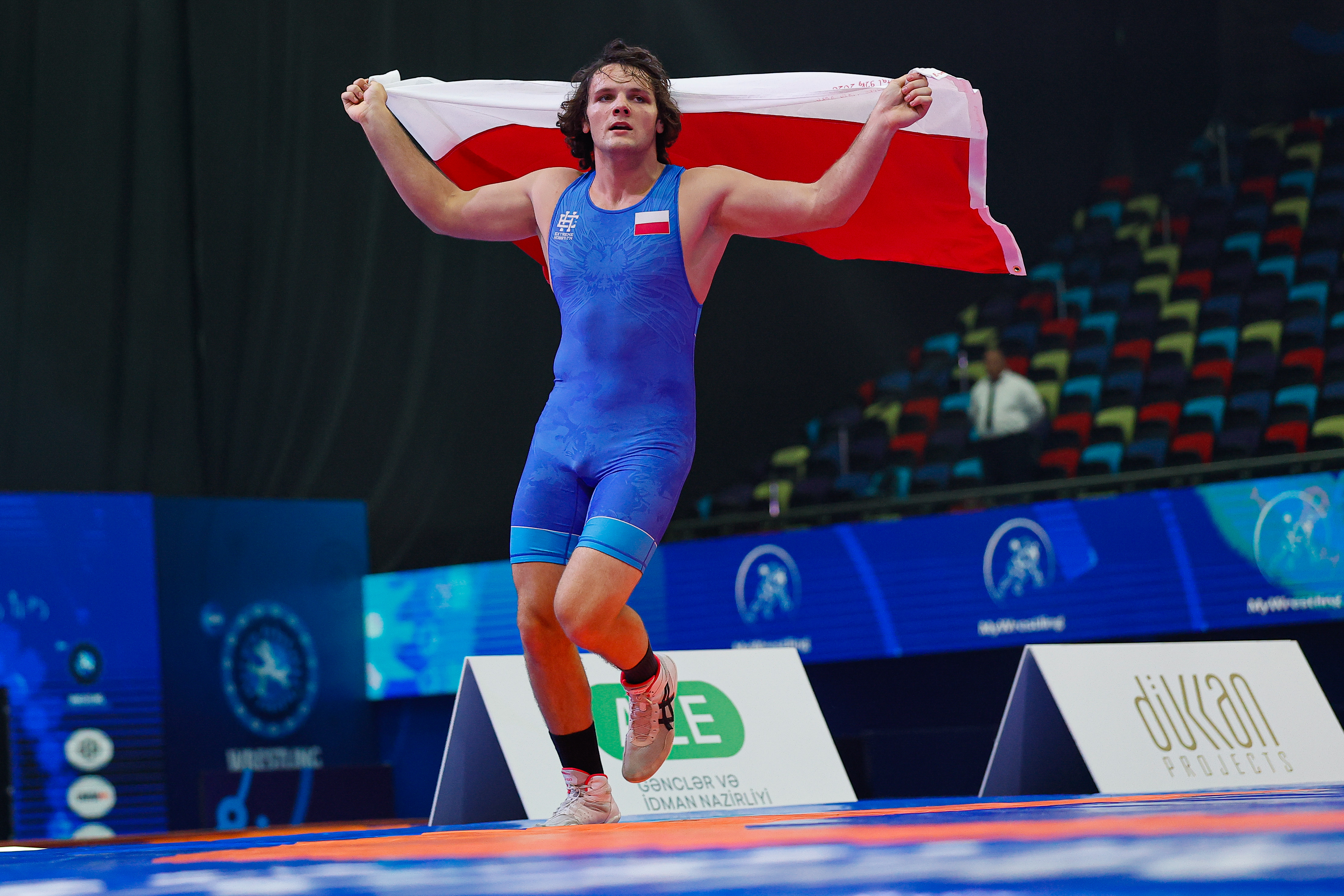 Tomasz MITAL (POL) became the first Poland wrestler in 10 years to win the Greco-Roman gold at U17 World Championships. (Photo: United World Wrestling / Kostadin Andonov)
Mital Breakthrough
At 92kg, U17 European champion Tomasz MITAL (POL) added a world title to his name and gave Poland its first U17 Greco-Roman gold medal in 10 years. Mital was up against Hlib YEVSIEIEV (UKR) in the gold medal bout and was in some trouble when Yevsieiev scored the first takedown to lead 2-0.
Mital pushed the pace in the second period and scored a running takedown around the zone and then lifted Yevsieiev, threw him outside the zone for a point and led 3-2. He defended his lead to win the gold medal and become only the fifth Poland wrestler to win a Greco-Roman gold at the U17 World Championships.
Click here for Women's Wrestling semifinal results

RESULTS
45kg
GOLD: Rylen WAX (USA) df. Ali JAVADLI (AZE), 13-5
BRONZE: Ognyan BURGAZOV (BUL) df. Armin ESMAEILI (IRI), via forfeit
BRONZE: Arsan ALIEV (RUS) df. Afruzbek IBRAGIMOV (UZB), 10-0
51kg
GOLD: Bunyod HASANOV (UZB) df. Abdurrahman HUSEYNLI (AZE), 9-0
BRONZE: Gevorg HARUTYUNYAN (ARM) df. Saba ABASHIDZE (GEO), 5-0
BRONZE: Artem TKACHENKO (RUS) df. Vadim TARELUNGA (MDA), 7-5
60kg
GOLD: Amirreza TAHMASBPOUR (IRI) df. Makhdi BAROTOV (TJK), 8-6
BRONZE: Sadriddin TULKINBOEV (UZB) df. Alexandru LUNGU (ROU), 10-2
BRONZE: Elmir CHARKAZOV (AZE) df. Hinata HANAMORI (JPN), 9-0
71kg
GOLD: Janes NAZARYAN (ARM) df. Aslan DZUEV (RUS), 4-3
BRONZE: Alinur TOLEUGALI (KAZ) df. Esmaeil ZAHERDOUST (IRI), 11-3
BRONZE: Ervin CZUCZOR (HUN) df. Kristiyan KRASTEV (BUL), 5-1
92kg
GOLD: Tomasz MITAL (POL) df. Hlib YEVSIEIEV (UKR), 3-2
BRONZE: Yusuf AKSU (TUR) df. Sandor ANTALY (HUN), 5-1
BRONZE: Amirreza MEHRITALAR (IRI) df. Mirjalol SHOVKATOV (UZB), 4-3
Share your thoughts.
Comments