

#WrestleParis

Women's Wrestling at Olympics: 20 years strong

By United World Wrestling Press

PARIS (July 8) -- Inside an academy located in the middle of a farm at a village in Haryana, the northern Indian state that’s the country’s wrestling capital, a bunch of teenage girls had scribbled the name of their hero on a wall – Helen MAROULIS (USA).

When women’s wrestling made its Olympic debut, some of these girls were not even born. There were no roads leading up to the academy where they trained until a few years ago — the best way to reach the academy was on foot from the nearest highway exit point roughly a couple of miles away. And internet connectivity was patchy at best.

Yet, the story of Maroulis’s dominance had traveled to this far-flung village and became a part of the folklore. Few stories illustrate better the impact and the reach of women’s wrestling.

In less than three weeks, the eyes of the entire sporting – and wider – world will be fixed on Paris when the Olympic Games get underway. On the mat at the Grand Palais Éphémère in Champ de Mars, more stories of inspiration will unfold, paving the way for many young wrestlers to follow in the footsteps of their heroes.

At the Paris Olympics, women's wrestling will celebrate its 20th year of being at the Games. Back in 2004, when it was included in Athens, there were only four categories. In Paris, as was the case in Tokyo, there will be six — the same as Freestyle and Greco-Roman.

The 2024 Games will also be significant for the officials. As many as 11 female referees will be part of the officials. Back in 1988, it was only one.

AthensWomen's Wrestling at the 2004 Athens Olympic Games. (Photo: United World Wrestling / Martin Gabor)

Wrestling at the Paris Olympics will also be a symbolic occasion given the key role France played in the evolution of the women’s game. It was at Pas-de-Calais where women’s wrestling took one of its first steps. A club in Calonne-Ricouart was the first to open its doors to women in 1971.

From this tiny space in a region roughly three hours from Paris, women’s wrestling spread in other parts of France before it became a popular activity in the rest of the world.

The seeds that were sown in France have blossomed in countries across the world. As women’s wrestling traveled to Beijing, London, Tokyo and now arrives in Paris – following the journey that began in Athens – it left behind immaculate footprints for young, aspiring children to follow.

Tayla FORD (NZL)Tayla FORD (NZL) is the first wrestler from New Zealand who will compete at the Olympics. (Photo: United World Wrestling / Amirreza Aliasgari)

Next month, when the competition gets underway in the French capital, history will be in the offing as Tayla FORD (NZL) will become the first female wrestler from her country to make it to the Olympics.

Ford’s story is one of sheer perseverance, not just hers but even of those around the wrestler. Her father, a high school wrestler, got Ford into wrestling after it was included in the Olympics programme. He had a mat installed in their garage and every day, the father and daughter trained.

In a way, Ford’s story is similar to the wrestlers from the Olympic women’s wrestling’s undisputed powerhouse, Japan.

The queen of wrestling, Saori YOSHIDA (JPN), began her journey in the same way. Before she went on to win every title there was to win – three Olympic gold medals, 13 World Championship titles, four Asian Games and Asian Championship gold medals each – Yoshida learnt the art at home.

Her father built a dojo at home where Yoshida, began to wrestle before she could even run properly. The rest, as they say, is history. The rise of Kaori ICHO (JPN), who went 13 years without a loss, followed a similar arc. And so do the stories of the other Japanese women, from Risako KAWAI to Yui SUSAKI.

Not to forget Icho, who won four gold medals at the Olympics, becoming the first Olympic athlete to win four golds in the same individual sport.

In Athens 20 years ago, Japan won only 2 gold medals. Since then, they have won 13. This level of dominance is rare to see in any sport. One of the few countries that’s consistently come close to challenging Japan’s dominance, and been a thorn in their flesh when it comes to a clean sweep of gold medals, is the USA.

Remarkably, the USA did not even compete at the World Championships until 1989, two years after the first edition for women took place. But once they landed on the scene, they took everyone by storm.

Afsoon JOHNSTON (USA) – who won a bronze medal – Asia DEWEESE (silver) and Leia KAWAII (silver) finished on the podium in 1989 and became sort of the pioneers of women’s wrestling in the US. Since then, there hasn’t been a time when the athletes from the Olympic powerhouse haven’t been among the medals.

The rise of women’s wrestling in the US is also a fascinating story, with nearly 50,000 girls competing in high school championships last year. Those young girls saw the wrestling stars from the country on television and decided to tread the same path they’d chosen.

A major reason for the surge in popularity in the US has been wrestlers like Maroulis. Her gold medal at the Rio Olympics in 2016 – the first American woman to achieve that feat – is seen as one of the big milestones that gave the sport a massive push.

Maroulis’s feat didn’t just inspire children in the US. The story traveled the world over, including a remote village in India. If anything, it showcased the sport’s transcending influence.

#WrestleCoralville

U.S. Completes Pan-American Team Title Sweep

By Vinay Siwach

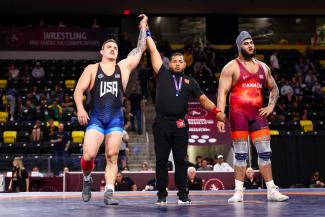
CORALVILLE, IOWA, United States (May 10) -- The United States captured six out of seven gold medals in Freestyle to close out the Pan-American Championships in Coralville, Iowa.

After winning the Greco-Roman and Women's Wrestling team title, the U.S. also won the Freestyle title with 240 points and Puerto Rico finished second with 150 points. Canada was third with 129 points.

UWW Plus

The three 2025 world medalists in action on Sunday for the U.S., all came back with gold medals. World champion Trent HIDLAY (USA) won gold medal at 92kg, defending his Pan-Am title, world silver medalist Levi HAINES (USA) won gold at 70kg while world bronze medalist Real WOODS (USA) prevailed at 65kg to win the title.

Other three champions were Liam CRONIN (USA) at 57kg, improving from his bronze medal last year, Ridge LOVETT (USA) at 70kg and Wyatt HENDRICKSON (USA) who defended his 125kg title.

Arturo SILOT (CUB) was the only wrestler to deny the U.S. gold medal as he defeated Stephen BUCHANAN (USA), 15-4, in the 97kg final. This was his first-ever Pan-Am gold after being denied for four straight years in the finals.

In the marquee match of the night, Woods faced Peiman BIABANI (CAN) in the 65kg final, a rematch of the World Championships bronze-medal bout which Woods won 3-1.

On Sunday, Woods dictated the pace of the final, getting the first point for Biabani's passivity in the first period. Woods opened the second period with a quick leg-attack before elevating Biabani's leg as the Canadian tried to defend on one leg. Woods did not let go and scored a takedown to lead 3-0 with 2:33 left.

Under pressure to score, Biabani got rewarded when Woods was put on the activity clock and when the American did not score, Biabani got a point. But Biabani could find a takedown which would have given him the win and the gold medal. He only managed a stepout as the clock expired.

Hidlay was in a five-wrestler round-robin bracket at 92kg and the world champion was clearly the best among all. He opened with an 11-0 win over Lucas BORDEAUX (BRA) in Round 1 before scoring a similar 11-0 win over Pool AMBROCIO (PER) in Round 2.  Andrew JOHNSON (CAN) wasn't spared either as Hidlay added another 11-0 win in Round 3.

Shane JONES (PUR) managed to score two points on Hidlay who remained unfazed and worked on a 13-2 win but secured the victory fall in Round 4, thus outscoring his opponents 46-2 in four bouts.

Haines was also in a round-robin bracket with five wrestlers at 79kg and followed a similar path like Hidlay to the gold medal. He scored an 11-0 victory over Michael LABRIOLA (PUR) before beating Sergio ESPINOZA (MEX), 10-0, in Round 2.

Patrick LEDER (CAN) almost pinned Haines when the Canadian blocked his head between the legs lace using his legs but Hains quickly escaped before winning 13-2. In Round 4, Haines picked an easy 10-0 win over Jhoan SERNA (VEN) to claim gold.

The 125kg final between Hendrickson and Jorawar DHINSA (CAN) was all fireworks as both wrestlers went for the throws. Dhinsa managed an arm throw for four points against Hendrickson who countered two other lateral drop attempts to score his points. When Dhinsa tried another lateral drop, Hendrickson landed on top and kept the Canadian's back on the mat to win the final via fall.

Cronin upgraded his bronze to gold after a close 5-4 win over Darian CRUZ (PUR) in the 57kg final. In an actionless first period, Cronin went up 1-0 at the break as Cruz was put on the activity clock in which he failed to score.

Cronin was put on the activity clock in the second period but eight seconds in, he countered Cruz to score a stepout and lead 2-0. Cruz fired a takedown with a minute left and took a 2-2 criteria lead. However, that was short lived as he hit a deep attack and Cronin caught him in a tangle with his legs and scored two points. Cruz challenged the decision but lost as the reviews showed that Cronin was the only one with control in the exchange.

Down 5-2 with 22 seconds left, Cruz managed a stepout and a point for Cronin's fleeing as the clock expired.

Ridge LOVETT (USA) earned a gold medal at 70kg with a win over Victor SOTO (PUR) in the final. He secured the fall over Soto after building an 11-0 lead. Lovett did not give up a single point in the tournament.

Silot Wins 97kg Gold

Kyle SNYDER (USA) denied him for three years and then Justin RADEMACHER (USA) stopped him last year. But Silot made sure that Zagreb Open champion Stephen BUCHANAN (USA) did not stop him from winning his first Pan-Am gold after four disappointments.

In the 97kg final, Silot came out firing and hit an arm throw for four points before Buchanan scored a takedown and lace to make it 4-4. However, Silot continued the exchange and used double armlock to throw Buchanan again for four points and then turned him to lead 10-4 at the break.

Silot needed 25 seconds in the second period to once again throw Buchanan using double arm locks and score four points. The U.S. challenged the four-point call but it was upheld, the lost challenge adding one more point to Silot's score to make it 15-4.


Photo

RESULTS

57kg
GOLD: Liam CRONIN (USA) df. Darian CRUZ (PUR), 5-4

BRONZE: Edwin SEGURA (GUA) df. Justin ROSALES (NCA), 8-6
BRONZE: Pedro MEJIAS (VEN) df. Juan RAMIREZ (DOM), via inj. def.

65kg
GOLD: Real WOODS (USA) df. Peiman BIABANI (CAN), 3-2

BRONZE: Joseph SILVA (PUR) df. Joshua KRAMER (ECU), 5-4
BRONZE: Shannon HANNA (BAH) df. Tommy GARCIA (DOM), 7-3

70kg
GOLD: Ridge LOVETT (USA) df. Victor SOTO (PUR), via fall (11-0)

BRONZE: Michael ZALE (CAN) df. Mauricio LOVERA (ARG), via inj. def.

79kg
GOLD: Levi HAINES (USA)
SILVER: Michael LABRIOLA (PUR)
BRONZE: Patrik LEDER (CAN)

92kg
GOLD: Trent HIDLAY (USA)
SILVER: Shane JONES (PUR)
BRONZE: Andrew JOHNSON (CAN)

97kg
GOLD: Arturo SILOT (CUB) df. Stephen BUCHANAN (USA), 15-4

BRONZE: Cristian SARCO (VEN) df. Steven BURRELL (JAM), 6-5
BRONZE: Luis PEREZ (DOM) df. Edwin MORALES (PUR), 4-3

125kg
GOLD: Wyatt HENDRICKSON (USA) df. Jorawar DHINSA (CAN), via fall (12-4)

BRONZE: Gabriel DE SOUSA (BRA) df. Brandon ANGUIANO (MEX), via fall (4-0)
BRONZE: Jose DIAZ (VEN) df. Jonovan SMITH (PUR), 2-1
