YoungestToOldest

The Youngest/Oldest GR Gold Medalists in Olympic History

By Ikuo Higuchi

(This is the last of a three-part series that appeared on the Japan Wrestling Federation website. It was translated for UWW by Ken Marantz.)

A Style Dominated by Europeans
Compared with the United States and Asia, where most wrestlers start the sport in freestyle, many in Europe start out in the sport as youth in Greco-Roman style. This can account for the fact that out of 196 gold medals awarded at the Olympics so far, 168 have gone to Europeans (170 if wrestlers from current Asian countries who competed for the Soviet Union are included). 

Even so, it took more than a century of Olympics before a teenager would bring home a gold. Islambek ALBIEV (RUS) broke through the barrier at the 2008 Beijing Olympics, where he won the 60kg gold at 19 years 7 months 15 days. A world junior champion in 2006, Albiev added to his stature when he triumphed at both the European and World Championships the year after Beijing.

Albiev remains the lone teenager to win a Greco gold heading into the Tokyo Olympics, although such a feat might have more to do with timing than skill, given that the Olympics come only once every four years. A wrestler who is 16 or 17 in an Olympic year will likely never get a legitimate shot at a gold as a teenager (not that it really matters in the end if one wins a gold at 19 or 20; it is just being mentioned here for historical purposes). 

Take the case of legendary Hamza YERLIKAYA (TUR), who was just 17 years 3 months 16 days when he won the 82kg title at the 1993 World Championships. But his triumph at the 1996 Atlanta Olympics came 1 month 18 days after he had celebrated his 20th birthday. Yerlikaya would add another Olympic title in 2000 and world title in 2005 before going on to become a member of Turkey's Parliament.

The 1987 World Championships in Clermand-Ferrand produced a teenaged Greco champ in Pedro Favier ROQUE (CUB), who won the 52kg gold at 18 years 8 months 26 days. He would have still been 19 at the Seoul Olympics the following year, but it was not to be. Cuba, following the lead of the Democratic People's Republic of Korea, did not participate in the Games in the south of the peninsula.

Comparatively, freestyle has eight Olympic champions who were in their teens or 20, while Greco has just half that number with four. Perhaps this shows how Greco relies more on experience to master. 

It looking at the oldest gold medalists, the world and Japanese media heralded the crowning of a 40-year-old champion at the 1972 Munich Olympics. Anatoli ROSCHTSCHIN (URS) was 40 years 6 months 0 days when he won the over-100kg crown. But there had been an older champion before that, back in the days before mass media. At the 1920 Antwerp Olympics, Adolf LINDFORS (FIN) was 41 years 6 months 12 days when he triumphed in the over-84kg class. And he certainly earned his medal--he won all five of his matches by fall, with his second-round victory take 23 minutes 43 seconds and his win in the final lasting a whopping 47 minutes 38 seconds. (In that era, the time limit for a match was reportedly 50 minutes.)

As in freestyle, the majority of champions on the oldest-ever list are in the upper weight classes. Of the top 15, the lone lightweight champions (68kg or lower) came in the pre-World War II era. Since the end of the war, there have been only six gold medalists aged 30 or over in the lightweight divisions, most recently Davor STEFANEK (SRB), who was 30 years 11 months 4 days when he won the 66kg gold at the 2016 Rio de Janeiro Olympics.

By the way, Japan has had four Greco champions in Olympic history. The youngest was Masamitsu ICHIGUCHI (JPN), who was 24 years 9 months 7 years when he took the 57kg gold at the 1964 Tokyo Olympics. The oldest, 1984 Los Angeles Olympic 52kg champion Atsuji MIYAHARA (JPN), was 25 years 7 months 13 days on the day of his triumph.

Why am I bringing this up? If the upcoming Tokyo Olympics had been held as scheduled this summer, current world 60kg champion Kenichiro FUMITA (JPN) could have broken Ichiguchi's record as youngest-ever by winning the gold on Aug. 3, when he will be 24 years 7 months 16 days. But with the Games postponed for year, Fumita instead has a chance to become the oldest-ever. The final is tentatively slated for Aug. 2, 2021, when Fumita will be 25 years 7 months 15 days--just two days older than Miyahara.

TOP 15 YOUNGEST OLYMPIC CHAMPIONS (GRECO-ROMAN)
Name                                                        Age                               Olympics                       Wt.    Date of birth
1. Islambek ALBIEV (RUS)                    19 years 7 months 15 days         2008 Beijing       60kg     1988/12/28

2. Hamza YERLIKAYA (TUR)             20 years 1 month 18 days         1996 Atlanta         82kg     1976/06/03

3. Suren NALBANDYAN (URS)           20 years 1 month 21 days         1976 Montreal       68kg     1956/06/03

4. Shazam SAFIN (URS)                       20 years 3 months 20 days      1952 Helsinki         67kg     1932/04/07

5. Alexandre KARELINE (URS)          21 years 0 months 2 days           1988 Seoul           130kg     1967/09/19

6. Varteres SAMURGASHEV (RUS)   21 years 0 months 13 days         2000 Sydney          63kg     1979/09/13

7. Boris GUREVICH (URS)                    21 years 4 months 4 days       1952 Helsinki          52kg     1931/03/23

8. Ji-Hyun JUNG (KOR)                        21 years 5 months 0 days       2004 Athens            60kg     1983/03/26

9. Alexander KOLTSCHINSKI (URS) 21 years 5 months 4 days           1976 Montreal    +100kg   1955/02/20

10. Khassan BAROEV (RUS)                 21 years 8 months 24 days      2004 Athens          120kg     1982/12/01

11. Roman VLASOV (RUS)                    21 years 9 months 30 days      2012 London           74kg     1990/10/06

12. Jouko SALOMAEKI (FIN)              21 years 11 months 7 days         1984 Los Angeles   74kg     1962/08/26

13. Schamil CHISAMUTDINOW (URS)  21 years 11 months 21 days   1972 Munich           68kg     1950/09/20

14. Henri DEGLANE (FRA)                    22 years 0 months 18 days      1924 Paris              +82kg     1902/06/22

15. Vincenzo MAENZA (ITA)                 22 years 2 months 30 days      1984 Los Angeles      48kg     1962/05/02

TOP 15 OLDEST OLYMPIC CHAMPIONS (GRECO-ROMAN)
Name                                                        Age                                       Olympics                        Wt.    Date of birth
1. Adolf LINDFORS (FIN)                   41 years 6 months 12 days          1920 Antwerp           +82kg     1879/02/08

2. Anatoli ROSCHTSCHIN (URS)      40 years 6 months 0 days            1972 Munich          +100kg     1932/03/10

3. Johannes KOTKAS (URS)               37 years  5 months 24 days          1952 Helsinki           +87kg     1915/02/03

4. Kaaro ANTTILA (FIN)                   36 years  10 months 10 days         1924 Paris                   62kg     1887/08/30

5. Carl WESTERGREN (SWE)           36 years  9 months 25 days          1932 Los Angeles      +87kg     1895/10/13

6. Claes JOHANSON (SWE)               35 years  9 months 16 days          1920 Antwerp           82.5kg     1884/11/04

7. Erik MALMBERG (SWE)                35 years  6 months 23 days          1932 Los Angeles        66kg     1897/01/15

8. Eemeli VAERE (FIN)                      34 years  10 months 23 days         1920 Antwerp          67.5kg     1885/09/28

9. Axel GROENBERG (SWE)             34 years  2 months 18 days           1952 Helsinki              79kg     1918/05/09

10. Mijain LOPEZ NUNEZ (CUB)     33 years  11 months 26 days          2016 Rio de Janeiro  130kg    1982/08/20

11. Ahmet KIRECCI (TUR)                33 years 9 months 10 days            1948 London              +87kg     1914/10/27

12. Ivar JOHANSSON (SWE)             33 years  6 months 9 days            1936 Berlin                    79kg     1903/01/31

13. Rudolf SVENSSON (SWE)            33 years  4 months 11 days           1932 Los Angeles          87kg     1899/03/27

14. Vaeinoe KOKKINEN (FIN)          32 years  8 months 13 days           1932 Los Angeles          79kg     1899/11/25

15. Valentin NIKOLAEV (URS)          32 years  8 months 0 days            1956 Melbourne            87kg     1924/04/06

#wrestlebishkek

Asian Championships: Rise of Sujeet Fuels India’s 65kg Gold Hopes

By Vinay Siwach

BISHKEK, Kyrgyzstan (April 4) -- When SUJEET (IND) steps on the mat at the Asian Championships in Bishkek on Friday, he will carry hopes of a country looking for an Asian champion in a Freestyle weight class other than 57kg for the past seven years.

The 23-year-old is unbeaten this year, winning gold medals at the Zagreb Open and Muhamet Malo Ranking Series, making him the favorite to win gold at 65kg in Bishkek. The last time India won a gold medal at the Asian Championships was 2019 when Bajrang PUNIA (IND) won in Xi'an, China.

"I don't think much about anything," Sujeet says. "I say the name of the God and step on the mat. I will do the same at the Asian Championships.

"I am happy that I wrestle at 65kg because India has a decent history at 65kg. I will also try to carry it forward."

The 65kg field in Bishkek includes returning 61kg Asian champion Takara SUDA (JPN) who is moving up one weight. Suda's ability to score at any time in a bout puts him as the biggest threat against Sujeet.

World bronze medalist Umidjon JALOLOV (UZB) is another strong competitor for Sujeet. The Indian enjoys a 4-0 head-to-head record against the Uzbekistan wrestler but at last year's Asian Championships, Sujeet pulled out of his bronze medal bout against Jalolov due to an injury.

Another tough competitor for Sujeet can be Peyman NEMATI (IRI). The two wrestled in the final of the Zagreb Open and the Iranian managed to keep Sujeet quiet despite losing 3-0. He will be keen to avenge that loss and win gold for Iran.

Abdulmazhid KUDIEV (TJK), a world bronze medalist at 70kg in 2024, can spring a surprise and so can former U17 world champion Rustamzhan KAKHAROV (KGZ).

Early Start

Hailing from village Imlota, Charkhi Dadri in Haryana, a state that produces majority of wrestlers in India, Sujeet was introduced to wrestling in his village.

"There was an old akhada [training school] in my village so I used to go there," he says. "No coach had formal experience as such and I used to lose at the district level. I remember I lost in 2019 at the state level."

While there was little history of wrestling in the village itself, Sujeet's father Dayanand KALKAL was a national-level wrestler and was keen for his son to pick the sport as well. Till 2020, Sujeet continued training in the village.

"I was decent in studies," he says. "I balanced it with wrestling but after school, it was all wrestling. My village was very supportive of my wrestling. And then in 2021, I made the switch."

From south-west Haryana, Sujeet moved to Sonipat, a district in Haryana 60 kilometers north of New Delhi. With more experienced training partners, Sujeet could feel the improvements in his wrestling.

"The shift in 2021 to Sonipat changed my wrestling," he says. "My wrestling matured and the other wrestlers had international experience so it helped me in all aspects."

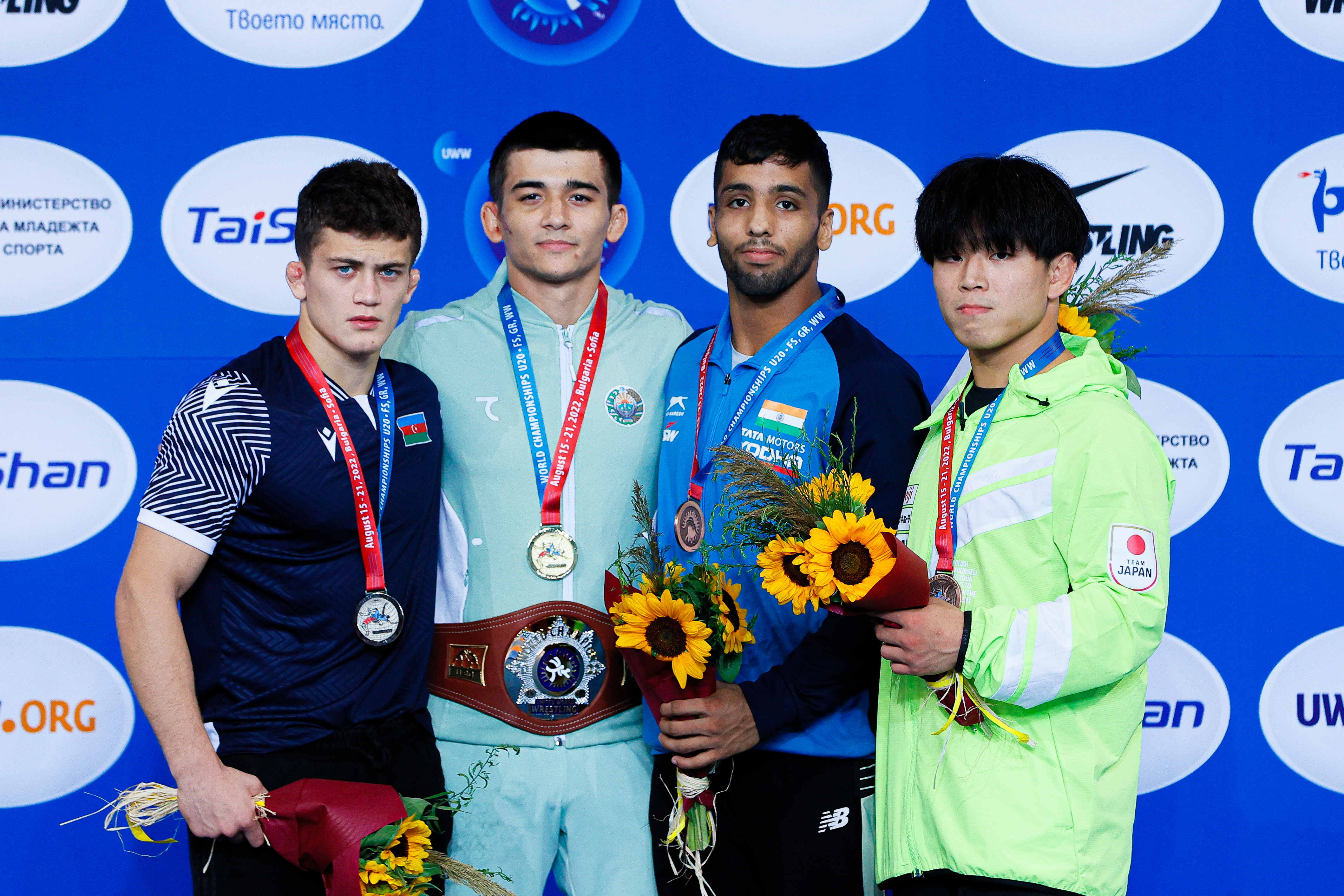
SUJEET (IND)SUJEET (IND), third from left, won a bronze medal at the 2022 U20 World Championships in Sofia. (Photo: United World Wrestling / Kostadin Andonov)
In just one year, Sujeet made the U20 Indian team and was on his way to Bulgaria for the World Championships. He lost to Ziraddin BAYRAMOV (AZE) in the semifinals but won a bronze medal at 65kg, his first in international wrestling on debut.

"I was happy that I won a medal in my first-ever competition despite it being bronze," he says. "My wrestling was different than my opponents. I had never experienced that. But slowly I got used to it."

The biggest challenge for Sujeet was the vast difference in wrestling between junior and senior levels.

"When you shift from junior to senior, there is a lot of difference from power to technique," he says. "Opponents study you a lot once you are consistently competing. Everyone studies each other but I stick to my techniques."

Senior Career

Sujeet made the required adjustments and won the senior nationals in India to make the team with a hope to qualify for the 2024 Paris Olympics. But that journey ended in a heartbreak.

At the Asian Olympic Qualifiers in Bishkek, Sujeet failed to reach the competition due to floods at the Dubai airport. A month later at the World Olympic Qualifiers in Istanbul, Sujeet squandered a 2-0 lead against Zain RETHERFORD (USA) and missed out on a ticket to Paris.

"My father says do not celebrate too much when you win, don't be disheartened when you lose, balance it," he says. "So I try to keep it balanced. I don't sulk when I lose. I think about it a little and then move on, sit with my friends and try to see what I can improve."

In need of training partners who could challenge him with different styles, Sujeet spent a few months training overseas. He picked Mongolia, Russia and Japan, and picked a few details from the sparring sessions. He also realized that depending on the renowned Indian conditioning will not be enough to win medals at the world level.

"In India, the training lasts long, usually 3-4 hours," he says. "In Japan, they have smaller training sessions with focus on speed. Russia also has longer sessions with focus on scrambles and bouts.

"Our stamina comes from the longer trainings which are also very hard. The Indian sit-ups are quite different. Others also have unique ways to train but they focus on their own styles. But we ultimately work hard for longer bouts."

Sujeet ended 2024 with a bronze medal at 70kg at the U23 World Championships.

For the majority of 2025, he remained an under-the-radar wrestler. He won the Ranking Series event in Budapest but was far off from being a medal threat at the September World Championships. However, a bout against Olympic silver medalist Rahman AMOUZAD (IRI) at the World Championships caught the attention of the fans.

Though he lost 6-5, Sujeet was surprisingly the only wrestler who troubled Amouzad, the eventual world champion, in Zagreb.

"It was my first bout so I was all over the place and he was clearly stronger than me," he recalls. "May be next time I will be calmer. I took too much pressure on myself to win a medal and that showed in my bout against Real WOODS (USA)."

Woods beat Sujeet in repechage after an initial flurry of turns and then defended his lead to win 7-5. Sujeet returned home empty-handed.

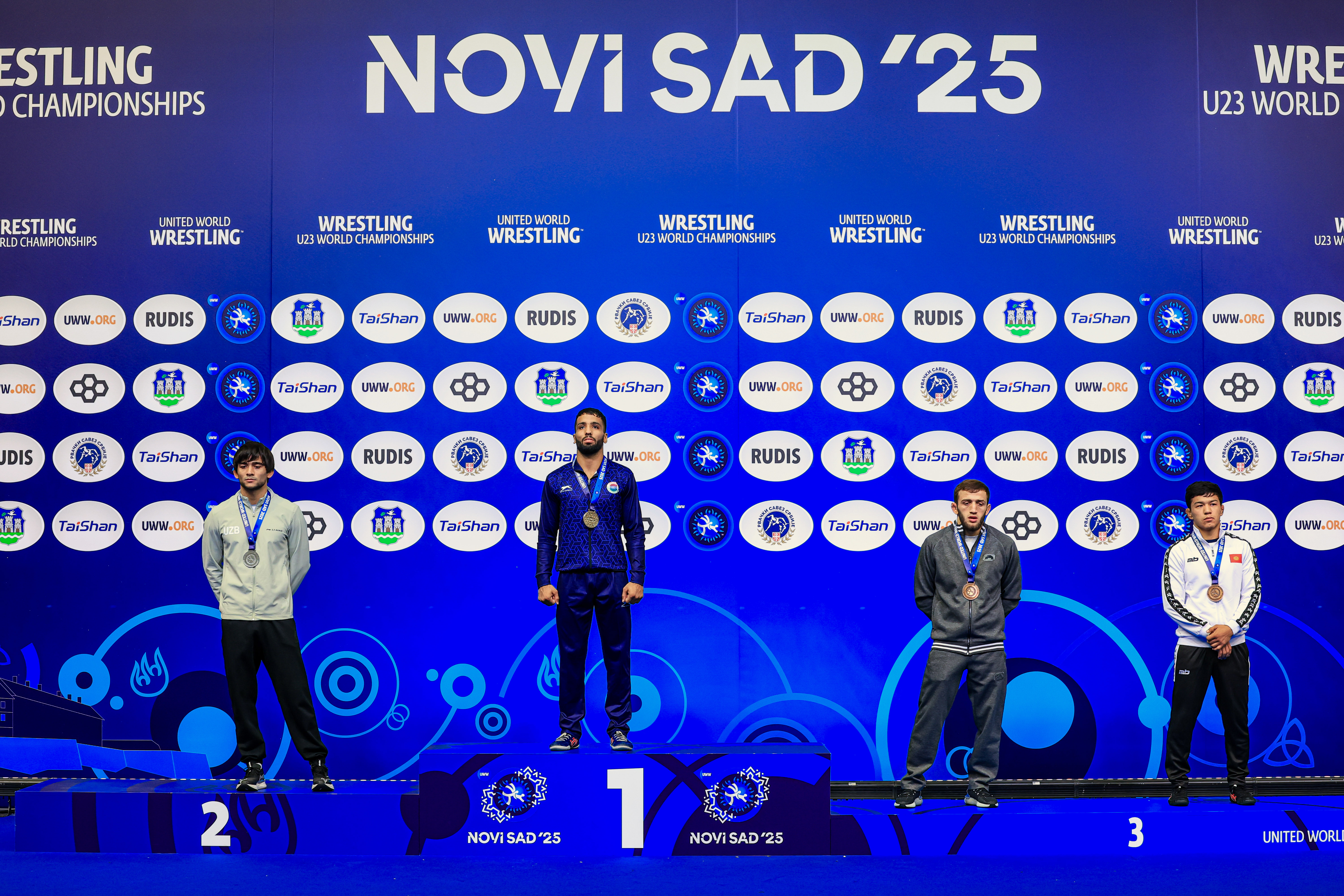
SUJEET (IND)SUJEET (IND), second from left, as the U23 world champion in 2025. (Photo: United World Wrestling / Amirreza Aliasgari)

Unbeaten Streak

But in a month's time, Sujeet would make amends and win the U23 world title with a stunning series of win over former U23 world champion Bashir MAGOMEDOV (UWW) in the quarterfinals, former U20 world champion Yuto NISHUCHI (JPN) in semifinals and Jalolov, who had won bronze in Zagreb, 10-0 in the final. He scored in the final 10 seconds in the quarterfinals and semifinals.

"At the U23 Worlds, I did not care much about the draw," he says. "I think I can manage to score at any moment. I do panic but I try to remain calm. I like going for the sweep and catch both legs to score points."

The Asian Championships will be a huge test of Sujeet's recent form and skill. A gold in Bishkek can put him in the top-tier of 65kg. Does he have the class to win in Bishkek and beyond?

"My wrestling is going good," he says. "Some win via technique, some win by speed. I personally feel my wrestling is good to win here."