

Zenkina, Khoma power Ukraine to top at U20 Beach Wrestling Worlds
Monday, September 29, 2025 - 09:52 By Vinay Siwach
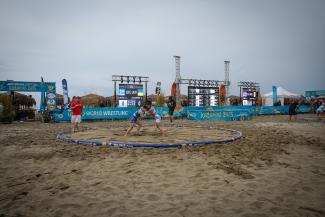
KATERINI-PIERRIA, Greece (September 28) -- Riding on inspiring performances by former world U17 champion Mariia ZENKINA (UKR) and European silver medalist Yelyzaveta KHOMA (UKR), Ukraine emerged as the best country at the U20 World Beach Wrestling Championships in Greece.
Out of the four gold medals on offer in women's category, Ukraine won two while Romania and Serbia won one each. In the men’s division, Iran dominated its way to the top of the team rankings.
Ukraine finished at the top of the team race with 85 points while the United States was second with 50 points. Serbia managed to finish third with 39 points.
Zenkina, a U17 World Championships silver medalist in 2022, showed her skills on the beach as well and won all her bouts, including the final, without giving up a point.
Facing compatriot Daria KONSTANTYNOVA (UKR) in the +70kg final, Zenkina got the first point when Konstantynova failed to score after being put on the 30-second activity period. Zenkina then scored via snapdown which forced Konstantynova to touch the sand with her knees.
Zenkina defended her 2-0 lead for the remaining 27 seconds to claim her second world title, the first coming at U17 level in 2021.
Khoma was equally dominant in her run to gold at 60kg but needed strong defense in the final against local favorite Evdoxia PAPADOPOULOU (GRE) to win the gold medal.
The final was off to an electric start with both wrestlers giving it a go and scoring points. It was Papadopoulou who scored the first point with a stepout and took a 1-0 lead. However, Khoma fired back with a snapdown with Papadopoulou's elbow touching the sand and she took a 1-1 criteria lead.
Papdopoulou tried forcing a stepout when Khoma used double underhooks to throw the Greece wrestler who landed on her elbow, giving one more point to Khoma. In the next exchange, Khoma tried a whizzer but she touched her head on sand before Papadopoulou's which cost her one point and the lead exchanged hands. Now, the Greece wrestler led 2-2 on criteria with two minutes remaining in the match.
Khoma wasted no time in launching her next attack and pushed Papadopoulou towards the edge of the ring. As Papadopoulou tried to counter throw, Khoma kept her balance and forced her opponent to touch the sand. This gave Khoma the winning score of 3-2 as in Beach Wrestling, the first wrestler to three points wins.
Ukraine's third finalist Alevtyna LIASHENKO (UKR) was not so lucky as she lost the 50kg final to Ana ROTARU (ROU) via fall. Rotaru hit a blast double to open the scoring in the final and take a 1-0 lead. She used a similar technique to score her second point and lead 2-0 with 53 seconds left in the match.
She left nothing to chance and hit a perfect headlock throw for three points, ending the match 5-0, and victory via fall. [A three-point move in Beach Wrestling is considered fall].
Serbia won its first-ever gold medal at the U20 World Championships after European silver medalist Masa PEROVIC (SRB) scored a fall over world U17 champion Alexandra MOISEI (MDA) to claim the top medal at 70kg.
Moisei scored the first point of the final with hip toss and take a 1-0 lead and extended it to 2-0 by avoiding a trip attempt from Perovic who fell head first and lost another point. Moisei was going for the winning third point when Perovic attempted a lateral drop. While backstepping to avoid the drop, Moisei lost her balance and Perovic used that to her advantage and dropped Moisei on the back for three points and the win.
Iran's golden double
A day after winning the U17 World Championships team title in men's category, Iran continued to dominate Beach Wrestling by winning the U20 team title as well.
Like its U17 team, Iran won two golds in U20 competition to finish at the top of the team rankings with 77 points. Moldova finished second with 57 points while Ukraine was marginally behind at third with 55.
After missing out in the final in the first two weight classes, Ramtin RAVANBAKHSH (IRI) and Mersad SHAKERI (IRI) made sure Iran doesn't miss out on the finals by reaching the gold medal bouts at 90kg and +90kg respectively.
Ravanbakhsh showed impeccable defense in the final against Alexandru BORS (MDA), a former U17 World Championships silver medalist in Freestyle, at 90kg to win the gold medal. In fact, he had to beat Bors twice.
The two first met in a Group A match, which Ravanbakhsh won 1-0, before facing again in the final, where the Iranian repeated the result.
Shakeri was more active in his matches but was tested by Kostiantyn ZADOIANCHUK (UKR) in the final. He, however, managed to hold on to a 2-0 victory.
Shakeri hit a powerful snap which completely unbalanced Zadoianchuk who touched the sand with his knee and Shakeri got the first point. Shakeri got his second point with a stepout which Zadoianchuk had no chance to defend.
At 70kg, Eduard LENARD (ROU) dashed the hopes of local fans by beating Ilias KARNAVAS (GRE) in the gold medal bout in just 44 seconds.
Karnavas was sure that he got the first point as he pushed Lenard towards the edge but Lenard managed to keep himself inside and not give up the point for stepout. As Karnavas kept pushing, Lenard hit a counter whizzer for a point to dramatically turn the advantage around and lead 1-0.
As Karnavas got on a single-leg attack in another sequence, Lenard dropped him on his back with a whizzer which was scored as three points, giving the win to the Romanian. Karnavas challenged the call but on review, the original call for three points was upheld and Lenard was announced as the winner.
Moldova earned itself a gold medal at 80kg as Gabriel OJOG (MDA) scored a victory via fall over Zurab MAMULADZE (GEO) in the final. Mamuladze tried to hit a big move on Ojog who blocked it and landed on top of Mamuladze to score three points and the victory.
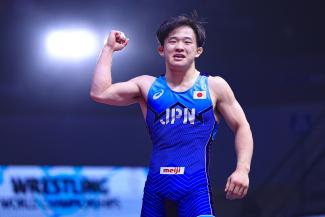

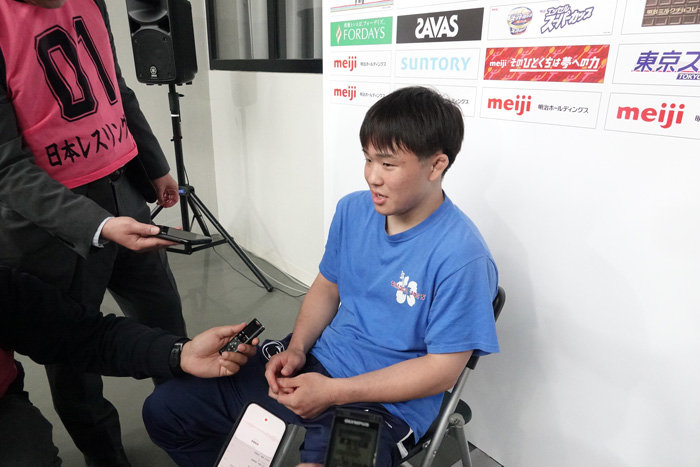 Masanosuke ONO (JPN) giving interview on the sidelines of the Meiji Cup. (Photo: wrestling-spirits.jp / Ikuo Higuchi)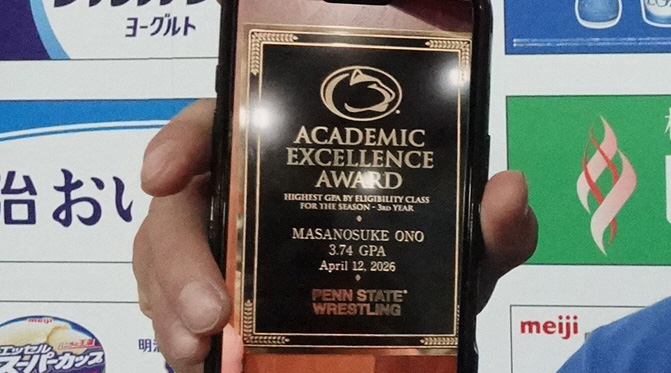
Share your thoughts.
Comments