

Makhmudov, coach put on clinics in rural Japan
Monday, December 4, 2023 - 18:12 By Ken Marantz

TOKYO, Japan (December 4) --- After adding a second straight world title this year to his Olympic silver medal, Akzhol MAKHMUDOV (KGZ) would surely be recognized on any street in Bishkek. Last month, he won over a new group fans in a rural prefecture of Japan, and may have even helped one to someday challenge him.
Makhmudov spent three days last month in Japan putting on wrestling clinics at the invitation of the Ehime Prefecture Wrestling Association along with his personal coach Meirambek AKHMETOV (KGZ), according to a story recently posted on the Japan Wrestling Federation website submitted by Masashi OCHI, secretary general of the association.
Makhmudov, who became Kyrgyzstan's first-ever male world champion when he won his first gold medal at Greco 77kg in 2022, also met with the Ehime Prefecture governor, did a little sightseeing, and got in some workouts as he prepares to start training in earnest for the Paris Olympics.
 Akzhol MAKHMUDOV, holding his world championship belt, and coach Meirambek AKHMETOV, 2n from left, meet with Ehime Prefecture Gov. Tokihiro NAKAMURA, 2n from right, and other officials. (Photo: Japan Wrestling Federation)
Makhudov impressed everyone involved with his sincerity, dedication and professionalism, Ochi wrote, and was just the type of role model the association wanted to present. Asked about the secret of his success in a question-and-answer session by a young wrestler, Makhmudov gave a heartfelt answer that shows he has never been one to cut corners.
"You know yourself what will be difficult for you, but if you keep at it and don't give up, you will definitely succeed," Makhmudov. "Please don't select the easy road. Your hard work will definitely pay off, so keep going. Anything you do -- wrestling, work, study -- do because you love, cherish your family, and listen to your coach. If you do these, everything will go well."
Ehime Prefecture, with a population of 1.3 million, is spread over 5,600 square kilometers on the northwestern coast of the southern island of Shikoku, across the Seto Inland Sea from Hiroshima. It is famous for its Japanese tangerines, known as "mikan," and its picturesque mountains and coastline. It has also produced some notable wrestlers of late.
The prefecture has established a program to promote youth sports, and the wrestling federation had the idea to invite a top foreign wrestler as a guest instructor. They consulted UWW-licensed referee Kuninori KOIKE, who contacted his acquaintance Akhmetov, who himself is now an international referee who officiated at the Tokyo Games two years ago.
That set the wheels in motion, and Makhmudov and Akhmetov left Bishkek on Nov. 8 for the long journey to Japan via Almaty and Busan. They landed at Kansai International Airport in Osaka and spent the night in Tenri, Nara Prefecture, before taking a flight the next day from Osaka's Itami Airport to Matsuyama. about 270 kilometers to the west.
On the morning of Nov. 10, Makhmudov and Akhmetov paid a courtesy call on Gov. Tokihiro NAKAMURA in the prefectural capital of Matsuyama. That afternoon, the first clinic was held in the neighboring city of Imabari at Imabari Technical High School, with about 40 junior high and high schoolers from throughout Ehime Prefecture in attendance.
 Makhmudov and Japan's Greco 67kg champion Kyotaro SOGABE hit it off during the clinics and used the opportunity to spend some time practicing together. (Japan Wrestling Federation)
Helping out as special instructors were several distinguished alumni of Imabari high schools, including Kyotaro SOGABE, a 2022 world U23 bronze medalist at Greco 67kg, and Rin MIYAJI, the 2021 world silver medalist at women's 68kg. There was time set aside for instruction, drills and open sparring, with Koike serving as an interpreter.
On Saturday Nov. 11, Sogabe's coach at powerhouse Nippon Sports Science University, Shingo MATSUMOTO, joined the clinic. Matsumoto, the head coach of all three styles at the university, won nine straight national titles from 1999 to 2007 and appeared in two Olympics at Greco 84kg, finishing seventh at the 2004 Athens Games.
In the morning, Akhmetov taught techniques from the standing position in Greco. His experience working with Kyrgyzstan's youth team came through, Ochi noted, as he explained everything calmly and in great detail. Akhmetov said that Greco techniques need to be learned from a young age, and expressed surprise that most Japanese wrestlers do not become fully committed to Greco until they are in college. "Japanese wrestlers are physically fit, but lack technique," Akhmetov commented.
That afternoon, they became ambassadors of sorts for the sport at an event aimed at giving youngsters who had had little or no exposure to wrestling a chance to experience it. Held at the Ehime Prefectural Budokan in Matsuyama, Makhmudov led the prospective athletes in warm-ups, mat games and mini-matches. "Your stances when you tie up and your understanding the rules are fantastic," Makhudov commented.
 Participants in a clinic gather for a group photo with Makhmudov and Akhmetov. (Photo: Japan Wrestling Federation)
At the end, the children were allowed to ask Makhmudov some questions. Asked what he pays most attention to in regard to being a professional athlete, he replied, "I only eat things that are good for my body."
The third and final "Makhmudov Camp" on Nov. 12 was held at Hojo High School in Matsuyama, where Akhmetov focused on throws from standing and both offense and defense in par terre. He could be heard yelling out "Combination!" a number of times. The clinic was not limited to Greco, and the few girls in the group fervently went through the drills.
Meanwhile, Makhmudov and Sogabe had really hit things off with each other, and worked together on techniques and did some sparring. The 45-year-old Matsumoto even got in on the act and went toe-to-toe with Makhmudov, drawing the eyes of everyone in the room. Ten years before Makhmudov won his first of his three Asian titles at the age of 18 before a delirious crowd in Bishkek in 2018, Matsumoto added a gold at the Asian Championships to his two silver medals in one of his final competitions.
During the three days, Makmudov impressed his hosts with a regimen of exercise, proper nutrition and sufficient rest. He said he has promised to refrain from drinking until after the Olympics. "He is the consummate pro," said one official.
 Makhmudov strikes a warrior pose in a samurai helmet and armor at Matsuyama Castle. (Photo: Japan Wrestling Federation)
Makhmudov also found time to visit one of Ehime's main tourist attractions, Matsuyama Castle, which was built in 1603 and has been designated a National Historic Site. There he donned a samurai helmet and armor for a commemorative photo while "assuming a warrior pose," as Ochi describes it. At a souvenir shop nearby, he was treated to Ehime mikan juice which comes directly out of a faucet.
On the last day of the clinics, Makhmudov bid farewell to the participants by saying, "Let's meet again at the Asian Championships or Olympics. Thank you." Even with Japan's Nao KUSAKA also having qualified at Greco 77kg, Makhmudov will certainly have some supporters in a small pocket of southern Japan.
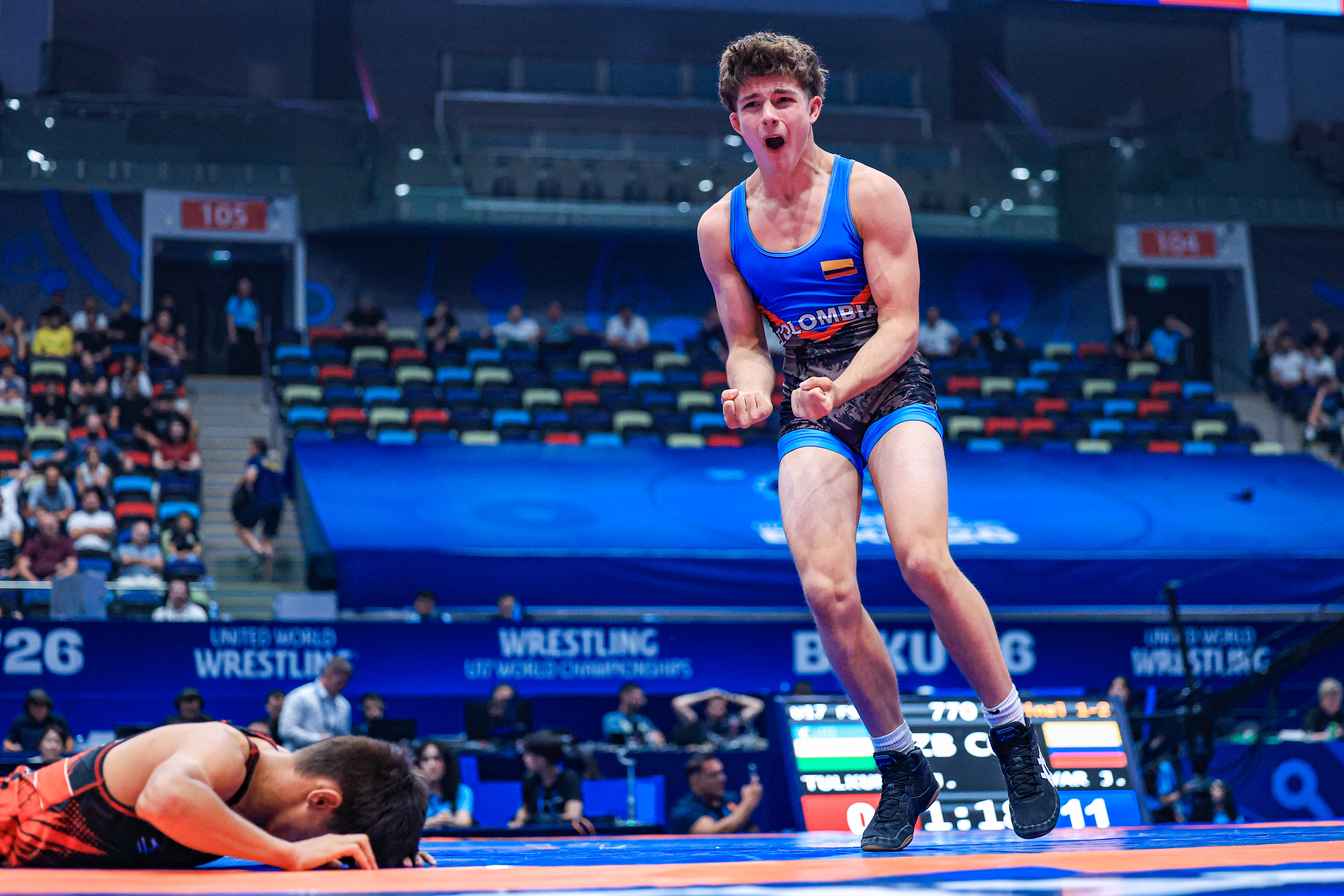 Jovanni TOVAR (COL) celebrates after winning the 55kg gold medal. (Photo: United World Wrestling / Amirreza Aliasgari)
Share your thoughts.
Comments