

Rising Star Fujinami Leads Japan Gold Rush at Asian U-15 Girls
Friday, November 16, 2018 - 18:03 By Ken Marantz

FUJIMI, Japan---Having already surpassed her world medalist brother in one aspect, Akari FUJINAMI (JPN) continues to establish herself as a likely future star in Japan's women wrestling.
Fujinami, a junior high schooler who this summer became a world cadet champion, stormed to victory in the 54kg division to lead a gold rush by the host country at the Asian U-15 Girls Championships on Friday in Fujimi, north of Tokyo.
Fujinami was one of six Japanese who made it to the top of the medal podium in the 10 weight classes, with Miu OBATA (39kg), Yu SAKAMOTO (46kg), Moe KIYOOKA (50kg), Kanami YAMANOUCHI (58kg) and Ayano MORO (62kg) also emerging victorious. Japan also won two silver medals.
India claimed three golds, including a victory at 42kg by world cadet bronze medalist SWEETY (IND), along with three silvers and a bronze, while Uzbekistan took the remaining title in the heaviest weight of 66kg as well as four bronzes. It was a bittersweet day for Mongolia, which had to settle for four silver medals to go with one bronze.
Japan, which did not have an entry in the lightest weight class of 33kg, easily won the team title with 202 points, followed by India (181), Kazakhstan (125), Mongolia (114) and Uzbekistan (105).
As the tournament, the first for the continent in this age category, drew entries from just eight countries---China was noticeably missing---all of the weight classes featured round-robin groups. In divisions with six or more, there were two groups to determine semifinals spots, concluding with a gold-medal match.
Fujinami's weight class had just four entries, so the ranking was determined after each wrestler faced each other in a simple round-robin. Fujinami's domination was complete, as she needed less than a combined three minutes to vanquish her three opponents by fall or technical fall.
"Even if the matches are won easily, there are issues I want to address," Fujinami said. "Today, I wanted to work on going right into turning over [the opponent] after making a tackle. I achieved that up to an extent, but I'm not there yet."

Three of the six weight classes that had finals featured clashes between Japan and India, and none was a close as the victory by India's Sweety at 42kg.
Facing Miwa MAGARA (JPN), Sweety gave up a takedown and an exposure to fall behind 4-0 in the first of the two 2-minute periods. But using the counter-wrestling that Indian wrestlers have become so successful at, she gained a go-behind takedown to cut the lead to two points.
Magara stayed on the attack and, with the clock ticking down, Sweety managed to fend off a tackle and slip behind with :02 left in the match to win 4-4 on last-point criteria.
"I was thinking only about the gold medal," Sweety said of those tenuous final seconds.

In the next match, Sakamoto gained some payback for the hosts by pulling away in the second period to defeat ANTIM (IND), 10-2, in the 46kg final.
Sakamoto, who won a gold medal in the Klippan Lady Open cadet tournament in February, took a 2-2 lead into the second period, then used a cradle to tack on four points. She then added an exposure and a takedown to finish up the win.
"I was able to do what I practiced in the first match, second match and third match [semifinal]," said Sakamoto, who attends the Japan Olympic Committee's Elite Academy. "But I let [my opponent] get away in the fourth match which was for the title."

India's other golds came at 33kg, which had just two entries and saw Pooja RANI (IND) defeat Anna NAZARENKO (KAZ) by 11-0 technical fall, and at 36kg, in which KOMAL (IND) rallied from a 0-6 deficit to defeat Fuka KONDO (JPN) 6-6 on last-point criteria in the third of her four round-robin matches.
Uzbekistan broke up the Japan-India gold monopoly when Rushana ABDIRASULOVA (UZB) took the 66kg title, winning three of her four matches by fall. She beat runner-up Davaajargal ALTANSUKH (MGL), 8-2, in her third match of the round-robin.
For Fujinami, who turned 15 on Nov. 11, it was her eighth gold medal in eight domestic and international tournaments this year---four of which were at the cadet (16-17) level and which included the world 49kg title in July in Zagreb.
"I go in with the feeling of being the challenger," Fujinami said of taking on high school-aged opponents. "From now, I will be in the position of the one being followed, but I aim to win and become champion of Japan."
Fujinami, who hails from the same Mie Prefecture that produced Saori YOSHIDA, started wrestling at age 4 in the Inabe Wrestling Club coached by her father. The Inabe club also was the launching point for her brother Yuhi FUJINAMI (JPN), who won a bronze medal in freestyle 70kg at the 2017 Paris world championships (this year he failed to medal at 74kg), as well as Paris gold medalist Yuki TAKAHASHI (JPN).
Before making his mark on the senior level, Yuhi Fujinami was a world silver medalist as both a cadet and junior. By winning the first of possibly three world cadet golds, Akari has already bested her beloved brother, who is 7 years her senior but serves as a trusted coach and friend.
"Before tournaments, we exchange messages, and he teaches me techniques," Akari said. "If I have to say, right now he's a 'rival.' I'm like, I don't want to lose to him." She added that she respects what he has accomplished, saying, "I see with him, when you become a senior how tough it is to be third [in the world]."
Prior to her victory in Zagreb, her cadet titles came at Klippan Lady Open, the Japan Queen's Cup in April and the Asian Championships in Tashkent in May.
Fujinami, who will graduate from junior high school in March, will not be eligible to compete at the All-Japan Championships until she is 18. But that doesn't stop her from eyeing the 2024 Olympics in Paris. Off to a good start, time will tell if she can keep clearing the hurdles along the path to the ultimate goal of every wrestler.

Results
33kg (2 entries)
Final: Pooja RANI (IND) df. Anna NAZARENKO (KAZ) by TF, 11-0, 1:39
36kg (5 entries)
1st place: KOMAL (IND), 4-0
2nd place: Fuka KONDO (JPN), 3-1
3rd place: Kumushai ZHOODANBEKOVA (KGZ), 2-2
Key Match: KOMAL (IND) df. Fuka KONDO (JPN) 6-6 in 4th round
39kg (5 entries)
1st place: Miu OBATA (JPN), 4-0
2nd place: PINKI (IND), 3-1
3rd place: Nigina SABIROVA (UZB), 2-2
Key Match: Miu OBATA (JPN) df. PINKI (IND), 12-5 in 5th round
42kg (6 entries)
Final: SWEETY (IND) df. Miwa MAGARA (JPN), 4-4
3rd Place: Shugyla OMIRBEK (KAZ) df. Mushtariy TOLIPBEKOVA (UZB), 4-2
46kg (7 entries)
Final: Yu SAKAMOTO (JPN) df. ANTIM (IND), 10-2
3rd Place: Dilshoda MATNAZAROVA (UZB) df. LIAO Pei-Ying (TPE), 8-0
50kg (7 entries)
Final: Moe KIYOOKA (JPN) df. Khulan BYAMBASUREN (MGL), 3-0
3rd Place: Ulmeken ESENBAEVA (UZB) df. Altyn SHAGAYEVA (KAZ), 2-2
54kg (4 entries)
1st place: Akari FUJINAMI (JPN), 3-0
2nd place: Altjin TOGTOKH (MGL), 2-1
3rd place: Pratibha JANGHU (IND), 1-2
Key match: Akari FUJINAMI (JPN) df. Altjin TOGTOKH (MGL) by Fall, 1:01 (6-0) in 2nd round
58kg (7 entries)
Final: Kanami YAMANOUCHI (JPN) df. Bhagyashree FAND (IND), 5-0
3rd place: Maral BATTSOOJ (MGL) df. WENG Hsing-Yao (TPE) by Fall, :57 (2-0)
62kg (7 entries)
Final: Ayano MORO (JPN) df. Odzaya ERDENEBAT (MGL) by TF, 10-0 (2:18)
3rd place: Laylokhon SOBIROVA (UZB) df. SITTU (IND) by Fall, 2:38 (6-0)
66kg (5 entries)
1st place: Rushana ABDIRASULOVA (UZB), 4-0
2nd place: Davaajargal ALTANSUKH (MGL), 3-1
3rd place: Ayazhan TOKTASH (KAZ), 2-2
Key match: Rushana ABDIRASULOVA (UZB) df. Davaajargal ALTANSUKH (MGL), 8-2 in 3rd round
Team Standings
1. Japan, 202 points; 2. India, 181; 3. Kazakhstan, 125; 4. Mongolia, 114; 5. Uzbekistan, 105; 6. Chinese Taipei, 54; 7. Thailand, 37; 8. Kyrgyzstan, 32.

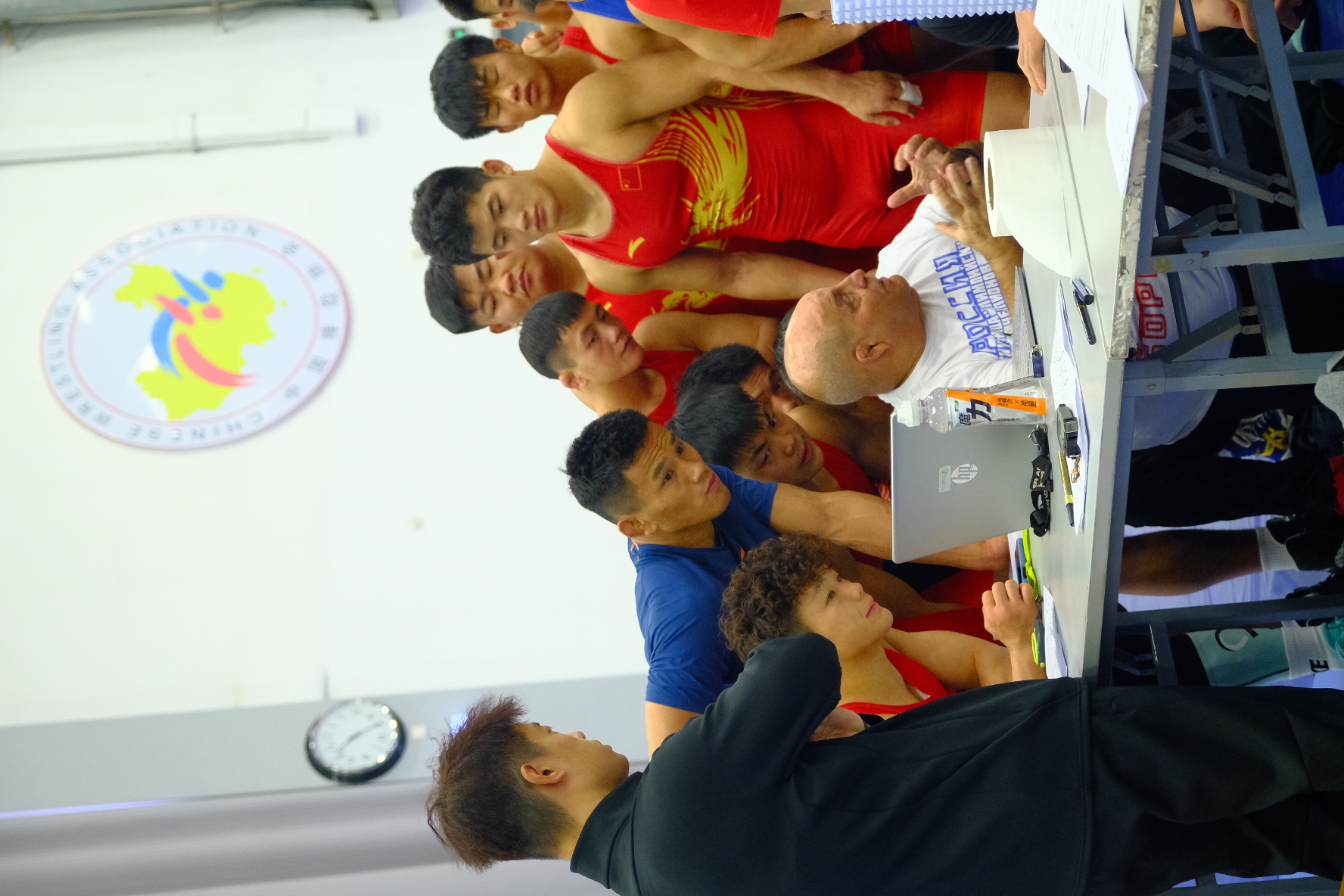 Raul DIAZ (CUB) with the Chinese Greco-Roman national team. (Photo: Xinhua News)
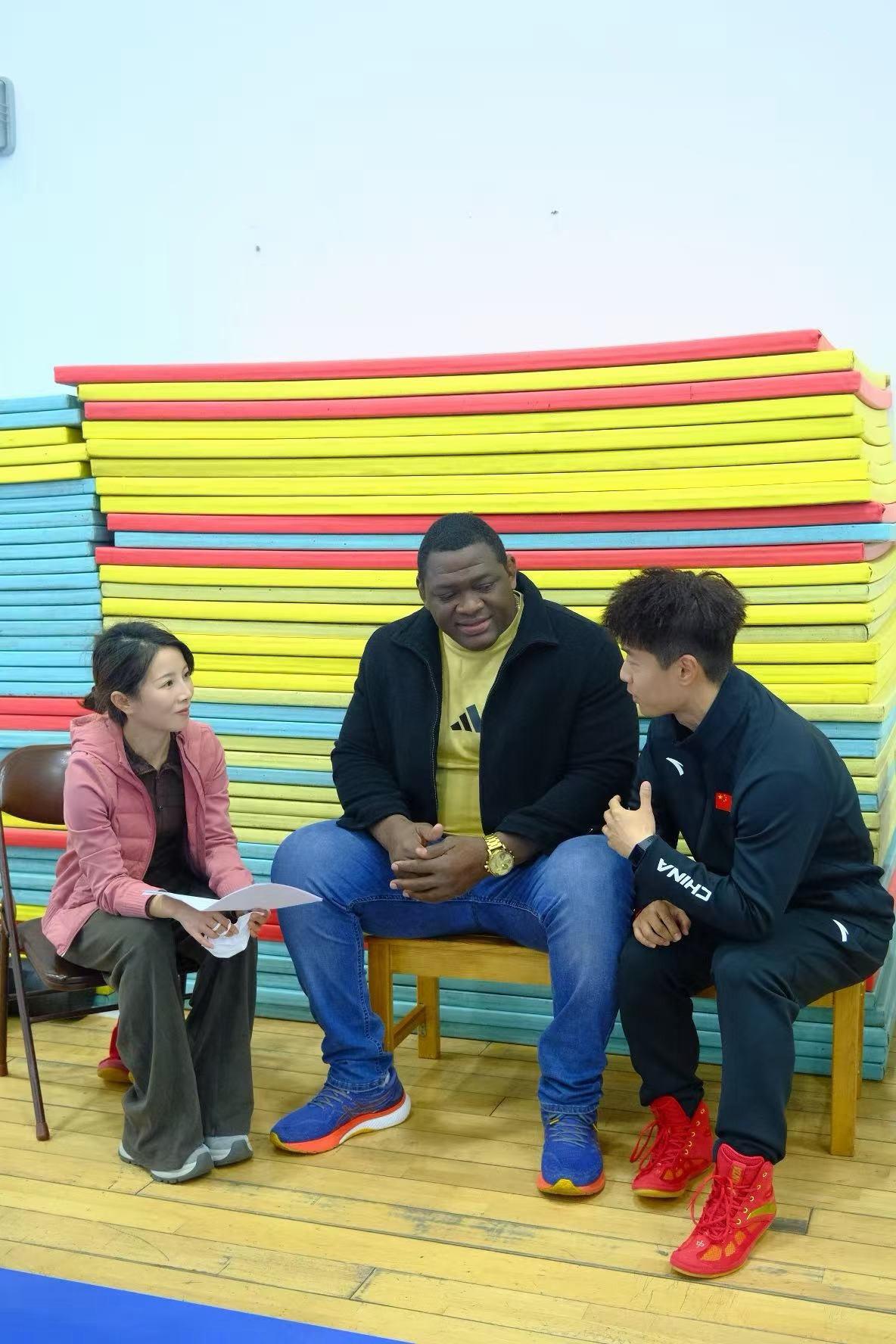 Reporter interviewing Mijain LOPEZ (center) and Shen SHIYAN (right), Spanish interpreter for the Chinese Greco-Roman team. (Photo: Xinhua News)
Share your thoughts.
Comments