#WrestleZagreb

WATCH: Tumur-Ochir's underhook supremacy

By Vinay Siwach

ZAGREB, Croatia (February 13) -- When Tulga TUMUR-OCHIR (MGL) walked back to the center after winning the bout against Evan HENDERSON (USA), he made it look rather casual.

The World Championships bronze medalist had performed a classy underhook throw for four points and won the quarterfinal 12-1 at the Zagreb Open Ranking Series last week. The bout had a lot of setups and transitions but one that stood out, perhaps in the whole tournament, was that underhook.

Hassan YAZDANI (IRI) and Rahman AMOUZAD (IRI) are at the top among underhooks. It's typical Iran style to attack and defend using the same setup. But Tumur-Ochir's underhook is very underrated.

An epic throw still fresh in the memory was against Bajrang PUNIA (IND) in the bronze medal bout at the 2019 World Championships which Punia survived after a long bridge position.

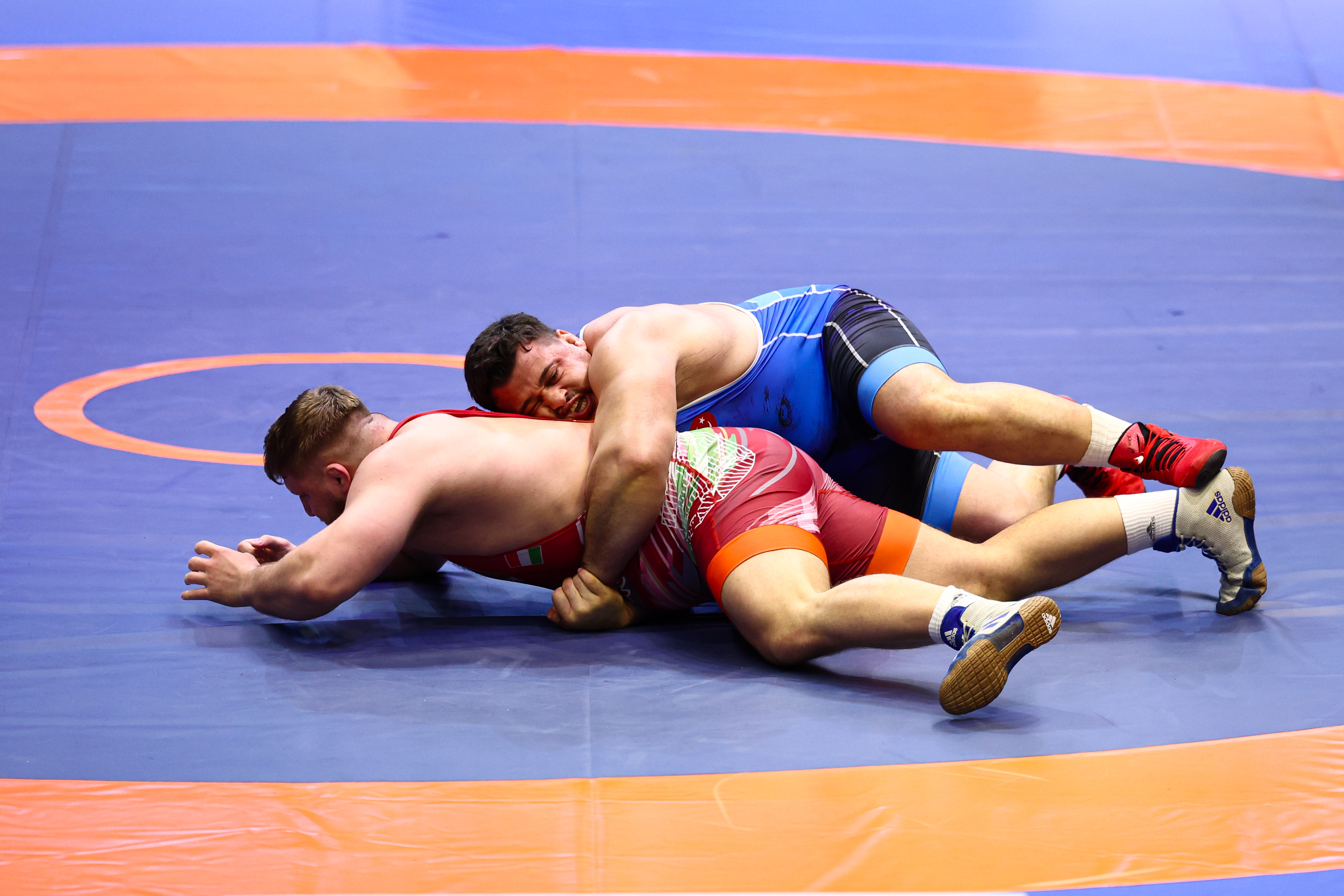
In Zagreb, Tumur-Ochir was more relaxed and after leading 8-1 at the break, he got into a dominant position. He put the underhook in place and snapped Henderson. Realizing that Henderson was ready for it, Tumur-Ochir quickly moved to grab for the inside leg and score a pushout. It was a little too far to control and Henderson defended with force.

Henderson pounced on an off-balance Tumur-Ochir and tried to get his arms around the Mongolian's back and almost got it. However, the underhook was still intact.

As Henderson tried to push his opponent to the mat, Tumur-Ochir flung a massive throw using the set underhook and power from his hips. The toss was worth four and victory.

And if the follow-through is a thing in wrestling, Tumur-Ochir perfected that as well. The grip was strong and the ties controlled. Tumur-Ochir made sure that Henderson lands on his back and not land on his arms which would have resulted in only two points for Tumur-Ochir.

Henderson was disappointed in losing that position as he slammed the mat after the bout. But there is little one can do when Tumur-Ochir gets going with those near-perfect underhooks.

Perhaps that was the reason Ismail MUSUKAEV (HUN) franticly moved away from Tumur-Ochir in the semifinals. But as Musukaev's conditioning worsened, TUmur-Ochir got his hands in the perfect place, scoring via stepouts and a takedown to win 6-1.

Then Joseph MCKENNA (USA) faced the wrath in the final. The first takedown scored by Tumur-Ochir in the second minute was a fake. He got an underhook on McKenna and as the latter defended it, Tumur-Ochir bent and hit a double-leg. In the second period, he once again put McKenna on the spot and hit the single leg using a similar setup.

With Tumur-Ochir becoming a big threat in 65kg, it would be a big test for veterans who have dominated this weight class so far.

But one bout that will test Tumur-Ochir will be against world champion Amouzad who is exceptional with his underhook, a move which made him the Asian and the world champion last year.

With the Asian Championships around the corner, this bout is more than a mere possibility.
#WrestleTirana

Kayaalp's 13: New Golden Standard Set in Europe

By United World Wrestling Press

TIRANA, Albania (April 20) -- On Tuesday evening in Tirana, Riza KAYAALP (TUR) did something that for years existed and was expected to continue to exist only as a hypothetical.

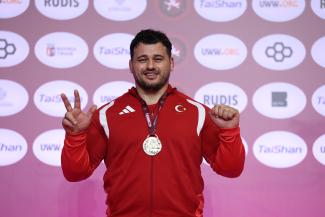
He won his 13th European title in Tirana on Tuesday, beating Darius VITEK (HUN), 7-1, in the 130kg European Championships. 2026 joined 2023, 2022, 2021, 2019, 2018, 2017, 2016, 2015, 2014, 2013, 2012 and 2010.

Riza KAYAALP (TUR)Riza KAYAALP (TUR) turns Darius VITEK (HUN) in the 130kg final. (Photo: United World Wrestling / Kadir Caliskan)
As the referee raised his powerfully sculpted right arm in triumph, Kayaalp raised the ceiling in Greco-Roman. He moved past the legendary Aleksandr KARELIN’s 12 European gold medals, the last of which he had won in 2000. Generations of wrestlers had competed, won and lost, knowing all the while that that number would outlast them. Until Kayaalp finally eclipsed it.

The moment itself wasn’t dramatic in the way history is often expected to be. Just a raised hand, a nod and a lap of honor around the mat with the Turkish flag around his shoulders. That’s been the story of Kayaalp’s career.

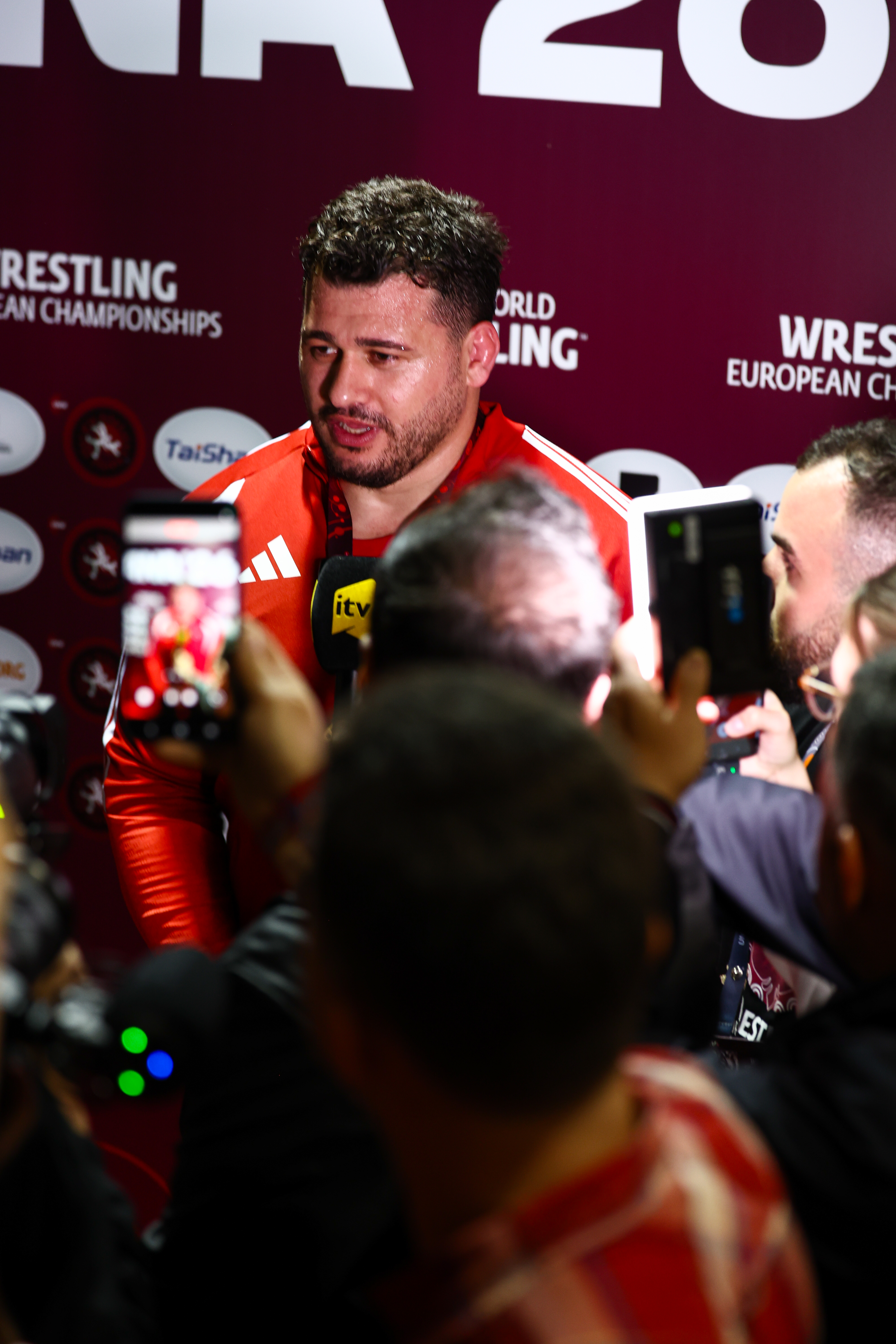
Riza KAYAALP (TUR)Riza KAYAALP (TUR) speaks to the media after winning the gold medal at the European Championships. (United World Wrestling / Jake Kirkman)
Born in Yozgat, in central Turkey, Kayaalp would have inherently understood the role of wrestling in Turkish sporting heritage and the place champions of the sport have historically held in the nation. He would have grown up in the shadow of two-time Olympic and eight-time European champion Hamza YERLIKAYA, who defined Turkish wrestling in the 1990s and like everyone else in the sport, under the global shadow of Karelin.

Slowly and methodically Kayaalp would try to match them. His career has been relentless and consistent rather than spectacular. Since his first European gold in 2010, won as a twenty-year old, Kayaalp has claimed titles across two decades. He’s adapted through rule changes, generations of opponents, and brutal physical wear and tear of time itself.

Apart from his European titles, he has five World Championships gold medals, and three Olympic medals -- a bronze in London 2012, silver in Rio 2016, bronze again in Tokyo 2020. Every time a major medal was to be decided over the past decade and a half, Kayaalp would with almost absurd reliability be counted in the mix.

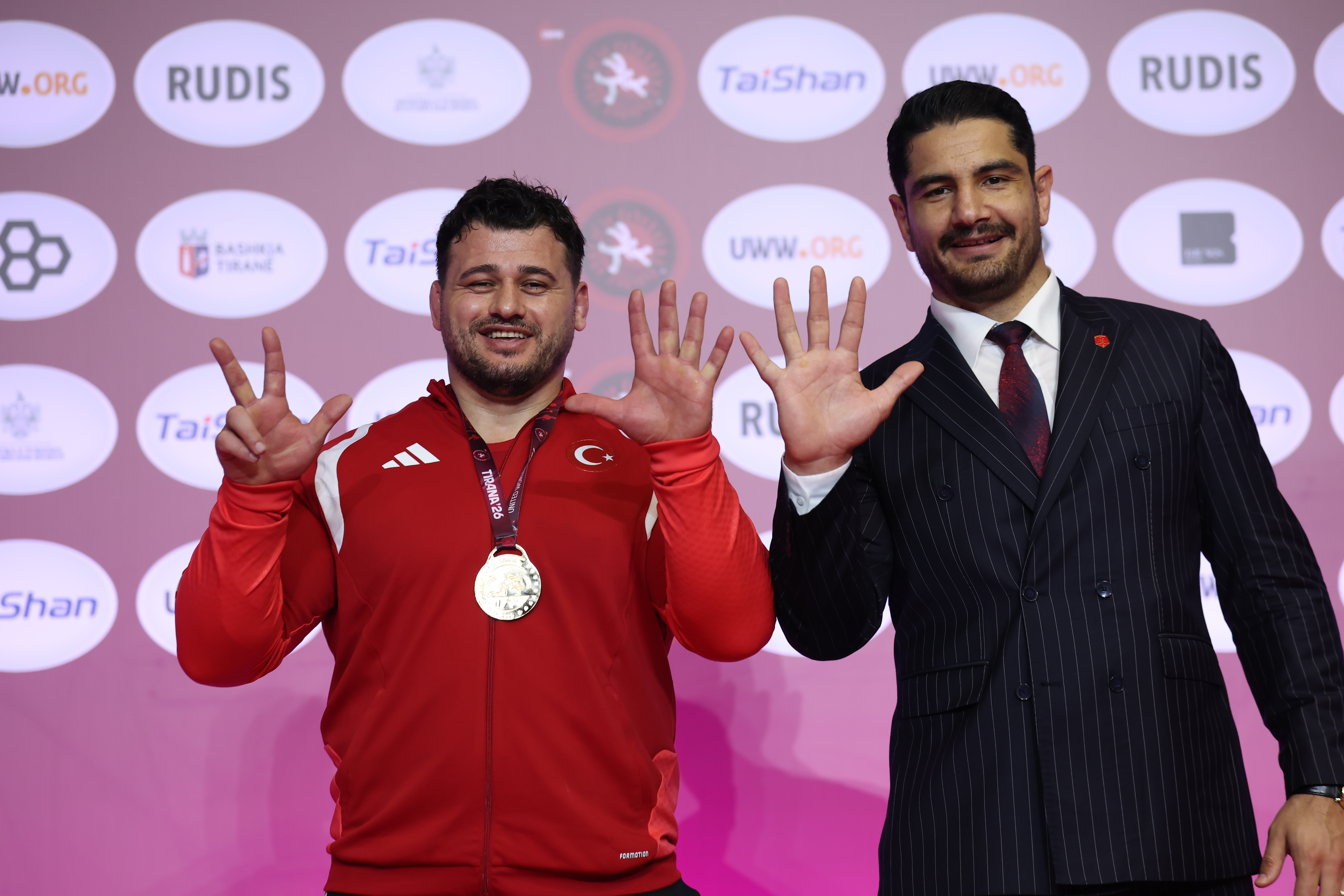
Riza KAYAALP (TUR)Riza KAYAALP (TUR) with Taha AKGUL (TUR) at the medal ceremony in Tirana. (Photo: United World Wrestling / Kadir Caliskan)

For all of Kayaalp’s longevity, his career has always carried the one obvious gap compared to Karelin or Yerlikaya -- no Olympic gold. That absence will still be there. That gap is unlikely to close any time soon. As such the European mark became a milestone within his grasp. Or in the last few years, a milestone just out of grasp.

Indeed, for Kayaalp the title will provide a sense of closure. He had equalled Karelin’s record at the 2023 European championships in Zagreb. Prior to that tournament, he had in an interview with Anadalou Agency spoken of equalling Karelin’s record, breaking it at the 2024 European Championships and finally finishing his career on a high note with a gold at the 2024 Paris Olympics.

But things would not go as planned. At the 2024 European Championships, Kayaalp was pinned in the final by Sergey SEMENOV (UWW) -- only the second final he had ever lost in Europe. A few months later despite qualifying for the Olympics he was unable to compete due to a medication issue linked to treatment for persistent tinnitus. His appeal to the Court of Arbitration for Sport was upheld, clearing the way for his return. He would describe the period as the toughest of his career.

But the ordeal had left him with a new purpose and a desire to exit the stage on his own terms.

“For an athlete with so many titles, this was the worst thing that could happen,” he said. “Because of a simple issue, we faced a huge problem. But I always believed I would overcome it, return to my job and leave the sport on my own terms,” he had told Anadalou Agency at the start of 2026 when he made his return to international competition at the Zagreb Ranking series earlier this year.

“There was fatigue before. In this 18-month period, my desire to work came back stronger. I was already motivated to be champion. Now it is even greater. I feel renewed,” he had said.

While Kayaalp has said he would compete until the 2028 Olympics, he had also spoken of the unfinished business he had had in Europe. “I was so close,” he said. “Fourteen finals, 12 European titles, one more for the record, and then something unwanted happens. But everything is resolved. To bring that record to my country would mean a lot,” he had said then.

He had come close once and fallen short. That could have been the ending -- a near miss against an immortal number. Instead, with his 13th European title, Kayaalp gets to tell his story. He stands alone as the most decorated European wrestler of all time.

Records though exist to be broken. At some point, inevitably, another wrestler will look at Kayaalp's number and decide to chase it. But at least for some time, records exist to define limits. For over a quarter of a century that limit was Karelin’s 12. Now it’s Kayaalp’s 13.