

2019 European Grappling Championship
Saturday, April 6, 2019 - 16:45 By

Bucharest, Romania (April 6th) –After an action-filled first day of No-Gi Grappling yesterday, the athletes put on the Gi and tied their belts for action in Grappling. Day 2 was just as good, athletes showcased their adaptability and utilized the Gi to the fullest to tangle up their opponents with sweeps from the guard and chokes from all positions and every angle.
Men’s Grappling
World silver medalist in 2018 and veteran of the 62KG division, Dmytro BARANOV (UKR) came better prepared than ever to this year's European edition. BARANOV (UKR) won 3 matches on his way to the final including a redemption match against France’s Anthony DE OLIVEIRA who defeated him in the final of No-GI yesterday. In the finals against Akhmed Zulpukarovitch MAGOMEDOV (RUS), his veteran's experience proved the difference, winning the match 5-5 ( criteria).
Khachbar KHACHILAEV (RUS) aggression and takedown oriented game were too much for his opponents over the course of both days. At +100KG this explosive athlete was all over his opponents winning gold in both styles. In the final of Grappling, Abdel Hakim DJABALI (FRA) was a game opponent but fell short 5-2.
Women’s Grappling
One gold medal was not enough for Svitlana SKRYPNYK (UKR). After winning big yesterday she followed up with an equally impressive performance in the Gi. Taking on 4 opponents on her way to the finals, SKRYPNYK (UKR) defeated all including the bronze medal winner in No-Gi Anzhelika PEKH (RUS). In the finals match Polina KRUPSKAIA (RUS) proved to be her toughest test of the day. After an early back take to score 4 points, SKRYPNKY (UKR) was forced to make use of her skilled guard retention to hold off the surging Russian. The 4 points was just enough for the win and with it the title 53KG.
Grappling Team Results:
1.) Russia
2.) Ukraine
3.) Poland
Next up for Grappling and Grappling No-GI will be the Pan-American Games in Buenos Aires, Argentina on April 15th and 16th. Make sure to catch it all on United World Wrestling.
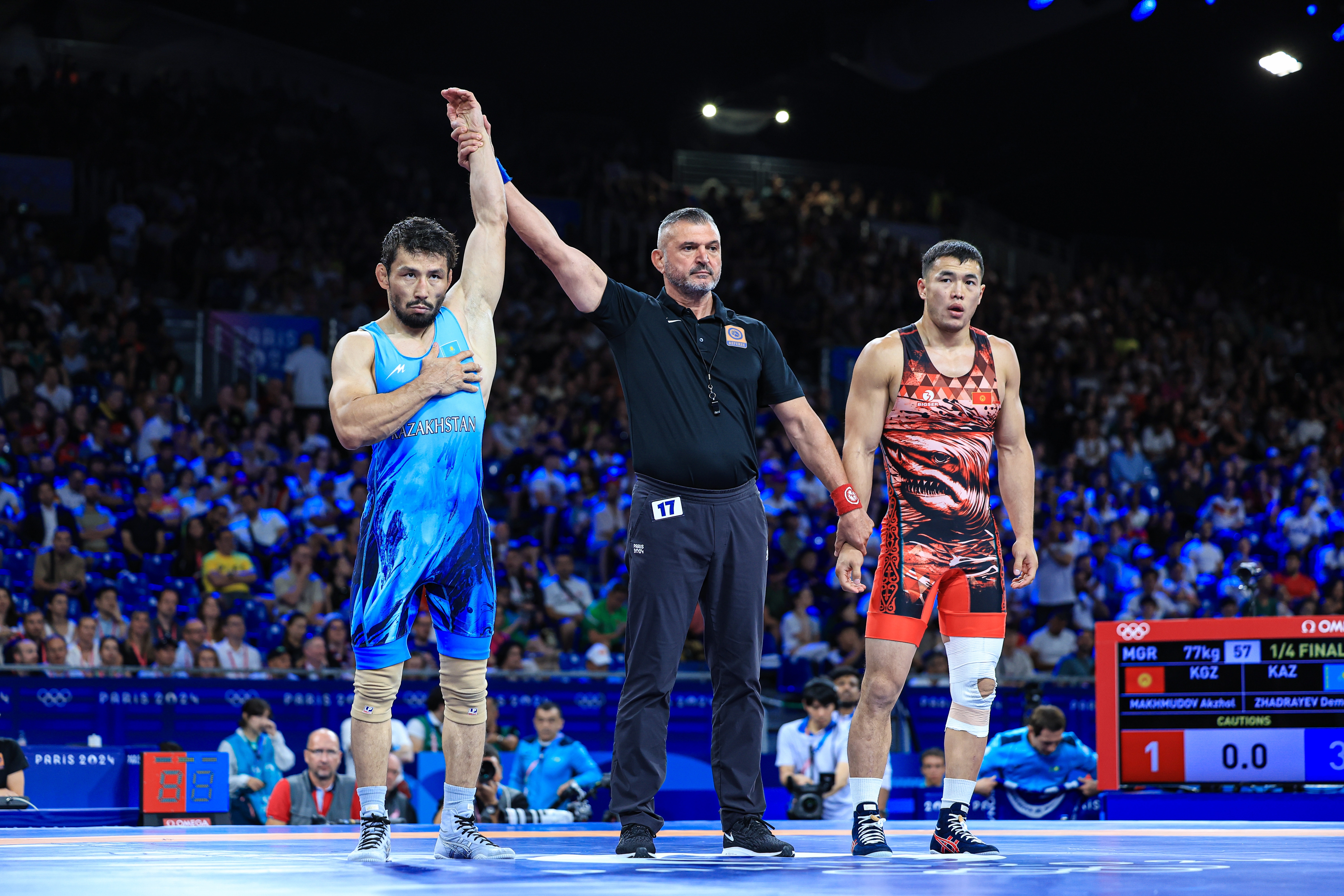 Demeu ZHADRAYEV (KAZ) defeated Akzhol MAKHMUDOV (KGZ), 3-1, at the 2024 Paris Olympics. (Photo: United World Wrestling / Amirreza Aliasgari)
Share your thoughts.
Comments