

Azerbaijan Brings #WrestleDortmund Gold Medal Haul to Three
Wednesday, June 30, 2021 - 19:48 By Eric Olanowski

DORTMUND, Germany (June 29) --- Azerbaijan’s Kanan HEYBATOV (AZE) and Dzhabrail GADZHIEV (AZE), cornered by recent-retiree and Rio Olympic bronze medalist Jabrail HASANOV (AZE), claimed junior European gold on Wednesday night and brought their overall gold medal haul to three.
Turan BAYRAMOV (AZE), who won 70kg gold on Tuesday night, was Azerbaijan’s third junior freestyle gold medalist.
After two cadet European bronze medal finishes, Heybatov finally got over the hump and claimed his long-awaited gold medal. He trailed Levik MIKAYELYAN (ARM), 3-0, but flipped his offensive switch on and picked up a pair of takedowns and exposures in the final two minutes and won the 61kg title, 8-5.
Gadzhiev, a ’19 cadet world champion, blew through Taner GARIP (TUR) and won his second European title of the year. He also won gold at the U23 European Championships earlier this year.
In the first period, Gadzhiev trailed 1-0, but grasped a high-level single leg and quickly transitioned into a right-side gut wrench for the 4-1 lead. In the closing period, the 19-year-old planted Garip on his face with a snap down and extended his lead to 6-1. He pushed that lead to eight points after he threw his Turkish opponent for four points. Leading 10-2, the Azeri used an underhook throw-by to pick up the match-ending takedown and the 74kg title.
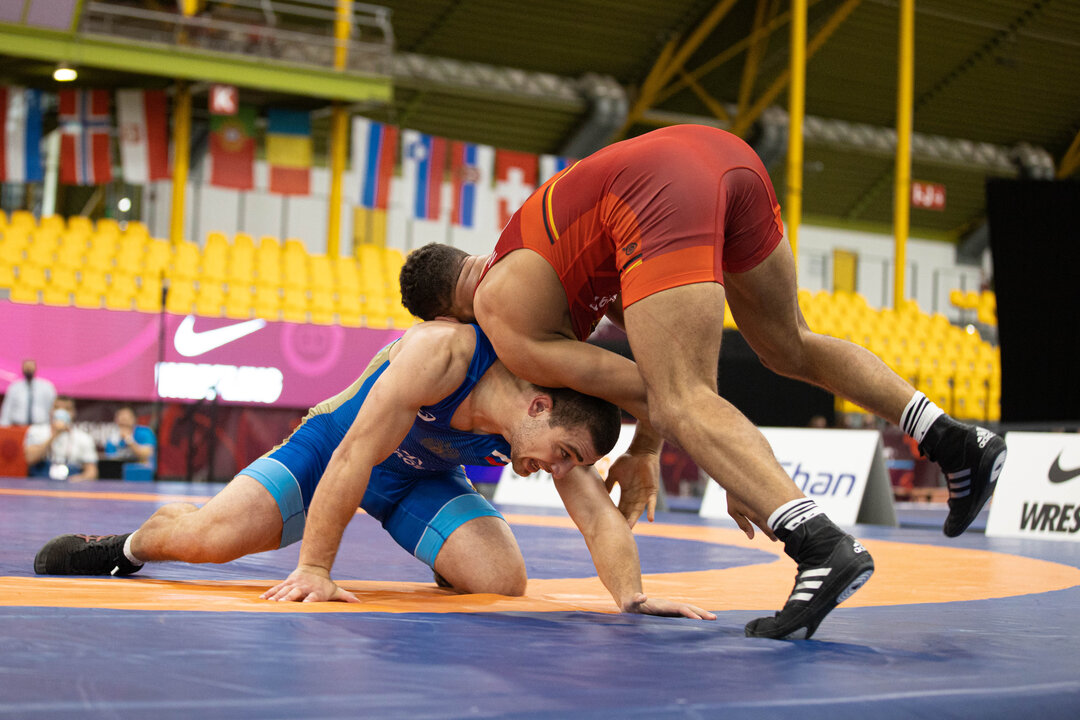
Arslan BAGAEV (RUS) scores the match-winning stepout against Joshua MORODION (GER) in the 86kg finals. (Photo: Kadir Caliskan)
Meanwhile, Russia (185 points) came into Wednesday with three champs and tacked on two additional golds, and walked away with the team title, 59 points ahead of second-place Turkey (126 points)
Azerbaijan (119 points), Ukraine (103 points) and Armenia (101 points) rounded out the top five in the freestyle team race.
Arslan BAGAEV (RUS) bagged 86kg gold with an impressive 10-0 throttling of Joshua MORODION (GER). While leading 1-0 off a step out, the Russian hit an elbow pass to a trio of leg laces and headed into the second period with a commanding 9-0 lead. He wasted no time in the second period, shooting an open double leg which resulted in a stepout to win, 10-0.
Islam KILCHUKOV (RUS) picked up a four-point win over Johannes MAYER (GER) in the 92kg finals and handed Russia their fifth overall gold medal of the competition. He picked up an inactivity point and stopped a pair of German shots and scooped up four counteroffensive points to win, 5-1.
The final freestyle gold medal of the competition went to Lyova GEVORGYAN (ARM). He crushed Aydin AHMADOV (AZE) in the gold medal match and won his second career European title and first since winning the ’18 cadet European gold. He only needed a little over two minutes to score his 11 points and reach the top of the European podium.
Wrestling at the Junior European Championships resumes on Thursday at 11:30 (local time) and can be followed on www.uww.org.
RESULTS
61kg
GOLD - Kanan HEYBATOV (AZE) df. Levik MIKAYELYAN (ARM), 8-5
BRONZE - Daviti ABDALADZE (GEO) df. Khamzat ARSAMERZOUEV (FRA), 3-3
BRONZE - Pavel ANDRUSCA (MDA) df. Hamza ZOPALI (TUR), 8-4
74kg
GOLD - Dzhabrail GADZHIEV (AZE) df. Taner GARIP (TUR), 12-2
BRONZE - Magomed ABDULKADYROV (RUS) df. Vladimeri GAMKRELIDZE (GEO), 3-3
BRONZE - Stas David WOLF (GER) df. Vadym KURYLENKO (UKR), 7-3l
86kg
GOLD - Arslan BAGAEV (RUS) df Joshua Philipp David MORODION (GER), 10-0
BRONZE - Rakhim MAGAMADOV (FRA) Denys SAHALIUK (UKR), 6-1
BRONZE - Emre CIFTCI (TUR) df. Joel HENCZ (HUN), 7-5
92kg
GOLD - Islam KILCHUKOV (RUS) df. Johannes MAYER (GER), 5-1
BRONZE - Sergey SARGSYAN (ARM) df. Krisztian Gabor ANGYAL (HUN), 11-0
BRONZE - Daniil PIDLYPENETS (UKR) df. Andro MARGISHVILI (GEO), 3-2
125kg
GOLD - Lyova GEVORGYAN (ARM) df. Aydin AHMADOV (AZE), 11-0"
BRONZE - Arsamag ZASSEEV (RUS) df. Daniel PIRTACHI (MDA), 11-0
BRONZE - Vasyl SOVA (UKR) df. Csaba UBORNYAK (HUN), 6-5

 Roman BRAVO YOUNG (MEX) battles Lucas RODRIGUEZ (PUR) in the 57kg final. (Photo: United World Wrestling / Osvaldo Aguilar)
 Austin GOMEZ (MEX), red, celebrates after winning the 70kg final. (Photo: United World Wrestling / Osvaldo Aguilar)
 Justin RADEMACHER (USA) scores a takedown against Arturo SILOT (CUB) in the 97kg final. (Photo: United World Wrestling / Osvaldo Aguilar)
Share your thoughts.
Comments