LIMA, Peru (June 17) -- Ten nations competed at the Pan-American Beach Wrestling Championships in Lima, Peru. In the men's category, Ecuador, Honduras, Guatemala and Argentina won gold medals while in women's, Colombia won two golds, and Ecuador and Chile won one each.
Former Pan-Am champion Luisa VALVERDE (ECU) won the gold medal at 60kg in women's after a victory via fall over Jania DUNIGAN (PUR) in the final. She used a beautiful headlock throw for the win.
At 50kg, Natalia PERDOMO (COL) pinned Genesis RAMIREZ (PUR) to win gold and the second gold medal for Colombia came when Alexa CUERO (COL) blanked Ruth JIMENEZ (PUR), 3-0, in the 70kg final.
Chile got its gold medal at +70kg when Melanie SANCHEZ (CHI) both her bouts in round-robin. She defeated Aomi RIQUES (PER) and Gabriella REID (PUR), who finished with silver and bronze, respectively.
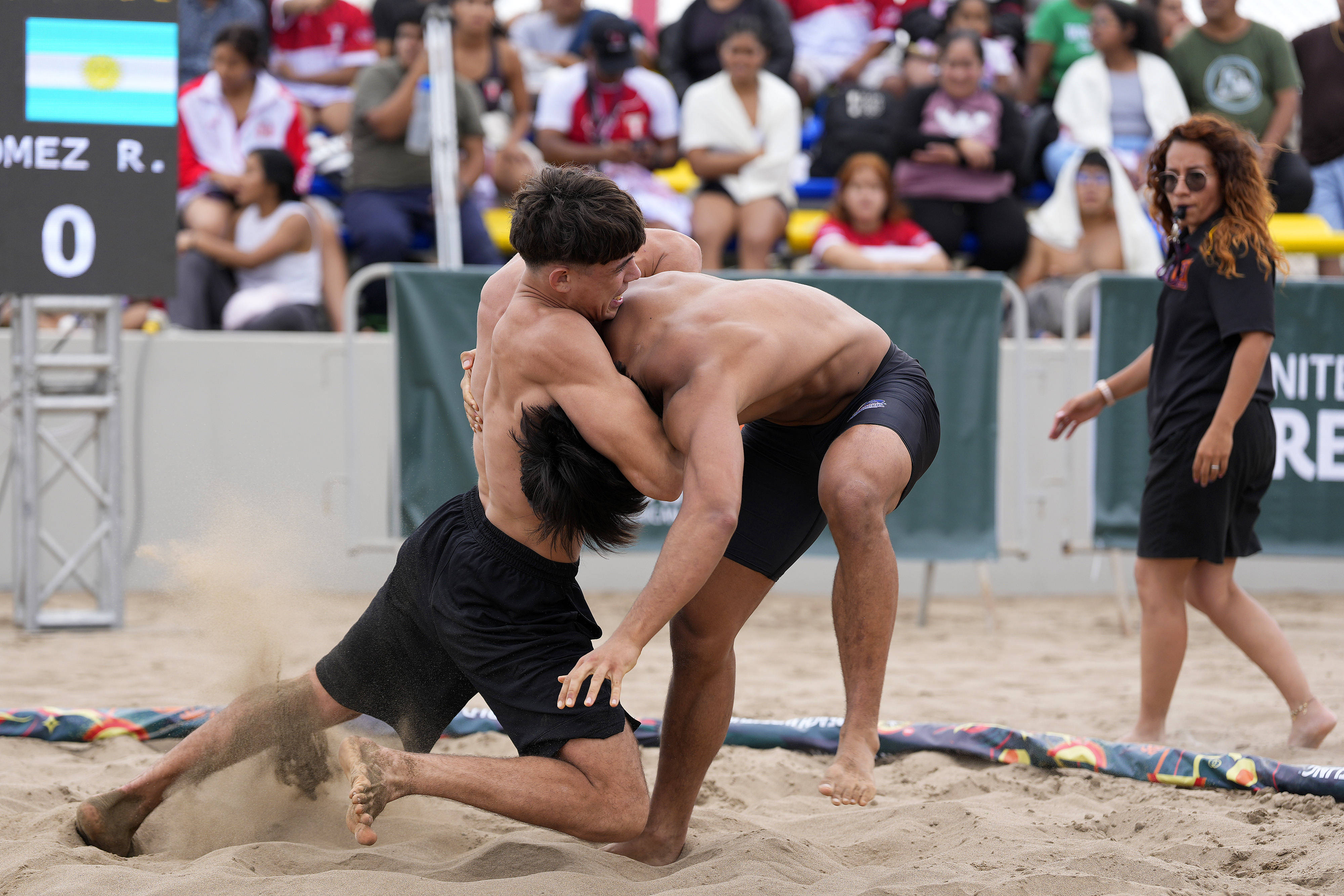 Ricardo GOMEZ (ARG), left, won the +90kg gold medal for Argentina. (Photo: United World Wrestling / Osvaldo Aguilar)
Jeremy PERALTA (ECU) was the first gold medal at men's 70kg as he secured a victory via fall over Alex PICHUCHO (ECU) in the final in just 55 seconds.
The second gold medal was claimed by Luis BARRIOS (HON) who blanked Sixto AUCCAPINA (PER), 3-0, in the 80kg final. He scored three different point to win the bout three seconds before the clock expired.
Three wrestlers posted three wins at 90kg but it was Cristhoper PEREZ (GUA) who emerged as the gold medalist as he had more classification points. Apart from Perez, Jesus LANDA (PER) and Carlos ESPINOZA (PER) also had three wins each. Perez managed eight classification points, Landa had seven and Espinoza had five.
In +90kg weight class, Ricardo GOMEZ (ARG) held on to a close 2-1 victory in the final over Jean ZAMBRANO (ECU) to clinch the gold medal.
RESULTS
Men's BW
70kg
GOLD: Jeremy PERALTA (ECU) df. Alex PICHUCHO (ECU), via fall
BRONZE: Arnoldo PROBOSTE (ARG) df. Caleb NEGRON (PUR), 1-0
80kg
GOLD: Luis BARRIOS (HON) df. Sixto AUCCAPINA (PER), 3-0
BRONZE: Yael PEREZ AKE (MEX) df. Adrian MAYNARD (BAR), 3-1
90kg
GOLD: Cristhoper PEREZ (GUA)
SILVER: Jesus LANDA (PER)
BRONZE: Carlos ESPINOZA (PER)
+90kg
GOLD: Ricardo GOMEZ (ARG) df. Jean ZAMBRANO (ECU), 2-1
BRONZE: Glean GONZALEZ (ECU) df. Kensil GRAJALES (PER), 3-1
Women's BW
50kg
GOLD: Natalia PERDOMO (COL) df. Genesis RAMIREZ (PUR), via fall
BRONZE: Vicky LEON (ECU) df. Nathaly HERRERA (PER), via inj. def.
60kg
GOLD: Luisa VALVERDE (ECU) df. Jania DUNIGAN (PUR), via fall
BRONZE: Meissy VALDEZ (GUA) df. Andrea AVELINO (MEX), via fall
70kg
GOLD: Alexa CUERO (COL) df. Ruth JIMENEZ (PUR), 3-0
BRONZE: Cielo FAJARDO (PER) df. Karla PAICO (PER), via fall
+70kg
GOLD: Melanie SANCHEZ (CHI)
SILVER: Aomi RIQUES (PER)
BRONZE: Gabriella REID (PUR)




Share your thoughts.
Comments