

Dakar to Mexico, Beach Wrestling Hits the Right Notes in 2024
Friday, December 6, 2024 - 12:32 By Vinay Siwach

CORSIER-SUR-VEVEY, Switzerland (December 6) -- In 2024, Beach Wrestling had a momentous year. From Dakar to Rio de Janeiro, there were championships and Games. And the World Series traveled from Mexico to Greece.
The second edition of the African Championships in Beach Wrestling was held in Dakar, Senegal in June. Dakar will host the 2026 Youth Olympic Games with Beach Wrestling being one of the main sports. The city also hosted the Beach Sports Festival.
Apart from the Dakar event, the Beach Wrestling calendar was packed with international tournaments, thanks to UWW's efforts to develop the sport.
The Beach Wrestling Committee also made a few changes to the sport, bringing in the challenge and the activity clock from 2024. This meant that two additional ways to get one point in Beach Wrestling were added: if a wrestler has been called passive and fails to score points during the 30-second activity period, his opponent will receive a point, and the wrestler whose opponent requested a challenge and the challenge is unsuccessful will receive a point.
Each wrestler is entitled to at least two unsuccessful challenges per event — one during the group stage and eliminations and another during the medal match.
For the first time, the Pan-Am Championships were held in the U15, U17, U20 and U23 age-groups. The U15 event was held in El Salvador and Mexico dominated the tournament by winning the title in both men's and women's events. The U17 event was in Dominican Republic with Ecuador winning the men's title and Puerto Rico winning the women's title.
At the U20 Pan-Ams in Peru, Ecuador continued its dominance with the men's title while Mexico bounced back and won the women's title. In Colombia for the U23 event, the hosts won both the men's and women's team titles.
Similarly, the European Championships in the U15, U17 and U20 age groups were held in Romania, a country which has taken keenly to the sport. Romania was so dominant in the competitions that it won the men's and women's team titles in five of the six categories. Only the U20 men's team title was won by Moldova.
UWW's commitment to growing the sport saw a new country host a Beach Wrestling event in Dakar. The African Championships were attended by over 100 wrestlers with the competition going over two days. Hosts Senegal emerged as the best country in both men's and women's categories. It won three gold medals and one silver in each category, combining for eight medals in eight weight classes.
A documentary capturing the essence of Senegal, promoting culture and rich tradition in wrestling, was also produced by UWW.
The U17 World Championships in Beach Wrestling was held in Greece this year along with the World Championships in the U20 age group.
The United States, which has been promoting the sport extensively on the national level, won its first-ever world title as the women captured the team title in the U17 age-group, thanks to the three silver medals it won.
Ukraine emerged as the best team in men's, winning the title over Romania which won two gold medals. But Ukraine had a better performance overall and it pipped Romania for the top spot.
In U20, Moldova destroyed the field, winning three gold medals and the team title in men's while Ukraine made amends by winning the women's title, which it lost at the U17 level.
Beach Wrestling World Series
The fifth edition of the Beach Wrestling World Series saw a remarkable start in Mexico in March along with the Pan-Am Championships. The first stop saw Mexico on the board with two gold medals in the women's category. The men's was more scattered with the U.S., Guatemala, Argentina and Venezuela winning gold medals.
The second stop of the series travelled to a familiar Saint-Laurent-Du-Var which saw records tumbling. The highlight of the tournament was Moldova's growing stature in Beach Wrestling.
Two wrestlers -- Vasile DIACON (MDA) and Traian CAPATINA (MDA) -- won gold medals. Diacon ultimately emerged as the best 80kg wrestler in the world and secured first place in the final rankings. Capatina was second in the final rankings in 90kg.
Romania hosted the third spot and the battle between the hosts and Ukraine in the women's category lived up to expectations. Ukraine won two gold medals and Romania won one out of four available. In men's, Capatina repeated as the gold medalist in 90kg and Mamuka KORDZAIA (GEO) continued his winning run at +90kg.
The fourth stop was in Greece, and not much changed from the other stops. The glittering beaches saw winners from Romania, Ukraine, the United States, Turkiye, Moldova, Azerbaijan and Georgia. It all came down to Porec, Croatia for the finale. With ranking points up for grabs, it meant that the world champions would be decided in Porec.
The final stop in Porec decided the winners of the series. Ana Marie PIRVU (ROU) was the top wrestler in 50kg, Anastasiya KRAVCHENKO (UKR) in 60kg, Oksana HERHEL (UKR) in 70kg and Eliana BOMMARITO (USA) in +70kg. Bommarito was the only wrestler across categories to maintain a 100 percent record -- winning four gold medals.
In men's Yunus COSKUN (TUR) won the top spot in 70kg, Vasile DIACON (MDA) in 80kg, Ibrahim YUSUBOV (AZE) in 90kg and the evergreen Mamuka KORDZAIA (GEO) in +90kg.

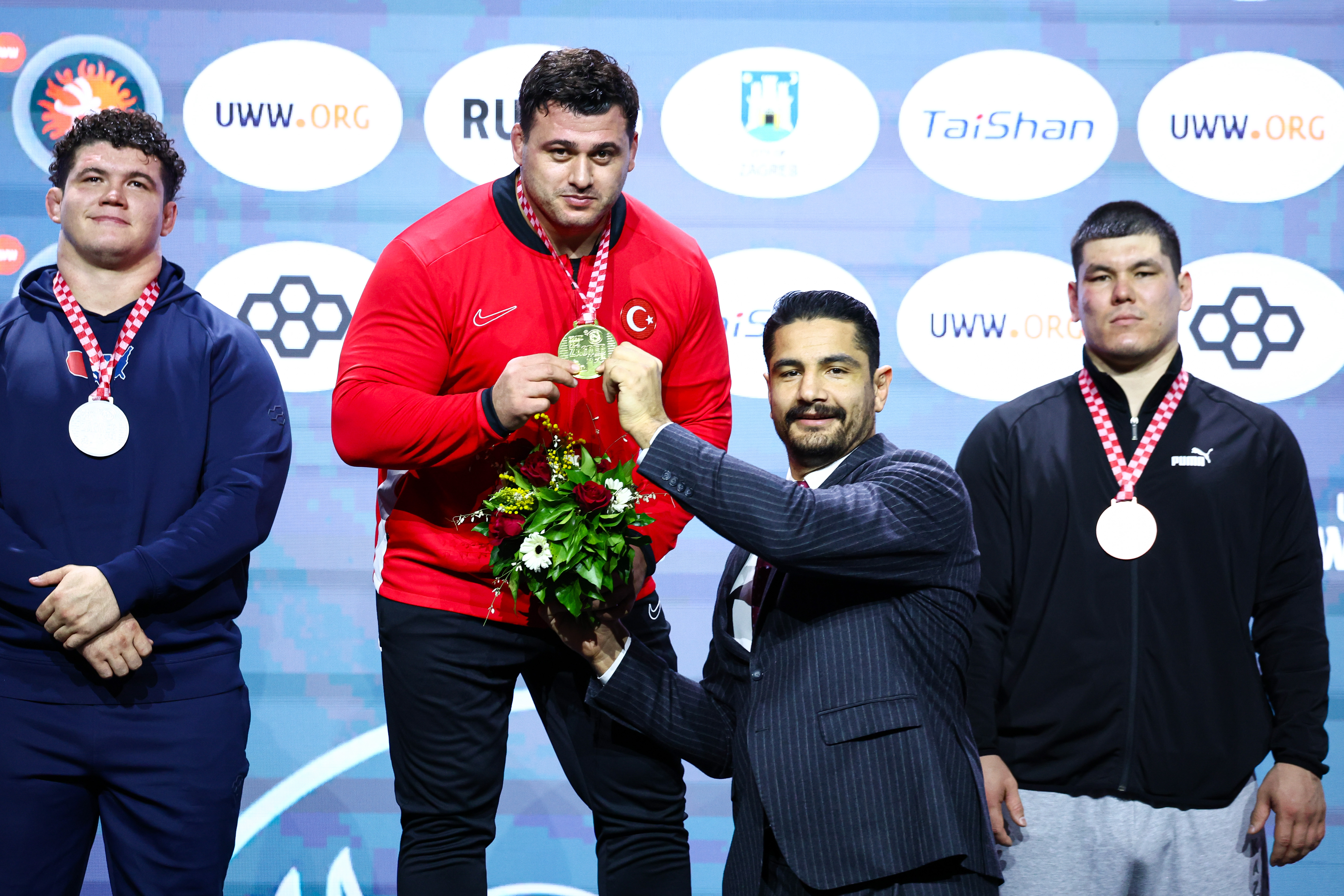 Riza KAYAALP (TUR) receives the gold medal from Taha AKGUL (TUR). (Photo: United World Wrestling / Jake Kirkman)
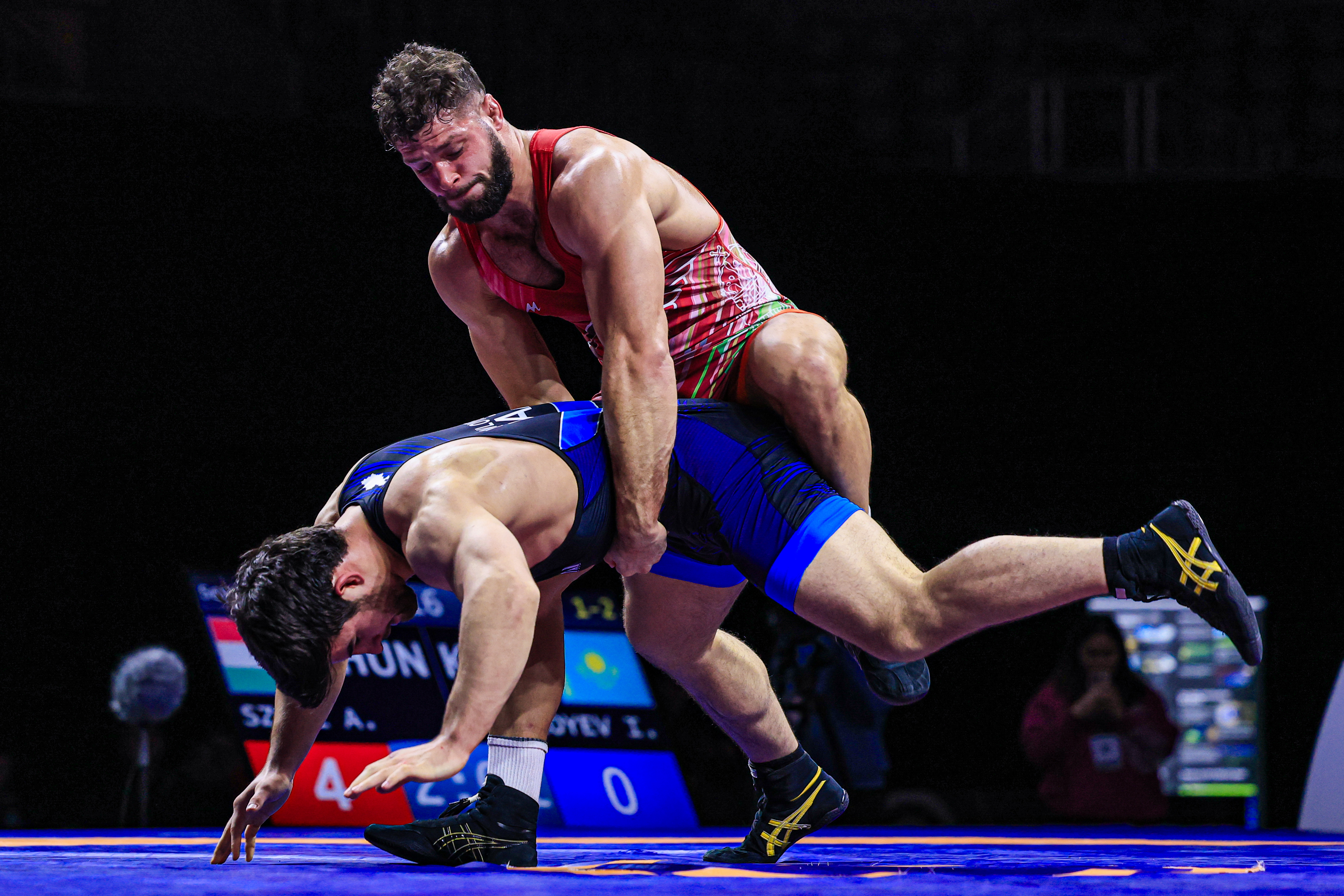 Alex SZOKE (HUN) tries to score against Islam YEVLOYEV (KAZ) in the 97kg final. (Photo: United World Wrestling / Amirreza Aliasgari)
Share your thoughts.
Comments