BUDAPEST, Hungary (July 19) -- The final day of the Budapest Ranking Series 2026 will see six Greco-Roman weight classes - 55kg, 60kg, 63kg, 82kg, 97kg and 130kg. The biggest talking point is the return of Tokyo Olympic champion Musa EVLOEV (RUS).
WATCH LIVE | LIVE MATCH ORDER | GRECO-ROMAN STORYLINES
130kg semifinal - Marat KAMPAROV (RUS) clears the semifinal hurdle with a 1-1 criteria win over Wenhao JIANG (CHN) and he will face Laszlo DARABOS (HUN) for the gold medal after he won 5-1 against Konsta MAEENPAEAE (FIN).
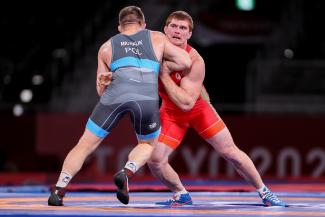
97kg semifinals - Musa EVLOEV's (RUS) comeback is cut short by Alex SZOKE (HUN) in the 97kg semifinal. Evloev held a 1-1 criteria lead but Szoke pushed him towards the zone. Evloev, trying to prevent a stepout, went for the headlock throw but Szoke escaped and scored a takedown to take a 3-1 lead with 33 seconds left in the bout. He defend it to win. For the gold medal, he will face another Russian as Ilia ERMOLENKO (RUS) blanked Arif NIFTULLAYEV (AZE), 10-0. After scoring from par terre, Ermolenko scored a stepout to lead 6-0 and then threw Niftullayev for four points to win 10-0
82kg semifinals - Asian champion Shahin BADAGHIMOFRAD (QAT) enters the final after a 4-1 win over Tornike MIKELADZE (GEO). Badghimofrad managed a go-behind when Mikeladze slipped in the second period to lead 2-1. Georgia challenged that there was leg foul but lost the challenge which made the score 3-1. The Qatar wrestler got the par terre and won 4-1.
Gamzat GADZHIEV (RUS) with a throw from par terre against Mihail BRADU (MDA) to lead 5-0 and then defends from par terre to complete a 5-1 win.
63kg semifinals - Zhambolat LOKYAEV (RUS), who last wrestled internationally in 2021, Kerem KAMAL (TUR) counters with a throw but only gets a stepout to lead 1-1 on criteria. Kamal with a powerful takedown in the second period to extend his lead to 3-1. He tries a throw but cannot complete it but Russia challenge for two points as Lokyaev fell on top of Kamal. Challenge as lost as it was all Kamal's risk. The two keeping getting their holds and locks but Kamal manages another stepout for a 5-1 lead. A stepout for Lokyaev but Kamal enters the final after a 5-2 win.
European champion Sergey EMELIN (RUS) holds on to a 1-1 criteria win over Aref MOHAMMADI (QAT).
60kg semifinals - Zholaman SHARSHENBEKOV (KGZ) blanks Asian champion Alisher GANIEV (UZB). What a performance from Sharshenbekov as he starts with a takedown and then gets the par terre to lead 3-0. He starts the second period with an strong throw for four points but Uzbekistan challenge the call and it is called a leg-foul from Sharshenbekov and the score is reversed to 3-0. But no stopping Sharshenbekov as he scores a go-behind and gets two points and lead 5-0. A tiring Ganiev gives up a stepout which is again cancelled after challenge. But Ganiev cannot get a point on Sharshenbekov who
Yernur FIDAKHMETOV (KAZ) uses his experience to hold off Yerbol KAMALIYEV (KAZ), 10-6, in the other semifinal and will now face Sharshenbekov for the gold medal.
55kg semifinals - In a rematch of the Asian Championships final, Ikhtiyor BOTIROV (UZB) slams LALIT (IND) using an arm throw for four points. India challenges that it was only two points for the throw. Though the four points stood, Lalit got two points for a block in danger and Botirov came on top and got the reversal point, giving Botirov a 5-2 lead. There is no more action or points in this bout as Botirov enters the final.
Brady KOONTZ (USA) stuns Artiom DELEANU (MDA) , 8-5, after a takedown and two stunning throws. He gave four points in the second period but held his lead to enter the final
13:33: Shahin BADAGHIMOFRAD (QAT) hit a head throw against Burhan AKBUDAK (TUR) and led 8-1. But Akbudak forfeits the match due to an elbow injury. It's the same one he had a surgery before. Badaghimofrad advances to 82kg semifinals
13:30: Zholaman SHARSHENBEKOV (KGZ) into the 60kg semifinal after a technical superiority 8-0 win over Mahmoud SAAD (EGY). He scored six points from par terre to lead 7-0 at the break and then gets the one point for the win in the second period
13:15: Asian champion Alisher GANIEV (UZB) with a 16-second pin over BAOYINJIYA (CHN) at 60kg. Might have been called a little too quickly
13:11: Asian champion Ikhtiyor BOTIROV (UZB) needed a late stepout to beat Iskhar KURBAYEV (KAZ), 6-5, at 55kg. Kurbayev with a beautiful suplex in the second period to lead 5-5 on criteria but failed to hold on to it.
13:10: Musa EVLOEV (RUS) moves into the 97kg semifinals after Kevin MEJIA (HON) has to forfeit due to injury. Evloev got the par terre but failed to score as Mejia defended. Mejia actually scored a reversal but was cancelled on a challenge. Evloev then scored a takedown and Mejia called for a medical timeout.
12:58: European champion Sergey EMELIN (RUS) keeps Murad MAMMADOV (AZE) at bay and wins 5-1 at 63kg. He got two par terre position and scored three stepouts in his win.
12:40: Kerem KAMAL (TUR) counters Aftandil TAALAIBEK UULU (KGZ) with a block after takedown and launches the Asian champion for two turns and lead 8-2. He thought he finished the match when a correct throw was counted for two points but Kyrgyzstan challenged and the points were cancelled as Taalaibek Uulu never came in danger. The second period remained pointless and Kamal won 8-2
12:30: Sergei SEMENOV (RUS) worked on a great throw for four points on Gino DILBERT (HON) but seemed to have injured his knee when landed. He forfeits the 130kg after the injury
12:20: Burhan AKBUDAK (TUR) needed a challenge to survive. Leading 6-5, Akbudak was struggling with conditioning and Demeu ZHADRAYEV (KAZ) pushed him out for one point and make it 6-6 with Akbudak leading on criteria. However, Akbudak challenged and on review, Zhadrayev was seen grabbing the singlet. The stepout was cancelled and Akbudak led 6-5 again. Moreover, it gave him time to catch a breather. He gave up a stepout at the end but Akbudak was still a 6-6 criteria winner. Kazakhstan challenged for fleeing but lost it to add one more point to Akbudak's score and win 7-6
12:15: Alex SZOKE (HUN) gets the par terre in the first period but fails to score. Hayk Khloyan (ARM) gets the par terre in the second period but fails to score. With the score 1-1, Szoke wins on first-point scored criteria.
12:12: Asian champion Shahin BADAGHIMOFRAD (QAT) begins his 82kg campaign with a 4-1 win over Azimjon SOATULLAEV (UZB) at 82kg.
11:42: Musa EVLOEV (RUS), first time competing at UWW tournament in 5 years, begins with a 3-0 win over Timothy YOUNG (RUS) at 97kg. He got two points for par terre in each period and one stepout for the win.
11:40: World silver medalist Alisher GANIEV (UZB) with a close 2-1 win over Enes BASAR (TUR) at 60kg. Ganiev with a stepout from par terre to lead 2-0 and then Basar doesn't score any points from par terre and Ganiev defends his lead.
11:35: Zholaman SHARSHENBEKOV (KGZ) looking incredibly locked in! After his first victory via fall, he now beats Elmir ALIYEV (AZE) 10-0 in the second bout at 63kg. Sharshenbekov, who built a 7-0 lead from par terre, needed 39 seconds in the second period to score a takedown against Aliyev to win. Aliyev challenged the takedown but lost it to add one more point to the score of Sharshenbekov.
11:20: Demeu ZHADRAYEV (KAZ) gets one back in his rivalry against Akzhol MAKHMUDOV (KGZ). The Kazakhstan wrestler, who defeated Makhmudov at the Paris 2024 and went on to win silver, pins Makhmudov at 82kg. Makhmudov tried to gut-wrench Zhadrayev from par terre but Kazakhstan wrestler blocked and grabbed the arm to get the fall.
11:12: Kerem KAMAL (TUR) with some highlights. He launches Sunny KUMAR (IND) for two massive throws, second of which was a five-point slam as he win at 63kg, 10-0
11:00: Hayk KHLOYAN (ARM), who recently defeated Musa EVLOEV (RUS), now gets the better of Paris 2024 Paris medalist Uzur DZHUZUPBEKOV (KGZ) at 97kg. Khloyan scored a turn from par terre in the first period and then was awarded par terre in the second period as well. He scored another gut-wrench to lead 6-0. Dzhuzupbekov did not score any points from par terre and lost a challenge as well to hand a 7-1 win to the Armenian
10:45: Zholaman SHARSHENBEKOV (KGZ) hits Dalton ROBERTS (USA) with an underhook throw and completes the fall in in quick time. Sharshenbekov, who wrestled at 63kg at the Ulaanbaatar Open in his first tournament since Paris 2024, is now at 60kg.



Share your thoughts.
Comments