

End of 2020 Olympic Road for Rio Medalists Tosaka, Ota; Susaki, Irie Set up Latest Showdown
Saturday, December 21, 2019 - 17:07 By Ken Marantz

TOKYO (Dec. 21)—Looking to add to the medals they won at the Rio 2016 Olympics, Eri TOSAKA and Shinobu OTA faced difficult paths to Tokyo 2020. The road came to a disappointing and official end for both on Saturday.
Rio champion Tosaka fell in the women’s 50kg semifinals at the All Japan Championships to a determined Yui SUSAKI, who set up yet another showdown with nemesis Yuki IRIE in her rejuvenated bid for a place at Tokyo 2020.
Ota, denied at Greco-Roman 60kg, moved up two weight classes to 67kg in a desperate attempt to make it to Tokyo 2020, but the Rio silver medalist at 59kg was dealt an unceremonious thrashing in his first-round match.
Meanwhile, the Olympic ambitions of two other Rio medalists—Sara DOSHO and Rei HIGUCHI—remained alive for now, but after very different outcomes on the third day of action at Tokyo’s Komazawa Olympic Park Gym.
Following her triumph at 48kg at Rio, Tosaka missed two years after being plagued by injuries and undergoing foot surgery. During her time off, Susaki emerged as the new star in the lightest weight class, taking senior world titles in 2017 and 2018 while still a teenager.

Yui SUSAKI, a two-time world champion, defeated Olympic champion Eri TOSAKA, 6-0, in the 50kg semifinals and will meet rival Yuki IRIE in the gold-medal bout. (Photo: Sachiko Hotaka)
For Susaki, Tosaka had been a role model.
“She was an athlete I really looked up to,” Susaki said of Tosaka after beating her 6-0 on Saturday. “Whenever something appeared in the newspaper about her, I always read it closely. When things got tough, I would think about how Tosaka would deal with it, and that I should do the same.”
But the 20-year-old Susaki, who won the last of three consecutive world cadet titles in 2016, quickly went from fan to rival.
“The moment that the [match at the] Rio Olympics ended and she was on the medal podium, she changed from an athlete I admire to the athlete I want most to beat,” Susaki said.
Susaki, who had beaten Tosaka by technical fall at the All-Japan Invitational Championships in June, came out aggressively in Saturday’s match.
In the first period, she scored with a powerful double-leg takedown, then added a step-out for a 3-0 lead that she padded with a spin-behind takedown and another step-out in the second.
“There was some fear and uneasiness, but my feeling of wanting to win was so strong, it overcame that,” Susaki said. “That’s why I kept attacking at the end.”
Tosaka said she was better prepared, both mentally and physically, for this encounter.
“In June, I had the desire to win, but I didn’t think I could,” a tearful Tosaka said. “After a half year, I thought, I want to win and I believe I can win. I wrestled with the same mentality hat I had at the Rio Olympics.”
While Susaki moved a step closer to the Olympics, she is far from out the woods. She will have to find a way to get past Irie, the defending champion in the tournament also referred to as the Emperor’s Cup. In the other semifinal, Irie defeated Remina YOSHIMOTO 4-1.
Her recent battles with Irie have been epic, and are indirectly the reason Japan did not gain a spot at Tokyo 2020 at the World Championships in Nur-Sultan in a weight class it has dominated for more than a decade.
Irie remains the only wrestler on the planet to have ever beaten Susaki, and the third time she did it was in a playoff in July for a place on the team to the Nur-Sultan.
A medal there, regarded as a foregone conclusion, would have automatically earned Irie a spot at Tokyo 2020. But when she failed to finish even in the top six, the door reopened for Susaki and the others.
“I am back at the starting line, and I am absolutely determined to get revenge for the playoff, win [in the final of] the Emperor’s Cup and get to the Tokyo Olympics,” Susaki declared.
In that and the other Olympic weight classes in which Japan did not qualify for Tokyo 2020 at the worlds, the Emperor’s Cup winner will get a chance to earn a berth at the Asian Olympic qualifying tournament in Xi’an, China, in March.
Ota was hoping to be on that flight, but will now only be an observer to the Olympic process.
Ota had been beaten out at 60kg for a place on the team to Nur-Sultan by Kenichiro FUMITA, who clinched the Tokyo 2020 spot by winning the gold medal. Ota gained some consolation by moving up to 63kg and impressively winning his first world title.
But the Olympics were always his goal, and the only opening was at 67kg. He had hoped to gain some experience at that weight class at the World Cup, but the event was canceled due to political unrest in host Iran.
Still, he felt he was well prepared, although things could hardly have gone worse.
Looking ahead to a second-round clash with fellow world team member Shogo TAKAHASHI, Ota was taken to task by his unheralded first-round opponent, Takayuki INOGUCHI, a fifth-place finisher at the 2018 Asian Championships at 63kg.
Inoguchi stuffed Ota when the Olympic medalist attempted a reverse arm throw, sticking him onto his back and making him fight desperately to avoid a fall. A somewhat mysterious 2-point caution put Ota into a 4-0 hole.
Less than a minute into the second period, Inoguchi caught Ota with the same move that Ota had botched in the first period, a 4-point throw that sent him to his back again. When Ota avoided the fall, it only served to make the official result an 8-0 technical fall at 3:50.
“From the mistake I made on the first throw, and I don’t know why I got the caution, that changed the complexion of the match,” Ota said. “I panicked a little. The throw that he executed he timed perfectly.”
Ota admits that looking ahead to the next match contributed to his downfall.
“I thought too much about the second-round match with Takahashi, and this was the result,” he said.
Despite the loss, Ota said he didn’t feel a physical difference in the higher weight class, having prepared by training in Russia with heavier wrestlers.
“I prepared my body to compete at 67kg,” he said. “I didn’t feel a difference in weight class. That will not be an excuse. It was a match I feel I should have won.”

Miwa MORIKAWA upset Olympic champion Sara DOSHO, 9-2, in the semifinals at 68kg. (Photo: Sachiko Hotaka)
Dosho in decline; Higuchi on a high
Dosho hardly looked like an Olympic champion in losing 9-2 to World Cup teammate Miwa MORIKAWA in the semifinals at women’s 68kg, which puts up another barrier for her to get to Tokyo 2020.
Dosho secured a berth for Japan by placing fifth at Nur-Sultan, and would have filled it herself with a victory in the Emperor’s Cup. Now she will have to win a playoff on Feb. 1 against the winner of the final between Morikawa and Naruha MATSUYUKI , who knocked off world 72kg bronze medalist Masako FURUICHI, 3-0 in the other semifinal.
Dosho could be considered fortunate to even get to the semifinals, after barely squeezing out a 5-3 win over world 72kg junior champion Yuka KAGAMI in her previous match.
With Dosho leading 2-1, with all points scored on the activity clock, Kagami shot for a single and, with Dosho atop her back, she cleverly rose up and fell backwards, so that Dosho landed on her back, giving her 2 points with :17 left. After scrambling back to her knees, Dosho started trying to lever Kagami over, and finally got her past a 90-degree angle in the last five seconds for the win.
Higuchi, the Rio 2016 silver medalist at freestyle 57kg, had also shifted two weight classes in a bid to get to Tokyo 2020. But in direct contrast to Ota, Higuchi went down two divisions.
The 2018 U-23 world champion at 65kg, he had attempted but failed to unseat that year’s senior world champion Takuto OTOGURO for a ticket to Nur-Sultan. So he went down to 57kg, the division in which 2017 world gold medalist Yuki TAKAHASHI was unable to secure an Olympic berth.
On Saturday, Higuchi advanced to the final by scoring a takedown in the final half-minute to edge Kaiki YAMAGUCHI 3-2. That sets up a clash with Takahashi, who chalked up a fall and two technical falls en route to earning a chance for a fourth straight national title.

Takuto OTOGURO will square off with Rinya NAKAMURA in the 65kg. If Otoguro wins, he'll earn the Tokyo 2020 berth outright at 65kg. (Photo: Sachiko Hotaka)
Otoguro brothers stay in Olympic chase
Otoguro, also a fifth-place finisher at Nur-Sultan, kept his chances of earning the Tokyo 2020 berth outright at 65kg when he made it to the final against Rinya NAKAMURA, whom he beat by fall at last year’s Emperor’s Cup.
The other Japanese wrestler who clinched an Olympic berth at Nur-Sultan but did not medal, Mao OKUI at freestyle 74kg, will have to take the playoff route to Tokyo 2020 after losing 4-3 in the first round to Yuto MIWA.
Miwa subsequently lost to Keisuke OTOGURO, Takuto’s older brother, who had moved up from 70kg and kept his long-shot Olympic dream alive by making the 74kg final.
His opponent will be Daichi TAKATANI, who will be looking for revenge of sorts. Takatani had tried to make the worlds at 65kg, but lost to Takuto Otoguro in last year’s Emperor’s Cup final.
Takatani had an eventful day to say the least, using his bold and somewhat unorthodox counters to score four straight technical falls. That included a dramatic 15-5 win in the quarterfinals over Yuhi FUJINAMI, a 2017 world bronze medalist at 70kg who has returned from an injury-plagued season.

Haruna OKUNO captured the 53kg title with a 3-2 win over Nanami IRIE. (Photo: Sachiko Hotaka)
Okuno gains revenge, 2nd national title
Former world champion Haruna OKUNO, squeezed out of the Tokyo 2020 chase during the scramble into the Olympic weight classes, picked up her second national title at 53kg with a 3-2 victory over Nanami IRIE.
That win avenged a loss to Irie in a playoff in July for the world team to Nur-Sultan at 55kg, in which Irie went on to win the silver medal. Okuno, the 2018 world champion at 53kg, had been beaten out at that weight class by 55kg world gold medalist Mayu MUKAIDA.
In the final, Okuno scored a first-period takedown, but Irie went ahead on criteria with a takedown of her own early in the second period. Pressing to get the winning points, Okuno forced Irie out for a 1-point stepout with 1:03 left and held on for the win.
Sosuke TAKATANI, a 2014 world silver medalist at freestyle 74kg and Daichi’s older brother, will get another shot to qualify for his third Olympics after defending his 86kg crown, his ninth straight national title overall.
Takatani scored a takedown in each period in rolling to a 6-0 victory over Hayato ISHIGURO to earn his ticket to the Asian qualifying tournament after failing to secure an Olympic berth at Nur-Sultan.
In two Olympic weight classes in Greco with tickets to Xi’an on the line, the representative in Nur-Sultan came out on top, with Masato SUMI winning at 87kg for his third straight title and fourth overall, and Arata SONODA making it six straight at 130kg.

High schooler Yudai TAKAHASHI nearly grabbed the 79kg title but fell short on criteria against Shinkichi OKUI. (Photo: Sachiko Hotaka)
High school hex strikes again
The high school hex continued in the men’s styles at the Emperor’s Cup when Yudai TAKAHASHI had the freestyle 79kg title ripped from his grasp in the final seconds by Shinkichi OKUI.
Okui’s spin-behind takedown at the buzzer, awarded on challenge, gave him a 3-3 win on last-point criteria over Takahashi, who was bidding to become the first high schooler to win a freestyle championship since Yuji ISHIJIMA won the 52kg gold exactly 30 years ago.
On Friday, two high schoolers attempting to become the first-ever Emperor’s Cup champs in Greco-Roman both lost in their respective finals, as well as another in a freestyle final.
Day 3 results
Freestyle
57kg (25 entries)
Semifinals
Yuki TAKAHASHI df. Kotaro KIYOOKA by TF, 11-1, 5:48
Rei HIGUCHI df. Kaiki YAMAGUCHI, 3-2
65kg (21 entries)
Semifinals
Takuto OTOGURO df. Ryoma ANRAKU, 8-1
Rinya NAKAMURA df. Takuma TANIYAMA by TF, 11-0, 4:21
74kg (26 entries)
Semifinals
Keisuke OTOGURO df. Ken HOSAKA, 3-3
Daichi TAKATANI df. Jintaro MOTOYAMA by TF, 12-2, 4:42
79kg (11 entries)
Final - Shinkichi OKUI df. Yudai TAKAHASHI, 3-3
3rd Place - Taro UMEBAYASHI df. Yoshiaki NARABU by Def.
3rd Place – Yuta Abe df. Katsuya MURASHIMA by TF, 11-0, 3:47
86kg (11 entries)
Final - Sosuke TAKATANI df. Hayato ISHIGURO, 6-0
3rd Place - Shutaro YAMADA df. Takahiro MURAYAMA, 6-4
3rd Place - Shota SHIRAI df. Masao MATSUSAKA, 7-6
92kg (9 entries)
Final - Takuma OTSU df. Ryoichi YAMANAKA, 9-1
3rd Place - Koji YAMANE df. Yudai YOKOTA, 3-0
3rd Place - Takumi TANIZAKI df. Akinobu TAKEUCHI, 5-0
Greco-Roman
63kg (15 entries)
Final - Yoshiki YAMADA df. Masaki ISHIKAWA by TF, 9-1, 4:09
3rd Place - Harushi SHIMAYA df. Yusuke KITAOKA by TF, 8-0, 2:16
3rd Place - Ichito TOKUHIGA df. Shinsei YAMAMOTO by TF, 10-0, :56
67kg (21 entries)
Semifinals
Shogo TAKAHASHI df. Katsuaki ENDO by TF, 9-0, 4:01
Tsuchika SHIMOYAMADA df. Yuji UEGAKI by Fall, 1:18 (7-0)
77kg (17 entries)
Semifinals
Shohei YABIKU df. Tomohiro INOUE, 5-1
Kodai SAKURABA df. Takeshi IZUMI by TF, 13-5, 4:41
87kg (12 entries)
Final - Masato SUMI df. Takahiro TSURUDA, 6-1
3rd Place - Kanta SHIOKAWA df. Ryota NASUKAWA, 3-1
3rd Place - Ryosei OGATA df. Kaito MIYAMOTO by Fall, 2:27 (2-5)
130kg (10 entries)
Final - Arata SONODA df. Ryota KONO by TF, 9-0, 1:52
3rd Place - Shoma SUZUKI df. Tsuyoki HISAKA, 5-1
3rd Place - Sota OKUMURA df. Keita BANCHI by Def.
Women’s Wrestling
50kg (25 entries)
Semifinals
Yuki IRIE df. Remina YOSHIMOTO, 4-1
Yui SUSAKI df. Eri TOSAKA, 6-0
53kg (14 entries)
Final - Haruna OKUNO df. Nanami IRIE, 3-2
3rd Place - Umi IMAI df. Yuka YAGO, 7-5
3rd Place - Yumi SHIMONO df. Yu MIYAHARA by Def.
57kg (8 entries)
Final - Sae NANJO df. Akie HANAI, 4-0
3rd Place - Sena NAGAMOTO df. Chiho HAMADA, 7-6
3rd Place - Hanako SAWA df. Wakana OTA by TF, 10-0, 5:09
62kg (11 entries)
Final - Ami ISHII df. Atena KODAMA, 4-2
3rd Place - Yuzuru KUMANO df. Suzu YABIKU by Fall, 1:22 (4-0)
3rd Place - Kumi IRIE df. Yui SAKANO, 4-1
68kg (9 entries)
Semifinals
Miwa MORIKAWA df. Sara DOSHO, 9-2
Naruha MATSUYUKI df. Masako FURUICHI, 3-0
72kg (3 entries)
Round-Robin, Final Standings
1. Mei SHINDO (2-0)
2. Kanon KOBAYASHI (1-1)
3. Mai HAYAKAWA (0-2).
Key match: Mei SHINDO df. Kanon KOBAYASHI by Fall, 2:20 (5-0)
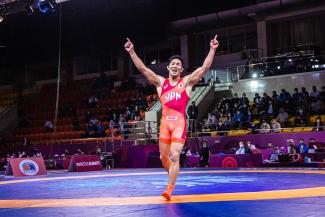
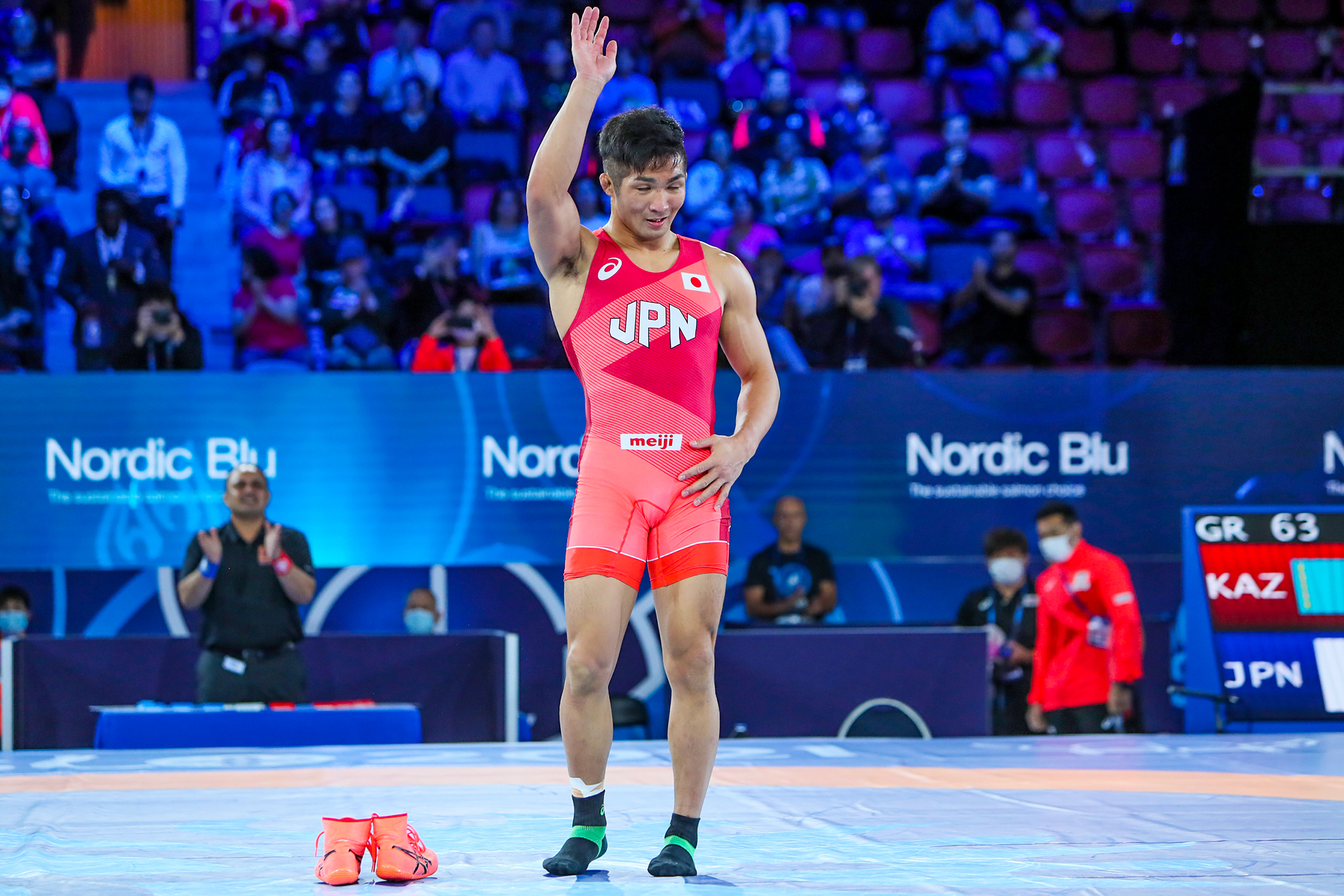 Tsuchika SHIMOYAMADA (AUS) had left his shoes on the mat during the 2021 World Championships to mark his retirement. (Photo: United World Wrestling / Martin Gabor)
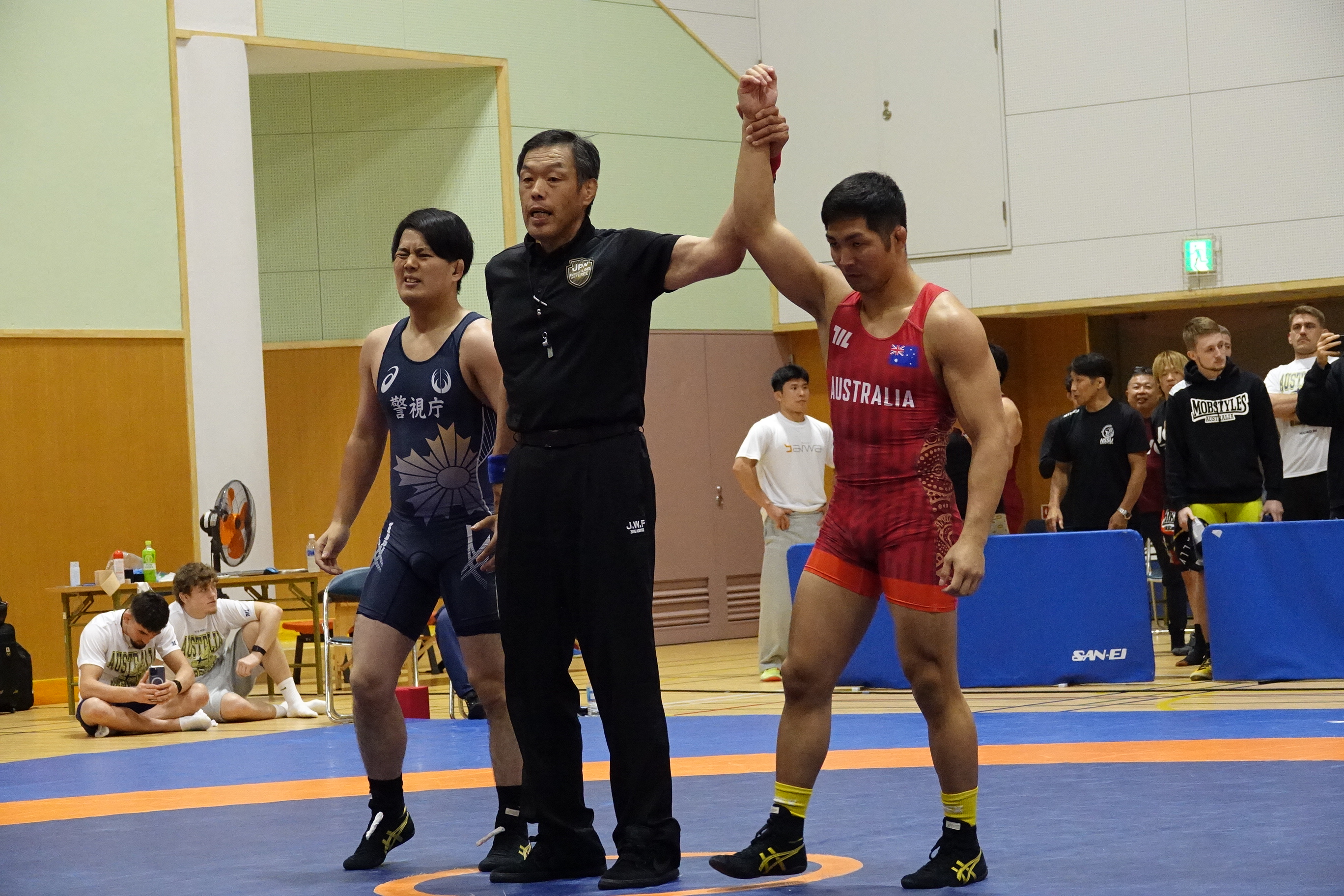 Tsuchika SHIMOYAMADA advances to the semifinals at the All-Japan Non-Student Championships in July with a 52-second win over Kokoro GOTO. (Photo: Koji Fuse / wrestling-spirits.jp)
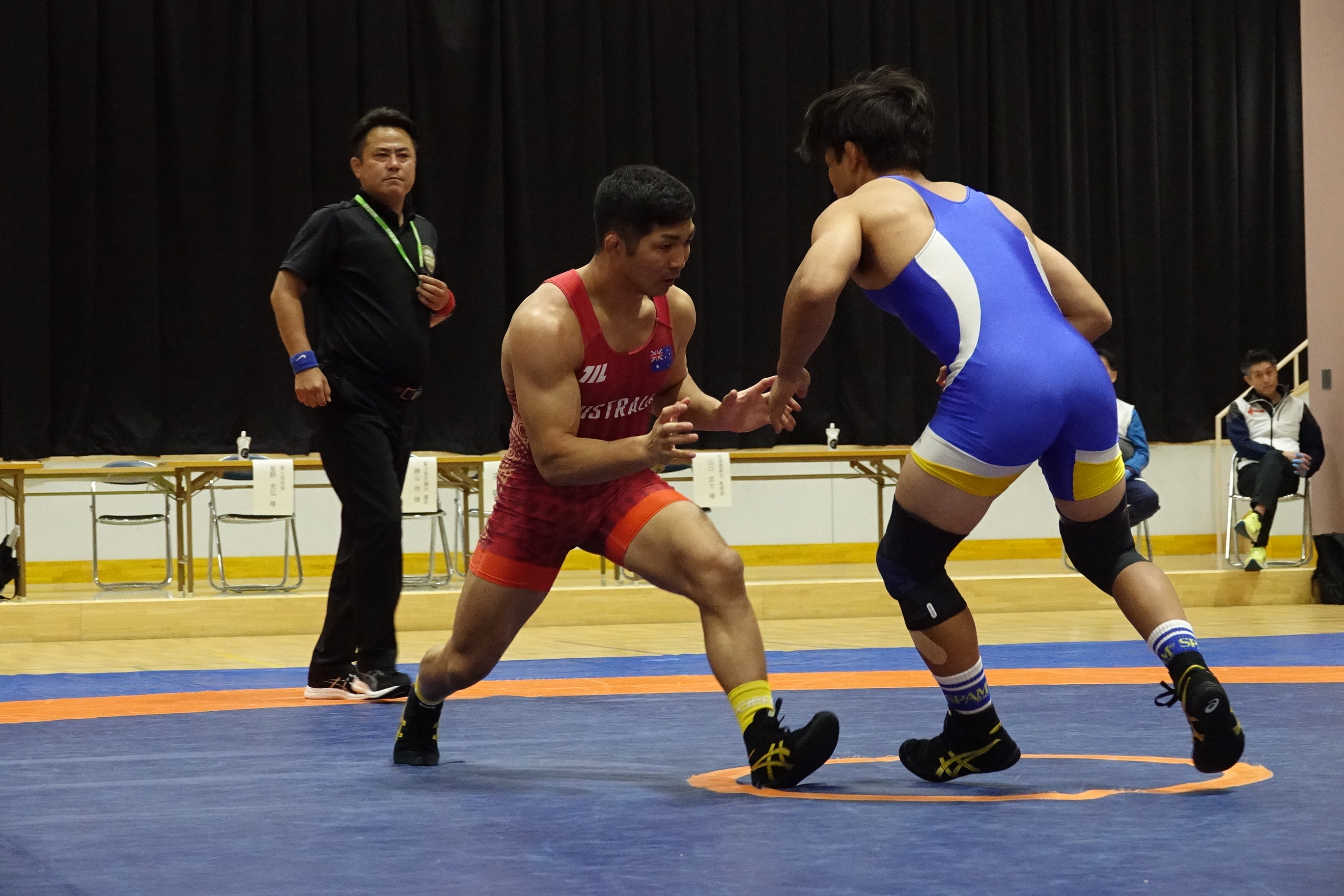 Tsuchika SHIMOYAMA faces Keitaro ONO in his opening match at the All-Japan Non-Student Championships in July. (Photo: Koji Fuse / wrestling-spirits.jp)
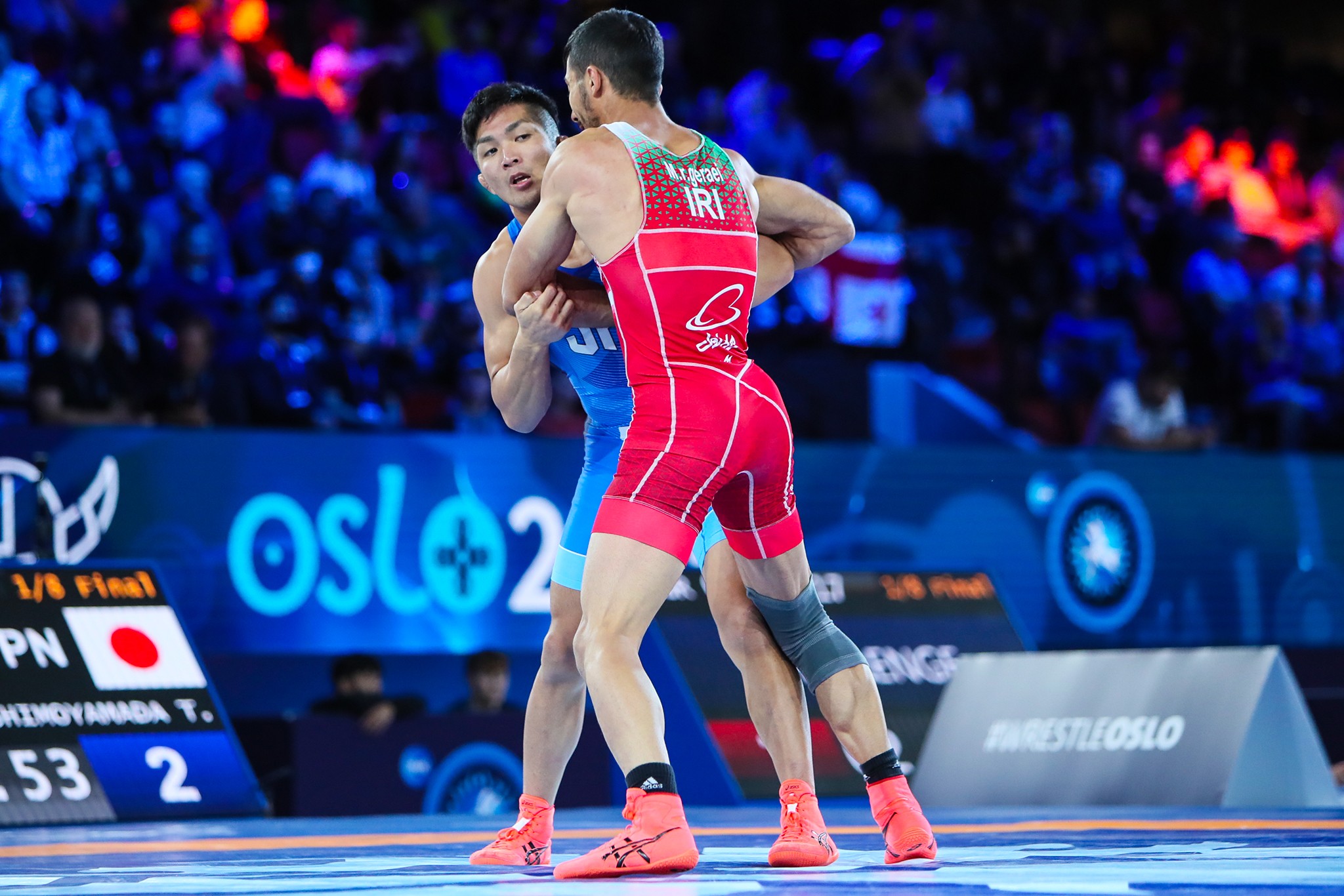 Tsuchika SHIMOYAMADA (AUS) was dominating Mohammadreza GERAEI (IRI) in their match at the 2021 World Championships before being pinned. (Photo: United World Wrestling / Martin Gabor)
Share your thoughts.
Comments