

Obituary

Franz Beckenbauer, football legend and wrestling's friend, passes away

By United World Wrestling Press

CORSIER-SUR-VEVEY, Switzerland (January 10) -- Franz BECKENBAUER was a football pioneer, a World Cup legend and one of the world’s biggest sporting heroes. A true global star, he was worshipped by millions across the globe. And it wasn’t just the football fans for whom he was a hero.

Beckenbauer, who passed away on Monday aged 78, held a special place in the wrestling family for his immense contribution to popularising the sport and bringing it back into the Olympic fold.

When the wrestling fraternity was leaving no stone unturned to return to the Olympics back in 2013, Beckenbauer famously lent his unwavering support. Fondly known as The Kaiser, he shared his thoughts on the future of wrestling, met UWW President Nenad LALOVIC to discuss ways to improve the sport’s visibility and campaigned for its inclusion in the Olympics after it was removed from the program 11 years ago.

For this, Beckenbauer was awarded wrestling’s highest honor, the Golden Necklace. It’s an award usually given to the heads of state.

Speaking at the ceremony, Lalovic had said: “Franz said he grew up wanting to be a wrestler but his coaches told him he was too skinny and to try another sport.  The world is pretty glad that he did.”

Indeed, world football is richer and in a better place today because of Beckenbauer.

FRANZFranz Beckenbauer was awarded wrestling’s highest honor, the Golden Necklace, by UWW Bureau Member Rodica YAKSI.

Gifted with grace that he combined with steely determination, the player who started as a forward before dropping back and starting as a defender until he eventually created an altogether new role – the libero - redefined football.

He is one of the three men to have won the FIFA World Cup as a player and a coach. On both occasions, he masterminded wins over two players hailed as the greatest to ever grace football.

At the 1982 World Cup, the West Germany team captained by Beckenbauer defeated the legendary Netherlands side led by Johan Cruyff, the father of ‘total football’ philosophy. Then, as a coach of the German team at Italia 1990, Beckenbauer halted Diego Maradona’s Argentina.

At club level, too, he tasted incredible success with Bayern Munich, whom he led to three consecutive European titles as a player before taking them to further heights as a manager and later as the club’s president.

In the later stages of his career, Beckenbauer had a successful spell with Bundesliga side Hamburger SV and went on to win three North American Soccer League titles with New York Cosmos.

The Kaiser had an oversized impact on world football. But his influence reached far beyond the football field, as the sport of wrestling experienced in 2013.

UWW mourns the passing away of one of the true sporting icons spanning generations and expresses its deepest sympathies to the Beckenbauer family.
#WrestleZagreb

Tazhudinov in search for answers despite bronze medal

By Vinay Siwach

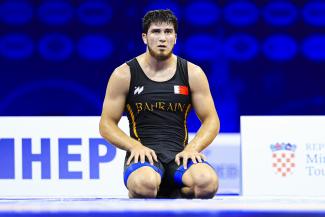
ZAGREB, Croatia (September 16) -- A World Championships medal might be a career milestone for most wrestlers, but for Akhmed TAZHUDINOV (BRN), the bronze he won in Zagreb is a prize he hopes to forget.

Coming into the tournament in Zagreb, Tazhudinov was considered as the best wrestler in the world and the favorite to win the gold medal at the 97kg. He had built a reputation of a wrestler who bulldozes anyone who stands in his path, as he did to win the gold medal at the 2024 Paris Olympics.

But Tazhudinov was anything but an Olympic and world champion in Zagreb.

He almost dropped his quarterfinal match with Mogomed KURBANOV (UWW), needing a front headlock roll to survive. The thrill of victory was short lived, as Amirali AZARPIRA (IRI) showed that Tazhudinov is indeed human, winning their semifinal 5-2 to end Tazhudinov's golden run.

"My initial goal was the gold medal," Tazhudinov said. "I wanted to become a two-time world champion. Unfortunately, it didn't happen -- maybe it was meant to be this way. It's very painful to lose."

As he searched for answers for his performance, Tazhudinov said that recent shoulder surgery may have affected his wrestling at the World Championships.

"I was coming back after surgery, after a serious injury," Tazhudinov said. "Maybe that had an effect, I don't even know. It took me a very long time to get myself together. At the beginning, training sessions were very difficult."

Tazhudinov returned from surgery to win two gold medals in a one-month span -- first at the Spain Grand Prix and then at the Budapest Ranking Series in June.

After the semifinal loss to Azarpira, Tazhudinov returned the next night for the bronze-medal bout with 34-year-old Akhmed MAGAMAEV (BUL), which only further put Tazhudinov under the scanner despite winning the match.

Magamaev was on the activity clock when he bodylocked Tazhudinov and slammed him for four points just before the 30 seconds elapsed. Tazhudinov rebounded with a takedown to make it 4-2 at the break.

He began the second period with another takedown to make it 4-4, but Magamaev continued the scramble and both wrestlers were awarded two exposure points each, putting the Bulgarian ahead 6-6 on criteria.

A counter lift to exposure gave Tazhudinov the lead for the first time, 8-6, and as Magamaev tried doing the counter lift, he gave up two as Tazhudinov blocked him. The final scramble, which gave Tazhudinov an 11-10 win, was challenged by Bulgaria. Eventually, it was scored 13-10.

Despite winning the bout, Tazhudinov shook his head as he left the mat, perhaps surprised himself by his lackluster performance.

"Honestly, I don't even know what went wrong," he said. "It means I wasn't well enough prepared. It means I wasn't in my best shape. It means I need to work even more."

Tazhudinov said he had difficulty preparing mentally for the bronze-medal bout after the loss to Azarpira.

"After the semifinal loss, I couldn't motivate myself at all for the bronze-medal match," he said. "I don't even know how I stepped onto the mat. I wasn't mentally ready to wrestle at all, and that's why the match was so difficult.

"But I will not give up -- I'll go home, work on my mistakes, and train even harder to come back stronger."