

#WrestleBelgrade

FS Preview: Iran and USA favored to clash for team title

By Eric Olanowski

COSIER-VEVEY, Switzerland (August 30) --- The United States and Iran account for 11 returning world medalists – six of which were gold medalists in Oslo -- and are poised to go toe-to-toe for the freestyle team title at the 2022 World Championships in Belgrade, Serbia. 

The elite group of freestyle competitors will be led by defending world champions Thomas GILMAN (USA), Kyle DAKE (USA), Jordan BURROUGHS (USA), Hassan YAZDANI (IRI), Kamran GHASEMPOUR (IRI) and Amir ZARE (IRI).

The tournament gets underway September 10, but the freestyle portion of the competition will be on the tail end of 2022 World Championships. The world’s most popular wrestling style starts Thursday, September 15.

Last year in Oslo, the United States (168 points) medaled in seven of ten weights and edged Iran (162 points) and their seven medalists by six points in the team race. Each squad returns a trio of world champions, setting up what’s expected to be the closest team race since the 2017 World Championships, when Snyder beat Abdulrashid SADULAEV (RWF) in the final match of the event, helping America edge the Russians by one point.

What are placements worth?
Gold = 25 points
Silver = 20 points
Bronze = 15 points
Fifth = 10 points
Seventh = 8 points  
Eighth = 6 points
Ninth = 4 points
Tenth = 2 points

Without 125kg Tokyo Olympic champion Gable STEVESON (USA) in America’s lineup and defending world champion Zare expected to finish with at least a bronze medal, the Stars and Stripes enter the World Championships in a 15-point hole.

There most critical weights where the USA can expunge that 15-point deficit are 57kg, 74kg and 97kg. These are the three weights where seeded American and Iranian wrestlers are on the same side of the bracket, setting up potential quarter or semifinal meetings.
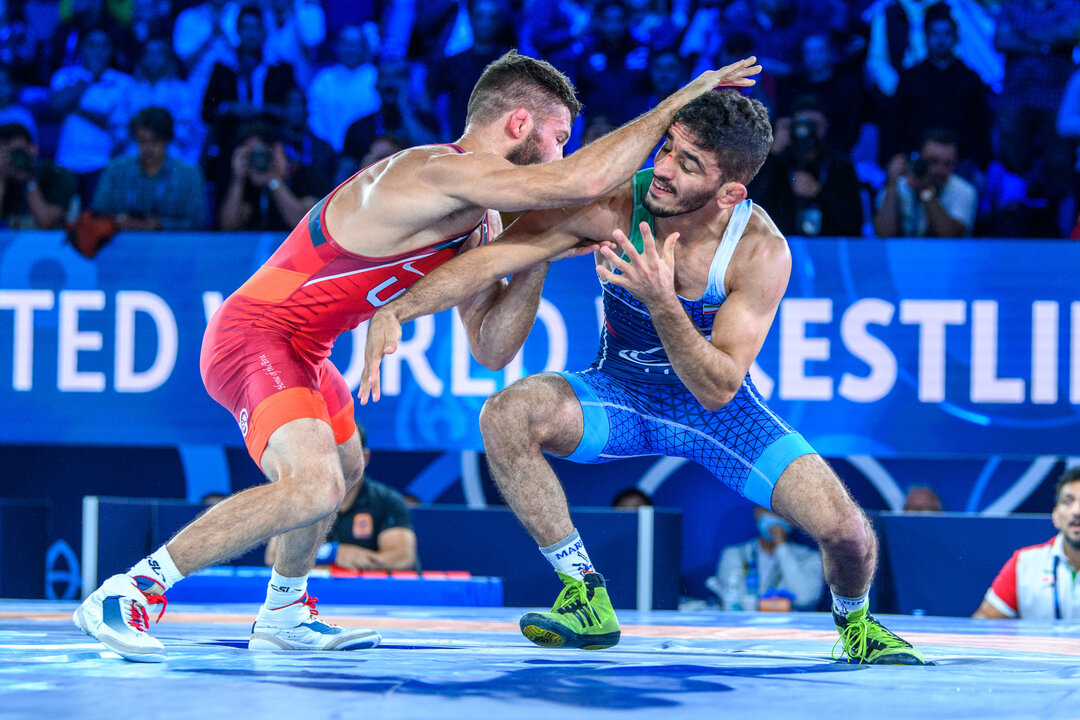

Alireza SARLAK (IRI) and Thomas GILMAN (USA) clash in the 2021 world finals. They are expected to meet in the semifinals in Belgrade. (Photo: Tony Rotundo)

At 57kg, reigning world champion and Olympic bronze medalist from Tokyo Gilman could see Alireza SARLAK (IRI) in the semifinals. The American is seeded No. 1 at the weight, while the Iranian is seeded fourth.

Gilman owns the two-match advantage against Sarlak, having picked up victories in the 2021 world finals and the semifinals at the '22 Zouhaier Sghaier Ranking Series event.

For that matchup to happen in the semifinals, Gilman must get through No. 8 Muhammet KARAVUS (TUR), and Sarlak must take out No. 5 Vladimir EGOROV (MKD).

At 74kg, Dake is the top-seeded wrestler. He'll share the top side of the chart with Iran’s No. 5 Yones EMAMICHOGHAEI (IRI).

Dake will likely take on European bronze medalist No. 8 Mitchell FINESILVER (ISR) in the quarterfinals. They met at the ’21 Henri Deglane, where Dake took out the Israeli wrestler 11-0 in the opening period.

If fifth-seeded Emamichoghaei wants to keep Iran’s hopes of winning the freestyle team title alive and down Dake in the semifinals, he’s going to have to get through No. 4 Turan BAYRAMOV (AZE) in the quarterfinals.

At 97kg, the biggest storyline is how the seeds played out.

Kyle SNYDER (USA) and Mohammadhossein MOHAMMADIAN (IRI) sit together on the top side of the chart. The reason it’s significant is that the last time these two met – in the 2020 Matteo Pellicone semifinals – the Iranian pinned the two-time world champion.

Snyder is the top-seeded wrestler, while Mohammadian is seeded fifth.

For the Snyder and Mohammadian semifinal match to come to fruition, the American must beat No. 8 Mamed IBRAGIMOV (KAZ), while the Iranian must defeat No. 4 Mahamed ZAKARIIEV (UKR).

Outside of the weights where American and Iranian are positioned on the same side of the bracket, other key weights in the team race include 61kg, 65kg, 70kg, 79kg, 86kg and 92kg.

Iran holds a slight advantage at 61kg due to Reza ATRI's (IRI) world and Olympic experience. He'll be making his fourth appearance in Iran's senior world lineup. Last year, he finished in fifth place at the Tokyo Olympic Games and World Championships.

Seth GROSS (USA) will represent the USA at 61kg. He earned her first Worlds berth by beating 2021 world silver medalist Daton FIX (USA) in a three-match playoff.

The biggest unseeded dark horses in the 65kg bracket are Rahman AMOUZAD (IRI) and Yianni DIAKOMIHALIS (USA).

Both Amouzad and Diakomihalis underperformed at last year’s World Championships. They both went 1-1 in Norway. Amouzad finished in 11th place, while Diakomihalis finished in 12th place.

But with another year of experience under their belt, they’re poised to welcome the pressure that comes along with fighting for a team title.

The Belgrade Worlds will be Amouzad’s second competition up at 65kg after continuing his four-year growth spurt. Since 2018, he’s wrestled at 45kg, 48kg, 57kg, 61kg and seems to have settled in at 65kg. The lengthy Iranian competed at 61kg in his senior world debut a season ago but moved up to 65kg for April’s Asian Championships.

Amouzad showed that he’s a true 65kg guy by winning Asian gold in Ulan-Baatar earlier this year. In the gold-medal match, he scooped up a massive win over Tokyo Olympic bronze medalist Bajrang PUNIA (IND).

Diakomihalis will try to end America’s 65kg non-world-medal curse that dates back to the ’06 Guangzhou World Championships when USA’s freestyle head coach Mike ZADDICK  won world gold and secured the Stars and Stripe's last 65kg/66kg world medal.

At 70kg, No. 5 Amirmohammad YAZDANICHERATI (IRI) and No. 6 Zain Allen RETHERFORD (USA) are on opposite sides of the chart and wouldn’t wrestle until the finals.

Yazdanicheratri made his world team debut last year at 65kg, finishing with a silver medal. He’s moved up to 70kg to ultimately prepare himself for a run at Iran's 74kg spot for the 2024 Paris Olympics.

Retherford will make his third appearance for the Red, White and Blue on the senior-level world stage. He finished in 11th place in Paris and 26th place in Nur-Sultan.
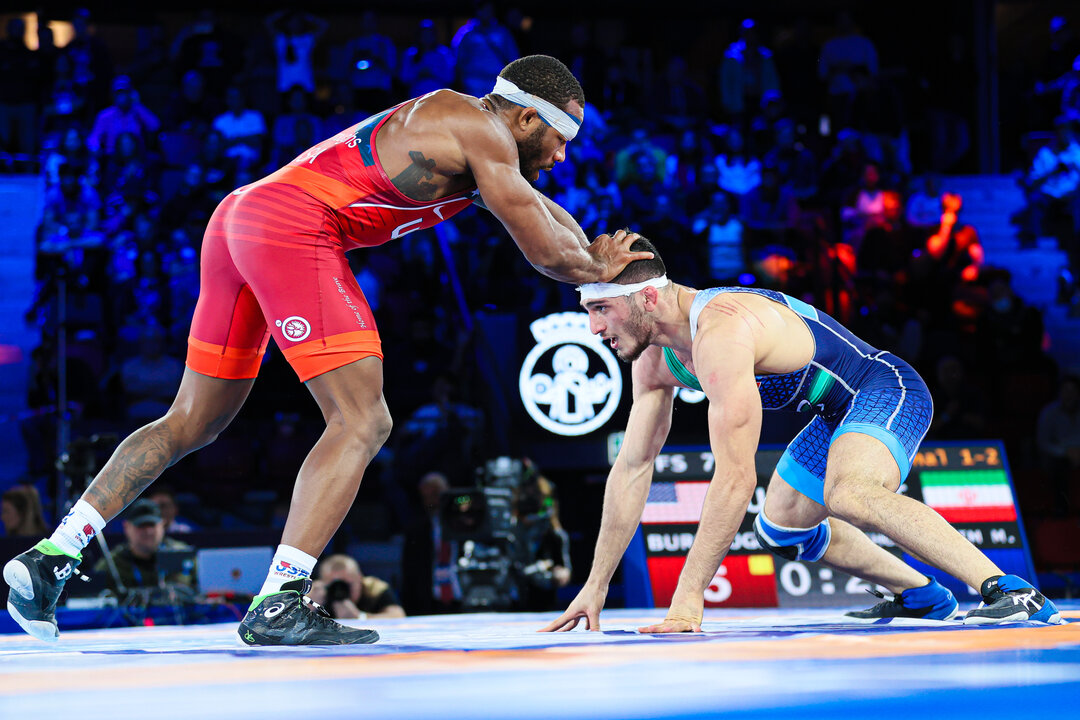

Jordan BURROUGHS (USA) and Mohammad NOKHODILARIMI (IRI) could meet in the 79kg world finals. They met for gold in Oslo, with the American picking up the victory. (Photo: Tony Rotundo)

Last year’s world finals opponents Jordan BURROUGHS (USA) and Mohammad NOKHODILARIMI (IRI) are seeded first and second at 79kg, respectively, and wouldn't wrestle again until the finals.

Burroughs is heading to Belgrade looking to bag his sixth world title, which would be an American male record. His road to rewriting the history books will go through No. 8 Baliyan GOURAV (IND) in the semifinals before wrestling either No. 4 Arman AVAGYAN (ARM) or No. 5 Vladimeri GAMKRELIDZE (GEO) in the semifinals.

Nokhodilrimi has a tougher path to the gold-medal match. In the quarters, he’ll compete against No. 7 Saifedine ALEKMA (FRA), who was last year’s European runner-up. If he beats the French wrestler, he’ll compete against reigning European champion No. 3 Georgios KOUGIOUMTSIDIS (GRE) or European bronze medal winner No. 6 Muhammet AKDENIZ (TUR).

Regarding the 86kg bracket, all eyes will be on two guys: Hassan YAZDANI (IRI) and David TAYLOR (USA). The pair of Olympic champions are in a league of their own and are expected to meet for the fifth time in their career.

Yazdani is the first-seeded wrestler, and Taylor is seeded second. Barring a catastrophic meltdown, the superstars would meet for a second consecutive year for a world title.

Heading into Belgrade, Taylor owns the 3-1 advantage, but Yazdani gained the momentum after beating his American rival in the 2021 world finals.
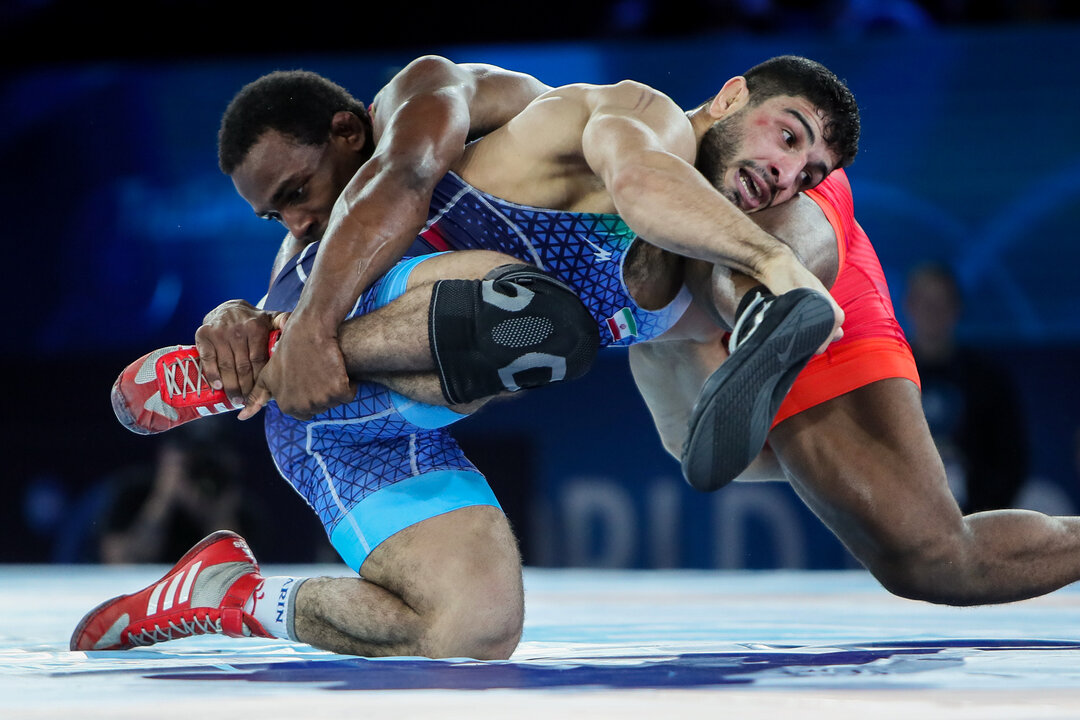

Kamran GHSEMPOUR (IRI) stopped J’den COX (USA) in the semifinals and stopped the American from winning a third world title. They are both entered at 92kg. (Photo: Kadir Caliskan)

There are two headliners entered in the 92kg field, but Kamran Ghasempour holds the upper hand on two-time world champion J’den COX (USA) after winning their Oslo semifinal meeting en route to winning world gold last year.

Ghasempour heads into Belgrade as the top seed in the 92kg chart after his world title run and gold-medal performance at the Bolat Turlykhanov Cup Ranking Series event.

Ghasempour is looking to win an 11th consecutive tournament. Since 2018, he’s claimed gold at 10 straight events. Those events include the senior-level World Championships, two U23 World Championships, and a pair of Asian Championships, among others.

Ghasempour sits on opposite sides of the bracket from the Rio Olympic bronze medalist Cox. They’d have to remain unbeaten until the finals to clash for a second time.

But to get to Cox, Ghasempour must take out No. 8 Orgilokh DAGVADORJ (MGL) in the quarters and either No. 4 Andrii VLASOV (UKR) or No. 5 Viky VIKY (IND) in the semifinals.

Cox is seeded third and sits on the bottom of the bracket with his quarterfinals opponent No. 6 Adilet DAVLUMBAYEV (KAZ). The American must beat the Kazakh, then defeat either No. 2 Osman NURMAGOMEDOV (AZE) or No. 7 Miriani MAISURADZE (GEO) to reach the finals against Ghasempour.

Trained in Japan and USA, Yoneoka hopes to coach Norway to global success

By Ken Marantz

TOKYO, Japan (July 20) -- Yurie YONEOKA has taken her share of knocks along her lifelong path in wrestling, but she always seems to land on her feet. This time it has planted her onto a second different continent.

Yoneoka, a Japanese who competed collegiately in the United States before becoming a coach there, has been hired as head coach of the Norwegian national women’s team, which hopes some of the success of her home country can rub off after decades of slim results.

Norway, which was among the top nations in women’s wrestling in the early 1990s, has not produced a women’s world champion since Gudren HOELE won the last of her five world golds in 1998 at 56kg, and its last world medal of any kind was a bronze in 2005 by Lene AANES at 59kg.

The 29-year-old Yoneoka was hired on an initial two-year contract, but with eyes on producing results at the 2028 Los Angeles Olympics. That’s a tall task in itself, as Norway has only had one woman qualify in wrestling for the Olympics in its history when Signe Marie STORE made the field at 69kg at the 2016 Rio Games but finished 18th.

YoneokaYurie YONEOKA talks with the press during a recent trip back to Japan. (Photo: Japan Wrestling Federation)

“We have a six-year goal which is Los Angeles [2028],” Yoneoka said during an interview in Tokyo earlier this month when she returned to attend a wedding. “But we have to take baby steps. So the first thing is to medal at the European Championships at the senior level, and the junior [U20] level as well.

“We will hopefully get a World Championships medal. That's the closest way to get to the Olympics,” she said, referring to the direct Olympic qualifying places available at the World Championships.

Yoneoka, who ultimately would like to land an executive position at United World Wrestling so she can advance the standing of women and Japan, found out about the Norway opening from a notice on the UWW website. She immediately applied and, after an extended interview process, was hired in June.

"At the time I was coaching at the university in the United States and I was looking to take a step up for a more high-level coaching job,” she says. “My [ultimate] goal in my life is working at United World Wrestling. So I was thinking what are the good steps to reach my goal, and I was thinking higher-level coaching would be a very good opportunity.”

YoneokaYurie YONEOKA addresses members of the Norwegian national team for the first time during a brief visit last month. (Photo courtesy of Yurie Yoneoka)

Norway has a current senior star in two-time European champion Grace BULLEN, but she has yet to meet expectations in terms of world medals and Olympic qualifying. Yoneoka said her focus will be more on developing the next generation of wrestlers.

“My main focus, which the federation asked me, is mostly on U20,” she says. “But I will do a lot of camps to collect the girls and bond together regardless of age. For U17 and U15, I will probably still coach and go to the competition if I am available, but not super-focused, more like support.”

Yoneoka is looking to centralize the national team operations in Oslo and has already set up a training camp for September. She has only briefly met team members and is still waiting for a work visa and a place to live.

Having been exposed to the sport both in Japan and the United States, Yoneoka feels she brings a broad perspective to Norway and can allow team members to find the style that best suits them.

“While making the most of each individual’s own style, I believe it is vital to add to what they do well, rather than completely change their wrestling,” Yoneoka said in an earlier interview on the JWF website. “Six years will go by before you know it. If there is even the slightest feeling of hesitation, the goal will get further away.”

Looking at the differences, “Japanese style is very focused on basics, and they have high technique. Very good conditioning,” Yoneoka says. “The American style is very powerful, with big dynamic movement. They love to show stuff. And they have a lack of conditioning. Of course, they haven't done a lot of freestyle, so that's probably one point. The European style is very mixed, which I would say is very balanced between Japanese style and American style.”

YoneokaYurie YONEOKA, center on right, poses with University of Providence teammates after placing sixth at the 2019 U.S. national collegiate championships. (Photo courtesy of Yurie Yoneoka)

Coming to America

Although Yoneoka never competed at a World or Asian Championships on any level herself, she was a better-than-average high school wrestler, placing third at the national high school championships in an era that would produce several future Olympic champions.

But later disillusionment with her college program in Japan set in motion a journey that would bring her to one of the most rural and off-the-beaten-path parts of America.

As with the Norway job, Yoneoka’s interest in a jump across the Pacific was sparked by an online notice, this one on the Japan Wrestling Federation website in 2013. There was a call out for Japanese wrestlers interested in competing collegiately in the U.S.

Behind the project was Tadaaki HATTA, a former NCAA champion and U.S. national team coach who has long served as a link between the two countries.

In the past, a few Japanese males like Hatta have gone over to U.S. universities, most notably Yojiro UETAKE, who went undefeated at Oklahoma State in the 1960s and became a two-time Olympic champion, and Sanshiro ABE, who won an NCAA title at Penn State in 1996 and competed at that year's Atlanta Olympics.

But Yoneoka still remains the only woman to take the plunge. And it was not easy getting there. Yoneoka first had to pass the Test of English as a Foreign Language (TOEFL), a formidable hurdle given that “[English] was the subject I always got the worst grade at school. I was always at the bottom in the class. So I literally started from the ‘This is a pen’ level."

Talk about perseverance. Yoneoka failed the test 14 times -- 14 times! -- over a four-year period before finally earning a passing score. During that time, she worked part-time jobs as a receptionist at a dry cleaning shop and as a staff member at Costco.

Yoneoka had been recruited to attend Jamestown University in North Dakota, and the school patiently waited for her to pass the TOEFL test. "We kept in touch and [the school] was always supportive of what I was doing," she said.

Unfortunately, after she finally to Jamestown, she was unable to compete in her first year for reasons she still doesn't understand. The next year, coach Tony DEAND took a new job at the University of Providence in Great Falls, Montana, and took Yoneoka with him. And once again, she was declared ineligible to compete for a season. When Deand left after just one season, Yoneoka remained at Providence.

While going abroad to study afforded her more freedom than she had back in Japan, Yoneoka became too busy as a student-athlete to get caught up in the social scene. "I didn't party a lot at all," she says. "I had to make money, too, because I didn't get a full grant. I had to work on campus at the Starbucks, for only like two or three shifts [a week]."

She described her routine as "morning practice, go to class, work and practice. That was it."

In the end, her junior year was the only one in which she had a full competitive season. She won titles at the Spokane Open and the Battle of the Rockies, then finished sixth at the 2019 Women’s Collegiate Wrestling Association Championships at 116 pounds (52.6kg). She was ranked third in the nation at 109 (49.5 kg) in her senior year, only to have the 2020 championships canceled due to the pandemic.

After graduating with a degree in sociology, she was hired as an assistant coach at Providence, making her the first-ever Japanese woman to coach on the collegiate level in the United States.

She says it was difficult to leave Providence and the team to take the job with the Norwegian team, but says the response was positive. "It was pretty hard, especially for girls who I built a really good relationship with," she says. "They were very sad, but they were happy for me that I got the job."

YoneokaYurie YONEOKA, second from right, stands on the medal podium after placing third at the 2010 Junior Queens Cup. To her right is champion Risako KAWAI, now a two-time Olympic gold medalist. (Photo courtesy of Yurie Yoneoka)

Sweet bribe launches career

Yoneoka’s entry into the wrestling world was basically the result of a bribe. The culprit: Her father. The enticement: Chocolate.

Born in Tokyo, Yoneoka’s family moved to nearby Kashiwa, Chiba Prefecture, while she was a toddler. Her father, who was a dedicated amateur handball player, was looking for a sport for his four-year-old daughter when he spotted a poster at the local civic sports center. It was for a local kids wrestling club.

“He was like, 'This is it,’” Yoneoka recalls. “But I was a very, very shy girl and he was like, 'Do you want to go because I will buy you chocolate.' And I love chocolate. So chocolate is the only reason I went into wrestling.”

She still remembers her first day in the sport. "It was a very hard practice. [My father] threw me into the practice, and I had to do the whole practice on the first day. I almost cried."

But with a mix of determination and stubbornness that would get her through trying times later in life, Yoneoka stuck with it and showed potential. She developed a love for the sport and continued until being forced to stop briefly because of one of Japan's main social problems -- bullying, which she suffered in junior high school.

"I got bullied heavily and I couldn't go to school for awhile," she says. "So I had to stop wrestling as well because the wrestling team was practicing at that junior high. A few months later, I just changed schools."

Determined to get back into the sport, she passed the entrance exams for Saitama Sakae High School in neighboring Saitama Prefecture. It is among the top schools for wrestling in the Kanto region, which includes Tokyo and the surrounding prefectures, but also one that is also academically oriented.

"I wanted to be the best wrestler that I could ever be, and my dream was to go to the Olympics, too," Yoneoka says. "[I thought], where can I go to achieve that goal? There were only a few selective schools in the Kanto area because [women's] wrestling was still developing.

"Sakae was a very good school which has a pretty good academic program, too. My parents only wanted me to put my best [effort] into both academics and athletics. [They said] if you go in the advanced program of study, you can keep wrestling. I studied and got into the school."

Aside from the curriculum, going to Sakae meant enduring another hardship -- a two-hour train commute from her home in Kashiwa. "Those three years were probably one of the hardest times in my life," she says. "Practice started at 7 [a.m.], so I had to wake up before 5 and hop on the train for two hours."

YoneokaYurie YONEOKA poses with members of Norway's U15 team. (Photo courtesy of Yurie Yoneoka)

In 2010, Yoneoka placed third in the U17 division of the Junior Queens Cup at 49kg, a weight class won by future two-time Olympic champion Risako KAWAI. The next year, she won a bronze medal at the National High School Championships in that weight class, which was won by Nanami IRIE, a future world silver medalist.

To get an idea of how competitive the 2011 high school nationals were, the champions of three other weight classes would go on to become Olympic champions --Kawai, Eri TOSAKA and Sara DOSHO. Yoneoka met Tosaka at a wrestling camp during junior high school and they remain friends to this day.

"That was really tough," Yoneoka said of the competition. "I was actually very insecure about my wrestling. It [gave] me the power to push through, that I had to be better every day. But I was insecure that I could make it."

While the Big Three would all eventually go on to collegiate powerhouse Shigakkan University, Yoneoka was pressed by her coach to stay in the Kanto region and attend Toyo University. She never fully fit into the program and, after an undistinguished three years, dropped out during her senior year after the opportunity to go to the States came up.

"The wrestling community is pretty tight, and my high school coach pushed me to go to Toyo University," she says. "I liked it as a university, but the team situation was not what I had imagined or what I desired. It wasn't the best situation for me as an athlete.

"I didn't regret quitting the team, but I had a strong feeling that I shouldn't quit wrestling itself. I was feeling devastated about wrestling. I was like, what should I do with my life? All I had done with my life was wrestling. In very, very good timing I saw the advertisement by Tadaaki Hatta."

Having seen their daughter spend the last six years or so in the United States, what did her parents think about her career path now taking her to Norway?

"My parents were first of all surprised," she says. "But they know even if they say something, I will still do whatever I want to. For my parents, it was like, 'Alright go ahead.'

"My friends were like, 'Norway? I thought you were living in the U.S. forever.'"

Yoneoka looks forward to that first time one of her Norwegian wrestlers faces a Japanese opponent on the mat.

"I feel like I will be proud of the Norwegian to be competing against a Japanese because obviously, the Japanese wrestlers are the best," she says. "But I think that will be good for me to learn some things as well, and I have so much respect for the Japanese wrestling federation and wrestlers. It will be a little bit nostalgic, but it will be a good feeling."

Looking at the big picture, it is also about gaining acceptance for women in the sport.

"In the States, there are still issues that women's wrestling gets really disrespected by men's wrestlers or even just men," she says. "It's a big issue and I feel like girls have to stand up for themselves still, which is pretty sad.

"In Norway, there is a big equality system, like men and women have to be equal. I think it's good, but still, in the wrestling community, it's a tough fight. Of course, I will stand up for myself and for my girls as well as for my future as a woman. That's one of my goals."