

Gold Medal Wealth Spread Among Five Nations on First Night of #Zagreb2018 Greco Finals
Saturday, July 7, 2018 - 17:56 By Taylor Miller

ZAGREB, Croatia – Five different national anthems rang on Saturday night as five countries collected gold medals in the first night of the Greco-Roman finals at the Cadet World Championships in Zagreb, Croatia.
At 48 kg, Abror ATABAEV (UZB), who took bronze at this year’s Asian Championships, came out on top, defeating Asian gold medalist Sajjad ABBASPOURRAGANI (IRI), 4-4.
Put down for passivity, Atabaev maneuvered his way to a front headlock for a four-point throw, which ultimately gave the Uzbek the win on criteria.
Atabaev became only the third wrestler from Uzbekistan to win a Cadet Greco World title.
2018 Asian bronze medalist Amirhossein KHOUNSARI (IRI) scored seven points in his shutout win over Giorgi PERTAIA (GEO) in the 55 kg finals.
Khounsari only led 2-0 at the break but separated himself in the last minute with a takedown and also capitalizing on an attempted throw by Pertaia for exposure en route to his first World title.
Russia won a World title at 65 kg when 2018 European champion Muslim IMADAEV (RUS) defeated 2016 European champion Shant KHACHATRYAN (ARM) in a 3-0 match.
Imadaev scored on a gut when Khachatryan was put down in par terre. It was an early lead that the Russian held on to for the gold.
At 80 kg, Karen KHACHATRYAN (ARM) got behind European champion Giorgi TSOPURASHVILI (GEO) in the first 30 seconds for a takedown, which would be all he needed to win a Cadet World title.
Khachatryan redeems a fifth-place finish from Euros earlier this year.
To close out the night, European champion Muhammet BAKIR (TUR) dominated in the 110 kg final over two-time European bronze medalist Sarkhan MAMMADOV (AZE).
En route to his 9-0 tech fall, Bakir scored on two takedowns and a gutwrench.
The 2018 Cadet World Championships wrap up tomorrow, starting with repechage action at 10 a.m. ET, followed by medal matches at 12 p.m. ET live on unitedworldwrestling.org.
Greco-Roman team scores going into final day (top 10)
1. Iran – 75
2. Georgia - 54
3. Russia - 51
4. Uzbekistan - 50
5. Armenia - 45
6. Turkey - 33
7. Azerbaijan - 32
8. Kazakhstan - 32
9. Belarus - 25
10. Moldova - 20
Finals results
48 kg
GOLD - Abror ATABAEV (UZB)
SILVER - Sajjad ABBASPOURRAGANI (IRI)
BRONZE - Arshad ARSHAD (IND)
BRONZE – Iskhar KURBAYEV (KAZ)
1st - Abror Atabaev (Uzbekistan) dec. Sajjad Abbaspourragani (Iran),4-4
3rd - Arshad Arshad (India) fall Leonid Moroz (Moldova), 1:09
3rd - Iskhar Kurbayev (Kazakhstan) dec. Islam Aliev (Russia), 4-2
55 kg
GOLD - Amirhossein KHOUNSARI (IRI)
SILVER - Giorgi PERTAIA (GEO)
BRONZE - Amirbek SULTONOV (UZB)
BRONZE – Din KOSHKAR (KAZ)
1st - Amirhossein Khounsari (Iran) dec. Giorgi Pertaia (Georgia), 7-0
3rd - Amirbek Sultonov (Uzbekistan) dec. Manuel Stoica (Romania), 8-7
3rd - Din Koshkar (Kazakhstan) dec. Niklas Oehlen (Sweden), 6-0
65 kg
GOLD - Muslim IMADAEV (RUS)
SILVER - Shant KHACHATRYAN (ARM)
BRONZE - Samuel BELLSCHEIDT (GER)
BRONZE – Hossein GHASEMI (IRI)
1st - Muslim Imadaev (Russia) dec. Shant Khachatryan (Armenia), 3-0
3rd - Samuel Bellscheidt (Germany) dec. Bin Xu (China), 8-2
3rd - Hossein Ghasemi (Iran) dec. Khvicha Ananidze (Georgia), 7-0
80 kg
GOLD - Karen KHACHATRYAN (ARM)
SILVER - Giorgi TSOPURASHVILI (GEO)
BRONZE - Mohammad NAGHOUSI (IRI)
BRONZE – Turpan BISULTANOV (DEN)
1st - Karen Khachatryan (Armenia) dec. Giorgi Tsopurashvili (Georgia), 2-1
3rd - Mohammad Naghousi (Iran) dec. Bekzod Akhmedov (Uzbekistan), 6-1
3rd - Turpan Bisultanov (Denmark) dec. David Zhytomyrsky (Israel), 7-1
110 kg
GOLD - Muhammet BAKIR (TUR)
SILVER - Sarkhan MAMMADOV (AZE)
BRONZE - Tomasz WAWRZYNCZYK (POL)
BRONZE – Mikita KAVALSKI (BLR)
1st - Muhammet Bakir (Turkey) TF Sarkhan Mammadov (Azerbaijan), 9-0
3rd - Tomasz Wawrzynczyk (Poland) dec. Marcel Albini (Czech Republic), 7-1
3rd - Mikita Kavalski (Belarus) dec. Aleksandr Shaposhnikov (Russia), 3-1
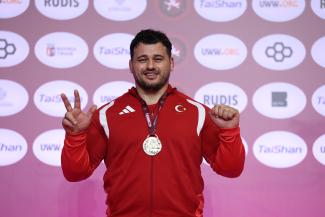
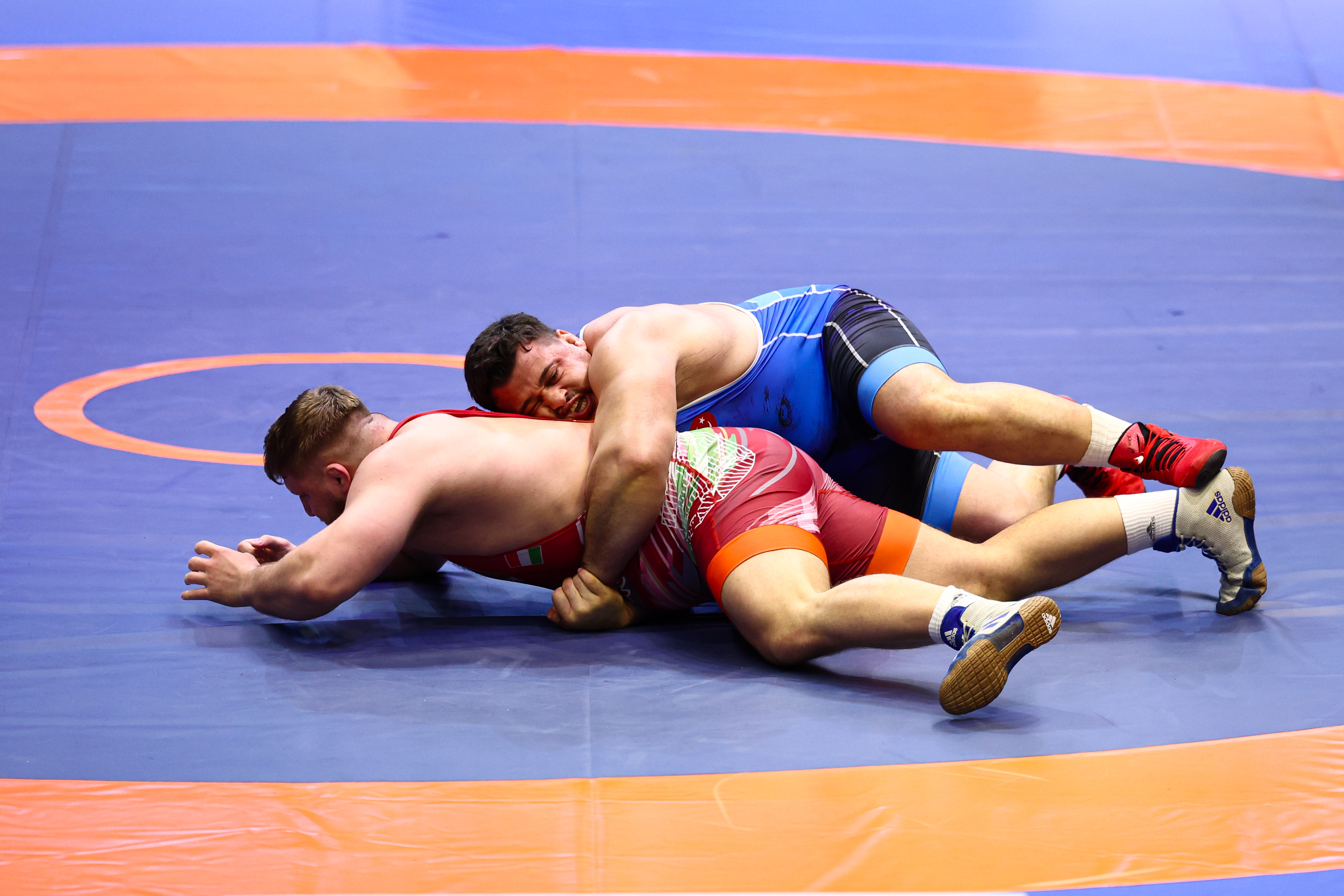 Riza KAYAALP (TUR) turns Darius VITEK (HUN) in the 130kg final. (Photo: United World Wrestling / Kadir Caliskan)
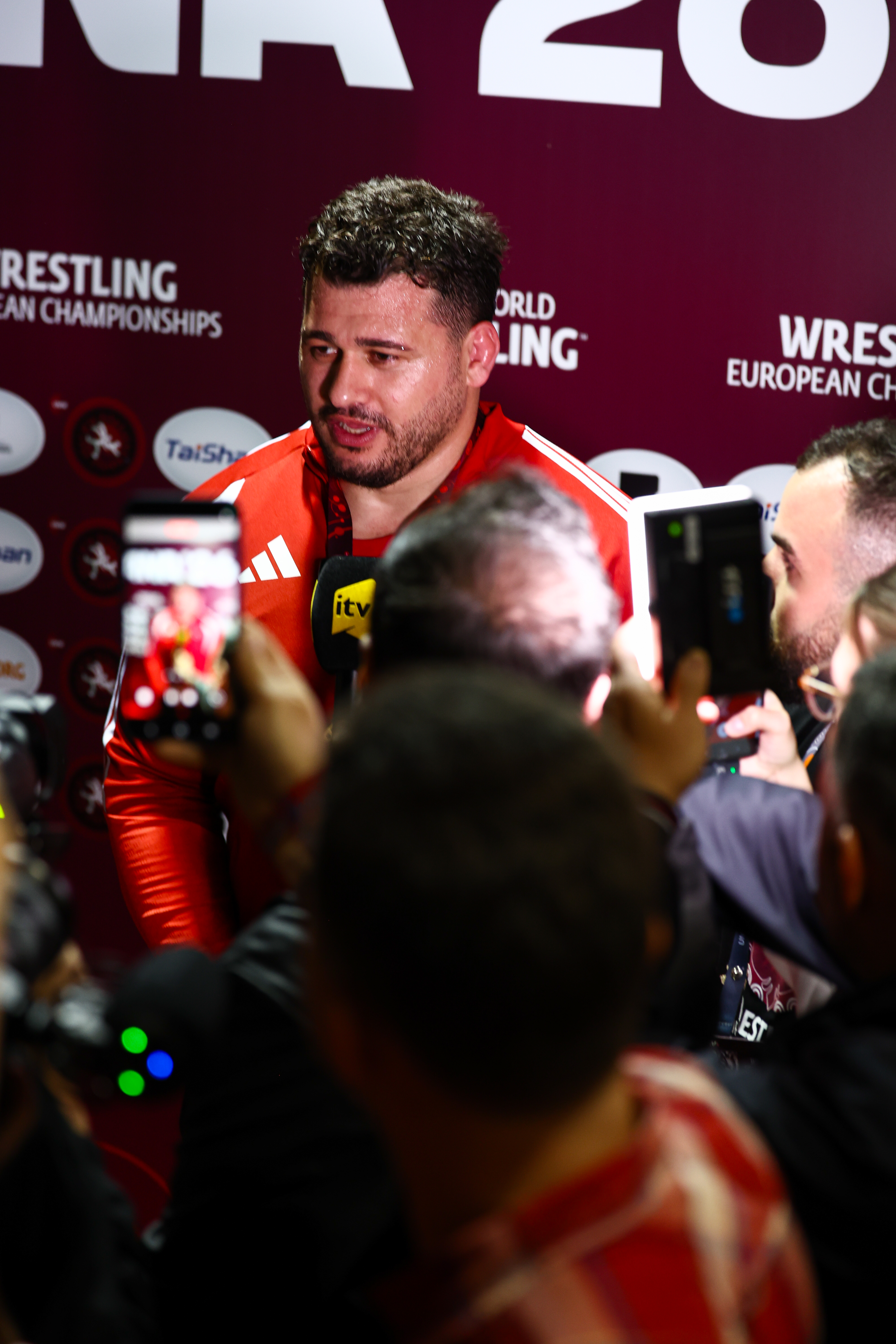 Riza KAYAALP (TUR) speaks to the media after winning the gold medal at the European Championships. (United World Wrestling / Jake Kirkman)
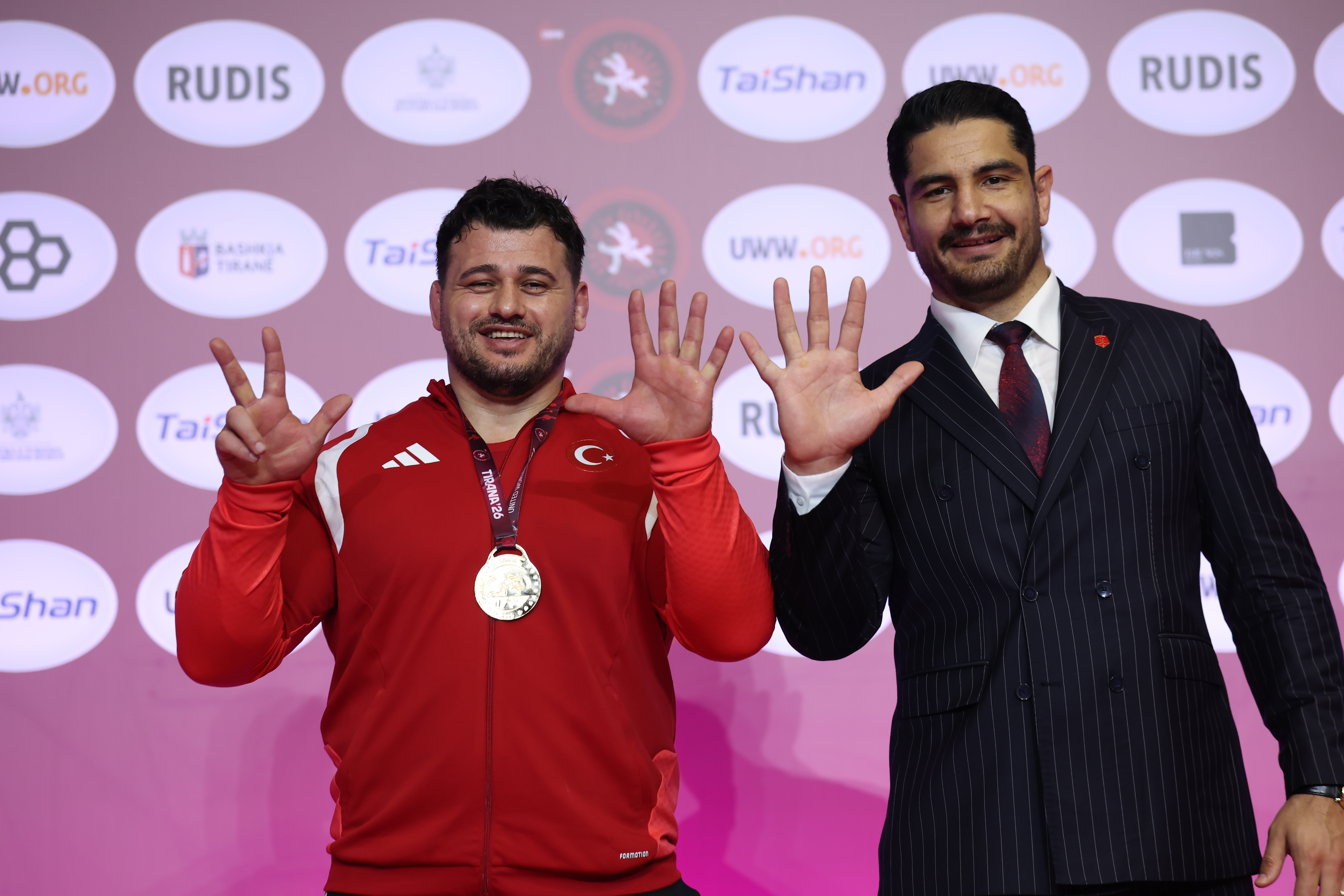 Riza KAYAALP (TUR) with Taha AKGUL (TUR) at the medal ceremony in Tirana. (Photo: United World Wrestling / Kadir Caliskan)
Share your thoughts.
Comments