

Higuchi, chasing Olympic gold, ready for Belgrade pit stop
Monday, August 28, 2023 - 21:54 By Vinay Siwach

TOKYO, Japan (August 28) -- In two Olympic cycles, Rei HIGUCHI's (JPN) life has come full circle.
As a 20-year-old, Higuchi took the wrestling world by storm at the Rio Olympics, claiming the silver medal at 57kg. His path to victory saw him overcome formidable opponents, including fan favorites like Yowlys BONNE (CUB) and Hassan RAHIMI (IRI).
By the time the Tokyo Olympics came, half of the 57kg wrestlers from Rio moved up to 65kg including gold medalist Vladimir KHINCHEGASHVILI (GEO) and bronze medalist Haji ALIYEV (AZE). Higuchi followed suit.
While Aliyev and Khinchegashvili managed to keep their form in the new weight class, Higuchi’s form tailed away after a U23 world title. He even failed to win the domestic playoff in 2019 against the then 65kg world champion Takuto OTOGURO (JPN). He realized that he didn't belong in the new Olympic weight class.
“When Otoguro won the playoff for the 2019 World Championships, then I decided to move back to 57kg,” Higuchi says. “Everyone in 65kg is taller and has more reach than me. It's difficult at 65kg. My aim is to win the Olympic gold and I thought if Otoguro is fifth in the World Championships, then it will be difficult for me to win gold in Tokyo at 65kg.”
 Rei HIGUCHI (JPN) wrestles Yowlys BONNE (CUB) at the Rio Olympics. (Photo: UWW / Tony Rotundo)
Little did Higuchi know that he wouldn't even qualify for the Tokyo Olympics for one of the most eyebrow-raising reasons in wrestling -- missing the weight.
Higuchi moved down to 57kg and at the Asian Olympic Qualifiers in Almaty, Kazakhstan in 2021, he was 50 grams over 57kg on the day of competition. Japan sent 2017 world champion Yuki TAKAHASHI (JPN) to the World Olympic Qualifiers and later he defeated Higuchi 4-2 in a playoff to win the spot on the Japan team for the Tokyo Games.
"I took care of everything, including diet, exercise, and caloric intake," Higuchi would later say about missing weight in Almaty. "I've done everything without compromise. But I didn't lose (the last 50 grams) in extreme conditions. It can't be helped. I have no choice but to accept reality. This is the result, it cannot be overturned."
More than seven years since that Rio final loss and two years since the weight debacle, Higuchi is making another bid to win the Olympic gold medal. All he has to do is win a medal in Belgrade next month.
“I was not interested in other competitions,” Higuchi says. “I only wanted to return to the Olympics and win. This year, I get to go to the Paris Olympics directly if I win the World Championships.”
 Rei HIGUCHI clinched his spot on the Japan team for the World Championships after winning the gold medal at 57kg. (Photo: Japan Wrestling Federation / Takeo Yabuki)
The 2023 world champion at 61kg began his Paris Olympics journey in June by winning the 57kg weight class at the Meiji Cup, the second of Japan's two-step qualifying process for the 2023 World Championships in Belgrade. A medal at the World Championships would mean that Higuchi automatically books his spot on the Japan team for Paris.
Two days after winning the Meiji Cup, Higuchi is back at his base, the Nippon Sports Science University in Yokohama, southwest of Tokyo. He isn't supposed to spar as he just finished the Meiji Cup and is recovering from a niggle in his knee. In March, Higuchi hit his knee hard on the mat and water accumulated inside it. Only in May, did it heal to a level that allowed Higuchi to wrestle.
Yet, he decides to take part in the evening practice. After the initial instructions from Shingo MATSUMOTO (JPN), the wrestlers are divided into two groups – Freestyle and Greco-Roman. Higuchi is drilling with youngsters one after another. He goes over various techniques including his trademark outside leg-attack, the brutal lace and defense from par terre. An arm-drag good enough to win in Greco-Roman.
While others rush for a sip of water or juice in the break, Higuchi is still on the mat shadow practicing his moves and talking to himself with hand movements as if reciting a script of an attack. He is back to work as soon as the whistle blows. The constant movements of legs, and those singles are a work of art that Higuchi has perfected over 23 years.
Like most Japanese wrestlers, Higuchi began wrestling when he was in elementary school. The native of Ibaraki in the Osaka Prefecture was three years old when his mother took him to practice in the school. For the next nine years, Higuchi would continue honing his skills at the same school before moving to Sakai for junior high school.
He participated in the All-Japan Junior High School and finished third. Higuchi wasn't happy.
“I won a bronze medal and I wasn't happy (with the result) so I became very serious about wrestling,” he recalls.
Soon, Higuchi would find himself at the Kasumigaura High School, regarded as one of the best, in Ibaraki Prefecture. The move meant he would shift 500 kilometers away from home to the east part of Japan but closer to Tokyo.
Higuchi rose through the ranks, making the Japan team for the 2012 U17 Asian Championships and winning gold, and later the 2013 U17 World Championships. He would finish eighth after losing to Uruzbeg TCUMARTOV (RUS) 7-5. In 2015, Higuchi would finish 21st at the U20 World Championships, the lowest in a 21-wrestler bracket after losing to Gadzhimurad RASHIDOV 10-0 at 60kg.
Who would then bet on a 20-something Japanese wrestler who finished last at the U20 Worlds to win an Olympic medal a year later? But Higuchi won the Asian Olympic Qualifiers in 2016 at 57kg and the rest is history.
His silver was celebrated at NSSU, home to Higuchi for nine years now. NSSU has produced numerous world and Olympic champions not just in wrestling but in other sports as well including gymnastics, swimming, marathon and judo (think Abe siblings.)
Like many others, Higuchi came here after high school to study Sports Science learning nutrition and functional anatomy among other subjects.
“I actually remember most of my studies in Sports Science,” he says before correcting himself, “I don't remember functional anatomy (one of the subjects).”
One would assume a student of sports science should not have much trouble related to weight. But here is Higuchi whose bout begins long before he steps on the mat.
If you follow Higuchi on social media, it's likely you have seen him posting his weight after the weigh-ins before a competition. He puts it on record that he has passed the weigh-ins. After all, it was his undoing two years ago.
Before most tournaments, Higuchi begins the process of cutting weight two months in advance. Earlier, he would skip meat and resort to eating only vegetables. But after missing Tokyo, Higuchi went for a deep dive to understand the process.
“I watched and learned a lot about cutting weight, especially fat, from various bodybuilders on YouTube. I now focus on food, weight training and cardio,” he says.
Higuchi now cooks his own meals when he wants to maintain weight, an addition to his long list of precautions during peak season.
“It's very difficult to skip meat,” he says. “I am trying to find a way to eat everything. I eat chicken, mushroom, white rice and tea.”
But the battle is not that easy for the 1.62-meter-tall wrestler.
“Cutting fat is okay,” he says. “But the one or two days when it's about the water, that kills me. I have to prepare for the weight cut around 2 months in advance.”
After missing the cut for Tokyo, a disheartened Higuchi would say “With all of the weight loss, I've been through a dark time.”
So what does Higuchi miss eating the most during his wrestling season?
“Chocolate,” he says while taking another bite of a chocolate cake, his first sweet in over three months.
As the training session at NSSU nears its end, Higuchi has decided to train with Kenichiro FUMITA (JPN), a world champion and Olympic silver medalist in Greco-Roman at 60kg. Fumita dominates the sparring, putting Higuchi down numerous times. The Freestyle wrestler tries to roll Fumita from par terre. No chance. Only if a lace was allowed in Greco-Roman. A few wrestlers stop their training to watch two of the best having a go at it.
The two Mikihouse teammates, a clothing brand based in Osaka, will be on a flight to Belgrade hoping to become world champs. A medal will see them directly qualify for the Paris Olympics where both will try to upgrade their previous silver medals.
But a lot has changed at 57kg since he last wrestled internationally at this weight class. Most of the wrestlers have changed weight classes or have retired. Zaur UGUEV is the defending Olympic champion. Zelimkhan ABAKAROV (ALB) is the world champion. Two youngsters are champions in Europe and Asia. Iran has lost its stronghold on the lightest weight. But Higuchi is updated.
“I don't care about the World Championships,” Higuchi says. “I watched Final X and Zain RICHARDS (USA) winning it. AMAN (IND), Abakarov, Uguev, Aliabbas RZAZADE (AZE). I watched them all.”
At 57kg, 34 wrestlers will try and stop Higuchi from winning the gold. Abakarov is the defending champion, Arsen HARUTYUNYAN (ARM) lost to Higuchi 10-0 last year but 57kg is a different ball game. There is Rzazade, Zanabazar ZANDANBUD (MGL) who has defeated Higuchi before, former world finalist Suleyman ATLI (TUR), Richards and Gulomjon ABDULLAEV (UZB) who almost beat Uguev in Tokyo.
“I watched a lot of videos to prepare about all the wrestlers for Belgrade,” he says referring to the 61kg wrestlers who entered the World Championships in 2022. “I like to watch videos of all the wrestlers."
For a wrestler who has been active internationally for close to a decade, Higuchi, admittedly, watches too much film on other wrestlers. While it gives insights into his opponents' style and he studies it to learn about them, Higuchi has another reason to do so.
“I am not very confident about myself that's why I watch so many videos,” he says.
It is a scarcely believable statement from a wrestler who outscored his opponents 46-7 in 2022. But then he did it at the Meiji Cup. On the day of his final against Yudai FUJITA (JPN), Higuchi would spend most of his day watching every possible video of Fujita, studying his defense and go-to attack. He remained untroubled in the final winning 4-0.
“I watch videos of all the wrestlers in my weight class. In the Meiji Cup, I watched all of Fujita's videos I could in the morning. His movements, how he gives the points, how he attacks,” Higuchi says. “Internationally, everyone is very tough so I need to watch more videos.”
 Rei HIGUCHI (JPN) on a motorbike in Tokyo. (Photo: Sachiko Hotaka)
Higuchi rides a motorbike to reach the interview spot. Taking the slower train meant arriving two minutes later than the agreed time. Higuchi, wearing a purple plain T-shirt, sat on a bench just outside the train station.
“Not in Japan,” Higuchi says when asked if anyone has recognized him or asked for a photo.
As the conversation moved towards that final against Khinchegashvili, Higuchi was quick to move on.
“I don't look back at my matches. I want to move on. Next match,” he says.
A lot of wrestling experts believe that Khinchegashvili went into a shell in the final two minutes, not allowing Higuchi to attack. No warning from the referee meant that a frustrated Higuchi would lose the final, 4-2, and the chance to become Japan's youngest male Olympic champion.
He may not agree to it but the loss lingers. Same way as the Tokyo Olympics miss. Higuchi denies both but that is what fuels his gold quest in Paris.
“No. I don't feel bad about missing the Tokyo Olympics,” Higuchi says. “The day I lost the chance to represent at the Tokyo Games, I began preparing for Paris.”
Higuchi pauses before his baby face beamed and he spoke English.
“Only Olympic gold.”
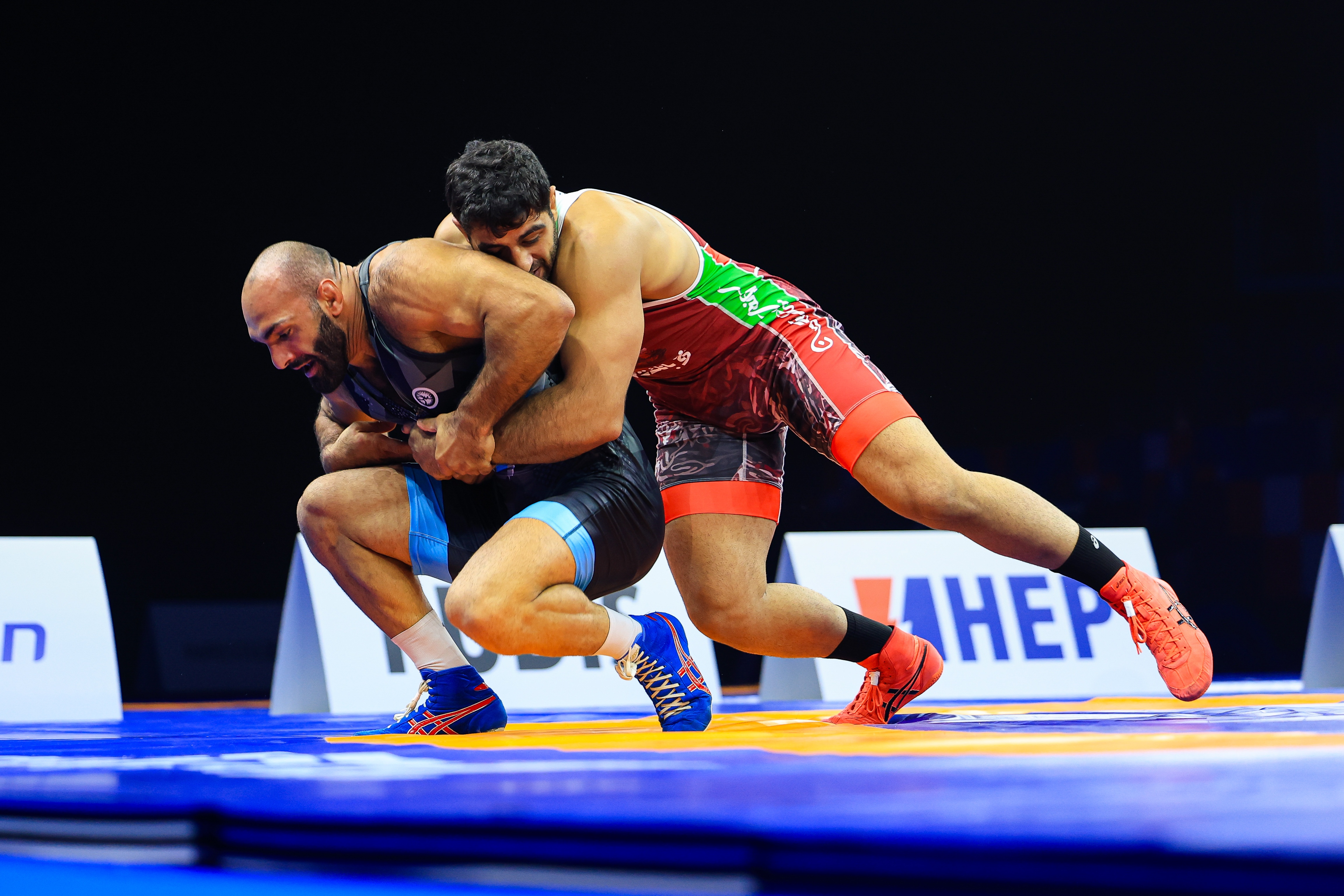 Mohammadhadi SARAVI (IRI) scores a takedown on Artur SARGASIAN (UWW) in the 97kg final. (Photo: United World Wrestling / Kadir Caliskan)
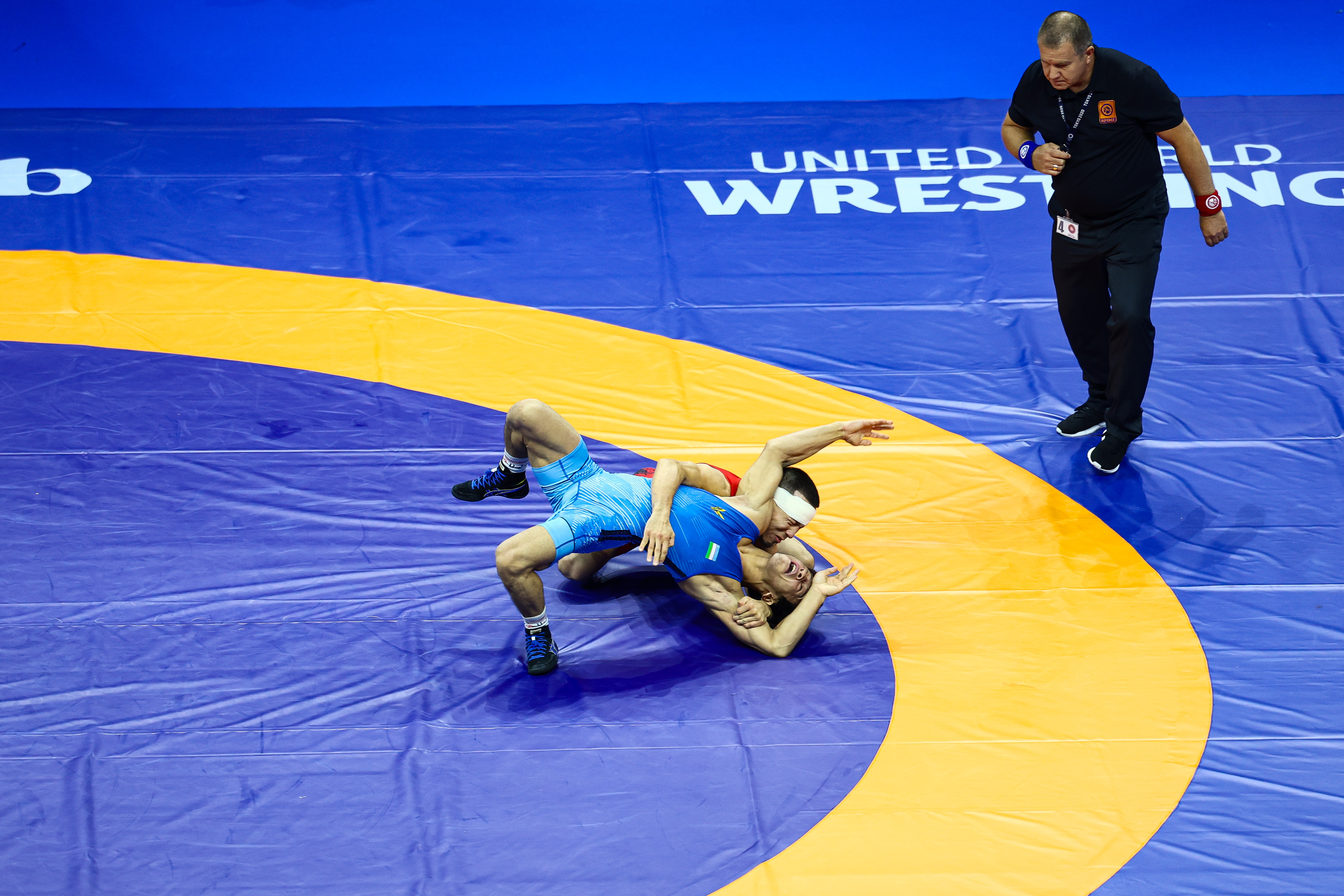 Aidos SULTANGALI (KAZ) scores a four-pointer on Alisher GANIEV (UZB) in the 60kg final. (Photo: United World Wrestling / Jake Kirkman)
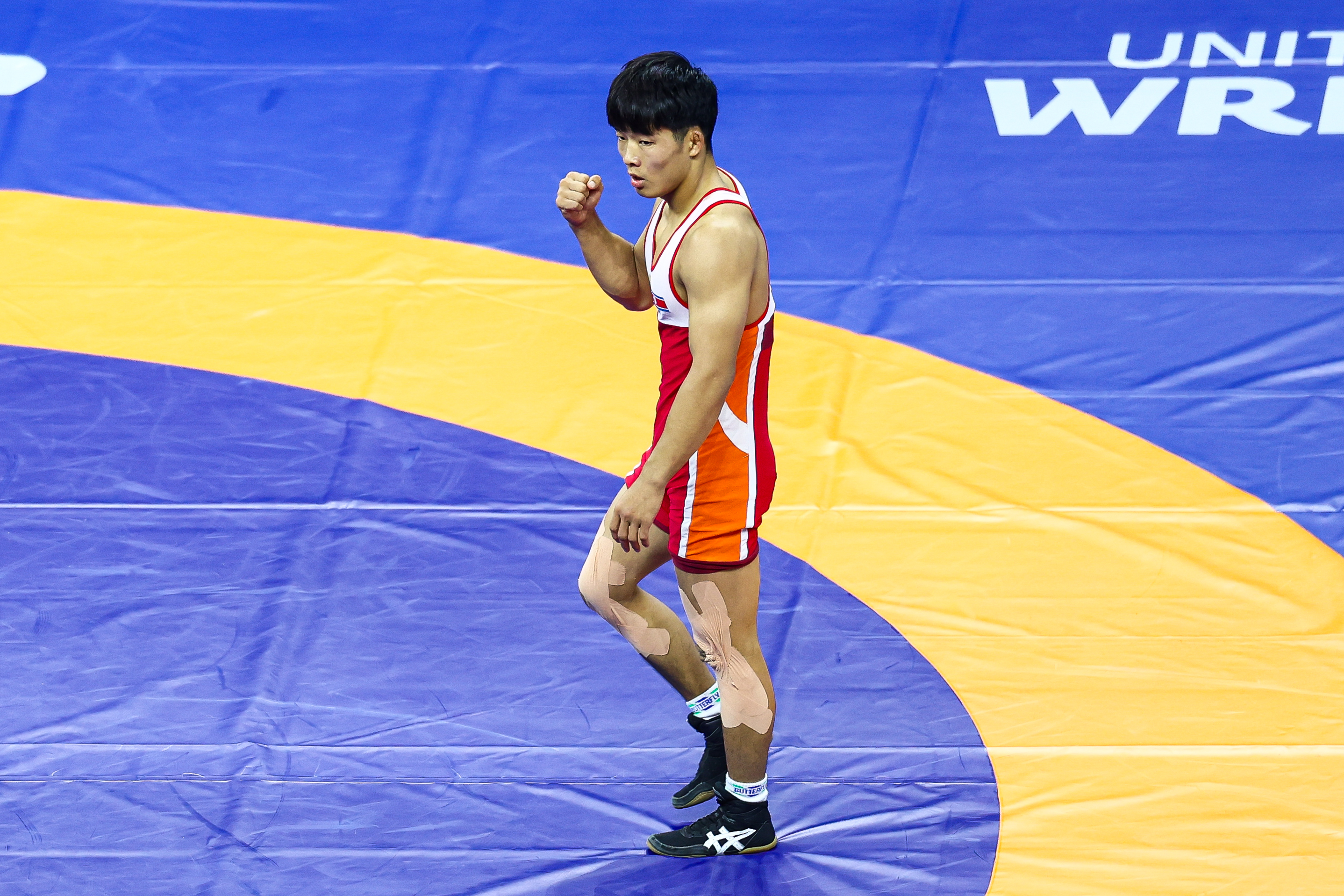 Se Ung RI (PRK) won a bronze medal at the 60kg weight class. (Photo: United World Wrestling / Jake Kirkman)
Share your thoughts.
Comments