

#wrestlenursultan

Host Kazakhstan among 6 Nations with 2 Semifinalists each as Greco Gets Underway

By Ken Marantz

NUR-SULTAN, Kazakhstan (Sept. 14) --- Almat KEBISPAYEV (KAZ) gave the opening session of the world championships the perfect closing act, thrilling the hometown crowd in the Barys Arena by grabbing the final semifinal spot on tap as Greco-Roman kicked off the competition.

Kebispayev, with a thrilling 7-4 win in the 63kg quarterfinals over Rahman BILICI (TUR), became one of two wrestlers in four weight classes from the host nation to earn places in the semifinals, to be held later in the day.

Kebispayev’s path to the final is blocked by Shinobu OTA (JPN), a Rio 2016 Olympic silver medalist aiming for his first world medal. The other semifinal pits European champion and top seed Stepan MARYANYAN (RUS) against Slavik GALSTYAN (ARM).

In the second round, Kebispayev forged out a close 2-2 win over Asian champion TUO Erbatu (CHN). 
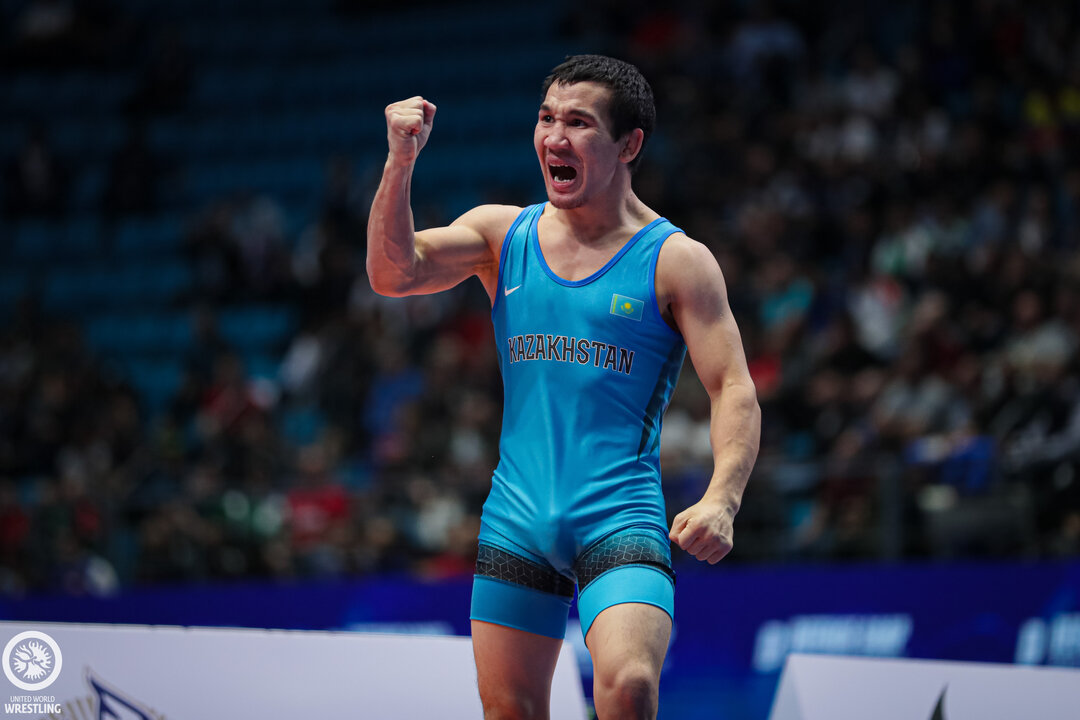
Khorlan ZHAKANSHA (KAZ) was one of two wrestlers from the host nation of Kazakhstan to make the opening day semifinals at the World Championships. (Photo: Kadir Caliskan)

Khorlan ZHAKANSHA (KAZ) also made the last four from the host nation, but faces a tough task ahead when he takes on defending world champion Eldaniz AZIZLI (AZE) for a place in the 55kg final.

In the other bracket, Nugzari TSURTSUMIA (GEO) will take on Shota OGAWA (JPN), a fifth-place finisher a year ago in the U23 World Championships who knocked off Asian champion Ilkhom BAKHRAMOV (UZB) in the quarterfinals.

It was tough day all around for the Bakhramov family, as older brother Islomjon, the Asian gold medalist at 60kg who moved up to 63kg, lost minutes later in the quarterfinals to lanky Galstyan, who scored a takedown with :25 left and held on for a 3-3 win.

The medals, to be awarded after the finals on Sunday, will be well spread around, as no country put more than two wrestlers into the semifinals. Azerbaijan, Georgia, Japan, Russia and Uzbekistan joined Kazahstan with two wrestlers each still in the running for gold. 
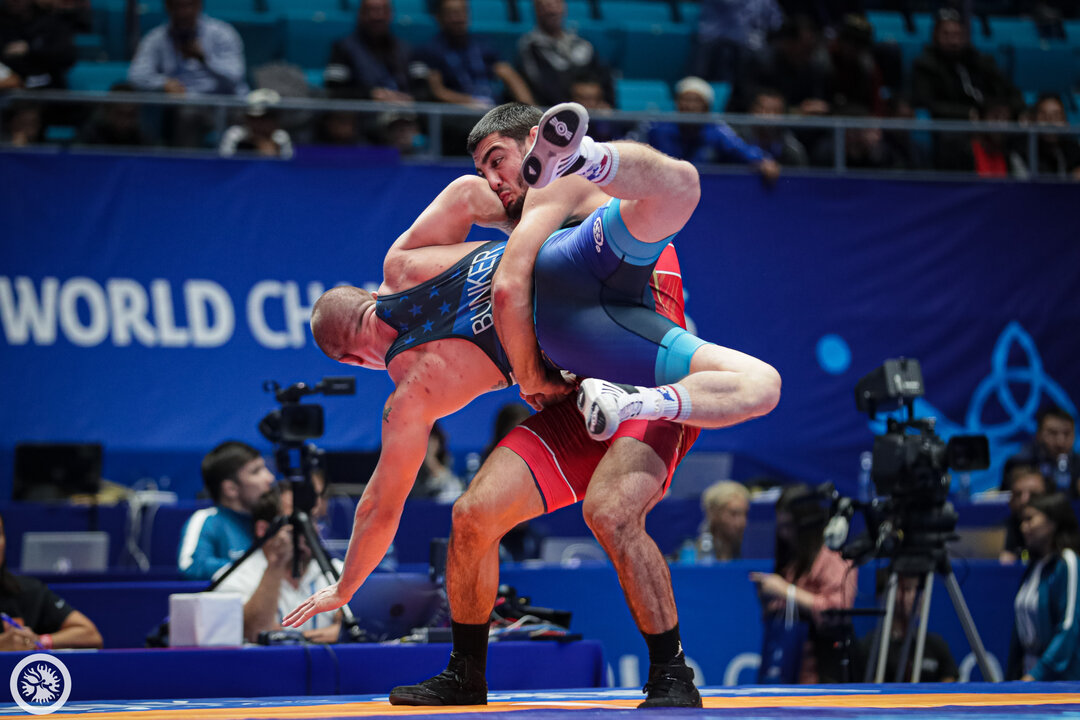
Aik MNATSAKANIAN (BUL) defeated Raymond  BUNKER III (USA), 6-2 in the quarterfinals, and will wrestle Aram VARDANYAN (UZB) for a spot in Sunday night's finals. (Photo: Kadir Caliskan) 

Bulgaria and Hungary both have one semifinalist each, and they are in the same weight class, 72kg, and both returning medalists. 

Top seed Aik MNATSAKANIAN (BUL), a bronze medalist a year ago in Budapest, will meet Aram VARDANYAN (UZB) for a place in the final, while veteran Balint KORPASI (HUN), a former world champion and 2018 silver medalist, has a semifinal date with European champion Abulazid MANTSIGOV (RUS).

Mantsigov advanced with a 4-0 victory over up-and-coming world junior champion Malkhas AMOYAN (ARM). 

The big upset of the session came at 82kg, when QIAN Haitao (CHN) threw down 2018 world silver medalist and top seed Emrah KUS (TUR) with a headlock and held on for a fall in 2:00. 

That was a harbinger of things to come in a weight class that threw away the form book and saw only one of the four seeds make it to the semifinals. 

Unheralded Nurbek KHASHIMBEKOV (UZB) knocked off European champion and fourth seed Rajbek BISULTANOV (DEN), lifting him from the par terre and dumping him onto his back before securing a fall at 1:43. 

Khashimbekov will next face European silver medalist Lasha GOBADZE (GEO), who had little trouble ousting Qian by technical fall. 

In the other semifinal, Asian champion Saied ABDVALI (IRI) will face Rafig HUSEYNOV (AZE). Abvali defeated Adlan AKIEV (RUS), who had ousted 2018 bronze medalist Maksim MANUKYAN (ARM) by fall in a thrilling second-round match.

Huseynov quieted the home crowd momentarily when he threw down Maxat YEREZHEPOV (KAZ), who suffered an apparent rib injury and was forced to default. Earlier, Yerezhepov had ousted 2018 world bronze medalist and No. 2 seed Viktor SASUNOVSKI (BLR).  

Day 1 Results

Greco-Roman - Semifinal Pairings
55kg (20 entries)
Eldaniz AZIZLI (AZE) v Khorlan ZHAKANSHA (KAZ)
Nugzari TSURTSUMIA (GEO) v Shota OGAWA (JPN)

63kg (18 entries)
Stepan MARYANYAN (RUS) v Slavik GALSTYAN (ARM)
Shinobu OTA (JPN) v Almat KEBISPAYEV (KAZ)

72kg (25 entries)
Aik MNATSAKANIAN (BUL) v Aram VARDANYAN (UZB)
Abulazid MANTSIGOV (RUS) v Balint KORPASI (HUN)

82kg (23 entries)
Lasha GOBADZE (GEO) v Nurbek KHASHIMBEKOV (UZB)
Saied ABDVALI (IRI) v Rafig HUSEYNOV (AZE)

Development

DNSS Program in Cambodia: Building Foundations for Wrestling Growth

By United World Wrestling Press

PHNOM PENH, Cambodia (December 2) --- From July 18 to November 30, 2024, the Development of the National Sports System (DNSS) program in Cambodia marked a significant milestone for the growth of wrestling in the country. Led by UWW Educator Martin Hauck (USA), this program provided a comprehensive approach to enhancing coaching, athlete development, and refereeing in Cambodia. Through a mix of workshops, camps, and tournaments, the initiative sought to foster collaboration, education, and enthusiasm for wrestling at all levels.

During the program, more educational opportunities were created for coaches, athletes, and referees. A key highlight was a youth national tournament held during the second visit, which connected athletes and coaches from several provinces, promoting competition and collaboration. Plans were made to make this event an annual tradition, further strengthening the sport’s foundation in Cambodia.

The program objectives included observing and assessing the national team during a high-performance camp in July, educating coaches on long-term athlete development, and organizing a one-day seminar in a neighboring province to introduce wrestling games to youth. Meetings with the Cambodia Wrestling Federation leadership helped establish a roadmap for future development and in-person training sessions.

Key deliverables included:

  • Running camps and seminars for coaches and athletes, focusing on practical and theoretical education.
  • Creating a Cambodian Coaches Course Curriculum and teaching topics such as emergency action planning, practice structuring, periodization, talent identification, and connecting traditional Cambodian wrestling with Olympic styles.
  • Organizing a youth national tournament and camp, which saw participation from almost all provinces, showcasing significant growth on and off the mat.
  • Promoting communication, education, and resource-sharing platforms for ongoing development.

The DNSS program not only strengthened technical skills but also built excitement and unity within the Cambodia Wrestling Federation. With a focus on collaboration among referees, coaches, athletes, and stakeholders, this initiative laid the groundwork for sustained development and opportunities in wrestling throughout Cambodia.

The Development of National Sports System (DNSS) program, conducted in Cambodia from July 18 to November 30, 2024, marked a significant step toward developing wrestling in the country. Led by UWW Educator Martin Hauck (USA), the program aimed to address critical gaps in coaching, athlete development, and organizational structure while fostering growth and enthusiasm for the sport nationwide.

CAMOver 100 participants competed in the national youth tournament during the Development of the National Sports System (DNSS) program in Cambodia.

Program Activities and Achievements

The DNSS program implemented a range of initiatives to address these challenges and lay the groundwork for wrestling’s growth:

  1. Youth Development and Competitions:
    The program introduced a national youth tournament, drawing over 100 athletes from nearly all provinces. This event not only provided a platform for competition but also fostered excitement and collaboration among athletes, coaches, referees, parents, and stakeholders.
  2. Coaching Education and Communication:
    Coaches participated in comprehensive seminars covering emergency action planning, athlete development, periodization, video analysis, coaching females, and practice structuring. A centralized communication platform on the Cambodia Wrestling Federation website improved collaboration among coaches and clubs, helping connect rural and urban areas.
  3. Structured Athlete Development:
    New frameworks for athlete progression were introduced, enabling coaches and athletes to engage in long-term development cycles. Practical sessions during national team camps allowed coaches to apply their learning while working with athletes from across the country.
  4. Safety and Inclusivity:
    Emphasis on mental health, recovery practices, and safety protocols improved understanding and implementation of safe wrestling environments.
  5. Stakeholder Engagement:
    Meetings with the Cambodia Wrestling Federation leadership resulted in a shared vision for growth, including plans to strengthen partnerships, increase opportunities, and enhance stakeholder representation.

Key Outcomes

The program’s efforts led to several important outcomes:

  • Improved communication and collaboration within the wrestling community.
  • Significant growth in coaches’ theoretical and practical knowledge.
  • Increased participation and retention among athletes and coaches.
  • The successful execution of Cambodia’s first youth national tournament.
  • The identification of Coach Sotheara as a future leader for the sport.

Path to Success

The success of wrestling in Cambodia will depend on sustained education, participation, and collaboration. With improved communication, increased opportunities, and the emergence of local leaders like Coach Sotheara, the sport is well-positioned for growth. The DNSS program has laid a strong foundation, and with continued effort, wrestling in Cambodia has the potential to thrive at both national and international levels.

By fostering education, inclusivity, and passion, this program has not only addressed immediate needs but also set a vision for wrestling’s bright future in Cambodia.