TOKYO (December 17) -- Five days after former world champion Masanosuke ONO made the stunning announcement that he was pulling out of the Emperor's Cup All-Japan Championships, another high-profile star aborted a long-awaited return to action by joining him on the sidelines.
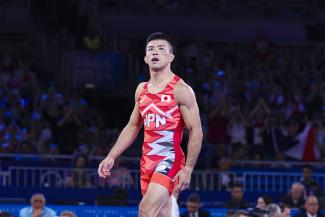
Olympic champion Kenichiro FUMITA announced Wednesday on the eve of the tournament that he was withdrawing due to an injury, keeping him out of what would have been his first tournament since his triumph at the Paris Olympics.
Fumita, who won the Paris gold at Greco 60kg but was entered at 63kg, made the announcement on his X account. Without disclosing the injury, he said it "was not a major injury that will have an effect on my wrestling career, but I feel it is not worth the risk at this time so I decided to withdraw."
The Emperor's Cup is also serving as the domestic qualifier for the 2026 Asian Championships, and as the first of two national domestic qualifiers for this year's World Championships and Asian Games. The latter holds particular significance in that Japan will be hosting the event.
Fumita, the silver medalist at the 2021 Tokyo Olympics and a two-time former world champion, had only competed at 63kg once in his career, at the 2023 German Grand Prix, where he placed second as a warmup for the World Championships, where he took home the silver.
The 30-year-old was due to take the mat on Thursday, the first day of the four-day tournament at Tokyo's Komazawa Gym.
"I deeply apologize to everyone who was looking forward [to seeing me] and to all those involved [with the tournament]," Fumita said. "I will make the utmost effort to be in top condition and be able to perform at the next competition."
Last Friday, Ono announced that he had withdrawn for health reasons, a move that indefinitely delays his return to the mats of his native country.
Ono revealed on social media that he had been diagnosed with a kidney problem, possibly linked to cutting weight to get down to 57kg, according to a report by Japan's top wrestling website Wrestling Spirits.
Ono has been competing at either 61kg or 65kg in recent years, and the stress of getting down to 57kg might have taken too big a toll. Ono said that he had gotten near 57kg the previous week when he experienced thickening of the urine, which can be regarded as a sign of dehydration.
Upon consultation with a doctor, it was decided "I will play it safe this time," Ono said.
The 22-year-old Ono has become a worldwide sensation, first by winning the senior world title at freestyle 61kg in 2024 with one-sided victories that included beating a past Olympic gold medalist and the reigning world champion, then for leaving the comfort of Yamanashi Gakuin University for the challenge of competing in American folkstyle at powerhouse Penn State University.
The Emperor's Cup would have provided a rare chance for Ono to compete in a freestyle tournament again, the first step on the path to getting back to the World Championships.
Ono said he will now return to Penn State, where he will resume his introduction into folkstyle. While he is redshirting this year -- the system that allows him to train with the team but not enter official competitions to preserve a year of eligibility -- he plans to enter an open tournament in January.
As pointed out by Wrestling Spirits, the big issue facing Ono now is whether or not he will be afforded a spot in the Meiji Cup All-Japan Invitational Championships in May next year, which will be the second domestic qualifier for the worlds and Asian Games.
As the name implies, the field is limited to invitees, using criteria set by the Japan Wrestling Federation based on results from major competitions over the past year. There are exceptions made for a wrestler who has been out of action for an extended time but has achieved "particularly outstanding results."
In the past, this has been interpreted to mean medaling at an Olympics, as the majority of wrestlers take time off following Olympic success. The question the federation will have to answer is, will a world title in 2024 earn Ono an invitation?
Asked directly by Wrestling Spirits, Kenji INOUE, the federation's chairman of the technical enhancement committee, replied, "At this stage, nothing has been decided."
There is one incentive for the publicity-starved JWF to include Ono in the Meiji Cup field -- it could set up a classic match-up between him and Paris Olympic champion Rei HIGUCHI.
Higuchi has not competed since winning the Paris gold, but has already stated he plans to return at the Meiji Cup with eyes on a first Asian Games appearance.
Ono has not competed in Japan since June 2024, when he participated in the East Japan Collegiate League, a team competition in which he helped Yamanashi Gakuin win the Division I title.
After winning the gold at the Non-Olympic Weight Class World Championships in Tirana in October 2024, he revealed he had been dealing with a broken ankle.
That kept him out of competition for awhile, then early in 2025, he headed across the Pacific to begin training with the Nittany Lion Wrestling Club. In March, he made the blockbuster announcement that he would enroll at Penn State.
Ono had been entered at 57kg at the Bill Farrell Memorial Invitational in New York in November, but was a late withdrawal for undisclosed reasons.
At the Emperor's Cup, Olympic weight classes will be contested over two days in the same format at the World Championships, while non-Olympic weights will be finished in a single day.
Although Fumita will no longer be competing, fellow Paris gold medalist Yuka KAGAMI will be making her return to the mat for the first time since her Olympic triumph at women's 76kg, which gets started on Thursday.




Share your thoughts.
Comments