

India dominates Commonwealth Games with 3 golds
Friday, August 5, 2022 - 21:02 By Vinay Siwach

COVENTRY, England (August 8) -- When Bajrang PUNIA (IND) lost to David TREMBLAY (CAN) in the 2014 Commonwealth Games final, a 13-year-old Lachlan McNEIL (CAN) was in the crowd at the Scottish Exhibition and Conference Centre in Glasgow.
While Tremblay managed to beat Punia, McNeil's attempt to repeat the feat eight years later in the Coventry Arena on Friday fell short as Punia, now a veteran of three Commonwealth Games, defended his 65kg gold medal with little trouble.
Punia and McNeil reached the 65kg gold medal bout by beating George RAMM (ENG) and Inayat ULLAH (PAK) with ease. With gold on the line, McNeil did put up a fight, scoring the only takedown against Punia in the competition, but it wasn't enough as the Tokyo bronze medalist won the bout 10-2.
That was one of the three gold medals India won on day one of wrestling at the Commonwealth Games in Birmingham. Deepak PUNIA (IND) and Sakshi MALIK (IND) were also crowned first-time Commonwealth champions.
But it was Punia's gold that delighted the huge contingent of Indian fans at the arena.
"When you are wrestling at any tournament, you don't think about the difficulty of it," Punia said. "I wrestled thinking everyone is important and I want to be back to the level I was in 2018 and 2019."
Since winning the bronze in Tokyo, Punia has suffered two losses -- against Rahman AMOUZAD (IRI) in the Asian Championships final and Abbos RAKHMANOV (UZB) at the Ranking Series in Almaty.
But with the World Championships just a month away, he would like to put behind the two losses and take confidence from the win in Birmingham.
"World Championships is the main goal," he said. "I have been preparing for that and now it's very close."
For McNeil, the Commonwealth Games were a learning experience as he tries to win a berth for Canada for the Paris Olympics.
"The sole purpose of coming here was to wrestle Bajrang," McNeil said. "He is a world-class wrestler and he proved it. But it's a great experience and I will carry it forward to the Olympics in Paris."
 Deepak PUNIA (IND), gold medalist, with the three other medalists at 86kg in Coventry. (Photo: UWW / Helena Curtis)
Another Punia had a higher stake in the final. Not only was Deepak wrestling for gold, but he also had to beat Muhammad INAM (PAK), a wrestler who has never lost to an Indian at the Commonwealth Games.
The two-time champion kept Deepak quiet for a long time but was called passive in the first period. Deepak scored a stepout during the activity period to lead 2-0 at the break. A tiring Inam kept going for half-hearted attacks and Deepak managed to get another stepout.
He managed to keep Inam away until the clock expired, winning the gold at 86kg, 3-0.
 Amarveer DHESI (CAN) won his first Commonwealth Games gold on Friday. (Photo: UWW / Helena Curtis)
The final freestyle gold medal went to Pan-Am champion Amarveer DHESI (CAN) who defeated another Pakistan wrestler in Zaman ANWAR in the final.
Anwar did score two points but Dhesi was class apart, winning the gold medal with a fall after leading 9-2.
In the semifinal, Dhesi was up against Mohit GREWAL (IND) and managed to get an easy 12-2 win and keep his promise of winning against India at the Commonwealth Games.
"An Indo-Canadian and Indian wrestling always makes things complex back home," Dhesi said. "But great to get the win and be on the top of the podium."
Dhesi will now try to repeat the feat at the World Championships in Belgrade.
"The weight class has some solid guys but my aim remains the same -- to reach the podium," he said.
 Blessing OBORUDUDU (NGR), red, defeated Linda MORAIS (CAN) to win the 68kg gold medal. (Photo: UWW / Helena Curtis)
Repeat for Oborududu, Adekuoroye
Olympic silver medalist Blessing OBORUDUDU (NGR) became a two-time Commonwealth Games champion after winning the 68kg gold medal in Coventry.
Wrestling former world champion at 59kg Linda MORAIS (CAN), Oborududu controlled the bout till the end and gave no chance to Morais to attack.
At one point the score was 3-1 and Morais fancied her chance of winning the gold with a takedown but Oborududu managed to score a go-behind in the final moments and win 5-1.
Blessing, who became the first-ever wrestler from Africa to reach an Olympic final in Tokyo, won gold in 2018 but has a silver from the 2010 edition and a bronze from 2014.
"For me, I was calm in the final," Oborududu said. "I wanted to control the final and not attack too much. I knew the match would be tough if I don't wrestle smart. I didn't need to panic and that's why I wrestled how I did."
Morais will also be at the World Championships at 68kg and will be hoping to avenge the loss.
"We thought it's a good opportunity to jump to 68kg and be part of the team," Morais said.
 Odunayo ADEKUOROYE (NGR) defended her 57kg gold after beating Anshu MALIK (IND) in the final. (Photo: UWW / Helena Curtis)
Adekuoroye, who wrestled Pooja DHANDA (IND) in the 57kg final in Gold Coast, defeated world silver medalist Anshu MALIK (IND) in the final to defend her gold.
In their only meeting before Birmingham, Adekuoroye won via technical superiority over Malik. While the score was close on Friday, the result was Adekuoroye won the gold.
She got a double leg for a takedown to lead 2-0 and kept Malik off the hooks for the remaining time. As the break approached, Adekuoroye once again blasted a double and made the lead 4-0.
Malik continued her attacks and did get a takedown after Adekuoroye was penalized for a passivity point. But the takedown was a little too late as the Nigerian won 7-3 before breaking to her dance to celebrate the gold.
 Sakshi MALIK's (IND) move that helped her secure the fall over Ana GONZALEZ (CAN). (Photo: UWW / Helena Curtis)
The gold at 62kg was captured by Sakshi MALIK (IND) as she came from behind to beat U23 world champion Ana GONZALEZ (CAN) in the final.
Gonzalez jumped to a 4-0 lead at the break with two takedowns and Malik was struggling to find openings.
"I thought I could win and I was really confident," Gonzalez said. "But I had to be a little proactive in the second period and not let her wrestle her way."
Malik, trying to get her favorite double-leg attack, kept Gonzalez close to her and snapped which allowed Malik to grab Gonzalez leg. She turned it into an underhook and got the double. With Gonzalez falling on her back, Malik kept the pressure and secured the fall.
"I have a bronze medal at Commonwealth and silver so this time I just thought that I have to get the gold and I am happy to get it," Malik said.
RESULTS
Freestyle
65kg
GOLD: Bajrang PUNIA (IND) df. Lachlan McNEIL (CAN), 9-2
BRONZE: George RAMM (ENG) df. Lowe BINGHAM (NRU), 11-0
BRZONE: Inayat ULLAH (PAK) df. Ross CONNELLY (SCO), 10-0
86kg
GOLD: Deepak PUNIA (IND) df. Muhammad INAM (PAK), 3-0
BRONZE: Alexander MOORE (CAN) df. Matthew OXENHAM (NZL), 10-0
BRONZE: Jayden LAWRENCE (AUS) df. Edward LESSING (RSA), 12-11
125kg
GOLD: Amarveer DHESI (CAN) df. Zaman ANWAR (PAK), via fall
BRONZE: Mohit GREWAL (IND) df. Aaron JOHNSON (JAM), via fall
BRONZE: Mandhir KOONER (ENG) df. Kensley MARIE (MAU), via fall
Women's wrestling
57kg
GOLD: Odunayo ADEKUOROYE (NGR) df. Anshu MALIK (IND), 7-4
BRONZE: Hannah TAYLOR (CAN) df. Sophia AYIETA (KEN), via fall
BRONZE: Nethmi PORUTHOTAGE (SRI) df. Irene SYMEONIDIS (AUS), 10-0
62kg
GOLD: Sakshi MALIK (IND) df. Ana GODINEZ GONZALEZ (CAN), via fall
BRONZE:: Berthe ETANE (CMR) df. Kelsey BARNES (ENG), 9-4
BRONZE: Esther KOLAWOLE (NGR) df. Abbie FOUNTAIN (SCO), 10-0
68kg
GOLD: Blessing OBORUDUDU (NGR) df. Linda MORAIS (CAN), 5-1
BRONZE: Tayla FORD (NZL) df. Amylee AZA (MAU), via fall
BRONZE: Divya KAKRAN (IND) df. Tiger COCKER (TGA), via fall
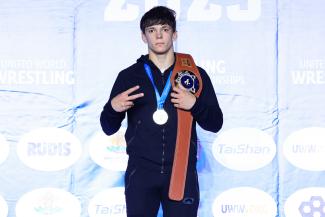
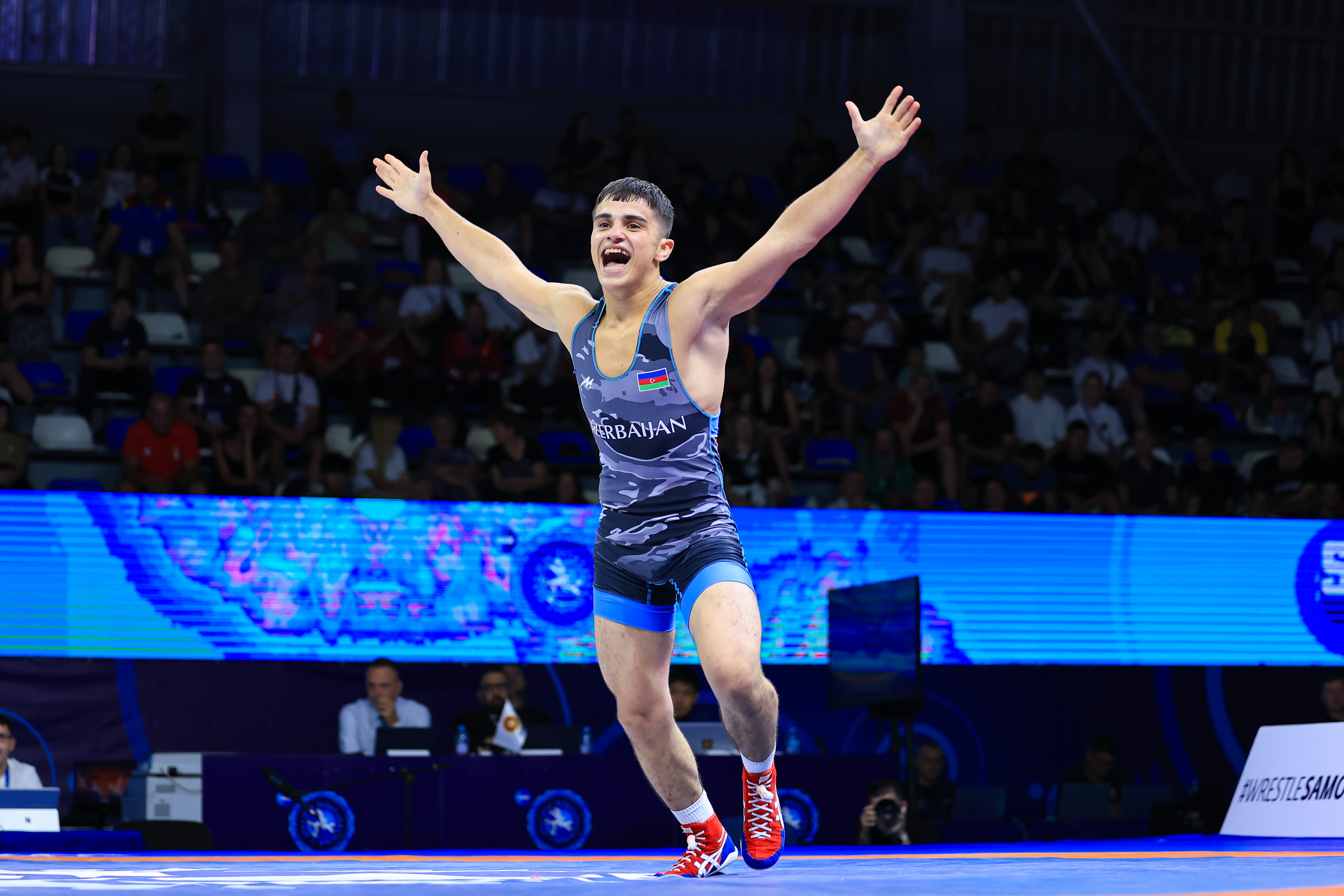 Aykhan JAVADOV (AZE) celebrates after winning the gold medal at 60kg. (Photo: United World Wrestling / Amirreza Aliasgari)
Share your thoughts.
Comments