

Japan Freestyle Squad Gets Together for 1st National Team Camp in Six Months
Tuesday, October 6, 2020 - 15:05 By Ken Marantz

TOKYO -- Save for a short period when his university was completely shut down, former world champion Takuto OTOGURO has been able to keep up a regular practice routine during the global pandemic.
But finally getting to work out with his fellow national team members takes it to another level. It gets the juices flowing, and raises hopes that the day the wrestling world gets back on the mat for competition won't be far off.
"To be here with the national team gathered together makes me feel grateful again," Otoguro said. "I feel motivated looking toward the Olympics."
The Japan national freestyle team started its first training camp in six months on Oct. 1 at the Ajinomoto National Training Center in Tokyo, with 17 of the nation's best converging for the eight-day conclave being held under strict health protocols.
In principle, the top two placewinners at last year's national championships were invited -- a few were excused due to university or company commitments -- as Japan begins preparation for the tentatively scheduled World Championships in December, Asian Championships in February and the Asian Olympic qualifying tournament in March. Whether any or all of the tournaments will be held is still just speculation.
The freestylers, who last got together in March this year, had been scheduled to have a camp in mid-July, following the women and Greco-Roman squads. While the latter two had their camps, freestyle was left in the lurch when a sudden surge of coronavirus cases in Tokyo caused the Japan federation to cancel.

Takuto OTOGURO ties up former Olympic medalist and national team coach Shinichi YUMOTO. (photo by Sachiko Hotaka/JWF)
"So many times we make a schedule and it's canceled, make a schedule and it's canceled," said freestyle head coach Kenji INOUE. "Under these circumstances, it could not be helped."
Scheduling a national team camp is no easy matter. Wrestlers are scattered around the country, and must be released by their university or club teams. Also, the federation needs to get the green light from its medical commission.
"Even if we [in the federation] want to hold this, we cannot do it without the support and cooperation of many people," Inoue said. "And then when we have to cancel after all the planning, all we can do it apologize to them. This time, along with being grateful for their cooperation, we can repay them by having a camp without incident."

Rei HIGUCHI squares off with former Olympic gold medalist and national team coach Tatsuhiro YONEMITSU. (photo by Sachiko Hotaka/JWF)
Following strict protocols
As with the camps held in July, the freestylers face strict regulations over their movements in the "bubble" of the NTC complex. There are limits on how many can be in the weight room at any one time. In the dining room, they are urged to sit diagonally across from each other, not face to face. Contact with the outside world is limited to an occasional run to the local convenience store.
Upon entering the wrestling room, they have their temperature taken, and sanitize not only their hands, but the bottom of their wrestling shoes. Each wrestler has taken a PCR test for the coronavirus; all came up negative.
"The teams did what they could and each individual did what he could," Inoue said. "I don't know if other countries did the same, but there's no anxiety on our part."
Otoguro has been somewhat fortunate in that Yamanashi Prefecture, where he attends Yamanashi Gakuin University, has been largely spared the brunt of the pandemic. Through Oct. 3, the prefecture west of Tokyo had just 194 cases and six deaths, compared to Tokyo with 26,376 and 411, respectively. As a whole, Japan has had about 1,600 deaths.
Otoguro and older brother Keisuke are the only Japanese in freestyle who have secured berths at the Tokyo Olympics, which were postponed a year to 2021. Takuto, the 2018 world gold medalist, earned his place at 65kg by finishing fifth at last year's World Championships, while Keisuke filled the 74kg spot by winning a domestic playoff, having moved up from 70kg.
Keisuke Otoguro had a slightly better situation coming into camp as he is a member of the Self-Defense Force Physical Training School team, which offers a high level of competition and ordinarily operates within a bubble of its own.
For inspiration, he has to look no farther than the team coaches, three of whom have won Olympic medals. Not only that, but Inoue (bronze, Athens 2004), Tatsuhiro YONEMITSU (gold, London 2012) and Shinichi YUMOTO (bronze, London 2012) are also on the national team staff.
"I am learning from wrestlers with the great experience of having won Olympic medals," Otoguro said. "I think that can be a big advantage for me."
His brother and Rei HIGUCHI, the Rio 2016 silver medalist at 57kg who will try to earn a spot in Tokyo in that weight class at the Asian qualifier, both got to see first hand how the coaches have not lost much since their active days.
Takuto Otoguro had the weight advantage in sparring with Yumoto, who wrestled at 55kg in his prime. But Higuchi faced the opposite situation in squaring off with Yonemitsu, who certainly looks like he would quickly get up to speed if he ever decided to return to competition.
"I have so much I can learn," Higuchi said of facing the muscular Yonemitsu, who has added bulk to the frame that triumphed in London at 66kg. "Naturally, there is a bit of a size difference. I need to overcome that. I'm the type that hates to lose, so it was very tough to take. I don't consider that the situation is hopeless."
Still, he is grateful for being back on the national team, as it gives him the chance for such encounters.
"If I'm not here, I don't have a chance [to wrestle] with Yonemitsu or Yumoto. It's fun, but it's also frustrating. This week, I'll do what I can to beat them."

Keisuke OTOGURO works on a takedown. (photo by Sachiko Hotaka/JWF)
Tough decision ahead
Higuchi had originally tried to make the Olympic team at 65kg, but couldn't get past Otoguro. He then dropped down two weight classes to 57kg to challenge former world champion Yuki TAKAHASHI, and defeated him in the final of the Emperor's Cup All-Japan Championships last December to earn a ticket to the Asian Olympic qualifier.
He hit a bump in the road when a cluster of infections broke out among the wrestlers at Nippon Sport Science University, his alma mater where he continues to train and serves as a graduate assistant. While it was not revealed whether Higuchi was among those infected, he said he made the best of the situation.
"Because of the coronavirus, the amount of practice was reduced," Higuchi said. "I went back home and had a lot of time off. I felt refreshed with a renewed sense of commitment. So it wasn't so bad."
Veteran Sosuke TAKATANI, a two-time Olympian and 2014 world silver medalist at 74kg who will try to make the Tokyo Games at 86kg, also had his training curtailed. But he is unperturbed about the long span between national team camps, which also saw the cancelation of all competition.
"I don't feel concerned at all," Takatani said. "Everyone in the country has to overcome this crisis. It's not a matter of, they did this or we couldn't do that. I'll just do what I can to get ready for the next competion."
What that competition will be is still up in the air, but even in the best-case scenario, Japan's top wrestlers will be forced to make a difficult decision.
The World Championships, normally held in September, have been scheduled for Dec. 12-20 in Belgrade. But that directly overlaps with the All-Japan Championships, which are slated for Dec. 17-20.
Normally, the team for the World Championships would be decided based on the results from the Emperor's Cup in December and the Meiji Cup All-Japan Invitational Championships in May or June. But the latter was canceled this year, and a Japan federation official said the winners at the Emperor's Cup will be given preference for places on the team to Belgrade. Some, however, may opt to stay in Japan for the Emperor's Cup, which will be their prerogative.
Takatani did not hesitate in saying he will opt for Belgrade. "My goal is to be No. 1 in the world, so if I'm given the chance, I want to definitely win the gold medal," he said, even though missing the Emperor's Cup would end his streak of nine consecutive national titles.
Both Takuto Otoguro and Higuchi said they are undecided at this point.
"I have to talk to my coach, I don't know now," said Otoguro, whose most recent competition was a gold-medal run at the Asian Championships in New Dehli in February. "Tokyo is the goal, that's the standard. Whatever tournament I enter before then, I'll aim to win the title."
Higuchi is playing it by ear as well, leaving it undecided at the moment but assuring he will be on the mat for one of them.
"It will depend on the timing of how I feel in terms of getting back my match sense," he said.
The women and Greco-Roman national teams will hold camps from Oct. 20 and 21, respectively.
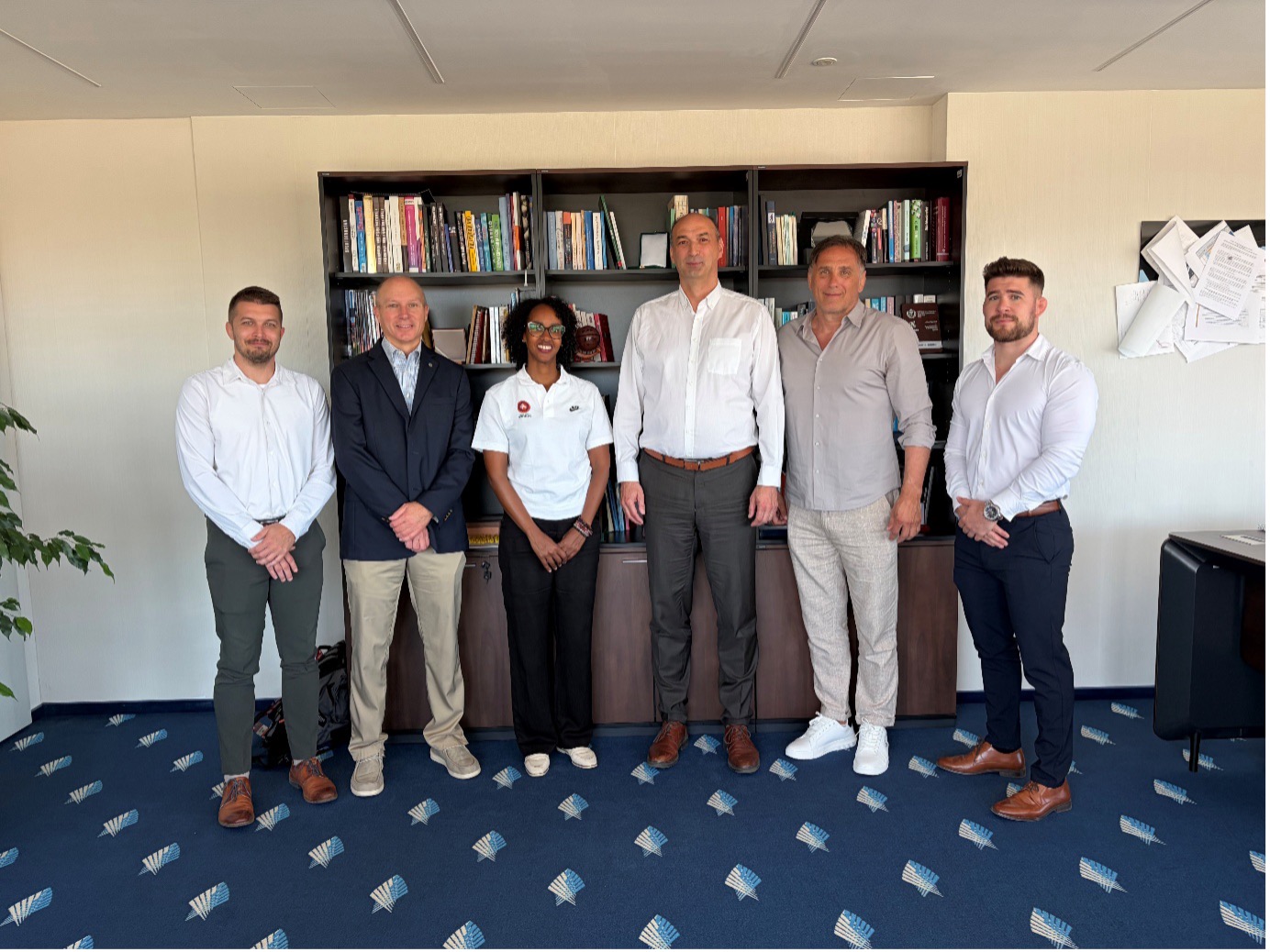 From left to right: Gabor FARKAS (HUN), Zach ERRETT, Deqa NIAMKEY, Tamas STERBENZ (HUN), Peter BACSA and Gergely BABSZKY (HUN).
Share your thoughts.
Comments