

Japan gold medalists meet fans, looking to inspire their successors
Thursday, August 29, 2024 - 14:15 By Ken Marantz

TOKYO (August 29) -- It may not compare to the punishing six minutes on the mat in an Olympic final, but standing for over two hours shaking hands, taking photos and signing autographs can take its toll -- and be rewarding in its own way.
Rei HIGUCHI was among five of Japan's eight gold medalists at the Paris Olympics who participated in a meet-and-greet on Sunday in Tokyo, where over 500 people turned out to see this new group of heroes.
"I don't want this to be the last event, so we can help make wrestling more popular," Higuchi said at a press conference following the session. "That's one of the responsibilities of the top athletes. I want to do all that I can."
Higuchi, the freestyle 57kg champion, was joined by fellow freestyle gold medalist Kotaro KIYOOKA (65kg), Greco winner Nao KUSAKA (77kg) and women's champions Tsugumi SAKURAI (57kg) and Sakura MOTOKI (62kg), as well as freestyle 74kg silver medalist Daichi TAKATANI.
The adoring fans came in all ages and sizes, from parents with toddlers to schoolkids sporting their wrestling club t-shirts to senior citizens, all waiting patiently in line for the chance to get up close and personal with a handful of the stars who had brought glory to their country.
For the wrestlers themselves, it was a way to express their thanks for the support they received, and to help inspire the next generation that can hopefully someday match or exceed the wrestling squad's outsized performance in Paris, where it won 11 medals in the 13 weight classes in which it had entries.
"It's amazing, more people showed up than I thought would," Sakurai said. "It really shows the value of the Olympics. I get a sense of how it gives the children dreams to shoot for.
"When I was little, I saw an Olympic gold medal and it really inspired me to work hard in wrestling. In the same way, it makes me happy if it inspires others by seeing my medal."
The event was held in the entranceway at the Komazawa Indoor Ball Sports Arena (Komazawa Gym is being renovated) in conjunction with the third day of the national collegiate championships. Many of the collegians came out for a peek at the medalists, some of whom are still, or until recently were, their teammates.
With the six lined up against a backdrop of posters of the Olympic squad, each person or group would hand their phone to a volunteer, who would snap photos as they were surrounded by the wrestlers.
The wrestlers flashed a smile and held up their medal for each shot, and sometimes one would put their medal around a young fan's neck. They all had no qualms about letting the fans touch the medal and feel its weight (and it's heavy, alright).
"I'm really happy to have so many people come to this and get a chance to touch the medal," Higuchi said. "Kids who are wrestling also came, and I am happy if this helps nurture those who will follow us. It seems that a lot of people watched the Olympics. I wanted to put [the medal] around the neck of every one, and I felt bad that there was a problem with time.
After the photos, they all took a few steps over to a table, where the wrestlers would sign autographs on t-shirts, notebooks or "shikishi," the traditional white cardboard used for such occasions. In some cases, they signed their names directly on a t-shirt that the fan was wearing.
Keito Ota, a 12-year-old from Tokyo whose mother allowed him to stay up and watch the Olympic finals that started at 4 a.m. Japan time, came to meet his favorite wrestler, Kiyooka.
"Kiyooka-san is so cool, so that's why I came to this autograph session," said Ota, a national schoolboy fifth-grade champion who was wearing his Figure Four Club t-shirt. "I was really glad [they are here], I'll work hard to become an athlete like them. The team that will be made up from my generation, we'll try to get more than eight medals."
 The six medalists, from left, Rei HIGUCHI, Kotaro KIYOOKA, Tsugumi SAKURAI, Sakura MOTOKI, Nao KUSAKA and Daichi TAKATANI, pose together after the event.
Needing to spread the word
It some ways, the event could be considered a case of preaching to the choir. There is no way of knowing how many came who had no interest in wrestling prior to the Olympics, but the Japan federation does have a problem when it comes to raising the popularity of the sport to match the country's achievements in it.
Overall, Japan won 20 gold medals in Paris, which means that nearly half were won in wrestling. But the media leans toward highlighting Gen-X favorites like skateboarding and rock-climbing, or gymnastics and table tennis in which the top competitors have become household names.
Going into Paris, the main focus when it came to wrestling was on women's 50kg star Yui SUSAKI, mainly because she was the only Japanese champion from the Tokyo Olympics who was defending her crown in Paris.
The national championships have not been regularly televised since the years when three-time Olympic champion Saori YOSHIDA was a media darling back in the early 2000s. In recent years, the only time it made the airwaves was when Rio Olympic champions Kaori ICHO and Risako KAWAI squared off to make the team to Tokyo.
"We wrestlers won eight of the 20 gold medals [won by Japan in Paris], and overall, we had 13 wrestlers and 11 won medals," the 28-year-old Higuchi said. "But it's not just about that result. From now, we have to use opportunities like this to make more people aware of the sport of wrestling.
"If wrestling stays unknown and is just a sport that comes up once every four years, there will be nobody coming up to follow us. We need to do activities that spread the word.
"It's because of those who support these events and tournaments that we were able to become wrestlers. We appreciate them, which includes the media, as we continue to do everything in our power to promote the sport."
Higuchi pointed out the vast difference between the crowd at the Japan college championships, which was maybe in the hundreds, and those at the U.S. NCAA tournament, which draws in the tens of thousands. "The intensity is completely different," he said.
During and after the Olympics, the wrestlers got valuable chances to publicize the sport on news programs and variety shows, which were only too happy to capitalize on the Olympic enthusiasm by booking appearances from the Paris medalists.
In one segment, Greco 60kg gold medalist Kenichiro FUMITA demonstrated to an unsuspecting host just how tight the waist hold of a gut wrench can be. He also got on the bottom of par terre to show how he resisted his opponents in Paris and kept from being turned. The host could barely budge him.
"The way we are treated, they are so nice, it's like we've become a celebrity," Takatani said. "Even if I made an unusual request, they listened to it. It showed just how highly regarded the Olympics is. It's like I saw a whole new world."
Sakurai, who had won a third straight world title heading to Paris (at 55kg in 2021 and conseeutive titles at 57kg in 2022 and 2023), said she had never gained much attention from the general public for her previous exploits.
"It was very different from the World Championships," Sakurai said. "The responses and the excitement from everyone after the World Championships and after the Olympics are different.
"The Olympics were broadcast on television and everyone knows the results. People [at this event] were so happy, like they were meeting their idols, even just to shake hands...I'm not the talkative type and it's hard for me to respond, but I'll do what I can to make them happy again."
With the abundance of golds, Kiyooka fell under the radar and lamented that he had not been invited onto any TV shows. But he still got some well-deserved recognition back in his hometown, where he was honored with a Citizen's Certificate of Honor from both Kochi Prefecture and Kochi City.
"They even came to greet me at the airport," Kiyooka said, adding that there is a parade planned for him and fellow Kochi native Sakurai -- they both started wrestling in the kids club coached by her father -- in September.
Kiyooka appears to have the fine makings for an ambassador for the sport. Asked what he attributed the success of Japan's team in Paris to, Kiyooka replied, "On the wrestling team of Team Japan, every one of us loves wrestling from the bottom of our hearts. We all want to have an influence and uplift others, and in doing so, it produced this result."
What lies ahead
So what will the champions do for an encore? For the moment, they are content to relish the adulation and take some time for a well-deserved rest.
It looks like Kiyooka and Kusaka will be the first ones to get back on the mat in earnest, as both plan to participate in the German Bundesliga in October.
"It's a place I've always wanted to go and give me a new dream," Kiyooka said. "Then I will get down to the job of defending my title in four years."
Kusaka had prepared for the Paris Olympics by traveling solo using his own money to train in Germany and Hungary. He also took part in the Bundesliga, where now he will have more name recognition as an Olympic champion.
Higuchi said that at 28, he does not feel his age is a barrier at all. He is undecided on trying next year to add to the world gold that he won last year at 61kg, but would like to arrange visits to top U.S. colleges like Iowa in the winter.
More than the World Championships, he said his focus is on the 2026 Asian Games, which remains the only major laurel missing from his collection. Adding to the incentive is that the Games will be held in the central Japan city of Nagoya.
"The one thing that is still missing is the Asian Games title, so I will aim to qualify for that," Higuchi said.
Motoki will be taking a break for awhile, but has her sights on someday completing the Grand Slam of age-group world titles.
She won the world U17 in 2018 and U20 in 2022, but has come up just short on the senior level, winning a bronze in 2022 and silver in 2023. She has yet to enter the world U23, and will still be eligible to enter next year's tournament.
"I went through a tough year up to the Olympics and I like wrestling, so I will take a break," Motoki said. "I don't want to train for records or to win consecutive titles or things like that, but I do want to take a stab at completing the Grand Slam. That gives me a new challenge and it will be nice if I can get it."
Higuchi calls for weight allowance
Higuchi also talked from first-hand experience about the sad saga of Vinesh PHOGAT (IND), and called for some kind of weight allowance for second-day weigh-ins.
Phogat had handed Susaki her first-ever international loss en route to the women's 50kg final, only to be disqualified for failing to make weight on the second day.
Higuchi can certainly sympathize. Looking to make up for his loss in the final at the 2016 Rio Olympics, he infamously failed to make weight for the Asian Qualifier for the Tokyo Games, which indirectly led to him missing out.
"I certainly understand her feelings of despair," Higuchi said. "But we are competing under rules, and you can't reverse a decision that has been made. The second day weigh-in is more difficult than the first, and it's something I would like to have changed."
Higuchi said that giving the wrestlers an allowance of one or two kilograms would make a huge difference, both physically and mentally.
"After the matches are over on the first day, you have to lose two or three kilograms," Higuchi said. "It's tough after the matches, and if you lose in the first or second round, you have to prepare without knowing if you will have a match or not. It's really grueling. I'd really like them to do even a little to help us out.
"But that's something for UWW to decide. All I can do is go along with [the rules]."


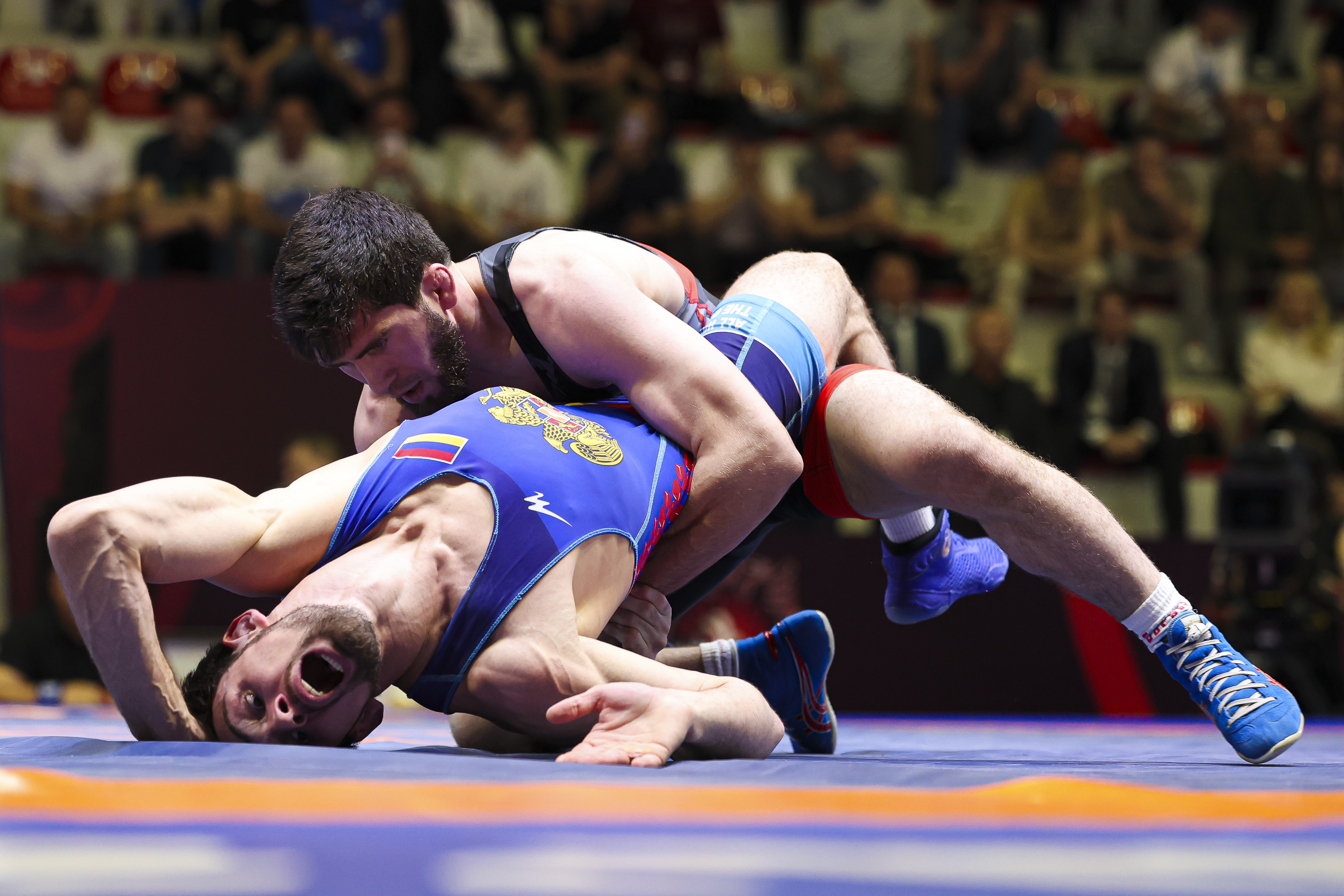 Zavur UGUEV (UWW) pins Arsen HARUTYUNYAN (ARM) in the 61kg semifinals. (Photo: United World Wrestling / Kadir Caliskan)
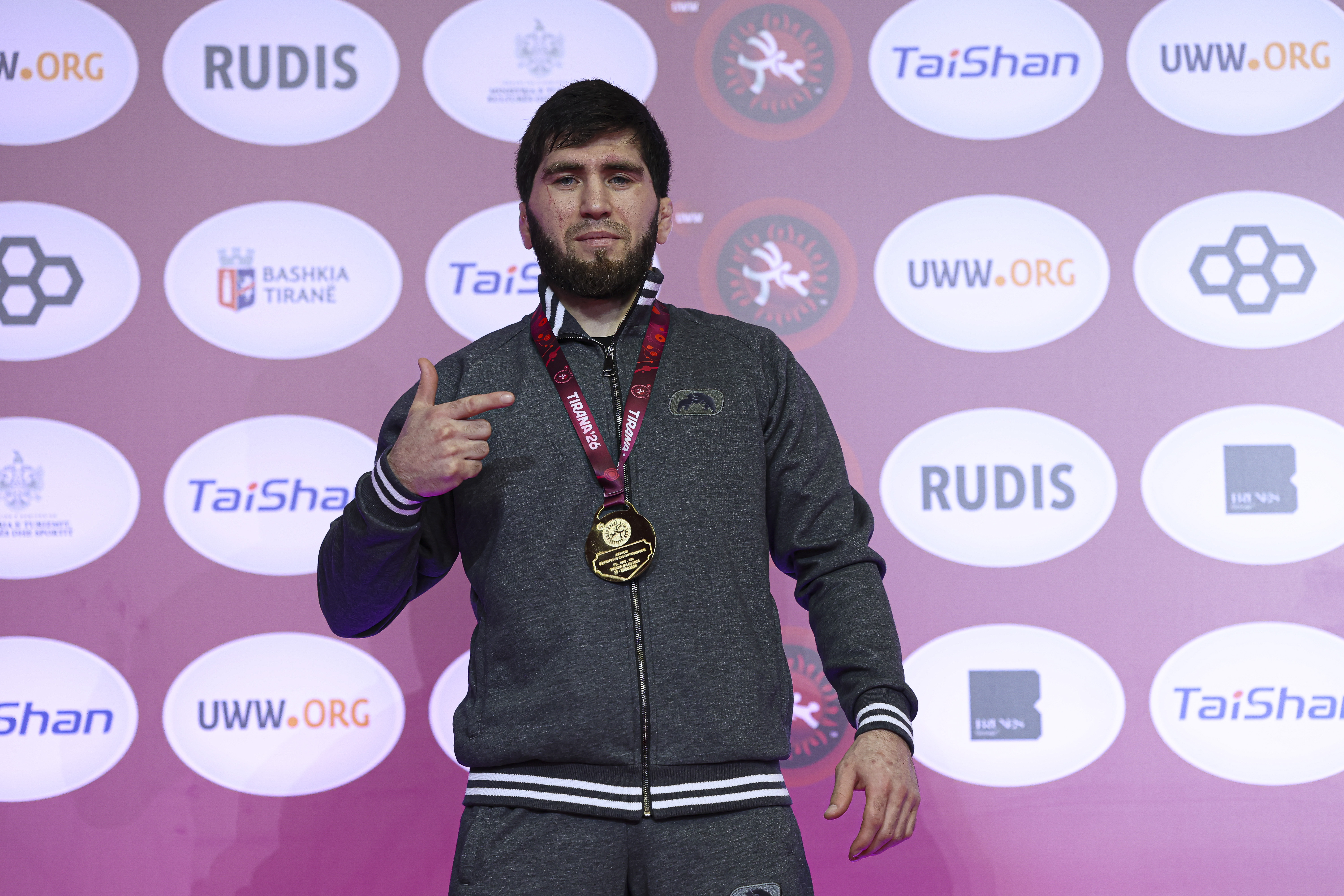 Zavur UGUEV (UWW) after winning the 61kg gold medal in Tirana. (Photo: United World Wrestling / Kadir Caliskan)
Share your thoughts.
Comments