

Japan seeks Asian Games dominance after 2018 debacle
Monday, October 2, 2023 - 08:06 By Vinay Siwach

HANGZHOU, China (October 2) — For the few unfamiliar ones, Japan’s dominance in women’s wrestling is unparalleled. The country has won the most world and Olympic medals in women’s wrestling. Out of the 24 gold medals in women’s wrestling ever awarded at the Olympics, Japan has won 15. No other country has more than two golds.
But here’s a mind-blowing fact for the sports nerds: Japan did not win a single gold medal in women’s wrestling at the 2018 Asian Games. World and Olympic champions faltered at different stages of the competition, and Japan had to return from Jakarta without gold.
FREESTYLE PREVIEW | GRECO-ROMAN PREVIEW
At the 19th edition of the Asian Games in Hangzhou, China, Japan will hope to bounce back from that disaster. Women’s wrestling at the Asian Games will be held on October 5 and 6 at the Lin’an Sports Culture and Exhibition Center.
Apart from Japan, hosts China will hope to leave its mark at the continental level as it continues to rebuild its team after the Tokyo Olympics. The Asian Games will also mark the return of DPR Korea to wrestling for the first time since the 2019 World Military Games in Wuhan, China. The nation is known to produce some of the strongest wrestlers, especially in the lower-weight classes.
Japan can certainly think that the 2018 performance will not be repeated, as it is sending four world champions, including Akari FUJINAMI (JPN) who recently won her second world title in Belgrade. Fujinami is on a 127-match winning streak dating back to her junior high school days.
Joining her on the team are three-time world champion Tsugumi SAKURAI (JPN), two-time world champ Nonoka OZAKI (JPN), 2021 world champion Remina YOSHIMOTO (JPN), former U20 world champion and U23 world silver medalist Naruha MATSUYUKI (JPN) and former U20 Asian champion Nodoka YAMAMOTO (JPN).
Fujinami will be the clear favorite at 53kg as the 19-year-old looks to add more and more senior medals to her cabinet. Already a phenom in Japan, Fujinami appeared on the international stage in 2021 and won the gold medal at the World Championships in Oslo. She was expected to participate in 2022 but withdrew due to an injury that kept her out for second half of last year. But she returned to win the Asian Championships this year and also the World Championships just 10 days ago.
The NSSU wrestler outscored her opponents 56-7 in Belgrade with only Lucia YEPEZ (ECU) scoring points on her. Yepez certainly gave the Japanese a scare as she raced to a 5-0 lead but Fujinami gathered her composure and made it 16-7 before securing the fall.
The lean-looking 53kg wrestler boasts immense strength, and her ability to reach for the far ankle during low-single attacks has troubled her opponents, including those in Japan. In June, after her loss to Fujinami in the Meiji Cup, Tokyo Olympic champion Mayu MUKAIDA (now SHIDOCHI) said that Fujinami’s long limbs are difficult to counter once she reaches for the leg attacks.
While winning the gold medal will be her top priority, Fujinami may finally have her longtime wish of wrestling a Chinese opponent completed. Tokyo silver medalist Qianyu PANG (CHN) will look to put behind the disappointment of the World Championships as she failed to win a medal after suffering a last-second loss to Maria PREVOLARAKI (GRE).
Pang, who has been lacking her ‘A’ game since her return after Tokyo, is the Asian champion at 55kg and will look to repeat that performance, especially with the home crowd backing her. Her defense will also be put to the test if she manages to get a bout against Fujinami.
World Championships bronze medalist and two-time U20 world champion ANTIM (IND) will face another big test against both Fujinami and Pang. The Indian wrestled Fujinami in the Asian Championships final but lost 10-0. But her run in Belgrade, including a win over world champion Dominique PARRISH (USA), makes her favorite to reach the final at 53kg.
Tokyo Olympic bronze medalist Bolortuya BAT OCHIR (MGL) will lead the Mongolian challenge after moving up to 57kg for the World Championships as she failed to make the team at 53kg.
20-year-old Hyogyong CHOE (PRK) will be the surprise element for everyone, as she has not wrestled internationally before. Former U20 world silver medalist Marina SEDNEVA (KAZ) will look to earn a medal as well.
At 62kg, a fifth battle between Ozaki and Aisuluu TYNYBEKOVA (KGZ) is likely to take place in Hangzhou, with the head-to-head record tied at 2-2.
Three-time world champion and Tokyo Olympic silver medalist Tynybekova has recovered from the injury that kept her out of form for the entire 2022 season, as she reclaimed her world title in Belgrade last week. Earlier in April, she beat Ozaki at the Asian Championships.
The first face-to-face between the two was in 2021 when Tynybekova eked out a 6-4 win in the first round of the World Championships. But Ozaki avenged that loss in the final of the 2022 Asian Championships as Tynybekova pulled out injured during a deadly leg-lace from Ozaki.
At the 2022 World Championships, Ozaki would once again get the better of Tynybekova and win the gold medal at 65kg. Tynybekova tied the head-to-head score at 2-2 as she defeated Ozaki 2-2 at the Asian Championships in Astana.
While the first three bouts saw a few scoring actions, Tynybekova shut down Ozaki completely in Astana and then used her experience to win on technical points.
Both won world titles in Belgrade as Ozaki was wrestling at 65kg after failing to make the Japan team at 62kg. With Sakura MOTOKI (JPN) winning the 62kg silver medal in Belgrade, Ozaki’s hopes of going to the Paris Olympics are all but over. Tynybekova, on the other hand, won't mind adding an Asian Games gold medal to her name before the Paris Games.
However, both Ozaki and Tynybekova won't take their meeting on the mat for granted as Tserenchimed SUKHEE (MGL) is waiting in the ranks. Sukhee is a 2014 world champion and added a silver medal at the 2015 edition. She will look to make a statement win in Hangzhou.
Another strong medal contender is world silver medalist Jia LONG (CHN), a Tokyo Olympian and Asian champion at 65kg. Long finished a lowly 19th at the World Championships after losing to Purvedorj 8-5 but with a strong home crowd backing her, Long will be keen on avenging that loss.
Former U20 world silver medalist and Tokyo Olympian Sonam MALIK (IND) will be a medal contender as well given she is fully fit and brings her top game. Since Tokyo, Malik has a bronze medal at the Asian Championships but failed to medal at the 2022 World Championships and the Bishkek Ranking Series in which she lost 5-3 to Long.
 Tsugumi SAKURAI (JPN) won her third world title in Belgrade. (Photo: UWW / Kostadin Andonov)
Newly crowned world champion Sakurai has the chance to add an Asian Games gold medal that will add to her dominance at 57kg in the world. After winning two world titles at this weight class, Sakurai is the favorite going into the Paris Olympics next year. Sakurai's single-leg attacks are a menace for her opponents and then she blocks out counterattacks, frustrating her opponents and forcing them to commit mistakes. At the Asian Games, she will be tested by Kexin HONG (CHN) who won the U23 Asian Championships and has two silver medals from the Ranking Series in 2023.
Insun JONG (PRK), who finished fifth at the 2014 Asian Games, will look to cause some trouble as she returns to the mat after four years. It will be interesting to see the changes, if any, in Jong’s style.
Three youngsters — Mansi AHLAWAT (IND), Emma TISSINA (KAZ) and Laylokhon SOBIROVA (UZB) — can leave Hangzhou with a medal at 57kg.
 Remina YOSHIMOTO (JPN) was the 50kg gold medalist at the 2023 Asian Championships. (Photo: UWW / Kadir Caliskan)
If there was no Yui SUSAKI (JPN), Yoshimoto would have ruled the 50kg weight class. However, Yoshimoto remains the second-best behind Susaki in Japan for now but will be the front-runner for the gold in Hangzhou. Yoshimoto, who lost a thriller to Susaki at the Meiji Cup in June, had won the Emperor’s Cup in 2021 (Susaki skipped the tournament) to confirm her ticket to the Asian Games. Pushing the internationally unbeaten Susaki has made Yoshimoto a feared opponent for others.
The two-time Asian champion should move into the final with ease despite former Asian Championships silver medalist Namuuntsetseg TSOGT OCHIR (MGL) entering. Yoshimoto defeated Tsogt Ochir via fall in the 2022 finals.
China is banking on Jiang ZHU (CHN) as she looks to win a medal at 50kg. Ziqi FENG (CHN) won a bronze medal at the World Championships but is not participating in the Asian Games which gives Zhu a chance to put her name among the medalists.
Zhu won a silver medal at the Zagreb Open Ranking Series, scoring a point on Susaki, the first in four years by an international opponent. Zhu won a bronze medal in Alexandria but finished fifth in Budapest.
Pooja GEHLOT (IND), Svetlana ANKICHEVA (KAZ), Aktenge KEUNIMJAEVA (UZB) possess the ability to win a medal but it will take some doing to stand on the podium. Sonhyang KIM (PRK) is also a new face for international wrestling and it’s a wait-and-watch for what she has in her arsenal.
 Feng ZHOU (CHN) is the defending 68kg champion at the Asian Games. (Photo: UWW / Kadir Caliskan)
If there is one weight class in which China has the best chance to win a gold medal, it has to be 68kg. The defending champion Feng ZHOU (CHN) will be looking to add more silverware as she moves towards the descent of her long career. Zhou has been a permanent feature in the Chinese team and that experience will be handy as she tries to navigate the 68kg field. Among her strongest moves is the gut wrench as Zhou churns the turns with a strong grip.
But world silver medalist Delgermaa ENKHSAIKHAN (MGL), who had a dream run to the final in Belgrade before suffering a counter fall to lose in the gold medal bout, will keep a check on Zhou.
The two met in the final of the Bishkek Ranking Series and Zhou won 16-5. That gives Enkhsaikhan additional reason to punch above her weight. The Mongolian will carry the momentum from Belgrade where she won two bouts via fall, one via technical superiority and one via decision.
A storyline that continues to awe wrestling fans is the return of Yelena SHALYGINA (KAZ). The 35-year-old will be at her third Asian Games, the first two being 2006 and 2010. She won the gold medal in 2010 but took a break from wrestling after finishing fifth at the 2012 World Championships. But she returned a decade later at the Bolat Turlykhanov Cup in 2022 and also won a bronze medal at the 2023 Asian Championships. She was eighth at the World Championships in Belgrade.
Former U20 world champion Naruha MATSUYUKI (JPN) will look to make a mark at the senior level with a medal at the Asian Games. RADHIKA can prove to be the dark horse of the weight class as he looks to build on her silver medal finish at the 2022 Asian Championships at 65kg.
 Aiperi MEDET KYZY (KGZ) will look to improve her bronze from the 2018 Asian Games to gold. (Photo: UWW / Kadir Caliskan)
Like at the world level, the 76kg weight class will be a highly contested weight class at the continental level. At the Asian Games, world silver medalist Aiperi MEDET KYZY (KGZ) will be the favorite for the gold medal. But it is yet to be seen if she recovered from the knee injury suffered during the final of the World Championships.
The returning bronze medalist lost in 2018 but has improved significantly over the years. She won the Asian Championships in 2022 and has three silver medals in 2020, 2021 and 2023. The former U20 world champion also has wins over her opponents at the Asian Games including Juan WANG (CHN) and KIRAN.
But one of the biggest challenges for Medet Kyzy will be Zhamila BAKBERGENOVA (KAZ), the two-time Asian champion at 72kg making her debut at 76kg. She has two world medals at 72kg and won bronze this year. Bakbergenova’s ability to use big throws at crucial junctures in a match makes her extremely dangerous. However, adapting to the new weight class could be a challenge for her.
Juan WANG (CHN) will have the pressure of keeping the gold with China as Qian ZHOU (CHN) won it in Jakarta. Wang has been competing at the international level for more than a decade with multiple medals at the Asian level. At the World Cup, she defeated the then world champion Yasemin ADAR (TUR) with ease.
Nodoka YAMAMOTO (JPN) too had a successful World Cup and can challenge the senior stars. The 2022 U20 Asian champion Yamamoto won the 2021 Emperor’s Cup in December 2021 to book her spot on the Japanese team for the Asian Games.

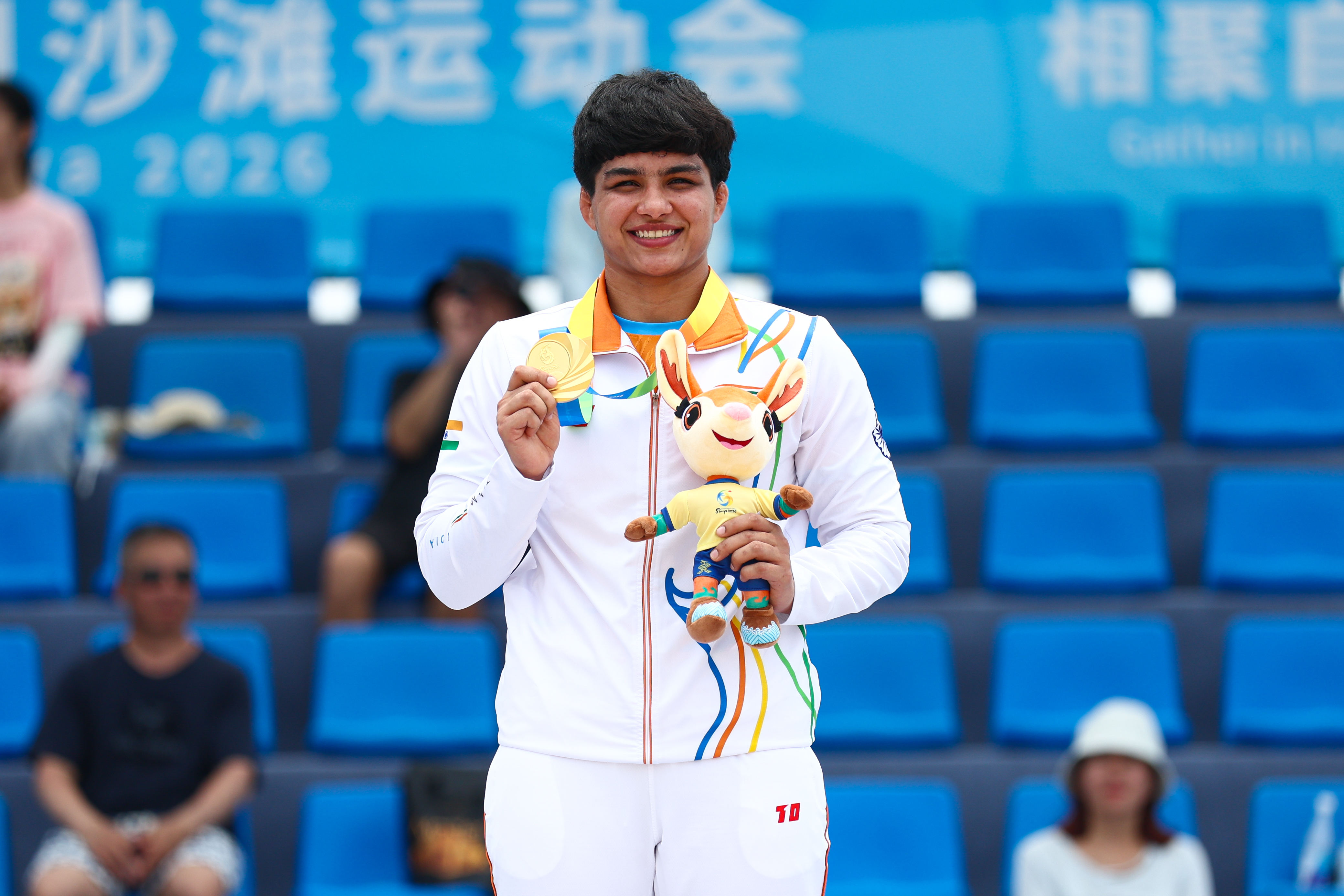 PRIYA (IND) won the gold medal in +70kg weight category in Sanya. (Photo: United World Wrestling / Jake Kirkman)
Share your thoughts.
Comments