

Kayaalp joins 5-time world champions' club; Japan women take 2 golds
Tuesday, September 13, 2022 - 20:53 By Ken Marantz
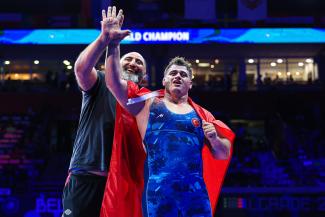
BELGRADE, Serbia (September 13) -- Even at less than 100 percent, Riza KAYAALP (TUR) can pack quite a wallop, which is why he has joined the elite list of five-time world champions.
Kayaalp emerged with a 1-1 victory on criteria in an intense tussle with Amin MIRZAZADEH (IRI) to take the 130kg title on Tuesday in the last Greco-Roman final on the program at the World Championships in Belgrade.
"It is a very nice feeling," said Kayaalp, who also has two silvers and two bronzes in his collection of world medals -- not to mention three Olympic medals.
"Hearing the national anthem is our goal. I am proud to represent my country. I think I will lie down for a few minutes because I am so exhausted."
In other action on the fourth day at Stark Arena, Japan's women got off to a good start as Mayu SHIDOCHI (JPN), who won the Tokyo Olympic gold at 53kg under her maiden name of MUKAIDA, captured her third world gold at 55kg, while rising star Nonoka OZAKI (JPN) dominated at 62kg for her first senior world title.
And two days after Kyrgyzstan's first-ever male world champion was crowned, Zholaman SHARSHENBEKOV (KGZ) gave the central Asian nation a second with a dominant victory at Greco 60kg.
 Riza KAYAALP (TUR) defeated Amin MIRZAZADEH (IRI) 1-1 in the 130kg final. (Photo: UWW / Kadir Caliskan)
In the Greco 130kg final, Kayaalp was unable to score any technical points, as he did when he defeated Mirzazadeh 7-2 in the bronze-medal match at the Tokyo Olympics. But he got the second of the passivity points and was able to preserve the lead he held on criteria for the win.
Mirzazadeh, the 2021 world U23 champion, was presented with a second chance for par terre late in the match but opted to remain on his feet. Unable to score, his defeat left Iran with the rare result of having no Greco golds for the tournament.
Kayaalp's victory helped Turkey capture the team title with 125 points. Azerbaijan finished second with 118, while host Serbia, with an amazing four champions, was third with 110.
Kayaalp, who won the European gold earlier this year, said he had been battling a shoulder injury and other ailments over the past two months during his preparation for Belgrade.
"Preparing for the World Championships with the injuries was very hard for me, especially in the last training camp it is very important to stay injury free," Kayaalp said. "I knew that the injuries will affect me in the final fight, so I changed my tactic a little bit. My defense is very good and we knew that."
 Mayu SHIDOCHI (JPN) picked up her third world title at 55kg. (Photo: UWW / Kostadin Andonov)
She may have a new name and was in a different weight class, but it was pure Shidochi who stormed to the women's 55kg gold with her fourth technical fall in five matches, without conceding a point.
Shidochi managed to finish up a 10-0 win over Oleksandra KHOMENETS (UKR) just before the end of the first period to add to the world titles at 55kg that she previously won in 2015 and 2018. She also has two silvers at 53kg.
Khomenets appeared to suffer an ankle injury when Shidochi scored her second takedown to go up 4-0, and offered little resistance when the Japanese got a takedown and then immediately executed a roll and an exposure to end the match at 2:59.
Shidochi, whose husband and coach Shota was in her corner in Belgrade -- the two got married after the Olympics -- was competing overseas for the first time since her triumph in Tokyo.
"The Tokyo Olympics was an international event, but it was held in my country, so it didn't have the feel of being international," Shidochi said. "This time, I felt like it was an overseas event for the first time in a long time. I was a bit nervous in the first match, but in that feeling, I wanted to put out everything I had. I feel that I kept moving up to the end."
The tournament is only a prelude to what lies ahead. Shidochi plans to return to 53kg for the Japan championships in December, which is the starting point for qualifying for the 2024 Paris Olympics. That puts her on a collision course with teen star Akari FUJINAMI (JPN), the 2021 world champion who missed this tournament due to a foot injury.
"After the Tokyo Olympics, heading to the Paris Olympics, I regard myself as the challenger and that's how I approached [this tournament]. I concentrated on each and every match and it's great that I was able to win out."
 Nonoka OZAKI (JPN) upgraded her 2021 bronze to gold by beating Kayla MIRACLE (USA) in the 62kg final. (Photo: UWW / Kadir Caliskan)
Ozaki also faces domestic competition that arguably exceeds that outside of Japan. She needed to defeat Tokyo Olympic champion Yukako KAWAI (JPN) to make the team to Belgrade and will have to do so again in the year ahead. Should she make the team, a victory at next year's World Championships will automatically secure a place at Paris 2024.
"I'm really happy, but when I was taking the medal podium, I thought if I'm not here again next year, I can't be satisfied," Ozaki said.
Having finished third last year in Oslo, Ozaki for now is content with accomplishing a goal of winning a senior world title, which she did with a 10-0 technical fall over Kayla MIRACLE (USA) in the 62kg final.
"For the final, all I thought was, I really want to win, I want to win," Ozaki said. "I wanted to relax, but my desire to win was so strong that I may have rushed things. But it was big that I was able to string together points. I think I had a good match."
Ozaki, like many Japanese women, likes to go directly to the lace lock and end their match quickly. Against Miracle, she was only able to complete two rolls after her first takedown. But she stayed patient and got two more takedowns to complete the mission.
"After getting a takedown, going right to work on the ground to end the match is the best style for winning for me," said Ozaki, who won the world U20 title last month. "Even if I can't do that, I use the three minutes and win in whatever way I can. After I scored six points, I thought there was still time and it would be alright if it went into the second period."
Ozaki, who is a product of the JOC Elite Academy that also produced Olympic champions Yui SUSAKI (JPN) and Takuto OTOGURO (JPN), is a rarity in Japan in that instead of going to a university that is a wrestling powerhouse, she took the academic route and passed the entrance exam for prestigious Keio University. The demands of being a true scholar-athlete add to her burden.
"I've had tough times," Ozaki said. "Wrestling was most on my mind, but I also had my studies. I was able to accomplish everything I wanted to. That it all came together here, it's the best."
 Zholoman SHARSHENBEKOV (KGZ) became Kyrgyzstan's second Greco-Roman world champ in Belgrade. (Photo: UWW / Kadir Caliskan)
For Sharshenbekov, the victory by compatriot Akzhol MAKHMUDOV (KGZ) at 77kg on Sunday night may have cost him a place in history, but it also served as motivation after he had to settle for the silver medal last year in Oslo.
In the final, Sharshenbekov built up a big lead with a 4-point throw and went on to defeat 20-year-old European silver medalist Edmond NAZARYAN (BUL) by an 11-2 technical fall in 2:30.
"After Akzhol won his final the other day, it gave me a lot of motivation and strength to win my gold medal as well," said Sharshenbekov, this year's Asian champion.
A 2-point penalty, an unsuccessful challenge and the 4-pointer put Sharshenbekov up 7-0 before Nazaryan, whose father Armen was a two-time Olympic champion, came back with a takedown when he slipped out of a throw attempt.
But that only delayed the inevitable as Sharshenbekov scored a takedown and added a throw to end the proceedings.
 World champion Aisuluu TYNYBEKOVA (KGZ) returned empty-handed from Belgrade. (Photo: UWW / Martin Gabor)
Tynybekova leaves empty-handed
Two-time world champion and Olympic silver medalist Aisuluu TYNYBEKOVA (KGZ) will leave Belgrade empty-handed after a furious comeback in her women's 62kg bronze-medal match fell short against Ilona PROKOPEVNIUK (UKR), who ended the bout in a cradle but an 8-7 victory.
Prokopevniuk, a three-time world U23 medalist, took a 7-2 lead early in the second period with a 4-point leg trip and a spin-behind takedown. Tynybekova cut the gap with an arm-drag takedown and a penalty. With the clock ticking down, Tynybekova secured a cradle and put the Ukrainian on her back for 2 but needing a fall, she ran out of time. An unsuccessful challenge made it 8-7.
 Karla GODINEZ (CAN) defeated Mariana DRAGUTAN (MDA) 6-2 in the 55kg bronze medal bout. (Photo: UWW / Kostandin Andonov)
In other third-place matches, Karla GODINEZ (CAN) will be taking home one of the women's 55kg bronzes, but sister Ana GODINEZ (CAN) came up just short in a bid for one at 62kg.
Karla scored two takedowns in the first period and went on to defeat Mariana DRAGUTAN (MDA) 6-2, while Ana fell into a 4-point hole against Xiaojuan LUO (CHN), but a comeback still left her on the short end of a 4-3 decision.
"Hasn’t sunk in yet," Karla said. "When I think about this I am like ‘Wow!’ Yes, I wanted the gold, but winning the bronze just shows that I am growing and that is a huge deal."
The sisters, born in Mexico, relocated to Canada with their family while in elementary school under the pretense that they were going to visit Disneyland. They both started wrestling in their late teens and won Pan American titles this year.
"I have only been wrestling for six years, so I have to put triple the time in to catch up to these girls," Karla said. "I am constantly working.”
In the other 55kg match, 2019 Asian champion Mengyu XIE (CHN) snatched a victory from the jaws of defeat by scoring a fall over 2019 world champion Jacarra WINCHESTER (USA) after trailing 12-4.
Winchester had scored a takedown and was attempting to execute a gut wrench that would end the match, but Xie stepped over and caught the American on her back. Xie eventually broke down Winchester's bridge and secured the fall at 4:56.
 Kenichiro FUMITA (JPN) won a bronze medal at 60kg. (Photo: UWW / Martin Gabor)
In Greco-Roman, it wasn't the color he wanted, but two-time world champion Kenichiro FUMITA (JPN) will leave Belgrade with a bronze medal at 60kg after defeating Murad MAMMADOV (AZE) 5-1.
Fumita, still feeling the sting of losing the final at the Tokyo Olympics, scored two points with a headlock that stopped a roll from par terre, then had a gut wrench of his own when he was on top.
In the other 60kg match, Aidos SULTANGALI (KAZ) added to the world bronze he won in 2018 with a 7-1 victory over Krisztian KECSKEMETI (HUN). The 2021 Asian champion took the lead for good in the first period with an arm-drag takedown and roll to go ahead 5-1.
At 130kg, Mantas KNYSTAUTAS (LTU) won his first world medal in four appearances with a 3-1 victory over Tokyo Olympic silver medalist Iakobi KAJAIA (GEO). Knystautas got a second chance in par terre and he took advantage, hitting a gut wrench with a half-minute to go for the decisive points.
Alin ALEXUC CIURARIU (ROU) pulled a rabbit out of the hat and stunned four-time Asian medalist Muminjon ABDULLAEV (UZB) 5-3 to take the other 130kg bronze.
Trailing 3-1 late in the second period, Alexuc Ciurariu got a pair of stepouts, then scored a snap-down takedown with :11 left for the victory. It was his first medal in nine trips to the senior World Championships.
 Samar HAMZA (EGY) became the first wrestler to reach the world final in women's wrestling. (Photo: UWW / Kadir Caliskan)
Hamza makes history; Susaki powers through
In the semifinals in four women's weight classes held earlier in the night session, Samar HAMZA (EGY) made more history when she became the first from her country to make a women's world final after rallying for a 3-2 victory over veteran Epp MAE (EST) at 76kg.
Hamza, who became Egypt's first-ever female world medalist when she took the bronze last year in Oslo, was trailing 2-0 after surrendering two activity-clock points. With Mae on the clock, Hamza scored a go-behind takedown with :25 left to go up on criteria, then got the activity point for good measure.
In Wednesday's final, the five-time African champion will face Tokyo Olympic bronze medalist Yasemin ADAR (TUR), who had to put on a late comeback of her own to defeat Genesis REASCO (ECU) 4-3 in the other semifinal. Down 3-0, Adar scored a takedown and added a lace-lock roll for the win.
Hamza will have her work cut out for her if she wants to take home the gold. The two met at this year's Mediterranean Games, where Adar scored a 10-0 victory.
 Yui SUSAKI (JPN) secured a fall in her 50kg semifinal. (Photo: UWW / Kadir Caliskan)
In other action, Olympic champion Yui SUSAKI (JPN) found another, equally devastating way to vanquish her opponent when she powered into the women's 50kg final with a victory by fall over Miesinnei GENESIS (NGR).
Susaki, who used her trademark lace-lock roll to such deadly effect in winning her first two matches in a combined 71 seconds, couldn't get that move going. So she switched to a chicken wing after her second takedown of the match and levered the African over for the fall at 2:25.
Susaki, looking to add to the world titles she won in 2017 and 2018, remains undefeated in her career against non-Japanese opponents.
In the final, she will face 2021 world bronze medalist Otgonjargal DOLGORJAV (MGL), who knocked off last year's runner-up and Tokyo Olympic bronze medalist Sarah HILDEBRANDT (USA) 6-2.
Hildebrandt struck first with a takedown, but Dolgorajav answered with one of her own, then added a 2-point exposure while stopping a roll attempt. In the second period, she fought out of one single-leg attempt, then spun out of another for a clinching takedown.
At 65kg, 2021 world silver medalist Miwa MORIKAWA (JPN) kept her gold-medal hopes alive with a 3-0 victory over 2020 European champion Mimi HRISTOVA (BUL).
Morikawa, this year's Asian champion, received an activity-clock point in each period and scored with a stepout in the second.
In the other semifinal, Jia LONG (CHN) overcame a five-point deficit against world U23 champion Koumba LARROQUE (FRA), scoring all of her points in the second period to scrape out a 9-7 victory. She notched the deciding takedown with :40 left.
Mongolia will have a second wrestler in Wednesday's finals after Asian silver medalist Khulan BATKHUYAG (MGL) pulled off a miracle comeback to defeat 2021 world junior champion Jonna MALMGREN (SWE) at 53kg.
Malmgren had dominated the match, scoring a takedown and exposure for a 4-0 lead in the first period, then started the second period with another takedown. But Batkhuyag never gave up and managed to get a half-nelson from standing and muscled Malmgren onto her back for a fall at 4:54.
Batkhuyag will face Dominique PARRISH (USA), a 3-1 winner over European silver medalist Maria PREVOLARAKI (GRE), in the gold-medal match to decide who will ascend to the throne left empty when reigning champion Fujinami became a late withdrawal. Japan did not send a replacement.

Day 4 Results
Greco-Roman
60kg (29 entries)
Gold- Zholaman SHARSHENBEKOV (KGZ) df. Edmond NAZARYAN (BUL) by TF, 11-2, 2:30
Bronze - Aidos SULTANGALI (KAZ) df. Krisztian KECSKEMETI (HUN), 7-1
Bronze - Kenichiro FUMITA (JPN) df. Murad MAMMADOV (AZE), 5-1
130kg (25 entries)
Gold- Riza KAYAALP (TUR) df. Amin MIRZAZADEH (IRI), 1-1
Bronze - Mantas KNYSTAUTAS (LTU) df. Iakobi KAJAIA (GEO), 3-1
Bronze - Alin ALEXUC CIURARIU (ROU) df. Muminjon ABDULLAEV (UZB), 5-3
Women's Wrestling
50kg (22 entries)
Semifinal - Otgonjargal DOLGORJAV (MGL) df. Sarah HILDEBRANDT (USA), 6-2
Semifinal - Yui SUSAKI (JPN) df. Miesinnei GENESIS (NGR) by Fall, 2:25 (8-0)
53kg (23 entries)
Semifinal - Khulan BATKHUYAG (MGL) df. Emma MALMGREN (SWE) by Fall, 4:54 (2-6)
Semifinal - Dominique PARRISH (USA) df. Maria PREVOLARAKI (GRE), 3-1
55kg (17 entries)
Gold- Mayu SHIDOCHI (JPN) df. Oleksandra KHOMENETS (UKR) by TF, 10-0, 2:59
Bronze - Mengyu XIE (CHN) df. Jacarra WINCHESTER (USA) by Fall, 4:56 (6-12)
Bronze - Karla GODINEZ (CAN) df. Mariana DRAGUTAN (MDA), 6-2
62kg (24 entries)
Gold- Nonoka OZAKI (JPN) df. Kayla MIRACLE (USA) by TF, 10-0, 2:28
Bronze - Ilona PROKOPEVNIUK (UKR) df. Aisuluu TYNYBEKOVA (KGZ), 8-7
Bronze - Xiaojuan LUO (CHN) df. Ana GODINEZ (CAN), 4-3
65kg (14 entries)
Semifinal - Miwa MORIKAWA (JPN) df. Mimi HRISTOVA (BUL), 3-0
Semifinal - Jia LONG (CHN) df. Koumba LARROQUE (FRA), 9-7
76kg (25 entries)
Semifinal - Yasemin ADAR (TUR) df. Genesis REASCO (ECU), 4-3
Semifinal - Samar HAMZA (EGY) df. Epp MAE (EST), 3-2

 Rei HIGUCHI (JPN) wrestling at the Lehigh University. (Photo: Courtesy of Lehigh University)
 Lehigh University wrestling training room.
 Rei HIGUCHI (JPN) with wife Yuki and daughter Nagi at the airport before flying to the United States. (Photo: Rei Higuchi / X)
 Posing with Jordan BURROUGHS (USA) and others at the 2017 NCAA Championships in St. Louis. (Photo courtesy of Rei Higuchi)
 Playing the role of the typical tourist at the Statue of Liberty in New York in February. (Photo courtesy of Rei Higuchi)
Share your thoughts.
Comments