

Left Behind in the Run to Tokyo 2020, Okuno Plods into 53kg Final at All Japan
Friday, December 20, 2019 - 16:00 By Ken Marantz

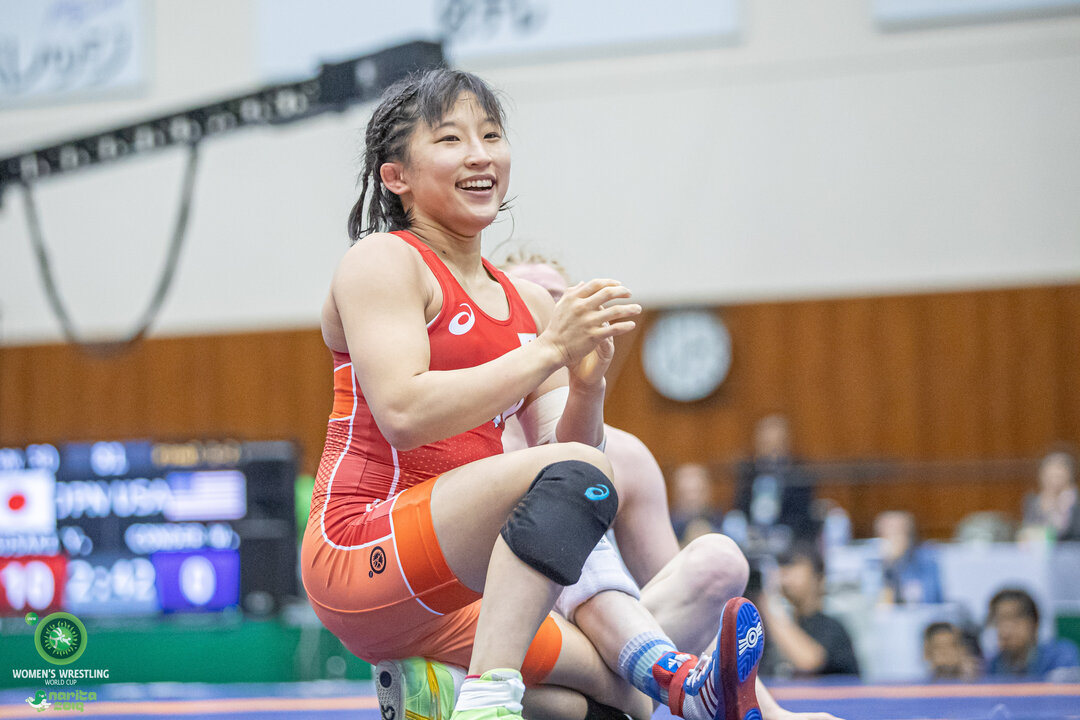
TOKYO (Dec. 20) — Throughout her career on the global stage, Haruna OKUNO has blown away all in her path, a trend she continued this year by winning both the world junior and U-23 titles over a two-month span.
Back home in Japan, however, missing out on the senior World Championships and subsequently a place at the Tokyo 2020 Olympics seemed to take the wind out of her sails.
Okuno put together two underwhelming victories to advance to the final of the women’s 53kg class on the second day of the All Japan Championships in Tokyo, setting up a rematch of a recent disappointing loss to world silver medalist Nanami IRIE.
Okuno could manage only two activity-clock points in fending off Asian junior champion Umi IMAI 2-0 in the quarterfinals, then rode a lone first-period takedown to beat unheralded Yuka YAGO 3-1 in the semifinals.
“After the World Cup [in November], I didn’t get in enough practice,” said Okuno, who won two matches in helping host Japan win a fifth straight World Cup. “Without practice, this is what happens. As I wanted focus on tying up, I think overall that went well. I’m not injured, but I’m not in good condition.”
Okuno, whose only international losses came at the world cadet in 2014 and Asian Games in 2018 (she finished third at both), picked up a second senior world gold in 2018 when she won the 53kg title in Budapest.
But both she and Irie lost out for the place in that weight class for the team to the World Championships in Nur-Sultan to Mayu MUKAIDA, the 55kg world champion who dropped down to the Olympic weight.
Okuno and Irie both entered the wrestle-off for the 55kg spot, and Irie pulled off a surprising 3-1 win to earn the ticket to Nur-Sultan, where she captured the silver medal in her senior world debut. Okuno, who had won two previous meetings between the two, never seemed to have her heart in the match.
“In the playoff for the World Championships, 55kg was the only weight class open [for us],” Okuno said. “Before the playoff, I hardly practiced for two months. I only trained for two days. This year was the least I’ve practiced in my life.”
There was speculation that Okuno might drop down to 50kg—the only women’s weight class in which Japan did not clinch an Olympic berth at Nur-Sultan—and enter the fray for the coveted ticket to the Asian Olympic qualifying tournament with Yui SUSAKI, Yuki IRIE (Nanami’s older sister) and Eri TOSAKA.
But she said Friday she never thought of going down to 50kg, citing the example of gold medalist Hitomi Obara’s struggle to get down to 48kg for the London 2012 Olympics.
“Obara cut weight for London, when the weigh-in was held the day before, and she spent two years to get down to the weight,” Okuno said. “Now, with the same-day weigh-in, it’s not so easy to just go out and win.”
Nanami Irie made the final with a 10-0 technical fall in the semifinals over Yumi SHIMONO.
Mukaida and the other world medalists in Olympic weights at Nur-Sultan automatically clinched Tokyo 2020 spots, and are sitting out the All-Japan tournament, also referred to as the Emperor’s Cup.
In the few weight classes in which Japan clinched an Olympic spot but did not medal, the winner at Komazawa Olympic Park Gym will fill the berth. In the remaining divisions, the winners will represent Japan at the Asian qualifier in Xi’an, China, in March.
Of the three wrestlers who failed to secure Olympic spots in Nur-Sultan and were involved in finals contested on Friday, two earned tickets to Xi’an and another shot.
Naoya AKAGUMA gained a point in each period with Takeshi YAMAGUCHI on the activity clock for a 2-0 victory to capture his second straight national freestyle 97kg title and third overall.
At Greco 97kg, Yuta NARA made it four national titles in a row with a 2-2 win over Yuri NAKAZATO. In Nur-Sultan, outside of the three medalists in the lightest weight classes, Nara was Japan’s only Greco wrestler to post a victory.
Nobuyoshi ARAKIDA’s two-year reign at freestyle 125kg ended when he had to default during the final to Tetsuya TANAKA due to a right elbow tendon injury that he originally suffered in Nur-Sultan.
“It’s disappointing to lose, but I knew going into the final I would put priority on the injury,” he said. “I knew that defaulting would be the best option.”
Meanwhile, there was high anticipation that the Emperor’s Cup would get its first-ever high school Greco champion and first in freestyle in 30 years—a direct result of all the maneuvering into Olympic weight classes that thinned out the non-Olympic divisions.
But all three high schoolers in men’s finals on Friday were taught a harsh lesson by collegiate opponents on just how intense the senior level can be.
Hikaru TAKADA came closest, falling 5-3 to Shin HARAGUCHI at freestyle 70kg. But the two Greco finals turned into routs, as Asian silver medalist Hiromu KATAGIRI needed just over a minute to crush Yu SHIOTANI with a 12-0 technical fall that he ended with a 5-point throw, and Ayata SUZUKI followed suit with a 9-0 technical fall of Kosei TAKESHITA.
“The opponent was a high school student, so I thought there is no way I’m going to lose,” Katagiri declared.

Sara NATAMI upset Yuzuka INAGAKI, 2-2, in the 59kg finals. (Photo: Sachiko Hotaka)
One of Japan’s top female high schoolers, Yuzuka INAGAKI, was not immune from the carnage. She was stunned by collegian Sara NATAMI, who pancaked her for 2 points in the second period of the 59kg final for a 2-2 win on big-point criteria.
Inagaki, the world junior and U-23 champion at 62kg, had beaten Natami 5-0 in their Nordic group the day before.
“Yesterday was under the Nordic system, so I knew I would have another chance,” said Natami, a 2018 Asian silver medalist. “I just had to build off [the loss].”
While the high schoolers came up short, Nao KUSAKA became the youngest-ever national Greco champion when, at 19 years and 22 days, he defeated Takuya TOMIZUKA 5-4 for the 72kg title.
Satoki MUKAI joined his father as a national champion with a 2-1 victory over Yoji KAWAMURA in the Greco 82kg final. His father Takahiro, a two-time Olympian, won eight straight titles at 74-82kg from 1982 to 1988.
In weight classes that ran through the semifinals on Friday, former world silver medalist Sosuke TAKATANI advanced to the final at freestyle 86kg as he pursues a berth in a third career Olympics.
Fellow world team member Yudai TAKAHASHI could give the tournament a male high school champion just yet after securing a spot in the freestyle 79kg final.
 Former two-time world champion Yui SUSAKI and Rio 2016 Olympic champion Eri TOSAKA could square off in the 50kg semifinals on Satruday. (Photo: Sachiko Hotaka)
Susaki, Tosaka drawn in same bracket
Former two-time world champion Yui SUSAKI and Rio 2016 Olympic champion Eri TOSAKA could meet in the women’s 50kg semifinals following the draw for Saturday, when the action starts for the marquee weight classes.
Yuki IRIE, who defeated Susaki in a playoff for a place on the team to Nur-Sultan, is the top seed in the other bracket of the high-profile division.
Susaki defeated Tosaka by technical fall in the final at the All-Japan Invitational Championships last June, which put her in the playoff with Irie.
In the women’s 68kg class, Rio champion Sara DOSHO, who finished fifth at Nur-Sultan, was handed a tough test to start out with, as she was drawn with highly touted high schooler Yuka KAGAMI.
Kagami, the world 72kg junior champion, had tried to make Tokyo 2020 at 76kg, but could not unseat world silver medalist Hiroe MINAGAWA. Now she has gone the other way, dropping down to 68kg.
At Greco 67kg, world 63kg champion Shinobu OTA could face defending national champion Shogo TAKAHASHI in the quarterfinals, which would be the second match for both.
Ota was the Rio 2016 silver medalist at 59kg, but failed to beat eventual world champion Kenichiro FUMITA for the place on the team to Nur-Sultan at 60kg. He moved up to 63kg and came away with his first world title, and has now jumped another division in a bid to return to the Olympics.
At freestyle 57kg, former world champion Yuki TAKAHASHI and Rio 2016 silver medalist Rei HIGUCHI were drawn in separate brackets, meaning they would not meet until Sunday’s final.
Day 2 results
Freestyle
61kg (19 entries)
Final - Ryuto SAKAGI df. Keita SHIMIZU, 5-3
3rd Place - Kodai OGAWA df. Raimu MAEDA by TF, 10-0, 3:22
3rd Place - Ryutaro HAYAMA df. Takumi YOSHIMURA, 7-1
70kg (16 entries)
Final - Shin HARAGUCHI df. Hikaru TAKADA, 5-3
3rd Place - Ryo YONEZAWA df. Tsuyoshi NAKAMURA, 10-8
3rd Place - Hidetaka SAKANO df. Shinnosuke SUWAMA by Def.
79kg (11 entries)
Semifinals
Yudai TAKAHASHI df. Taro UMEBAYASHI, 9-2
Shinkichi OKUI df. Yuta ABE, 5-2
86kg (11 entries)
Semifinals
Sosuke TAKATANI df. Shutaro YAMADA, 8-0
Hayato ISHIGURO df. Shota SHIRAI, 2-1
92kg (9 entries)
Semifinals
Takuma OTSU df. Yudai YOKOTA by TF, 12-1, 4:33
Ryoichi YAMANAKA df. Takumi TANIZAKI, 4-1
97kg (14 entries)
Final - Naoya AKAGUMA df. Takeshi YAMAGUCHI, 2-0
3rd Place - Taira SONODA df. Keiwan YOSHIDA, 6-2
3rd Place - Takashi ISHIGURO df. Atsushi MATSUMOTO by TF, 10-0, 3:42
125kg (14 entries)
Final - Tetsuya TANAKA df. Nobuyoshi ARAKIDA by Inj. Def., 3:00 (2-0)
3rd Place - Yasuhiro YAMAMOTO df. Takuto YASUDA by TF, 14-3, 4:55
3rd Place - Katsutoshi KANAZAWA df. Taiki YAMAMOTO, 5-4
Greco-Roman
55kg (23 entries)
Final - Hiromu KATAGIRI df. Yu SHIOTANI by TF, 12-0, 1:07
3rd Place - Takumi HOSHINO df. Kagetora OKAMOTO by TF, 8-0, 2:07
3rd Place - Hirokazu ONO df. Mizuki ARAKI, 9-3
60kg (12 entries)
Final - Ayata SUZUKI df. Kosei TAKESHITA by TF, 9-0, 3:16
3rd Place - Kaito INABA df. Tatsuto OSHIRO by TF, 9-0, 2:17
3rd Place - Kensuke SHIMIZU df. Maito KAWANA, 8-3
63kg (15 entries)
Semifinals
Yoshiki YAMADA df. Harushi SHIMAYA, 7-1
Masaki ISHIKAWA df. Ichito TOKUHIGA by TF, 10-0, 1:44
72kg (22 entries)
Final - Nao KUSAKA df. Takuya TOMIZUKA, 5-4
3rd Place - Minto MAEDA df. Ibuki KATSUURA by TF, 9-1, 5:13
3rd Place - Takahiro YAMAMOTO df. Masaki KONDO by Fall, 1:53 (4-0)
82kg (15 entries)
Final - Satoki MUKAI df. Yoji KAWAMURA, 2-1
3rd Place - Yuto MATSUZAKI df. Masao TANAKA, 5-3
3rd Place - Rai HAYASHI df. Shoma YAMASAKI by Fall, 4:44 (7-0)
87kg (12 entries)
Semifinals
Masato SUMI df. Kanta SHIOKAWA, 5-1
Takahiro TSURUDA df. Kaito MIYAMOTO, 7-0
97kg (14 entries)
Final - Yuta NARA df. Yuri NAKAZATO, 2-2
3rd Place - Suguru KINOSHITA df. Masayuki AMANO, 2-1
3rd Place - Masaaki SHIKIYA df. Sanjuro TAKAHASHI by TF, 10-0, 2:06
130kg (10 entries)
Semifinals
Arata SONODA df. Shoma SUZUKI by TF, 8-0, 1:12
Ryota KONO df. Keita BANCHI by Fall, 1:58 (5-0)
Women’s Wrestling
53kg (14 entries)
Semifinals
Haruna OKUNO df. Yuka YAGO, 3-1
Nanami IRIE df. Yumi SHIMONO by TF, 10-0, 3:26
55kg (10 entries)
Final - Kana HIGASHIKAWA df. Tsugumi SAKURAI by Fall, 1:02 (2-0)
3rd Place - Tomoha UCHIJO df. Saki IGARASHI by Def.
3rd Place - Michika OHASHI df. Hikari HIGUCHI, 6-3
57kg (8 entries)
Semifinals
Akie HANAI df. Chiho HAMADA, 3-1
Sae NANJO df. Hanako SAWA by TF, 10-0, 2:06
59kg (6 entries)
Final - Sara NATAMI df. Yuzuka INAGAKI, 2-2
3rd Place - Yumi KON df. Ayami SUGIMOTO, 5-2
62kg (11 entries)
Semifinals
Atena KODAMA df. Suzu YABIKU, 7-0
Ami ISHII df. Kumi IRIE, 4-3
65kg (7 entries)
Final - Naomi RUIKE df. Miyu IMAI, 7-2
3rd Place - Miki KAWAUCHI df. Rin TERAMOTO, 6-6
72kg (3 entries)
Round-Robin
(Standings after 2 rounds)
1. Mei SHINDO (2-0), 2. Kanon KOBAYASHI (0-1), Mai HAYAKAWA (0-1).
76kg (5 entries)
Round-Robin, Final Standings
1. Yasuha MATSUYUKI (4-0)
2. Rino ABE (3-1)
3. Mizuki NAGASHIMA (1-2)
Key match: Yasuha MATSUYUKI df. Rino ABE, 10-1

Share your thoughts.
Comments