

#ChinaOpen2018

New Coach, New Outlook: China Aims for World Domination in Women’s Wrestling

By Eric Olanowski and Tim Foley

TAIYUAN, China (June 20) – On the eve of hosting its first competition in six years, the Chinese women’s national team, once relegated to silver linings, is poised for a breakout season.

Why such a golden outlook?

First came the appointment of a new president for the Chinese Wrestling Federation, Mrs. ZHANG Xia, a longtime referee and 1991 world champion at 62kg. Next, former Azerbaijan head women’s head coach (and native Bulgarian) Simon ATANASOV was hired to help run the nation’s powerful women’s program. Finally, and most importantly, the women on the Chinese team did what all great teams must do to win: they bought into the process.

“The federation wanted change and I’ve always wanted to coach a nation that can be the best in the world,” said Atanasov. “The Chinese are very tough and with good coaching they can be the top team in Asia and the world.”
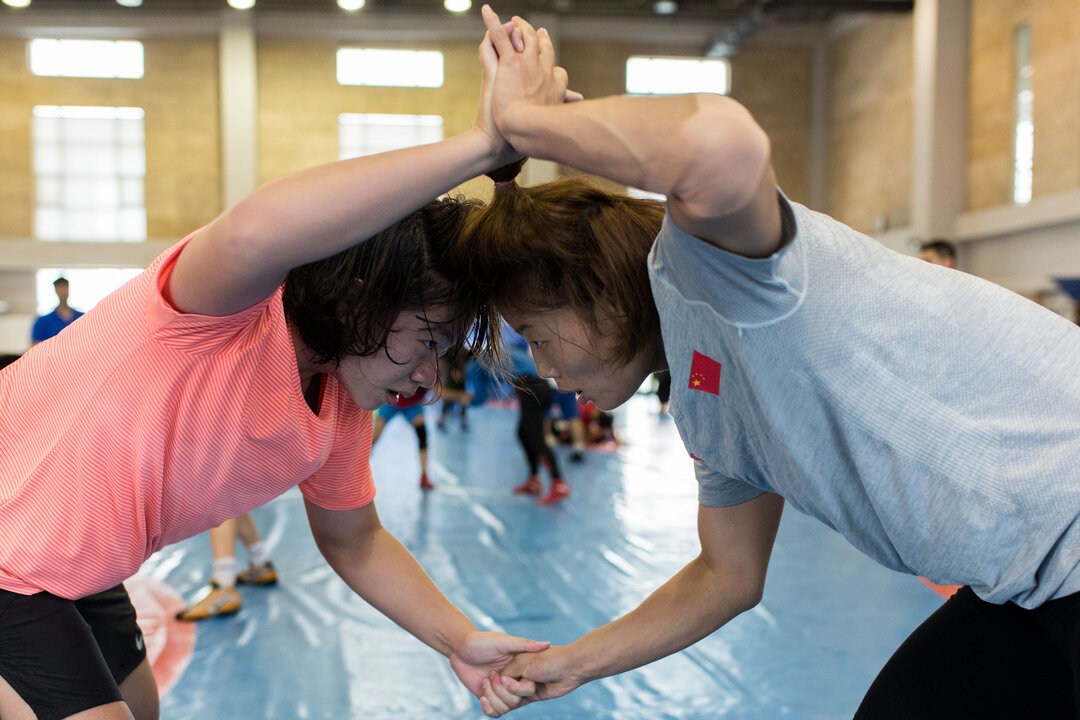

Chinese wrestlers tie-up during a practice session Tuesday as they prepare for this weekend's China Open (Photo: Max Rose Fyne)

Between Team China and world supremacy is a Japanese women’s program that has become synonymous with golden success. Since 2004 the island nation of 130 million people has accounted for an astonishing 11 of the possible 18 Olympic gold medals in women’s wrestling.

But in 2018 there are signs that the Chinese women are absorbing lessons from their new coach - putting on record-breaking performances at the Ivan Yarygin and Asian Championships along with a runner-up finish at the World Cup. “We’re trying to overthrow Japan and to do so we need to focus on teamwork,” said PANG Qianyu. “We also have to continue to study the sport and analyze their skills and techniques.”

(l-r) PALIHA Paliha, Simeon Atanasov, ZHOU Qian (Photo: Max Rose-Fyne)

The techniques and teamwork have been Atanasov’s focus since arriving in at the National Training Center in Beijing last year. Though geographical circumstances divide the national team into two distinct groups (Hubei/Shanxi on one side, Liaoning on the other), Atanassov sees a growing comradery and commitment to learning techniques.

“These girls feel a sense of pride for each other,” said Atanasov as he prepared wrestlers for the China Open. “They have big hearts for competition and I see every day their technique is much better.”

The dedication of the coaching staff is mirrored by the devotion of the athletes to a new idea of how high they can reach as a team. “Chinese wrestlers are more confident than we were before, and our confidence grows every time we compete,” said 2018 Asian Champion, ZHOU Qian (CHN). “We are building stronger.”

Ivan Yarygin bronze medalist, PALIHA Paliha added, “Coach Atanasov encourages us not to be afraid to make mistakes when we compete. He tells us not to fear, but to be confident.”
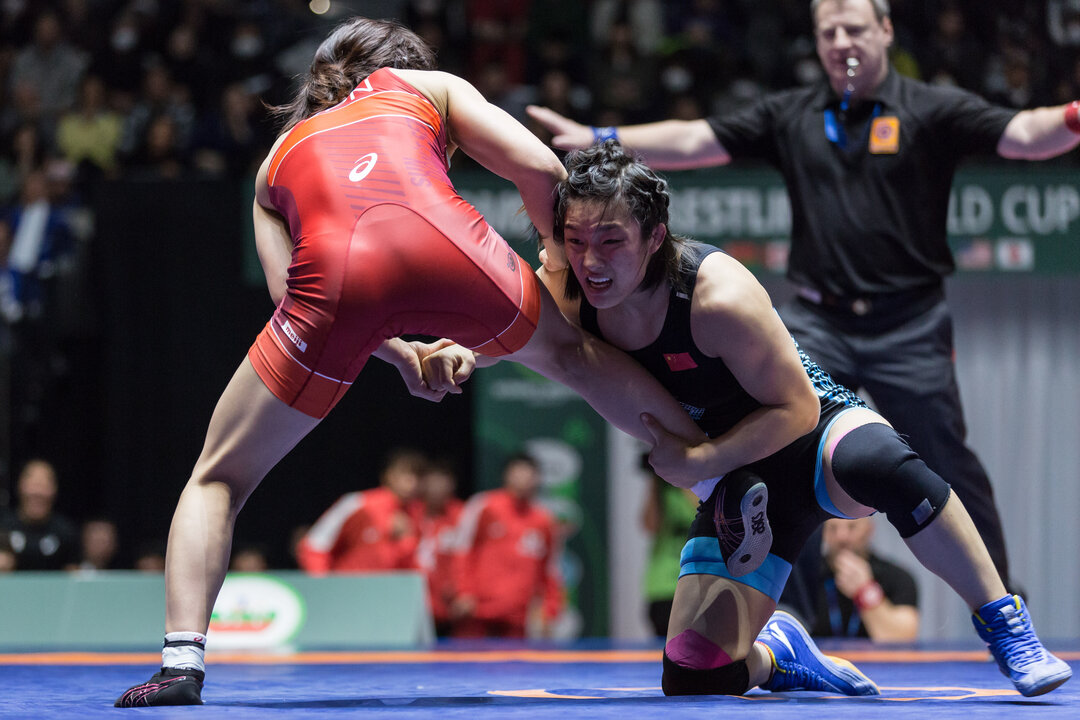
PEI Xingru PEI (CHN) looks to take down Yukako KAWAI (JPN) at the 2018 Women's Wrestling World Cup in Takasaki, Japan (Photo: Max Rose-Fyne)

The 2018 Asian Championships proved to be a major stepping stone for Team China’s quest for validation of their accomplishments. Where the nation of 1.4 billion had only captured a single gold medal in 2017, the team returned from their 2018 exploit with five gold medals – half the available top spots.

According to Zhou the seeds of confidence were nurtured by “a new coaching staff bringing new concepts to practice. They come up with unique ways of keeping us engaged – even when we’re tired.”

The China Open is certain to be another success for the Chinese women. With their top wrestlers competing and as many as three wrestlers entered per weight category the medal stand will likely be a sea of red. Adding to the level of competitiveness, a carrot for some competitors that a gold medal will punch their ticket to the prestigious Asian Games in Jakarta this August.
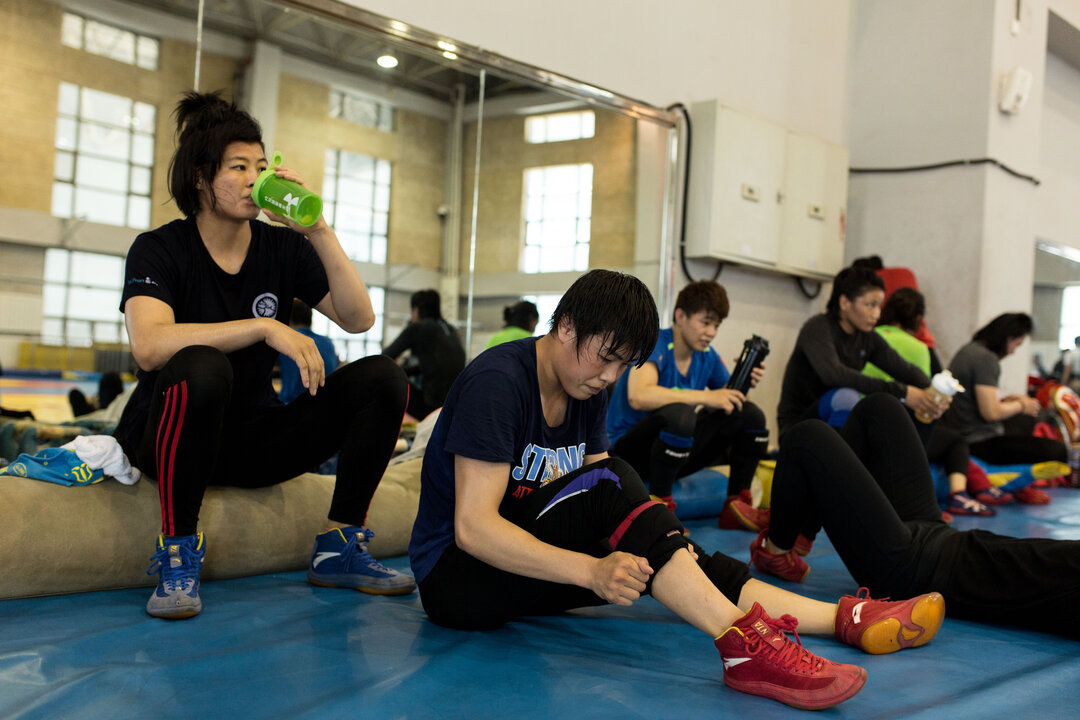


“I know they will compete hard at the tournament, because they have a lot of pride, but I will be looking for techniques,’ said Atanassov. “We have a world of opponents.”

Zhou, who took world silver in 2015 said no matter who is in the top spot Team China’s focus is renewed and turned inward.

“We do not do our best to overcome another country,” she said. “We look to become stronger for ourselves, and hopefully with that we will be at the top.”

#WrestleTirana

Interview: Iran Greco-Roman coach Hassan Rangraz

By Vinay Siwach

ZAGREB, Croatia (February 14) -- Iran won its first Olympic gold medal in Greco-Roman at the 2012 London Games. Rio 2016 was a blank but Mohammadreza GERAEI (IRI) won at the Tokyo Olympics. Soon, Iran changed the coaching staff and brought in Hassan RANGRAZ to lead the Iran team.

Rangraz enjoyed success at various levels but the 2024 Paris Olympics was one of the best that Iran had. Two gold medals, one silver and one bronze made it the most successful Olympics for Iran.

The 44-year-old soft-spoken former world champ has a different personality while coaching. He rarely takes the role of first coach during the bouts. But he is always animated in the corner, shouting instructions to his wrestlers and sometimes reacting to the referee's decisions.

As the new Olympic cycle for the 2028 Los Angeles Games begins, United World Wrestling caught up with Rangraz at the season opening Zagreb Open Ranking Series. Rangraz explained the success of Iran's Greco-Roman team, training in Tehran, defended the selection process and the fans who have a say on everything in Iran wrestling.

Hassan RANGRAZ (IRI)Iran's national Greco-Roman coach Hassan RANGRAZ during the 2024 Paris Olympics. (Photo: United World Wrestling / Jake Kirkman)

Excerpts:

- How do you see the success of Iran Greco-Roman team at the Paris Olympics?

Rangraz: In my opinion, the result of the Paris Olympics, with four medals, two of them gold, was a remarkable achievement in the history of Greco-Roman wrestling for Iran. This success was primarily due to the six years of planning by the federation, the efforts of former head coaches and previous coaches. I played a very small part in this journey.

- What is it like in the national camp for Iran?

Rangraz: Right after the Olympics, with a very short break, we began our planning. From the Olympics to the 2025 World Championships, we will have 22 training camps, totaling 220 days. We will also be competing for nearly 80 days. Out of the 365 days in a year, our wrestlers will be under direct supervision of the coaching staff for about 300 days. They will follow intense training programs and preparation matches. Even during the remaining 60 days, they will still be monitored indirectly through technical and strength training programs provided by the coaching staff.

- Iran's selection process often comes under scrutiny. Despite that, it keeps producing results. What are you thoughts on the current selection process in Iran?

Rangraz: We have a process and young wrestlers can enter this cycle to compete and prove their worth. The prime examples of this process are Esmaeili and Mohammadi. They shone in domestic and international tournaments, competed with top wrestlers in their weight classes. They performed and won Olympic medals. We are committed to implementing the national team’s selection process and giving talented young wrestlers the opportunity to prove themselves. This way, we can execute the talent identification process in the best possible way.

- What are the responsibilities and challenges as the national coach?

Rangraz: Wrestling is the number one sport in Iran and our national, patriotic, and traditional sport. Wrestling is part of Iran’s culture. Therefore, taking on the technical responsibility as the head coach primarily brings stress, anxiety, and immense pressure. On top of that, you have to be accountable for the results and take responsibility for the team’s performance. In terms of difficulty, I can confidently say that considering the intense scrutiny, being the head coach of the national team is so challenging it’s like working in a mine.

- The fans of Iranian wrestling are always involved. How do you see this and does it affect you in any way?

Rangraz: As I mentioned earlier, 80 million Iranians have a deep love for wrestling. Perhaps that’s why a tournament that may not hold much significance for people from other countries is so important to our people. They follow it closely, they care about it, they rejoice in victories and worry about defeats. This immense passion and support from fans is the greatest strength and asset for wrestling in our country.

- What is the roadmap for the 2028 Los Angeles Olympics?

Rangraz: We believe that the Olympic Games are just around the corner. Four years go by very quickly. To succeed in the Olympics, you need to work hard, but also work smart. You can’t afford to miss a single training session or day. With this mindset and determination and knowing how high and legitimate the expectations are, we continue on our path with great strength, despite all the pressures we feel in every competition.

I believe the future of Iranian wrestling is very bright. Iran is passionate about wrestling. One of my dreams is that, just like in 1998 and 2002, we can once again host the World Wrestling Championships in Iran. The main reason for this is that nowhere else in the world will you find such passionate and numerous fans. These fans are the greatest asset of world wrestling, not just Iranian wrestling, and their expectation is to host a World Championship event.