

#ChinaOpen2018

New Coach, New Outlook: China Aims for World Domination in Women’s Wrestling

By Eric Olanowski and Tim Foley

TAIYUAN, China (June 20) – On the eve of hosting its first competition in six years, the Chinese women’s national team, once relegated to silver linings, is poised for a breakout season.

Why such a golden outlook?

First came the appointment of a new president for the Chinese Wrestling Federation, Mrs. ZHANG Xia, a longtime referee and 1991 world champion at 62kg. Next, former Azerbaijan head women’s head coach (and native Bulgarian) Simon ATANASOV was hired to help run the nation’s powerful women’s program. Finally, and most importantly, the women on the Chinese team did what all great teams must do to win: they bought into the process.

“The federation wanted change and I’ve always wanted to coach a nation that can be the best in the world,” said Atanasov. “The Chinese are very tough and with good coaching they can be the top team in Asia and the world.”
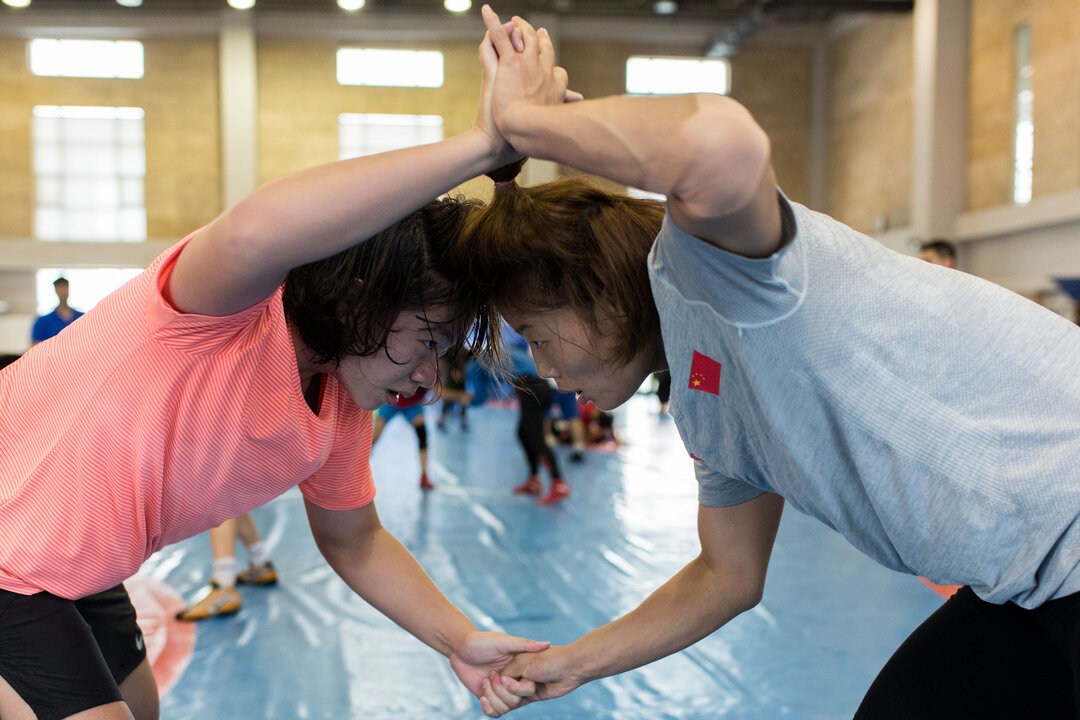

Chinese wrestlers tie-up during a practice session Tuesday as they prepare for this weekend's China Open (Photo: Max Rose Fyne)

Between Team China and world supremacy is a Japanese women’s program that has become synonymous with golden success. Since 2004 the island nation of 130 million people has accounted for an astonishing 11 of the possible 18 Olympic gold medals in women’s wrestling.

But in 2018 there are signs that the Chinese women are absorbing lessons from their new coach - putting on record-breaking performances at the Ivan Yarygin and Asian Championships along with a runner-up finish at the World Cup. “We’re trying to overthrow Japan and to do so we need to focus on teamwork,” said PANG Qianyu. “We also have to continue to study the sport and analyze their skills and techniques.”

(l-r) PALIHA Paliha, Simeon Atanasov, ZHOU Qian (Photo: Max Rose-Fyne)

The techniques and teamwork have been Atanasov’s focus since arriving in at the National Training Center in Beijing last year. Though geographical circumstances divide the national team into two distinct groups (Hubei/Shanxi on one side, Liaoning on the other), Atanassov sees a growing comradery and commitment to learning techniques.

“These girls feel a sense of pride for each other,” said Atanasov as he prepared wrestlers for the China Open. “They have big hearts for competition and I see every day their technique is much better.”

The dedication of the coaching staff is mirrored by the devotion of the athletes to a new idea of how high they can reach as a team. “Chinese wrestlers are more confident than we were before, and our confidence grows every time we compete,” said 2018 Asian Champion, ZHOU Qian (CHN). “We are building stronger.”

Ivan Yarygin bronze medalist, PALIHA Paliha added, “Coach Atanasov encourages us not to be afraid to make mistakes when we compete. He tells us not to fear, but to be confident.”
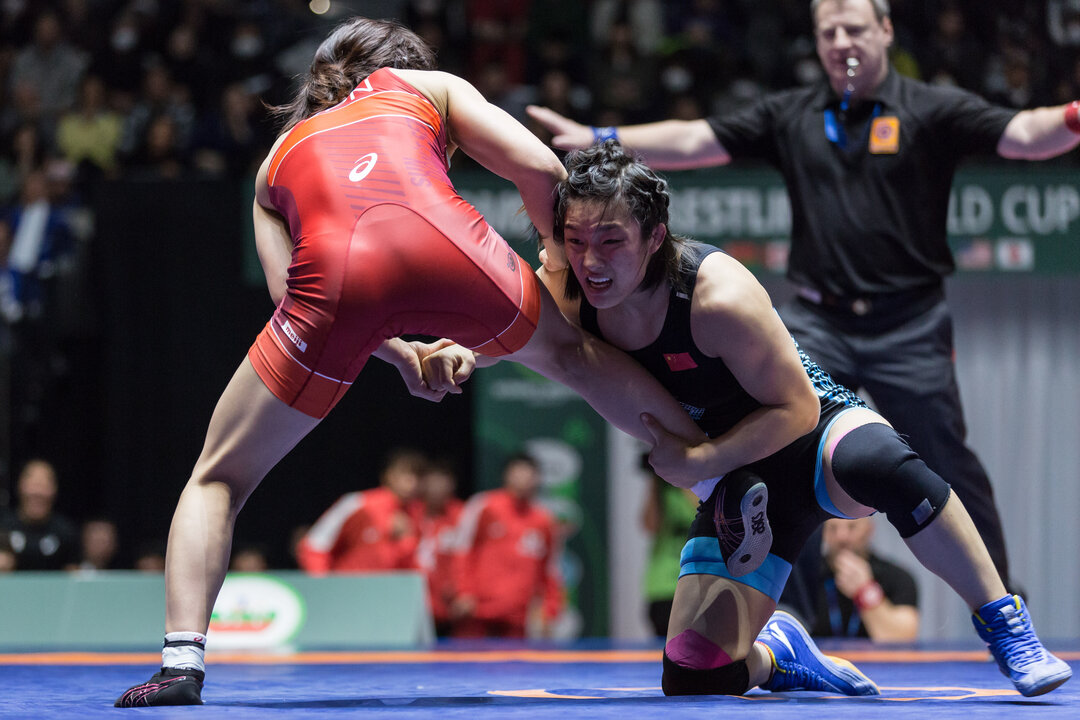
PEI Xingru PEI (CHN) looks to take down Yukako KAWAI (JPN) at the 2018 Women's Wrestling World Cup in Takasaki, Japan (Photo: Max Rose-Fyne)

The 2018 Asian Championships proved to be a major stepping stone for Team China’s quest for validation of their accomplishments. Where the nation of 1.4 billion had only captured a single gold medal in 2017, the team returned from their 2018 exploit with five gold medals – half the available top spots.

According to Zhou the seeds of confidence were nurtured by “a new coaching staff bringing new concepts to practice. They come up with unique ways of keeping us engaged – even when we’re tired.”

The China Open is certain to be another success for the Chinese women. With their top wrestlers competing and as many as three wrestlers entered per weight category the medal stand will likely be a sea of red. Adding to the level of competitiveness, a carrot for some competitors that a gold medal will punch their ticket to the prestigious Asian Games in Jakarta this August.
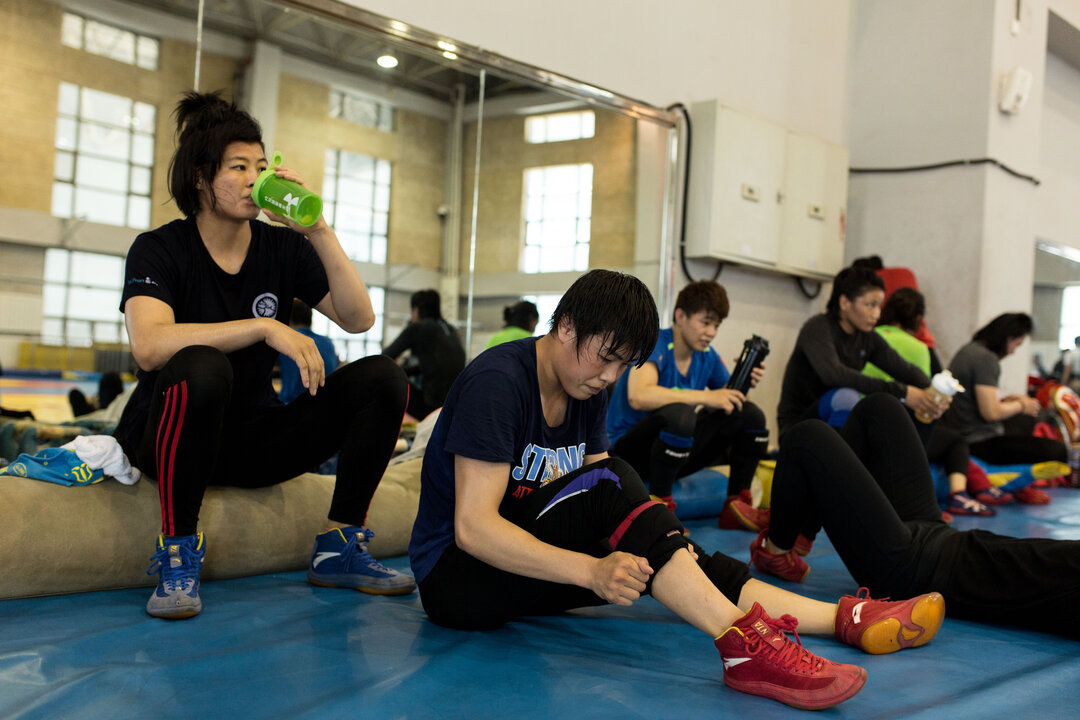


“I know they will compete hard at the tournament, because they have a lot of pride, but I will be looking for techniques,’ said Atanassov. “We have a world of opponents.”

Zhou, who took world silver in 2015 said no matter who is in the top spot Team China’s focus is renewed and turned inward.

“We do not do our best to overcome another country,” she said. “We look to become stronger for ourselves, and hopefully with that we will be at the top.”

marketing, #development

Wiebe inspires next gen at UWW-IIS camp in India

By Vinay Siwach

KARNATAKA, India (February 15) -- Erica WIEBE (CAN), the 2016 Rio Olympic champion, usually doesn't take it around but for her India trip, she made sure to pack her gold medal from Rio.

Call it luck, the gold medal turned out to be the highlight of her trip.

In India for a masterclass at the international women's wrestling camp organized by the Inspire Institute of Sport and United World Wrestling, Wiebe got mobbed by 50 young wrestlers as she showed them her medal. Wrestlers from Jordan, Estonia, South Africa, Mauritius, Mongolia, Kazakhstan and hosts India, all part of the camp, wanted to touch it, feel it and may be keep it.

"To see the looks on their faces and in their bodies responding to what it felt like to hold the kind of weight of your dream in your hand, I got emotional with them," Wiebe says. "It was so surreal for me to share the medal with the athletes because it brought me back to where I was at that time, and how it felt like winning an Olympic gold medal was just like this impossible dream that would never happen. It's really important for me to come here and do things like this to remind these women that, these crazy, unimaginable things are real. They can happen and to encourage them to continue to dream big."

No wrestler could walk away without a photo. A few even got emotional as they took the medal in their hands.

"God, I don't know how many times I have dreamt about that in the night," U17 world bronze medalist Lisette BOTTKER (EST) says. "When I got the medal on my hands, I was also trying not to cry but the feeling is awesome."

Maya QUTAISHAT (JOR) adds, "It seemed like the dreams of most of us wrestlers in front of us. Like getting the Olympic gold medal."

UWW and IIS organized the camp for wrestlers from around the world from January 15 to 31. It was hosted by IIS at it's world class facility in Vijayanagar, a township in Ballari district of north Karnataka, India.

Wiebe held a masterclass for the wrestlers along with training sessions with IIS head coach Amir TAVOKKALIAN, a former world silver medalist and Asian champion.

"It's a really amazing development opportunity for a young wrestlers from all around the world," Wiebe said. "There's several nations here, and it's so incredible to see the level of talent and passion of these young athletes. At the camp this week, we've had a number of sessions kind of leveraging different unique styles, having the different countries lead different warmups. We're here at the Inspire Institute of Sport which is a phenomenal world class facility. We don't have anything like this in Canada, there's very few facilities like this in the world. It's really exciting to see that India has this.

"Not only that, they have this for their athletes training, but they've invited many countries around the world to share in this moment and to leverage the resources that are available here on this site."

IIS President Manisha MALHOTRA also visited the camp and threw some light on the partnership with UWW to grow the sport.

"We're very passionate about the sport from an Indian ecosystem point of view," Malhotra said. "But what we realized is that, we need to start looking outside India to bring in expertise, look in partnerships. With that in mind, I think there was no better partner than UWW.

"They’ve done a phenomenal job with wrestling worldwide and growing the sport very well. The idea was to have a very good mix of people, whether they are from a very developed wrestling nation or from an underdeveloped wrestling nation, it needs to be a common platform where people can extract some sort of benefit for everybody. That was the main premise with what we worked with."

Apart from the training, wrestlers at the camp used the high performance center at IIS and indulged in sightseeing.

"Training here is very strong. We come out of the mat sweating a lot, and it's very tough," Qutaishat said, "The girls here are very high level. When I wrestle them, I learn a lot of techniques and so many things that I usually don't see back in my country. But I get to explore more as I go out to the camps."

Wiebe had an advice for all wrestlers, especially coming from smaller countries to the development camps.

"I told the athletes the goals are: to have fun, and to get better," Wiebe said. "And how do you do that? You find strength on the edge of failure. You have to put yourself on the line. Wrestling is not easy. You see it on the athletes bodies. They're pushing themselves to their limits, physically and mentally. They are tired. I remember being that way as an athlete. You always have to find another level to yourself."