In the second period of the final, Yazdani's underhooks stopped working and his gas tank showed a leak. His movement became slower although his mind wanted him to be quick against Stephen BUCHANAN (USA).
Buchanan matched Yazdani for position and let Yazdani take only a 2-1 lead at the break. But he caught Yazdani in the second period and launched the Iranian for a suplex for four. It's rare for Yazdani to be thrown around like that.
And with him falling behind 5-2, Yazdani tried to attack more and that's when opportunities for Buchanan opened up as he scored three takedowns and two steps, beating Yazdani 13-3 and capturing the gold medal in Zagreb.
This was Yazdani's only tenth loss at the senior level and first to a U.S. wrestler other than David TAYLOR (USA). It was also the first a wrestler defeated Yazdani via technical superiority.
With Buchanan's gold, the United States finished the tournament with five gold medals in Freestyle.
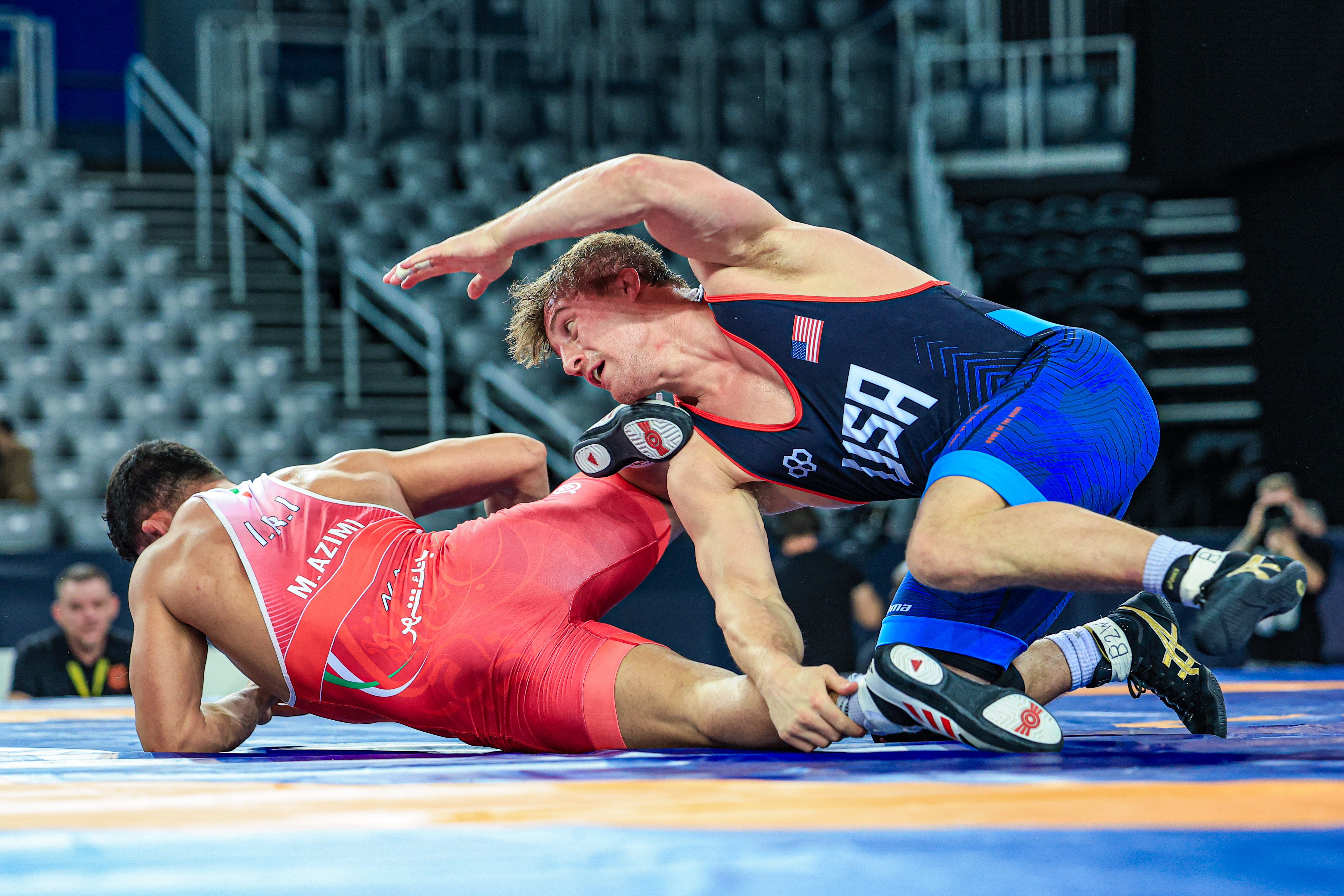 Trent HIDLAY (USA) scores a takedown against Mobin AZIMI (IRI). (Photo: United World Wrestling / Amirreza Aliasgari)
World champion at 92kg Trent HIDLAY (USA) forfeited his final against Mobin AZIMI (IRI). But Hidlay had defeated the Iranian 5-5 in their round robin bout.
Hidlay, known for his insane comeback in bouts, was down 5-0 against Azimi when he mounted a comeback. He scored a takedown and then a point to make it 5-3. He then scored a step out on Azimi which cut the lead to 5-4. Iran challenged the stepout call but lost it to tie the score 5-5 with Hidlay holding criteria. Hidlay then defended his criteria for the rest of the bout.
In another bout against an Iranian, Hidlay came back from 8-0 down to beat Abofazl RAHAMANI (IRI) 11-9 as he took the top spot in his group.
Rahamani and Azimi clashed as well in the round robin and it was Azimi who scored a takedown in the final seconds to beat his compatriot 4-3 and finish second in the group.
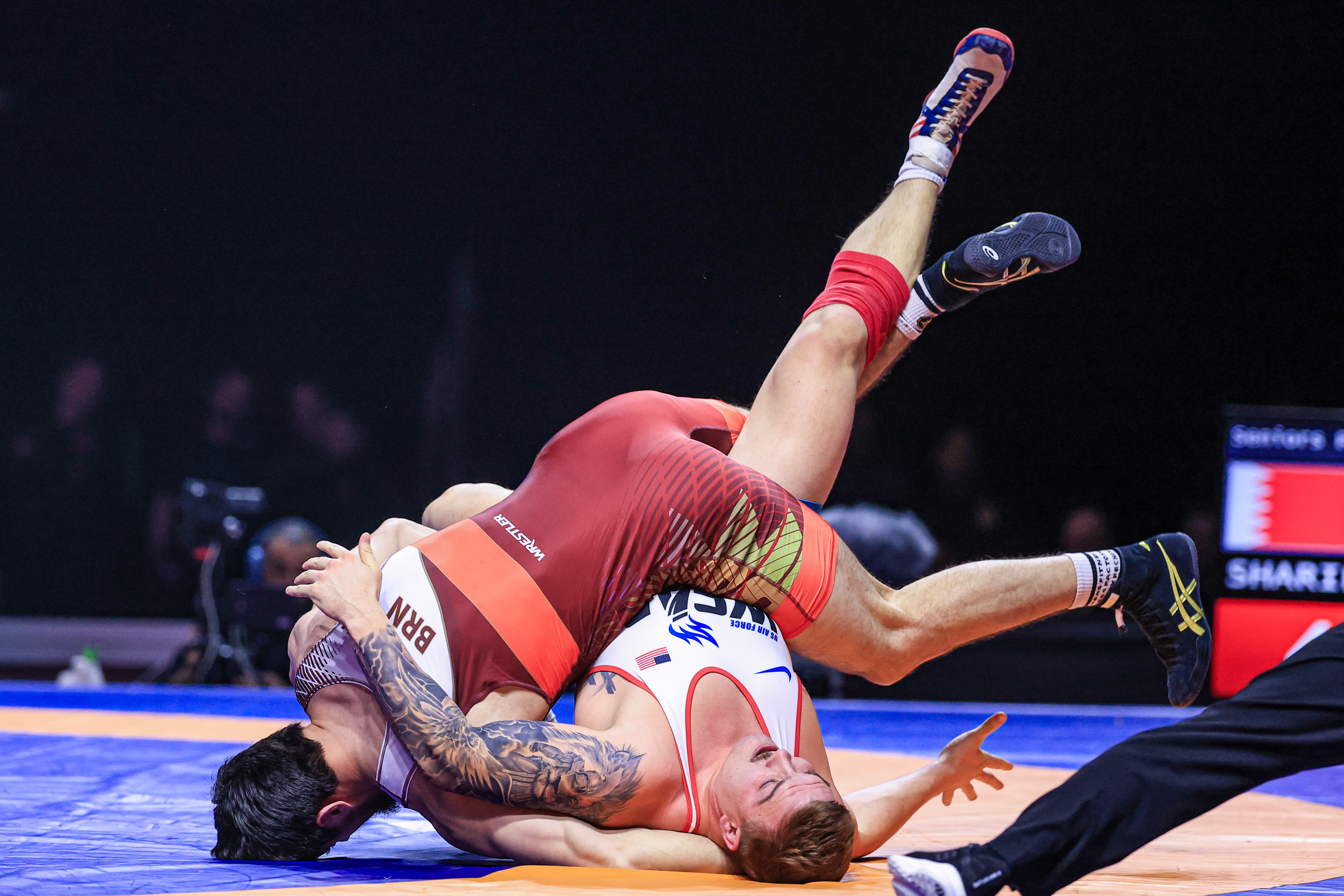 Shamil SHARIPOV (BRN) pins Wyatt HENDRICKSON (USA) in the 125kg final. (Photo: United World Wrestling / Amirreza Aliasgari)
At 125kg, Shamil SHARIPOV (BRN) is quickly emerging as the biggest challenger to world champion Amir Hossein ZARE (IRI) at the weight class.
Sharipov captured the gold medal at 125kg with a incredible cradle and turk position against Wyatt HENDRICKSON (USA). Shapirov locked Hendrickson in a leg-turn and then turned him on his back, keeping him down and securing the fall.
With a dominant performance in Zagreb, the Bahrain wrestler has put his name as a serious medal threat at the 2026 World Championships that will be held in Bahrain in October.
European silver medalist Zelimkhan KHADJIEV (FRA) defended his gold medal from 2025, winning a close 4-4 final against Dean HAMITI (USA) at 79kg.
Khadjiev was leading 4-1 when he was put on the activity clock. As the clock expired and he failed to score, Khadjiev also gave up a takedown which tied the score 4-4. But the French wrestler get the criteria due to his two two-point scoring moves.
RESULTS
Freestyle
79kg
GOLD: Zelimkhan KHADJIEV (FRA) df. Dean HAMITI (USA), 4-4
BRONZE: Evan WICK (USA) df. Daniel BRAUNAGEL (USA), 8-6
BRONZE: Adel PANAEIAN (IRI) df. Otari ADEISHVILI (GEO), via fall
92kg
GOLD: Mobin AZIMI (IRI) df. Trent HIDLAY (USA), via inj. def.
BRONZE: Dustin PLOTT (USA) df. Michael MACCHIAVELLO (USA), 6-1
97kg
GOLD: Stephen BUCHANAN (USA) df. Hassan YAZDANI (IRI), 13-3
BRONZE: Andro MARGISHVILI (GEO) df. Richard VEGH (HUN), 12-2
BRONZE: VICKY (IND) df. Adlan VISKHANOV (FRA), 8-2
125kg
GOLD: Shamil SHARIPOV (BRN) df. Wyatt HENDRICKSON (USA), via fall
BRONZE: Mortaza JANMOHAMMADZADEH (IRI) df. Robert BARAN (POL), 8-4
BRONZE: DINESH (IND) df. Kamil KOSCIOLEK (POL), via fall
Women's Wrestling
50kg
GOLD: Haruna MORIKAWA (JPN) df. NEELAM (IND), 5-2
BRONZE: MUSKAN (IND) df. Agata GOLUCHOWSKA (POL), 11-0
BRONZE: Elizaveta SMIRNOVA (UWW) df. Natalia WALCZAK (POL), 9-6
55kg
GOLD: Ekaterina VERBINA (UWW) df. Karla GODINEZ (CAN), 6-0
BRONZE: Nagisa HARADA (JPN) df. Beatrice FERENT (ROU), 2-1
BRONZE: Areana VILLAESCUSA (USA) df. Amani JONES (USA), 4-0



 df. Vahe POGHOSYAN (ARM) -by VSU, 9 - 0-.jpg) Egor KADIROV (RUS) is one of two Russian wrestlers who made the Greco-Roman finals on the opening day of the 2018 European Junior Championships. (Photo by Max Rose-Fyne)
Egor KADIROV (RUS) is one of two Russian wrestlers who made the Greco-Roman finals on the opening day of the 2018 European Junior Championships. (Photo by Max Rose-Fyne) 
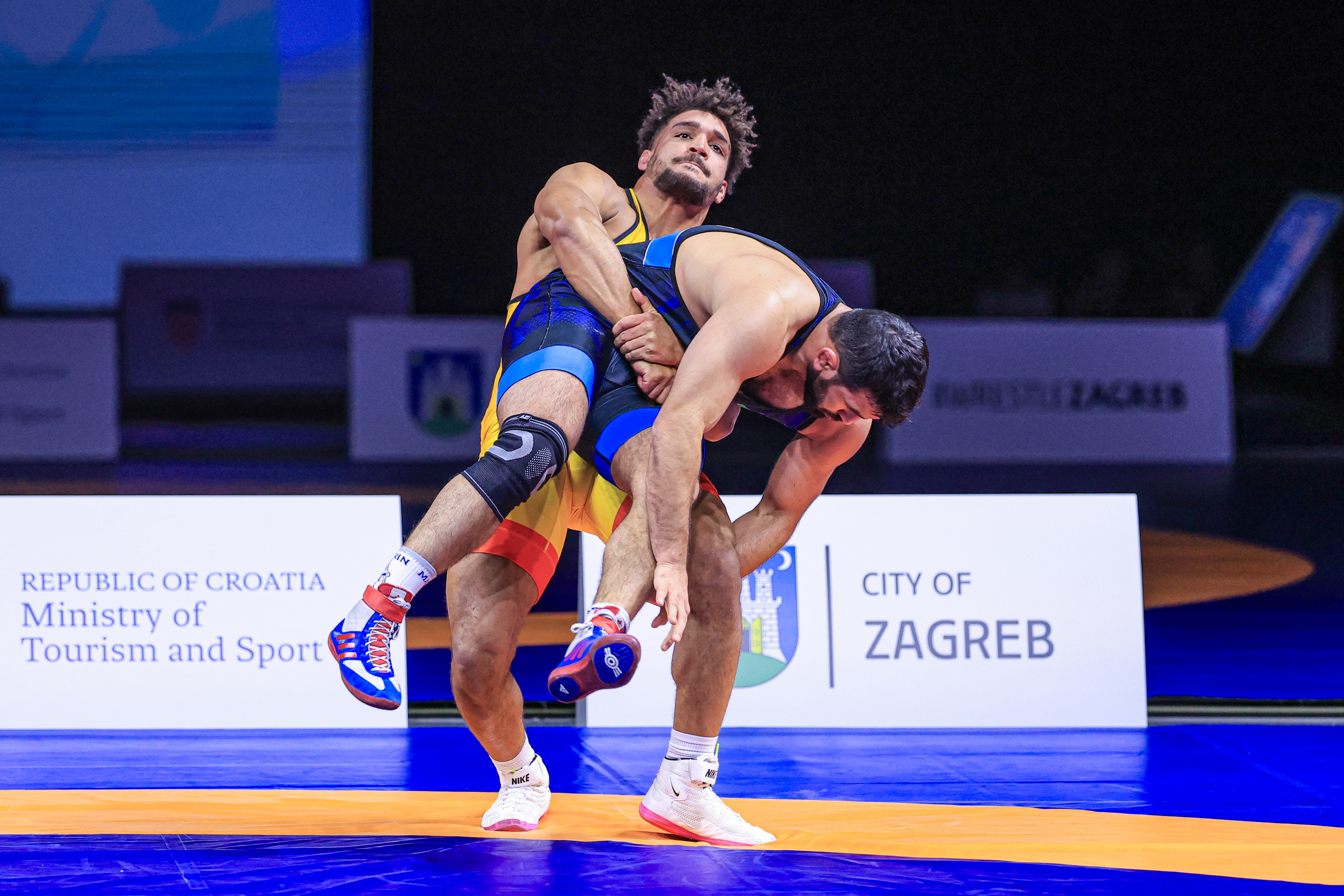 Stephen BUCHANAN (USA) launches Hassan YAZDANI (IRI) for a four-point throw. (Photo: United World Wrestling / Amirreza Aliasgari)
Share your thoughts.
Comments