Refugee Day

Olympic Feature: Amir Al-Awad

By United World Wrestling Press

United World Wrestling recently caught up with Olympic hopeful and Syrain refugee Amir Al-Awad. Until recently he used to train at the Olympic Club in Alexandria, but since the suspension of all sports activities due to COVID-19, all clubs in Egypt are closed since mid-March 2020. He is hopeful to resume some activities by the start of July, but throughout the lockdown period as of mid-March, Al-Awad has been training at home with a private coach to keep fit and not lose his momentum.

Right now Al-Awad says his main goal remains to prepare for the 2021 Olympic Games and the relevant qualification competitions. As such he will keep on training privately and cope with the challenging situation we are all facing until things return back to normal. 

To read more on Al-Awad's life check out this snippet from June 1st feature on Olympic.org

Amir Al-Awad, an 18-time Syrian champion, had consigned wrestling to the past when he and his family were forced to flee their country in fear in 2011. But, after being inspired by the chance to show his fellow refugees that anything is possible, he returned to the mats.

Syrian Amir Al-Awad is grateful to wrestling. Even at his lowest moments, when grappling on a mat was far from his thoughts, the sport has remained ingrained inside.

Wrestling makes you face challenges and as a wrestler I was taught to be resilient and confront life, no matter what, explained Al-Awad, whose life was sent spinning by the outbreak of civil war in Syria in 2011. “If I am thrown to the ground or hit the bottom I have to come up and start afresh.”

Wrestling-obsessed since he was nine years old, the former Asian and Arab champion has come to embody this ethos. After his house was destroyed, Al-Awad and his family became internally displaced as war raged around them. The former professional sportsman was routinely arrested. Both warring sides were suspicious of his determination not to declare an allegiance. Finally, when once again in jail and unable to look after his then-pregnant wife, Al-Awad decided they had to leave.

His wife made it to Egypt and eventually so too did Al-Awad. Abandoning a plan to try to reach Europe, the couple began the arduous task of building a new life as legal refugees. But, despite three years spent focusing on finding a job and caring for his young family, wrestling found its way back in.

“It became a win-win situation,” said the 18-time national champion.

...

To read more on Amir Al-Awad's journey back to the mat please click here: Olympic.org)
Obituary

Abdullah Movahed: Iranian Legend Who Elevated Wrestling to Art Form

By United World Wrestling Press

CORSIER-SUR-VEVEY, Switzerland, (May 1) -- Abdullah MOVAHED (IRI), one of the all-time greats of world wrestling and a dominant force in Freestyle during the 1960s, passed away in the United States on Thursday, April 30, after suffering a heart stroke. The Iranian legend was 86.

A member of the United World Wrestling Hall of Fame, Movahed’s name became synonymous with technical brilliance and relentless discipline. A five-time world champion, an Olympic gold medalist and twice Asian Games winner, Movahed was at the forefront of an era of Iranian excellence on the global stage. Competing in the 68kg and 70kg Freestyle weight classes, Movahed achieved a level of sustained dominance rarely seen in the sport.

Born in March 1940 in Babolsar, in Iran’s Mazandaran province, Movahed was introduced to volleyball as a young boy and was known locally for his exploits as a spiker. However, he quit the sport as he felt he wasn’t tall enough and didn’t believe he was suited for it. Ultimately, it was on the wrestling mat that he would carve out his legacy. 

He went on to join the Tehran Javan Sports Club, and as a youngster, Movahed didn’t have it easy. He frequently lost to established wrestlers like Mohammad SANATGARAN (IRI). However, he persevered, and coaches recognized his rare blend of agility, intelligence, and composure under pressure. These traits would define his career.

Movahed emerged during a time when Iranian wrestling was rich in talent. He shared the stage with wrestling legends such as Gholamreza TAKHTI (IRI), Mansour MEHDIZADEH (IRI), Ebrahim SEYFPOUR (IRI), and Emamali HABIBI (IRI). In such a company, greatness was neither guaranteed nor easily attained, but Movahed’s rise was swift.

His breakthrough came in 1962, when the erstwhile Soviet Union’s Freestyle champions travelled to Iran for a series of friendly bouts. His win over Zarbag BERYASHVILI made him an overnight sensation in Iran, and the following year, Movahed made his debut for the Iranian national team at the World Championships in Sofia, Bulgaria.

As a 23-year-old rookie, Movahed didn’t make much of an impact -- he shared sixth place with well-known Bulgarian wrestler Enyu VALCHEV (BUL). At the 1964 Olympics in Tokyo, he showed signs of improvement and finished fourth. A year later, at the World Championships in Manchester, he claimed his first world title, beginning an extraordinary run.

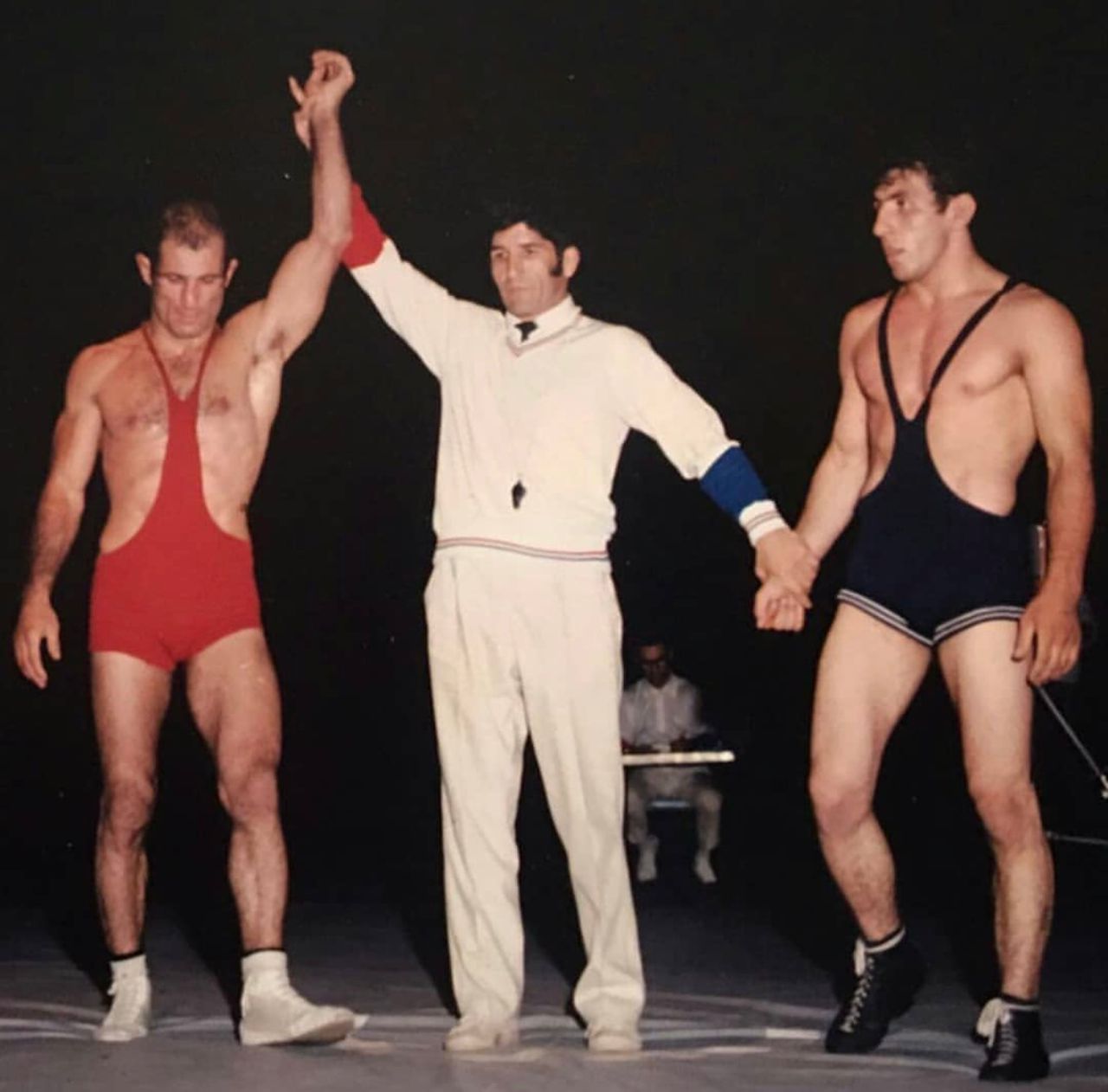
Abdullah MOVAHED (IRI)

From 1965 to 1970, Movahed was virtually untouchable. He won six consecutive major global titles at 68kg and 70kg, including World Championships in 1965, 1966, 1967, 1969, and 1970, along with Olympic gold at the 1968 Summer Olympics. That 1968 triumph, often cited as the pinnacle of his career, showcased his tactical mastery and unyielding determination. He also won the gold medal at the 1966 and 1970 Asian Games.

He returned for the 1972 Summer Olympics, but an unfortunate shoulder injury cut his campaign short, preventing a final chapter that might have further illuminated his already illustrious record. After the Games, Movahed, who had a master’s degree, moved to the USA, where he pursued a PhD at George Washington University. He continued to live there after earning his doctorate and worked as a mechanic.

Abdullah MOVAHED (IRI)

Beyond his medals, Movahed’s legacy lies in the standard he set. He helped define a golden generation of Iranian wrestling and inspired countless athletes who followed in his footsteps. His induction into the United World Wrestling's Hall of Fame secured his place among the all-time greats.

In mourning his passing, the wrestling world remembers not just a champion, but a craftsman whose sustained excellence elevated freestyle wrestling to an art form.