

Refugee Day

Olympic Feature: Amir Al-Awad

By United World Wrestling Press

United World Wrestling recently caught up with Olympic hopeful and Syrain refugee Amir Al-Awad. Until recently he used to train at the Olympic Club in Alexandria, but since the suspension of all sports activities due to COVID-19, all clubs in Egypt are closed since mid-March 2020. He is hopeful to resume some activities by the start of July, but throughout the lockdown period as of mid-March, Al-Awad has been training at home with a private coach to keep fit and not lose his momentum.

Right now Al-Awad says his main goal remains to prepare for the 2021 Olympic Games and the relevant qualification competitions. As such he will keep on training privately and cope with the challenging situation we are all facing until things return back to normal. 

To read more on Al-Awad's life check out this snippet from June 1st feature on Olympic.org

Amir Al-Awad, an 18-time Syrian champion, had consigned wrestling to the past when he and his family were forced to flee their country in fear in 2011. But, after being inspired by the chance to show his fellow refugees that anything is possible, he returned to the mats.

Syrian Amir Al-Awad is grateful to wrestling. Even at his lowest moments, when grappling on a mat was far from his thoughts, the sport has remained ingrained inside.

Wrestling makes you face challenges and as a wrestler I was taught to be resilient and confront life, no matter what, explained Al-Awad, whose life was sent spinning by the outbreak of civil war in Syria in 2011. “If I am thrown to the ground or hit the bottom I have to come up and start afresh.”

Wrestling-obsessed since he was nine years old, the former Asian and Arab champion has come to embody this ethos. After his house was destroyed, Al-Awad and his family became internally displaced as war raged around them. The former professional sportsman was routinely arrested. Both warring sides were suspicious of his determination not to declare an allegiance. Finally, when once again in jail and unable to look after his then-pregnant wife, Al-Awad decided they had to leave.

His wife made it to Egypt and eventually so too did Al-Awad. Abandoning a plan to try to reach Europe, the couple began the arduous task of building a new life as legal refugees. But, despite three years spent focusing on finding a job and caring for his young family, wrestling found its way back in.

“It became a win-win situation,” said the 18-time national champion.

...

To read more on Amir Al-Awad's journey back to the mat please click here: Olympic.org)
#development

Road to Dakar 2026 Continues with Successful Central Africa Programme in Brazzaville

By United World Wrestling Press

BRAZZAVILLE, Republic of Congo (June 21) -- The second stop of the United World Wrestling (UWW) Africa Regional Educational Development Programme, Road to Dakar 2026, concluded successfully in Brazzaville after a week combining athlete preparation, education, technical development and competition in Olympic and Beach Wrestling.

Held from June 8 to 14 in the Republic of Congo, the Central Africa phase brought together National Olympic Committees and National Federations from across the region under a unified objective: strengthening wrestling ecosystems and creating more accessible pathways toward the Youth Olympic Games Dakar 2026.

As the second of four regional tournaments scheduled within the continental Road to Dakar programme, the event represented another important milestone on the road to the first Olympic event to be hosted on African soil.

Africa REDT

The UWW Africa Regional Educational Development Programme was designed as a comprehensive and sustainable model that extends beyond competition. The initiative combines athlete development camps, coach and referee education, and practical competition opportunities.

By decentralising activities across regions and consolidating training and competition into one structure, the programme aims to reduce financial barriers for national federations and increase opportunities for athletes and technical officials.

Throughout the week, athletes participated in intensive daily training sessions, as coaches attended the UWW Technical Course - Level 2, focused on improving technical knowledge, athlete development methodologies and long-term performance planning.

Africa REDT

Simultaneously, referees took part in dedicated education sessions covering Beach Wrestling and introductory officiating pathways, preparing them for selection to undertake the International Category III referee examination in the future.

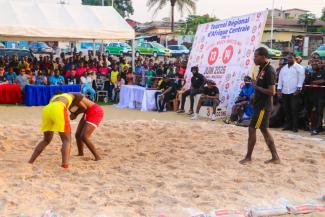
The programme concluded with the Regional Tournament, followed by the Beach Wrestling Regional Tournament, giving participants the opportunity to apply lessons learned during the educational phase directly into competition conditions.

The programme specifically prioritised youth development, with participating athletes largely drawn from the U17 age group and encouraging the involvement of emerging coaches across Central Africa. Support mechanisms jointly delivered by UWW and Olympic Solidarity helped facilitate participation through travel, accommodation, training access and tournament organisation.

Africa REDT

More than just a standalone event, Brazzaville demonstrated the long-term vision behind Road to Dakar 2026 by building stronger national structures, expanding participation and creating sustainable development opportunities well before the final qualification stages for the Youth Olympic Games.