

#BuchaWrestU23

Olympic Silver Medalist Higuchi Rallies to Make U23 World Finals

By Taylor Miller

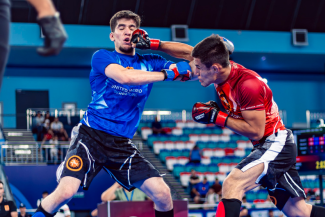
Photo of Rei HIGUCHI (JPN) by Martin Gabor. 

BUCHAREST, Romania – Friday night’s U23 World Championships semifinals provided a lot of excitement as it determined the first five gold-medal matches in men’s freestyle in Bucharest, Romania.

At 65kg, 2016 Olympic silver medalist Rei HIGUCHI (JPN) scored a takedown with 14 seconds left in the match to defeat Morteza GHIASI CHEKA (IRI) to advance to the finals.

Waiting for him in tomorrow’s gold match is 2018 Yasar Dogu runner-up Ali RAHIMZADE (AZE), who took out Roman ASHARIN (HUN), 5-3.

For 97 kg gold, 2017 Junior World silver medalist Givi MATCHARASHVILI (GEO) will take on 2017 Junior World bronze medalist Kollin MOORE (USA). The two last met up in the 2017 Junior World semifinals, with Matcharashvili taking a 16-4 win.

In the semifinals, Matcharashvili made work of Ali SHABANIBENGAR (IRI), producing a 10-0 technical fall, while on the side of the bracket, Moore battled back from an 8-2 deficit to defeat Magamed ZAKARIIEV (UKR), 10-8.

At 70 kg, 2017 Junior World champion and 2014 Cadet World champion David BAEV (RUS) edged out 2016 Junior World champion Enes USLU (TUR) on a caution-and-one call that was made after time ran out in the 70 kg semifinals. At the end of the match, the scoreboard read in favor of Uslu on criteria, but Russia’s corner challenged, asking for a caution and one for fleeing. The challenge ruled in favor of Baev and he advanced to the finals with a 7-6 win.

In the 70 kg gold-medal bout, Baev will take on Taimuraz SALKAZANOV (SVK), who dominated 2017 World Military runner-up Oleksii BORUTA (UKR), 9-0, in the other semifinal.

The 79 kg semifinals featured a couple of shutout wins as Nika KENTCHADZE (GEO) defeated 2014 Youth Olympic Games champion Yajuro YAMASAKI (JPN), 4-0, and 2015 Junior World champion Gadzhi NABIEV (RUS) blanked 2017 Junior World runner-up Isa SHAPIEV (UZB), 5-0, making tomorrow’s 79 kg gold-medal match a battle of Junior World medalists.

Tomorrow’s finals at 57 kg will feature 2013 Cadet World bronze medalist Toshihiro HASEGAWA (JPN) and Kumar RAVI (IND).

Ravi tallied a 10-8 win over 2017 Junior Asian champion Jahongirmirza TUROBOV (UZB) to advance to the finals, while Hasegawa had a come-from-behind win over Wahnhao ZOU (CHN), 5-2.

Saturday’s finals are set for 6 p.m. local time (11 a.m. ET) live on unitedworldwrestling.org.

Finals matchups
57 kg: Toshihiro HASEGAWA (JPN) vs. Kumar RAVI (IND)
65 kg: Ali RAHIMZADE (AZE) vs. Rei HIGUCHI (JPN)
70 kg: David BAEV (RUS) vs. Taimuraz SALKAZANOV (SVK)
79 kg: Nika KENTCHADZE (GEO) vs. Gadzhi NABIEV (RUS)
97 kg: Givi MATCHARASHVILI (GEO) vs. Kollin MOORE (USA)

Semifinals results

57 kg
Toshihiro HASEGAWA (JPN) df. Wanhao ZOU (CHN) 5-2
Kumar RAVI (IND) df. Jahongirmirza TUROBOV (UZB), 10-8

65 kg
Ali RAHIMZADE (AZE) df. Roman ASHARIN (HUN), 5-3
Rei HIGUCHI (JPN) df. Morteza GHIASI CHEKA (IRI), 4-4

70 kg
David BAEV (RUS) df. Enes USLU (TUR), 7-6
Taimuraz SALKAZANOV (SVK) df. Oleksii BORUTA (UKR), 9-0

79 kg
Nika KENTCHADZE (GEO) df. Yajuro YAMASAKI (JPN), 4-0
Gadzhi NABIEV (RUS) df. Isa SHAPIEV (UZB), 5-0

97 kg
Givi MATCHARASHVILI (GEO) df. Ali SHABANIBENGAR (IRI), 10-0
Kollin MOORE (USA) df. Magamed ZAKARIIEV (UKR), 10-8
#development

Development in 2024: UWW's rapid strides off and on mat activities

By United World Wrestling Press

CORSIER-SUR-VEVEY, Switzerland (December 10) -- Launching education programs that laid the foundation for future generations of sports administrators, a historic step taken towards gender parity, adding the first online beach wrestling course, providing unfettered access to coaches, wrestlers and spectators to an interactive site that analyses data from all major United World Wrestling tournaments and conducting workshops on the role of Artificial Intelligence (AI) in coaching.

The year 2024 will go down as a watershed year in wrestling not just because of the spectacular action on the biggest stage of all, the Olympics. The year will also be seen as critical because, through various developmental initiatives, the UWW did important groundwork to support the future generations of wrestlers.

One of the landmark moments of the year was the election of seven women to the UWW Bureau, the sport’s supreme body, during the Congress in Tirana, Albania, on October 27. This marked a big step in women’s wrestling leadership and made it the highest registered female candidate for the Bureau in UWW’s history.

“From Tokyo to Paris, we made great strides to promote gender equality within our wrestling community. We have to pave the way for our future generations for equal opportunities, no matter the gender, the religious beliefs, ethnicity, etc.,” UWW President Nenad LALOVIC said.

This was also the year when wrestling took another step in opening its platforms to wrestlers, coaches and fans from the world over. By making the site accessible to all, the data and metrics for each style at every major competition from 2020 to the present can be on the UWW Academy page under the ‘Analytics’ tab. This is a great way to see how points are being scored for each style, weight category, medal matches, teams, among other things.

One of the benefits of making all the data available is it could help improve training decisions (technical and tactical) and overall general knowledge of the sport.

Another great addition to the UWW Academy portal was the first-ever online beach wrestling course. This course is designed to provide an overview of beach wrestling, the fastest-growing style. Topics include the benefits of beach wrestling, basic rules and scoring, differences between beach wrestling and the Olympic styles, how competitions are organized, how bouts are organized and conducted, and the Beach Wrestling World Series.

Soon, there will be new referee and rules courses coming to the UWW Academy.

Apart from the wide array of online courses, the UWW also held on-ground sessions in different parts of the world.T

he More than Medals camps grew stronger this year, with sessions in Jordan, the Dominican Republic and for U17 wrestlers in Serbia.

A significant milestone was achieved by conducting the South-East Asia & Oceania Education Week in Perth from September 30 to October 4.

Representatives from seven Oceania nations — Australia, New Zealand, Samoa, Solomon Islands, Nauru, Tahiti, and the Marshall Islands — and a participant from Singapore gathered with the hope of enhancing wrestling expertise across the region. For many, the session was their first UWW certification in years, adding even more impact to the event and underlining the UWW’s efforts to grow the sport.

Argentina became the first country in the Americas to host a Level 3 Coaches Course. This was also the first-ever Level 3 course conducted in Spanish globally. Bulgaria successfully hosted a Level 2 Coaches Course while India was the destination for the Level 1 course.

A total of approximately 150 coaches benefitted from these sessions, marking a significant step in their education.

Tunisia, Senegal, Guatemala, Croatia, Bahrain and Saudi Arabia are some other countries where crucial UWW developmental programs were hosted.

Cambodia marked a significant milestone in terms of growth of wrestling in the country by conducting the Development of the National Sports System from July 18 to November 30, 2024.

Another important program was on using AI and other new technologies in coaching during the ASOIF Sports Development and Education Group (ASDEG) Workshop in Lausanne.

UWW Development Director and ASDEG Chair Deqa NIAMKEY, who was also elected as a Board Member of the International Council for Coaching Excellence (ICCE) in February 2024, underlined the transformative potential of AI.

The annual meeting, which attracted 60 experts representing over 30 International Federations (IFs), agreed to implement a range of initiatives over the next 12 months. It included supporting the IFs in increasing the representation of Women Technical Officials and Coaches to meet International Olympic Committee targets, establishing regular communication to facilitate cross-sport collaboration and knowledge-sharing and equipping IFs with incorporating technology in development programs and resources for education.