

Ozaki gains revenge over Tynybekova to win 62kg Asian title
Friday, April 22, 2022 - 12:58 By Ken Marantz

ULAANBAATAR, Mongolia (April 22) -- It wasn't the ideal way for the match to end, but Nonoka OZAKI (JPN) can claim to have properly avenged a disappointing loss at last year's World Championships.
Ozaki was well on her way to a decisive victory when an ankle injury forced world champion Aisuluu TYNYBEKOVA (KGZ) to default midway through the second period of their 62kg final on Friday at the Asian Championships.
"I lost to her once at the World Championships and when I knew that I would have a rematch in this match, I was determined to definitely win," said the 20-year-old Ozaki, who won the senior Asian title in her debut. "I wanted to test what I have done up to now in wrestling."
Ozaki's victory, avenging a loss to Tynybekova in the first round at the 2021 World Championships in Oslo, was one of four won by the powerful Japanese team on the fourth day of competition at the Buyant Ukhaa Sports Palace.
Japan also got golds from world champions Akari FUJINAMI (JPN) at 53kg and Tsugumi SAKURAI (JPN) at 57kg, while world silver medalist Miwa MORIKAWA (JPN) clinched the 65kg gold during the round-robin in the morning session.
Japan finished with seven gold and two silver to easily take the team title with 227 points, followed by host Mongolia with 167, thanks to four silver medals, and Kazakhstan, which got gold from a pair of twins and finished with 142 points.
 Nonoka OZAKI (JPN) used the leg lace to rack up points against Aisuluu TYNYBEKOVA (KGZ). (Photo: UWW / Bayrem Ben Mrad)
In the 62kg final, Ozaki had broken up a tense match by scoring a takedown and ripping off three lace locks to go ahead 9-1, when Tynybekova indicated she had injured her right ankle with 1:40 left on the clock.
After being checked by the tournament doctor and gingerly testing the ankle, the Tokyo Olympic silver medalist decided she could no longer continue. She had to be carried out of the arena and was not present for the medal ceremony to receive her ninth Asian medal.
The somber ending put a damper on what stands as the greatest triumph of the 19-year-old Ozaki's young career, which includes two world cadet golds. She made her international senior debut in Oslo, where she saw Tynybekova rally from a 4-0 deficit to win 6-4 and go on to take her second world gold.
Ozaki ended up with the bronze and was waiting for a chance for revenge, although not obsessing over it.
"I very much had thoughts of wanting a rematch," Ozaki said. "But the wrestlers who enter the Asian Championships are not just limited to Aisuluu. There are other strong wrestlers. My feeling is I have to win no matter who the opponents are."
In the final, both wrestlers were cautious and the first period ended with Tynybekova, a four-time Asian champion, holding a 1-0 lead from an activity point. In the second period, Ozaki gained an activity point of her own -- which came after a delay when the scoreboard suddenly went dark during the activity period.
Near the midpoint, Ozaki scored a takedown and immediately locked up Tynybekova's legs, then executed successive rolls in the way that the Japanese women do so effectively. She said she was unaware that Tynybekova had been injured during the series.
"I thought that if I was aggressive from the beginning, I would get points," Ozaki said. "I was a little tense, and in the second period, I wanted to wrestle a solid match. The match ended up going long, but in the end, it was good that I was able to turn her from the ground. The match flow seemed to be a success."
 Akari FUJINAMI (JPN) outscored her opponents 41-0 at 53kg. (Photo: UWW / Bayrem Ben Mrad)
At 53kg, 18-year-old phenom Fujinami continues to operate on a different plane, overwhelming Khulan BATKHUYAG (MGL) 11-0 in 1:17 in the final to give her four technical falls in four matches without conceding a point.
"It's my first Asian Championships, and my first international tournament since winning at the World Championships," Fujinami said. "I think that others are scouting me now, but I think I am making progress in my wrestling."
As good as she is already, Fujinami says she is always striving to improve and works to fix problems or self-proclaimed weak points. That's what came into play against Batkhuyag, whom she had met earlier in the day in a group-stage match that went into the second period.
"It was good that I ended the [final] from ground wrestling, but she was very powerful," Fujinami said. "From the first match, I knew she liked to grab the wrist. So I took measures against that. While doing so, I had good timing on my tackles and transitioned well to ground wrestling."
Fujinami, who now has a 97-match winning streak that dates back to a junior high school tournament in 2017, acknowledged that her victory was made easier by the absence of the Chinese and DPR Korean teams, both of whom have had success in the lower weights. Fujinami has yet to face a wrestler from either country and can't wait to do so.
"In the 53kg class, North Korea and China have strong wrestlers," Fujinami said. "It's a shame that they weren't able to be here. I'm sure the day will come when I face them, and I am committed to being prepared when I do."
Fujinami could get the chance in the fall. Instead of heading to Belgrade to defend her world title, she has opted to enter the Asian Games, to be held the following week in China. Because of the tight schedule, the Japan federation mandated that wrestlers had to choose one or the other.
"The Asian Games is the Asian version of the Olympics, and is an important event that comes only once every four years," said Fujinami, who this month started her first year at Nippon Sports Science University, where among her coaches is the four-time Olympic champion Kaori ICHO.
"It not only has wrestling but many other sports. I definitely want to win an Asian Games title."
Before that, Fujinami has one more important tournament, one that is domestic but will attract global attention.
At the All-Japan Invitational Championships in June, the teen could finally clash with Olympic champion Mayu MUKAIDA (JPN). The tournament will see the return to action of Japan's Olympic medalists, who have not competed since Tokyo.
"I'm figuring that I will probably meet her in June," Fujinami said. "But it's not just Shidochi, there are many other strong wrestlers. I'm not just keeping Shidochi in mind, but on all of them. If I have a match with Shidochi, I'm definitely aiming to win. I look forward to it."
 Tsugumi SAKURAI (JPN) pinned Anshu MALIK (IND) to win the 57kg gold. (Photo: UWW / Bayrem Ben Mrad)
For Sakurai, her victory at 57kg marked a successful move up to the Olympic weight after taking the world title in Oslo at 55kg. Her test under fire came in the final against world silver medalist and 2021 Asian champion Anshu MALIK (IND), and she passed with flying colors.
The 20-year-old Sakurai scored a takedown and then applied a chicken wing and armbar to lever the Indian onto her back for a fall in 53 seconds.
"That move is a specialty of mine," Sakurai said. "It was good that I was able to turn her over from the ground. My opponent was second in the world and I knew she is a strong wrestler, so I thought, this is the only way. I'm happy I was able to win with a fall."
With only seven entries, the weight class had a group stage, which meant that Sakurai had a busy morning that included three group matches and the semifinal. That helped make it an even more satisfying performance.
"This is my first tournament at 57kg as a national team member," she said. "I kept in mind my objective was to face various opponents and win the title. It was my first time to have four matches in the morning session; that was tough, but in the end, I was able to win out by sticking to my style."
Like her other young teammates, Sakurai is eyeing a trip to the 2024 Paris Olympics but has the hurdle of the current Olympic champion in her path. In Sakurai's case, that would be two-time Olympic gold medalist Risako KAWAI (JPN).
"Going abroad and winning the Asian Championships is a significant result for me," Sakurai said. "But in Japan, there are many strong wrestlers. There is the Olympic champion. I have to work much harder to be able to win in Japan. I want to work hard and get to the Olympics."
 Zhamila BAKBERGENOVA (KAZ) used a four-point move to beat Sumire NIIKURA (JPN) and clinch the 72kg gold. (Photo: Bayrem Ben Mrad)
Bakbergenova matches twin with gold
World silver medalist Zhamila BAKBERGENOVA (KAZ) says it was more nerve-racking to see her twin sister Madina capture a gold medal the previous day than it was for her to win one on her own.
With two of her four matches being decided on criteria, it took a steady state of mind for Bakbergenova to complete a perfect run of four wins to clinch the 72kg gold in the morning session.
"Of course, I'm very happy that I secured the gold medal," Bakbergenova said. "Yesterday my twin sister won a gold medal at the tournament. I am happy for my twin's accomplishment more than mine."
While Bakbergenova proved to be the class of the weight class in winning her second Asian gold and fourth medal overall, she faced a stiff challenge in handling the little time she had between matches.
"I had four consecutive matches with 20 minutes in between," she said. "But it was not about me winning and finishing the match fast. The time was running very fast for me. Just as I finished the match, they were calling me for the next round."
Bakbergenova, who started the day by forging a 3-3 win over eventual bronze medalist Davaanasan ENKH-AMAR (MGL), had her decisive test in her fourth match against newcomer Sumire NIIKURA (JPN), who would take the silver in the first overseas tournament of her career.
Bakbergenova scored a 4-point takedown to the back early in the second period, which put her ahead on criteria when Niikura rallied to tie the score at 4-4. The match ended with the score that way and a prone Bakbergenova desperately clinging to Niikura's leg to prevent a winning takedown.
"The Japanese wrestler was very powerful," Bakbergenova said. "My coach said to hold on and finish the first period, then start attacking from the second period. The match was hard and very competitive."
For the sisters, Ulaanbaatar holds a special place in their careers, which started when they were 14 in eighth grade. In 2013, they both won titles here at the Asian Cadet Championships.
Bakbergenova said she didn't personally witness sister Madina's triumph at 68kg on Thursday, but watching the matches was stressful.
"When Madina was wrestling yesterday, I wasn't at the stadium, instead I was at the hotel," she said. "But I watched every single match of Madina.
"It was very hard for me to see my twin wrestling because the opponents that she was drawn with were very competitive. It would be easier if I was the one wrestling. After the match, she told me that the next victory is yours."
 Miwa MORIKAWA (JPN) won her debut Asian Championships gold. (Photo: UWW / Bayrem Ben Mrad)
Like Bakbergenova, Japan's Morikawa went through the pressure cooker of wrestling all four of her group matches in the morning session, which she swept to take the 65kg gold.
The 2019 world junior champion's toughest match came in the third round of the round-robin when she scored all of her points in the second period of a 7-3 victory over eventual bronze medalist Purevsuren ULZIISAIKHAN (MGL). She had a fall and two technical falls in her other matches.
"It was good that I won the title, but there wasn't really any tough opponent so I thought I had to win," Morikawa said. "That was good, but looking ahead to the next tournament, makes me feel I have to step up my effort."
Morikawa said the short intervals between matches took their toll, but she also saw a positive side to the hardship.
"I like the glitter of the night session, but I had to do four matches in the morning session," Morikawa said. "I've never had the chance to have that experience, so conversely, it was lucky."
Morikawa had been on the Japan team that was supposed to take part in last year's Asian Championships in Almaty but was pulled just before departing Japan because of suspected exposure to the coronavirus.
"I'm really glad I could come to the Asian Championships this year. It took a year to win the title, but it's a good memory, " Morikawa said.
Morikawa, who barely missed out on the Tokyo Olympics when she lost a close playoff at 68kg to Sara DOSHO (JPN), plans to move up to eventually move back up to that weight.
"This year I will stay at 65kg and go to the World Championships, where I hope to win the title and make that the lead-in to moving up to 68kg."
In addition to Ulziisaikhan and Enkh Amar, host Mongolia got bronze medals from Bolortuya KHURELKHUU (MGL) at 57kg and Khongorzul BOLDSAIKHAN (MGL) at 62kg.
Zhuldyz ESHIMOVA (KAZ) won the bronze at 50kg for her eighth career Asian medal dating back to 2007, while Manisha MANISHA (IND) picked up the second bronze at 62kg, which had eight entries.
ALL PHOTOS: Asian Championships day four
Day 4 Results
Women's Wrestling
53kg (6 entries)
GOLD: Akari FUJINAMI (JPN) df. Khulan BATKHUYAG (MGL) by TF, 11-0, 1:17
BRONZE: Zhuldyz ESHIMOVA (KAZ) df. Aktenge KEUNIMJAEVA (UZB), 5-1
57kg (7 entries)
GOLD: Tsugumi SAKURAI (JPN) df. Anshu MALIK (IND) by Fall, :53 (4-0)
BRONZE: Bolortuya KHURELKHUU (MGL) df. Shokhida AKHMEDOVA (UZB) by TF, 11-1, 4:45
62kg (8 entries)
GOLD: Nonoka OZAKI (JPN) df. Aisuluu TYNYBEKOVA (KGZ) by Inj. Def., 4:20 (9-1)
BRONZE: Khongorzul BOLDSAIKHAN (MGL) df. Nabira ESENBAEVA (UZB) by TF, 10-0, 2:41
BRONZE: MANISHA (IND) df. Hanbit LEE (KOR) by Fall, 4:58 (4-2)
65kg (5 entries)
GOLD: Miwa MORIKAWA (JPN), 4-0
SILVER: Radhika JAGLAN RANA (IND), 3-1
BRONZE: Purevsuren ULZIISAIKHAN (MGL), 2-2
Key Match: Miwa MORIKAWA (JPN) df. Radhika JAGLAN RANA (IND) by TF, 10-0, 4:20 in Round 2
72kg (5 entries)
GOLD: Zhamila BAKBERGENOVA (KAZ), 4-0
SILVER: Sumire NIIKURA (JPN), 3-1
BRONZE: Davaanasan ENKH AMAR (MGL), 2-2
Key Match: Zhamila BAKBERGENOVA (KAZ) df. Sumire NIIKURA (JPN) 4-4 in Round 4
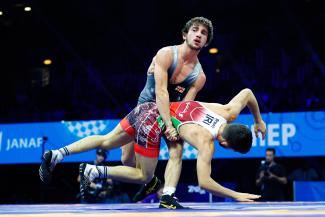
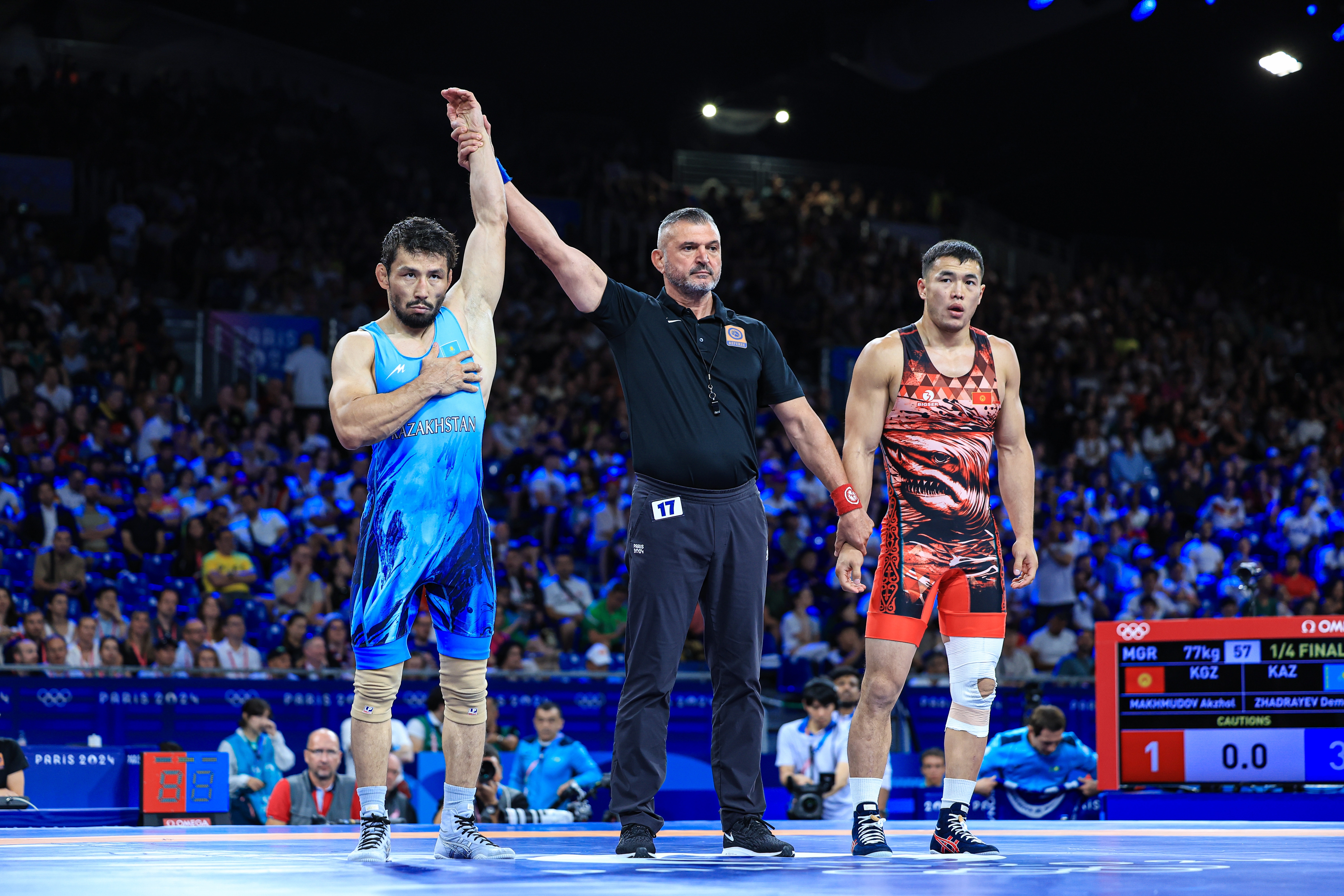 Demeu ZHADRAYEV (KAZ) defeated Akzhol MAKHMUDOV (KGZ), 3-1, at the 2024 Paris Olympics. (Photo: United World Wrestling / Amirreza Aliasgari)
Share your thoughts.
Comments