

Perfect Japan sweeps 5 golds at U20 Worlds
Thursday, August 18, 2022 - 21:44 By Vinay Siwach

SOFIA, Bulgaria (August 18) -- Japan has won every women's team title at the U20 Worlds they have participated in. But when the USA won the team title in Ufa last year in Japan's absence with Russia finishing second and India third, talks of other nations catching up with Japan were ripe.
But on Thursday, Japan once again reminded the world about the gulf in class between them and other nations in women's wrestling.
In what was a day of utter dominance on the mat, Japan swept all five gold medals on offer on Thursday at the U20 World Championships in Sofia, astonishingly only in 14 minutes and 45 seconds.
While Umi ITO (JPN), Moe KIYOOKA (JPN), Sakura MOTOKI (JPN) and Ami ISHII (JPN) finished their bouts in a total of eight minutes 45 seconds, only Ayano MORO (JPN) wrestled the full six minutes.
Moreover, all five wrestlers did not let any of their opponents score a single attacking point with Moro giving up a passivity point in the final.
U20 Asian champion Ito got it going with a 10-0 technical superiority over Audrey JIMENEZ (USA) in the 50kg final. Like all other of her bouts, she never looked in any kind of trouble.
Ito and Jimenez scrambled for the initial takedown but it was the former who got the upper hand. She then added another before getting a roll to lead 4-0. Two go-behinds got her the win in just two minutes and 22 seconds.
The 2017 U17 world champion was injured in the semifinal loss against world champion Remina YOSHIMOTO (JPN) at the Meiji Cup. But Ito said that the injury healed just in the nick of time for the U20 Worlds.
"I had the injury two months ago," Ito said. "But I overcame the injury, so like I did in the final, I was able to move well in my matches. Anyway, I'm relieved."
Wrestling at her first U20 Worlds, Ito did not feel any pressure whatsoever to win the title or begin the session with gold for Japan.
"I didn't feel any pressure," she said. "I was able to stay relaxed and I fought without feeling pressure."
With the win, Ito continued her unbeaten record internationally, extending back to 2017.
 Moe KIYOOKA (JPN) scored a 10-0 win over Albina RILLIA (UKR) in the 55kg final. (Photo: UWW / Kadir Caliskan)
Returning to Sofia for her second age-group World Championships, Moe KIYOOKA (JPN) repeated as the champion, this year at 55kg. Wrestling U20 European bronze medalist Albina RILLIA (UKR), Kiyooka finished the bout in three minutes and 36 seconds.
Aware of how the world looks up to Japan as the gold standard in women's wrestling, Kiyooka wanted to keep it the same way.
"Japan [women], of course, every year in international tournaments wins team titles," Kiyooka said. "Every country looks at Japan as a strong team. More than pressure, I'm aware that my country is strong so I prepare to go out and give everything in matches."
And she had a special motivation all the way from Japan going into the gold medal bout on Thursday.
Kiyooka's brother, Kotaro, won his first national collegiate title for Nippon Sports Science University at freestyle 65kg earlier on Thursday. Before his sister's final, he sent a text saying 'ganbatte', which translates to fight hard.
"It motivated me that my brother was watching," she said. "I heard that my older brother had won the title. I was very happy. It made me want to fight hard and achieve the goal of having us siblings win double gold. It became a source of energy and it made me twice as powerful."
Evident on the mat as she did not let Rillia even come close to finishing an attack. For Kiyooka, the performance was similar to any even if it was not the World Championships.
"No matter the tournament, I go into it thinking I will definitely win the title," she said. "More than being concerned about my opponents, I focus on putting out an effort that makes use of what I did in training up to now, and to have matches that I have no regrets about."
 Sakura MOTOKI (JPN) secures the fall over Viktoria BORSOS (HUN) in the 59kg final. (Photo: UWW / Kadir Caliskan)
Two senior world team members gave a peek into what to expect from them at the senior World Championships in Belgrade as both outclassed their opponents in the final.
At 59kg, Sakura MOTOKI (JPN) secured a fall over Viktoria BORSOS (HUN) using a cradle in just one minute and 11 seconds. After the final, Motoki said she learned the move recently.
"I thought I would try a new technique that I was taught, and it was really good that I did it well," Motoki said.
While she secured a fall in the final, her semifinal was a tight affair as she scraped past Ebru DAGBASI (TUR) 2-2 after a late takedown. Motoki said it was the nervousness of wrestling at a World Championships that got to her.
"I had a very disappointing match [semifinal on Wednesday]," she said. "I had to put that behind me and clear my head [for the final]. I felt the pressure. I'm also going to the [senior] World Championships, so yesterday [Wednesday, the nervousness and anxiety caused me to not wrestle so well."
Taking lessons from the U20 Worlds, Motoki, whose father Yasutoshi competed in Greco-Roman 63kg at the 2000 Sydney Olympics, will now train for Belgrade.
"In my training, I want to add new moves and develop more patterns of attack," she said.
 The four medalists at 68kg including gold winner Ami ISHII (JPN), second from left. (Photo: UWW / Kadir Caliskan)
Ami ISHII (JPN) was the second senior world team member to win the gold on Thursday. She was the quickest of the lot to finish her final, taking just a minute and 36 seconds. She pinned Nurzat NURTAEVA (KGZ) for the gold.
The former U17 Asian champion had to beat world silver medalist Rin MIYAJI (JPN) in the semifinal of the Meiji Cup and Naruha MAYSUYUKI (JPN) in the final and playoff to make the senior world team.
"Yes, there was [pressure]. I am going to the [senior] World Championships, so I thought that I absolutely have to win this tournament," she said.
Ishii is aware that the competition in Belgrade will be much tougher, especially at 68kg. Olympic champion Taymra MENSAH STOCK (USA), world champion Meerim ZHUMANAZAROVA (KGZ), Olympic silver Blessing OBORUDUDU (NGR), 65kg world champion Irina RINGACI (MDA), Feng ZHOU (CHN), and Alla BELINSKA (UKR) are expected to be in Belgrade. But Ishii is up for the challenge.
"I know that the matches will be a lot tougher, so in the short time remaining until then, I will do everything that I need to do to be prepared," she said.
 Ayano MORO (JPN) extending her unbeaten streak to 35 bouts. (Photo: UWW / Kadir Caliskan)
The final gold was won by Ayano MORO (JPN) who had to work hard for a 3-1 win against two-time U17 world champion Priya MALIK (IND) in the 76kg final.
Moro was called passive in the first period but she scored a stepout to lead 1-1 on criteria at the break.
Malik shot for Moro's legs on a few occasions in the second period but failed to score. Moro, however, hit a low double and scored a takedown and defended her 3-1 lead till the time expired.
With the win, she extended her unbeaten record to 35 bouts, a streak that began in 2017. Her last loss was to Ishii in the 57kg final at the National Junior High School Invitational 2017.
Out of her 35 wins, the bout against Malik was only the second in which she did not secure a fall or technical superiority. The final did leave Moro in tears as she was surprised that it took her six minutes to win the gold medal in Sofia.
"These tears are not for winning gold but for not dominating the final," Moro said. "I want to be at the Olympics and win it but not with this performance. I wrestled very poorly here."
 ANTIM (IND) ended Japan's winning run in Sofia. (Photo: UWW / Kostadin Andonov)
Antim stops Japan
Japan had the chance to put all 10 of its wrestlers in the final but ANTIM (IND) pinned Ayaka KIMURA (JPN) in the 53kg quarterfinals to dash its hopes. Japan, however, still has the chance to win 10 medals as Antim reached the final by beating Nataliia KLIVCHUTSKA (UKR), 11-2, in the semifinal.
Altyn SHAGAYEVA (KAZ) will try to stop Antim from becoming India's first woman to be U20 world champion after she defeated Shaimaa MOHAMED (EGY) via fall. The bout was closer than the scoreline shows as Shagayeva was almost pinned by Mohamed when the referees stopped the bout as the Egypt wrestler pulled Shagayeva's singlet.
The bout began in par terre and the Kazakhstan wrestler got the gut wrench to make it 5-1 before a final-second fall.
 Sofia MACALUSO (USA) reached the final at 57kg. (Photo: UWW / Kadir Caliskan)
At 57kg, Sofia MACALUSO (USA) entered the finals after three wins via fall. She defeated two returning medalists and Melda DERNEKCI (TUR) in the semifinals.
Macaluso will have Ruka NATAMI (JPN) in the final. The Japanese wrestler defeated Zeinep BAYANOVA (KAZ), 7-1 after trailing for most of the bout. Bayanova kept 1-1 criteria lead and Natami was called passive for the second but she scored an underhook for four.
The second USA wrestler to reach the final was returning U20 world champion Amit ELOR (USA), who moved past REETIKA (IND) 12-1 with ease. With a win away from her second U20 title, Elor will face Anastassiya PANASSOVICH (KAZ) in the final.
Panassovich was the second wrestler to beat a wrestler from Japan in a thrilling semifinal. Sumire NIIKURA (JPN) led 6-5 with just 15 seconds but Panassovich hit a double leg and scored a takedown to win 7-6. A lost challenge added one more point.
 Nonoka OZAKI (JPN) is a win away from becoming a U20 world champion. (Photo: UWW / Kostadin Andonov)
A battle between two former U17 world champions will be seen in the 62kg final as Asian champion and senior world bronze medalist Nonoka OZAKI (JPN) reached the final and Tokyo Olympian Sonam MALIK (IND) made it to the gold bout from the other side.
Ozaki defeated Birgul SOLTANOVA (AZE), 10-0, using a leg lace while Malik scored a fall over Bermet NURIDIN KYZY (KGZ).
Another India-Japan final will take place as PRIYANKA (IND) booked the spot against Mahiro YOSHITAKE (JPN) at 65kg.
Priyanka used an armbar to pin Dilnaz SAZANOVA (KGZ) while Mahiro YOSHITAKE (JPN) defeated Khadija JLASSI (TUN), 10-0.

RESULTS
50kg
GOLD: Umi ITO (JPN) df. Audrey JIMENEZ (USA), 10-0
BRONZE: Priyanshi PRAJAPAT (IND) df. Munkhgerel MUNKHBAT (MGL), via fall
BRONZE: Gultakin SHIRINOVA (AZE) df. Natalia WALCZAK (POL), 10-0
55kg
GOLD: Moe KIYOOKA (JPN) df. Albina RILLIA (UKR), 10-0
BRONZE: Roza SZENTTAMASI (HUN) df. Pei LIAO (TPE), via fall
BRONZE: Tuba DEMIR (TUR) df. MANJU (IND)
59kg
GOLD: Sakura MOTOKI (JPN) df. Viktoria BORSOS (HUN), via fall
BRONZE: Ebru DAGBASI (TUR) df. Bhagyashree FAND (IND), 3-1
BRONZE: Madina AMAN (KAZ) df. Aleksandra WITOS (POL), 4-1
68kg
GOLD: Ami ISHII (JPN) df. Nurzat NURTAEVA (KGZ), via fall
BRONZE: Nesrin BAS (TUR) df. ARJU (IND), 6-4
BRONZE: Sophia SCHAEFLE (GER) df. Luciana BEDA (MDA), 5-1
76kg
GOLD: Ayano MORO (JPN) df. Priya MALIK (IND), 3-1
BRONZE: Veronika NYIKOS (HUN) df. Melisa SARITAC (TUR), 7-5
BRONZE: Tristan KELLY (USA) df. Daniela TKACHUK (POL), via fall
Semifinals
53kg
GOLD: ANTIM (IND) vs. Altyn SHAGAYEVA (KAZ)
SF 1: ANTIM (IND) df. Nataliia KLIVCHUTSKA (UKR), 11-2
SF 2: Altyn SHAGAYEVA (KAZ) df. Shaimaa MOHAMED (EGY), via fall (7-1)
57kg
GOLD: Ruka NATAMI (JPN) vs. Sofia MACALUSO (USA)
SF 1: Ruka NATAMI (JPN) df. Zeinep BAYANOVA (KAZ), 7-1
SF 2: Sofia MACALUSO (USA) df. Melda DERNEKCI (TUR), via fall (12-3)
62kg
GOLD: Sonam MALIK (IND) vs. Nonoka OZAKI (JPN)
SF 1: Sonam MALIK (IND) df. Bermet NURIDIN KYZY (KGZ), via fall (8-0)
SF 2: Nonoka OZAKI (JPN) df. Birgul SOLTANOVA (AZE), 10-0
65kg
GOLD: PRIYANKA (IND) vs. Mahiro YOSHITAKE (JPN)
SF 1: PRIYANKA (IND) df. Dilnaz SAZANOVA (KGZ), via fall (5-0)
SF 2: Mahiro YOSHITAKE (JPN) df. Khadija JLASSI (TUN), 10-0
72kg
GOLD: Anastassiya PANASSOVICH (KAZ) vs. Amit ELOR (USA)
SF 1: Anastassiya PANASSOVICH (KAZ) df. Sumire NIIKURA (JPN), 8-6
SF 2: Amit ELOR (USA) df. REETIKA (IND), 12-1
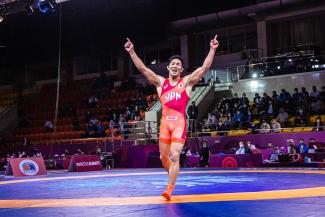
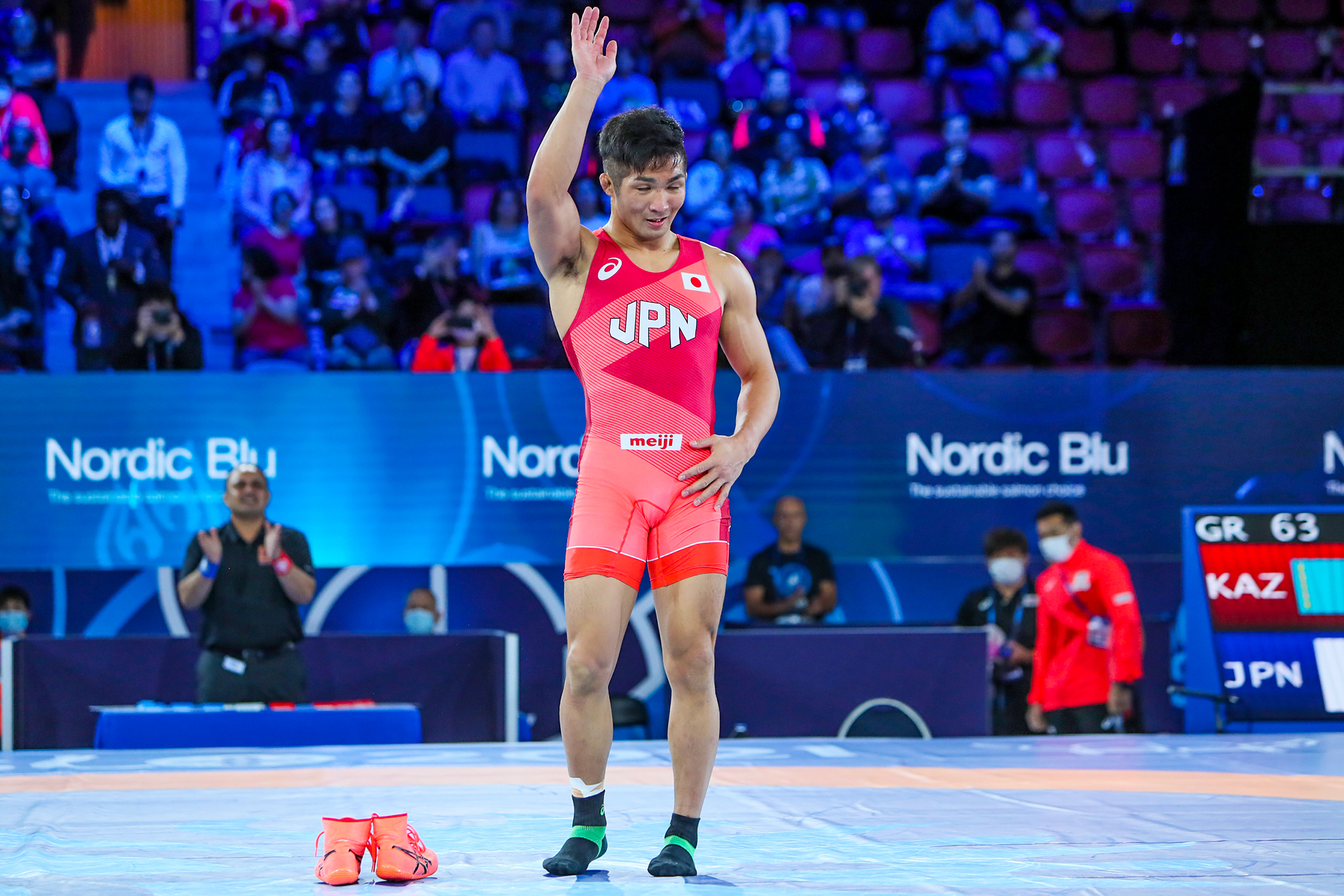 Tsuchika SHIMOYAMADA (AUS) had left his shoes on the mat during the 2021 World Championships to mark his retirement. (Photo: United World Wrestling / Martin Gabor)
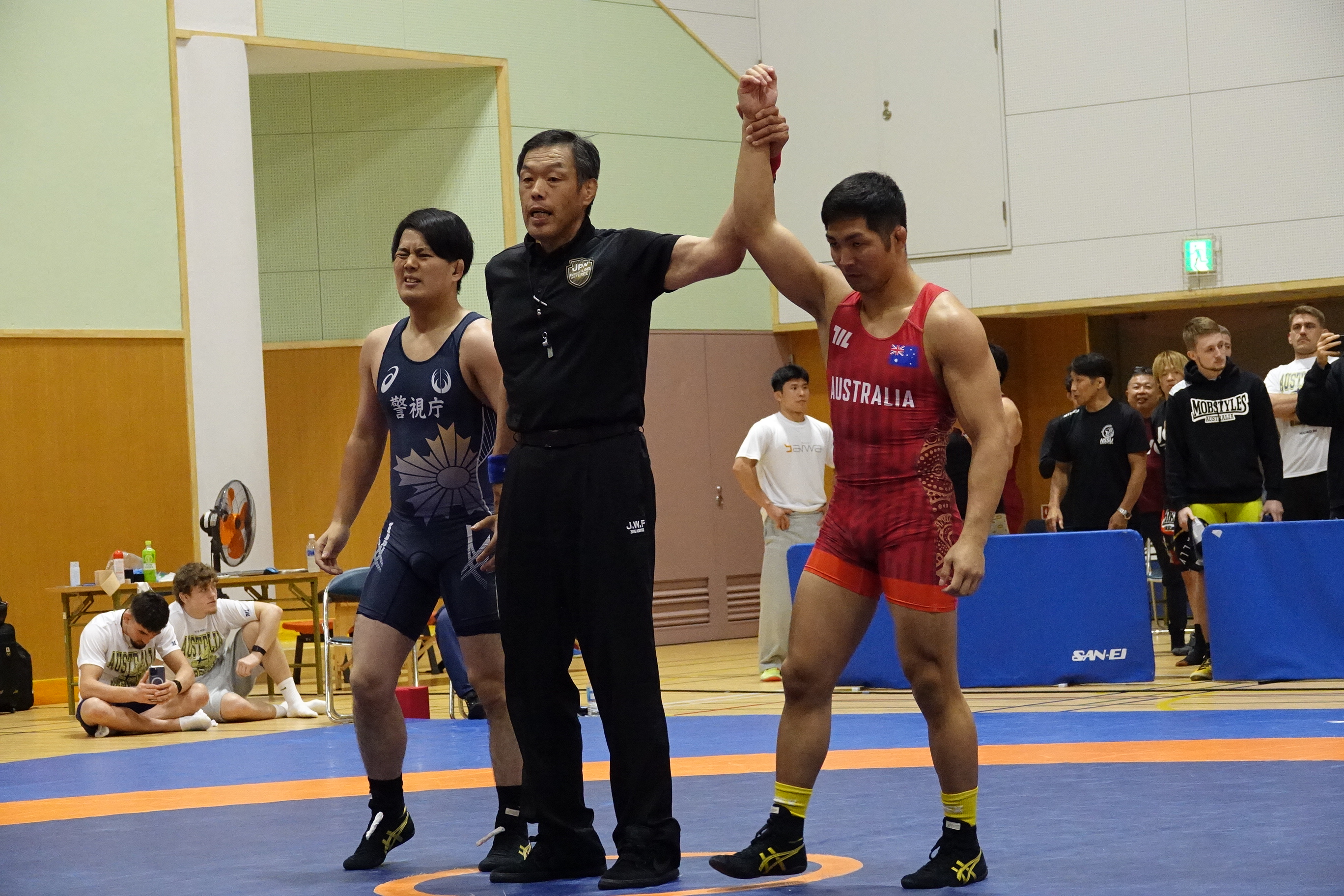 Tsuchika SHIMOYAMADA advances to the semifinals at the All-Japan Non-Student Championships in July with a 52-second win over Kokoro GOTO. (Photo: Koji Fuse / wrestling-spirits.jp)
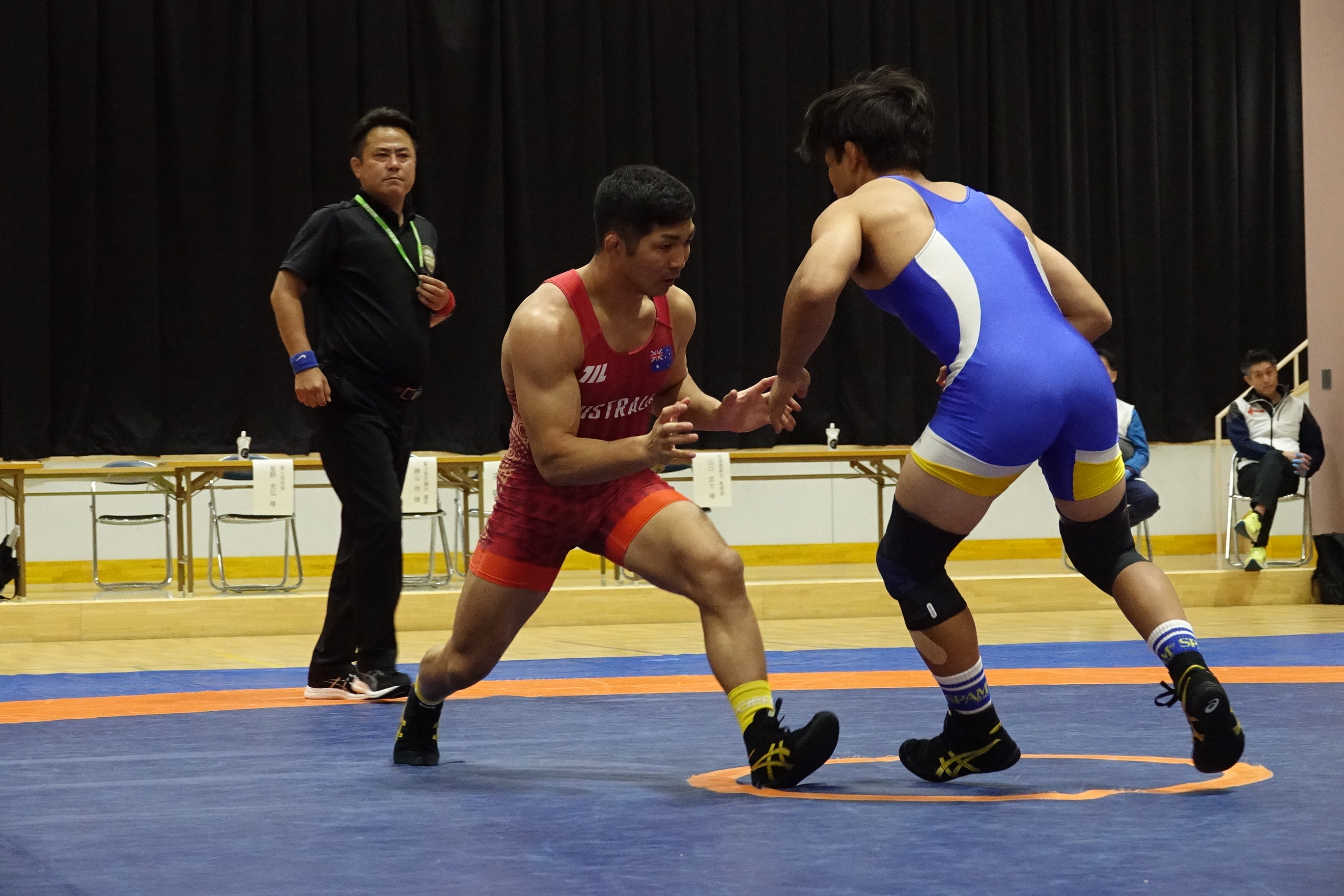 Tsuchika SHIMOYAMA faces Keitaro ONO in his opening match at the All-Japan Non-Student Championships in July. (Photo: Koji Fuse / wrestling-spirits.jp)
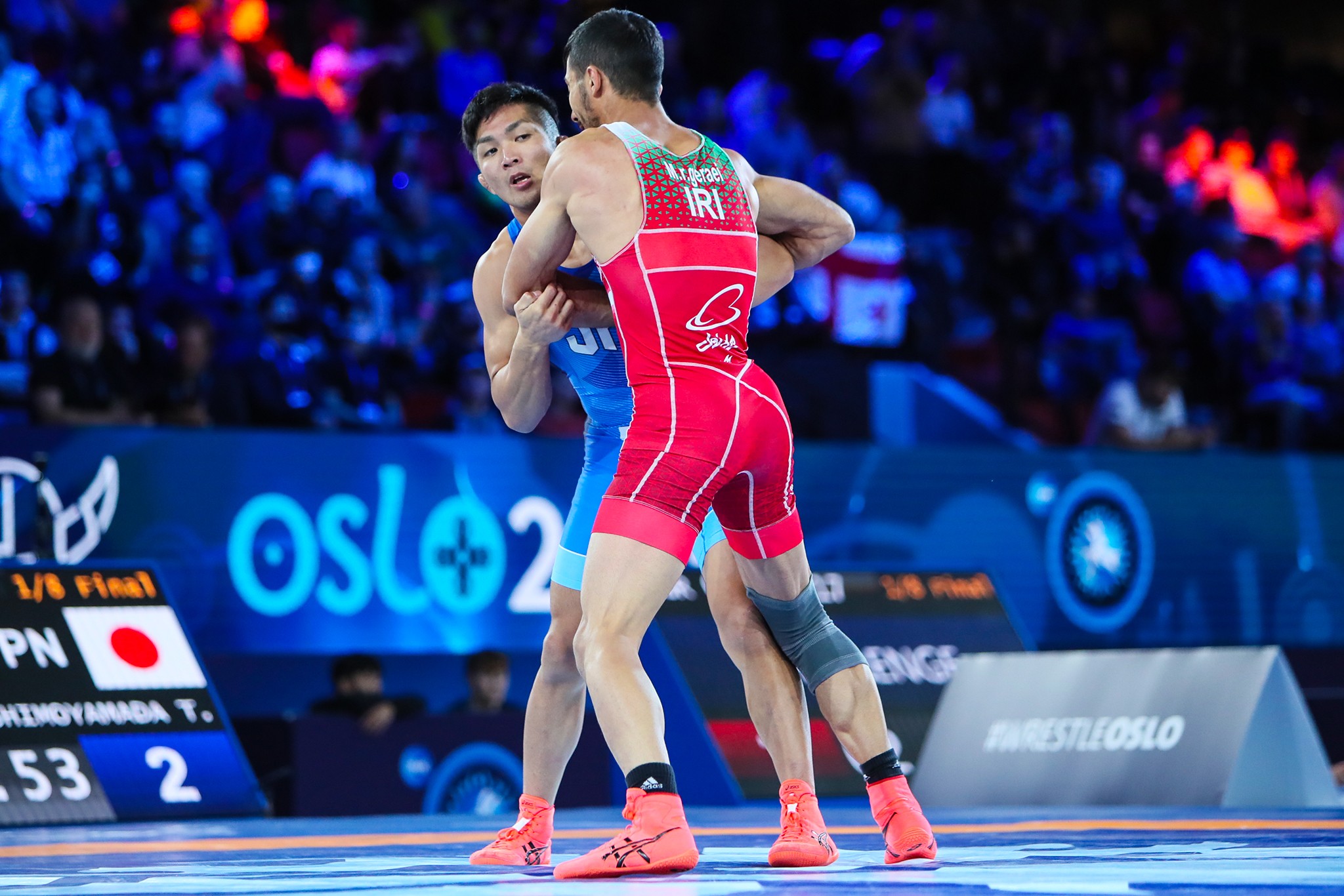 Tsuchika SHIMOYAMADA (AUS) was dominating Mohammadreza GERAEI (IRI) in their match at the 2021 World Championships before being pinned. (Photo: United World Wrestling / Martin Gabor)
Share your thoughts.
Comments